The 2023 Langley Drone Incursions: Seventeen Days Over a Sensitive Base
For 17 days in December 2023, unidentified drones repeatedly entered restricted airspace around Joint Base Langley-Eustis. The public record documents a serious defense failure, but it does not publicly establish who operated the drones.
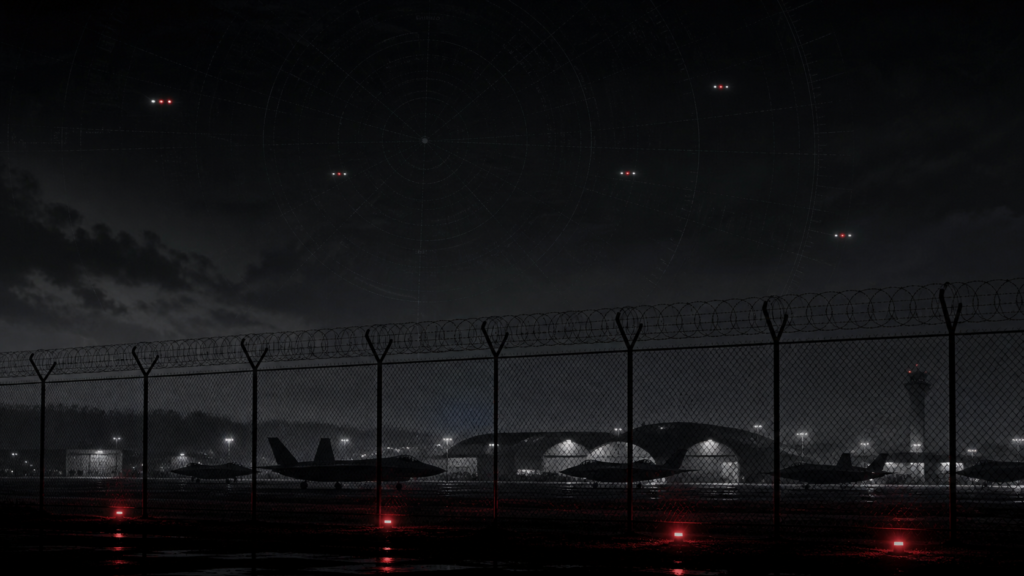
For 17 days in December 2023, unidentified drones repeatedly entered sensitive airspace around Joint Base Langley-Eustis in Virginia. Langley hosts F-22 Raptor aircraft and supports homeland-defense missions near the nation’s capital. The incursions became the longest and largest series of that kind the Defense Department had seen at the time, disrupted operations, and exposed gaps in the military’s ability to detect and respond to small unmanned aircraft at domestic bases.
The event is sometimes folded into discussions of unidentified anomalous phenomena because the operators and origin were not publicly identified. The available federal record points in a more specific direction: officials consistently described the objects as unmanned aerial systems or drones. The unresolved issue is attribution—who launched or controlled them and for what purpose—not whether the public evidence demonstrates extraordinary technology.
That distinction places Langley alongside other episodes where an unidentified object became a national-security problem without becoming evidence of a nonhuman craft. The 2023 North American balloon and object shootdowns likewise showed how identification, intent, and authority can remain uncertain at different stages of an official response.
What the official record confirms
The most detailed public federal account is the April 29, 2025 House Oversight hearing, “Securing the Skies: Addressing Unauthorized Drone Activity Over U.S. Military Installations.” Members and Defense Department witnesses repeatedly referenced the December 2023 event. The hearing record says drones were observed over Langley airspace for 17 days. Committee chairman William Timmons said F-22 squadrons were moved to alternate bases to reduce exposure and that officials discussed physical countermeasures.
Rear Admiral Paul Spedero Jr., then vice director for operations on the Joint Staff, called Langley the longest and largest series of domestic military-base drone incursions seen to that point. He said a comprehensive review of Langley and later incidents informed improvements in command and control, procedures, education, training, and coordination. Mark Ditlevson, acting assistant secretary of defense for homeland defense and hemispheric affairs, testified that the event focused and energized the department’s counter-small-UAS effort.
Ditlevson also delivered the bluntest official assessment of the response: during the incident, the department struggled to act in a timely and effective way, partly because an interagency coordination process had not been fully tested. He said some of those challenges remained, although later responses had improved. A Defense Department news account published after the hearing similarly stated that in December 2023 the department had little ability to detect, track, characterize, disrupt, or defeat the systems seen around the base.
Those statements establish that the incident was operationally consequential. They do not publicly establish the drones’ model, launch point, controller, sponsor, payload, or mission. The hearing includes suspicions and warnings about adversary surveillance, but no witness presented a public attribution of the Langley series to a named country, organization, or individual.
Why a drone can be seen but not attributed
Detection is only the first step. Radar, radio-frequency sensors, electro-optical cameras, infrared systems, acoustic sensors, and human observers provide different pieces of a track. Small drones may have limited radar signatures, fly low among buildings or trees, operate autonomously, avoid expected control frequencies, or launch from outside a base. A sensor may establish that something crossed a boundary without revealing who owns it.
The Government Accountability Office has described counter-drone technology as a layered problem. Detection tools can include radar, radio-frequency scanning, acoustic sensing, and infrared imaging. Mitigation can involve jamming, capture, or physical defeat, but each approach has limitations. A detection system effective against one size or flight profile may perform poorly against another. In the 2025 hearing, officials similarly stressed the need to fuse multiple sensors into a common operating picture.
Attribution adds investigative requirements: preserved sensor data, radio or network analysis, launch-site searches, recovered hardware, witness accounts, registration information, and sometimes intelligence collection. Even if investigators possess classified clues, that does not make those clues part of the public record. The responsible public conclusion is therefore that the Langley operators remained publicly unattributed, not that no government component had any hypothesis.
The legal and practical response problem
A domestic military base cannot treat every nearby drone as an incoming weapon. Homes, roads, businesses, parks, and civilian air traffic surround many installations. Shooting at an aircraft can create falling debris, missed rounds, or danger from an unknown payload. Electronic disruption can interfere with other systems. Officials must also distinguish careless recreational activity from surveillance or attack while determining which agency has authority to act on or beyond federal property.
Joint Base Langley-Eustis publicly warns that unauthorized drone operation on the installation is prohibited. But an operator may stand beyond the fence, and the aircraft may move between military and civilian airspace. Spedero told the House that a commander has standing authority to protect forces and property when hostile intent or a hostile act can be established. He also explained that an off-base operator generally requires coordination with local law enforcement.
Additional authority under 10 U.S.C. §130i applies to covered facilities and missions. At such sites, suspected unauthorized surveillance or interference can permit a response without first proving hostile intent. Yet the hearing documented limits: not all installations or missions qualified, policy guidance was complex, and data sharing with outside partners was constrained. Ditlevson said the department wanted broader coverage, durable authorization, and improved information sharing.
These are not semantic details. In a fast-moving event, a commander needs to know what sensors are available, whether the track is reliable, who can authorize mitigation, what techniques are lawful, who contacts civilian agencies, and where an off-base operator might be apprehended. Langley revealed that having a serious sighting did not automatically produce a coordinated response.
What the hearing does not prove
Several claims in the hearing were made by committee members during opening statements or questions, not offered as completed investigative findings by a Defense witness. One member said the drones performed complicated maneuvers and did not broadcast on known frequencies. Others framed broad military-base incursions as coordinated adversary surveillance. Those remarks are part of the record, but their presence in a hearing transcript does not independently verify technical details or attribution.
The defensible core is narrower. Multiple unmanned systems of unknown origin repeatedly entered or operated around restricted Langley airspace during December 2023. The activity persisted for 17 days, interfered with F-22 operations, and led to aircraft relocation. Officials assessed the response as inadequate and later used the incident to reshape counter-UAS coordination. No public case resolution names the operator.
That evidence standard is the same one applied to claims elsewhere in this archive. The site’s primary-source library prioritizes documents and sworn testimony, while the 2023 military-pilot testimony record illustrates why witness statements should be preserved without converting every reported characteristic into an established fact.
How Langley changed the defense conversation
By the April 2025 hearing, officials described several changes. U.S. Northern Command and U.S. Indo-Pacific Command had been designated as operational synchronizers for their regions. NORTHCOM had produced a commander’s assessment intended to guide command-and-control improvements and standard operating procedures. The department had expanded training and collaboration with industry and was carrying out counter-UAS tasks in the fiscal 2025 defense authorization act.
Spedero said later incidents at Plant 42 in California, Picatinny Arsenal, and Naval Weapons Station Earle in New Jersey provided additional lessons. Ditlevson said the department was acquiring tools to help commanders distinguish negligent from nefarious activity and conduct kinetic or non-kinetic mitigation. He also acknowledged that the work was incomplete.
The scale of the broader challenge was substantial. The hearing cited more than 350 drone detections at 100 military installations during 2024, with Spedero indicating in public testimony that the number had since grown. Those totals describe detections across many bases; they should not be confused with the number of aircraft at Langley or treated as proof that all detections were hostile.
An airspace-security case, not an exotic-craft finding
Langley deserves a place on the UAP and disclosure timeline because it shaped congressional oversight of unidentified objects near sensitive facilities. It also demonstrates the need for disciplined categories. “Unidentified” can refer to an unknown drone operator. “Anomalous” would require evidence of performance or properties that ordinary unmanned systems cannot explain. The public Langley record establishes the former and does not establish the latter.
That conclusion does not minimize the event. A conventional drone can collect imagery, interrupt flight operations, test defenses, or carry a dangerous payload. The later New Jersey drone controversy showed again how public uncertainty, legitimate sightings, misidentification, and official communication can collide. Langley’s importance lies in a verified security failure and unresolved attribution—not in claims the released evidence cannot support.
Sources
- Congress.gov, transcript of “Securing the Skies: Addressing Unauthorized Drone Activity Over U.S. Military Installations”
- Rear Admiral Paul Spedero Jr., written statement to the House subcommittee
- U.S. Department of Defense, “DOD Better Now at Defending Domestically Against Unmanned Systems”
- U.S. Government Accountability Office, “Science & Tech Spotlight: Counter-Drone Technologies”
- Joint Base Langley-Eustis, drone regulations