How Sen. Harry Reid Helped Fund Pentagon UAP Research in 2017
Learn how Harry Reid Pentagon UAP research moved from Senate advocacy to a DIA contract, and why 2017 reports brought it to light.
The 2017 UAP news story began with a misleadingly simple impression: that the Pentagon had suddenly started investigating unidentified aerial phenomena. In fact, the reporting brought public attention to work with earlier roots. The date in this article’s title marks the disclosure moment, not the beginning of the funding trail.
That distinction matters when assessing Harry Reid Pentagon UAP research. Reid did not personally create a Pentagon program or direct a proven extraterrestrial inquiry. His documented significance lies in Senate advocacy and political support for a Defense Intelligence Agency-backed effort that was funded and contracted before the news broke. Other Senate figures, Defense Department officials, and a private contractor also belonged to that chain.
This article follows the chronology rather than the mythology: how congressional interest intersected with DIA contracting, how the Advanced Aerospace Weapon System Applications Program (AAWSAP) relates to the better-known AATIP label, and how December 2017 reporting turned an obscure defense initiative into a lasting public controversy. The record supports a story of institutional support and limited, contested program definitions, not a shortcut to claims the evidence does not establish.
The 2017 UAP News Break Was a Disclosure Moment, Not the Start of Funding
On December 16, 2017, The New York Times reported that the Pentagon had supported an effort to examine unexplained aerial encounters, bringing an obscure subject into mainstream national news. That publication date explains the article’s 2017 framing: it marks when the story became broadly visible, not when the underlying federal spending began.
The relevant Defense Intelligence Agency contract, the Advanced Aerospace Weapon System Applications Program, or AAWSAP, ran from 2008 to 2012. Its roughly $22 million award went to Bigelow Aerospace Advanced Space Studies, a Nevada-based company. The later public association of that work with the label AATIP helped make the chronology seem less clear; the names, scope, and institutional relationship require separate treatment.
The important distinction is between revelation and authorization. The 2017 reporting established that a Pentagon-linked UAP effort had existed and drew attention to military accounts and videos. It did not establish that unidentified incidents were extraterrestrial or non-human in origin. This account therefore follows the narrower, documentable question: how Reid’s Senate advocacy helped create political support for a DIA-funded investigation years before the UAP news break.
What Harry Reid Actually Did: Advocacy, Access, and Senate Support
Reid’s contribution was political and institutional: he treated reports of unusual aerospace phenomena as a subject worthy of defense-intelligence attention and used the access of a Senate majority leader to press that case inside the national-security establishment.
Publicly released correspondence provides the clearest example. In a 2009 letter to Deputy Defense Secretary William Lynn, Reid asked that the DIA’s Advanced Aerospace Weapon System Applications work receive Special Access Program protection. A Special Access Program limits distribution beyond ordinary classified handling; it is a request for tighter control of sensitive work, not an authorization to create or fund a program. The request also shows Reid’s continuing interest after the underlying contract had begun.
The Senate support was broader than one office. Contemporary accounts of the funding effort identify Alaska Republican Ted Stevens and Hawaii Democrat Daniel Inouye as important allies. Their relevance was practical: senior senators could support a defense-intelligence priority through appropriations relationships, while Reid could lend leadership-level backing and help sustain attention to it. That cross-party alignment helps explain why descriptions of Harry Reid UFO research funding should not be reduced to a one-man directive.
Three roles must remain separate. Senators can advocate, seek restricted handling, and support appropriations; congressional appropriations provide money within the Defense Department’s budgetary framework; and an executive-branch agency chooses how to execute an authorized effort, including issuing a contract. Reid had influence over the first two stages, but the DIA, not Reid personally, administered the Pentagon-linked research program.
That distinction is the strongest reading of the record: Reid helped create the political support and access that made the initiative viable, while Stevens and Inouye added senior Senate support. It does not mean that the Senate majority leader could independently direct Pentagon spending or that the effort operated through an undocumented personal slush fund.
From Senate Interest to a DIA Contract: The AAWSAP Funding Trail
The operational step was a Defense Intelligence Agency procurement. The agency established the Advanced Aerospace Weapon System Applications Program, known as AAWSAP, as a contract effort rather than a Senate-run project. That distinction fixes responsibility in practical terms: Senate advocates could help create the conditions for funding, but DIA defined the requirement, selected a contractor, and managed the work.
The resulting award went to Bigelow Aerospace Advanced Space Studies, the research company associated with Nevada aerospace entrepreneur Robert Bigelow. Public reporting placed the contract’s value at roughly $22 million, with performance running from 2008 through 2012. Those dates matter because they locate the funded work years before its existence became widely known in 2017. In the Harry Reid AAWSAP funding story, Reid’s influence belongs upstream of contract execution; the DIA award is the administrative instrument that turned political support into a funded research activity.
A Defense Department contract establishes several concrete points: an agency authorized work within its budget, a named recipient was paid to perform it, and the parties had defined tasks and deliverables. For AAWSAP, the publicly described output included technical studies concerning advanced aerospace concepts and related phenomena. It is stronger evidence of an institutional decision to investigate than a senator’s interest alone, because it records an executive-branch commitment of resources.
It is not, however, a finding. Awarding a contract does not demonstrate that every reported incident was accurately described, that a proposed explanation was accepted, or that the research reached an extraordinary conclusion about the origin of unidentified objects. A procurement record answers who commissioned work, who performed it, and during what period; it does not by itself validate the contractor’s hypotheses or later claims about what the program discovered.
That boundary also keeps the chronology clear for the terminology discussion that follows. AAWSAP was the DIA contract program whose 2008–2012 funding trail can be identified through its recipient, value, and performance period. The better-known AATIP label emerged in public accounts of the same broader episode, but it should not be treated automatically as a synonym for every activity performed under the AAWSAP contract.
AAWSAP, AATIP, and Later UAP Offices: Why the Names Matter
The labels answer different historical questions, which is why treating them as interchangeable blurs the record. AAWSAP identifies the Defense Intelligence Agency contract vehicle: the funded, contractor-performed program discussed in the preceding section. AATIP, the Advanced Aerospace Threat Identification Program, became the label most readers encountered because it was central to the December 2017 public narrative about Pentagon interest in unusual military encounters.
That difference matters. A contract name ordinarily identifies a defined procurement, recipient, period of performance, and deliverables. A program label used in public reporting can instead describe an office function, a line of inquiry, or the work associated with particular personnel. The stronger formulation is therefore that AAWSAP and AATIP were publicly described as connected parts of the same broader episode, not that every AAWSAP task was automatically AATIP work.
The 2017 reporting placed particular emphasis on Luis Elizondo, who was described as having led AATIP after work associated with the earlier DIA-funded effort. That personnel-centered narrative made AATIP the durable public shorthand. It also encouraged a simplified story in which the $22 million contract, later Pentagon activity, and the released Navy videos appeared to belong to one unchanged program. The available public accounts do not support that level of identity.
Pentagon statements issued after the news break added another layer: they acknowledged an AATIP-related effort while characterizing its scope and status differently from some participant and journalistic descriptions. This is a genuine evidentiary distinction, not a semantic quibble. Official institutional descriptions establish what the department later chose to recognize and characterize; participant accounts can illuminate operations and intent but do not erase the boundaries of a documented DIA contract.
Later UAP offices should be kept separate as well. They represent subsequent Defense Department structures created to receive, analyze, and report on unidentified-anomalous-phenomena matters under later authorities. Their existence shows that the subject acquired a more formal public-facing administrative home; it does not turn AAWSAP, AATIP, and every later office into a single continuous organization. For this history, the useful checkpoint is simple: identify whether a claim concerns the DIA contract, the AATIP label used in 2017, or a later office before drawing conclusions from it.
Why the December 2017 Reporting Changed the Public UAP Debate
The decisive shift was one of public visibility. The December 2017 reports put three strands of information in the same national conversation: a Pentagon-linked research effort, accounts from military personnel, and Navy videos associated with unusual encounters. That combination gave the subject a defense and aviation context that reports of isolated civilian UAP sightings rarely possess.
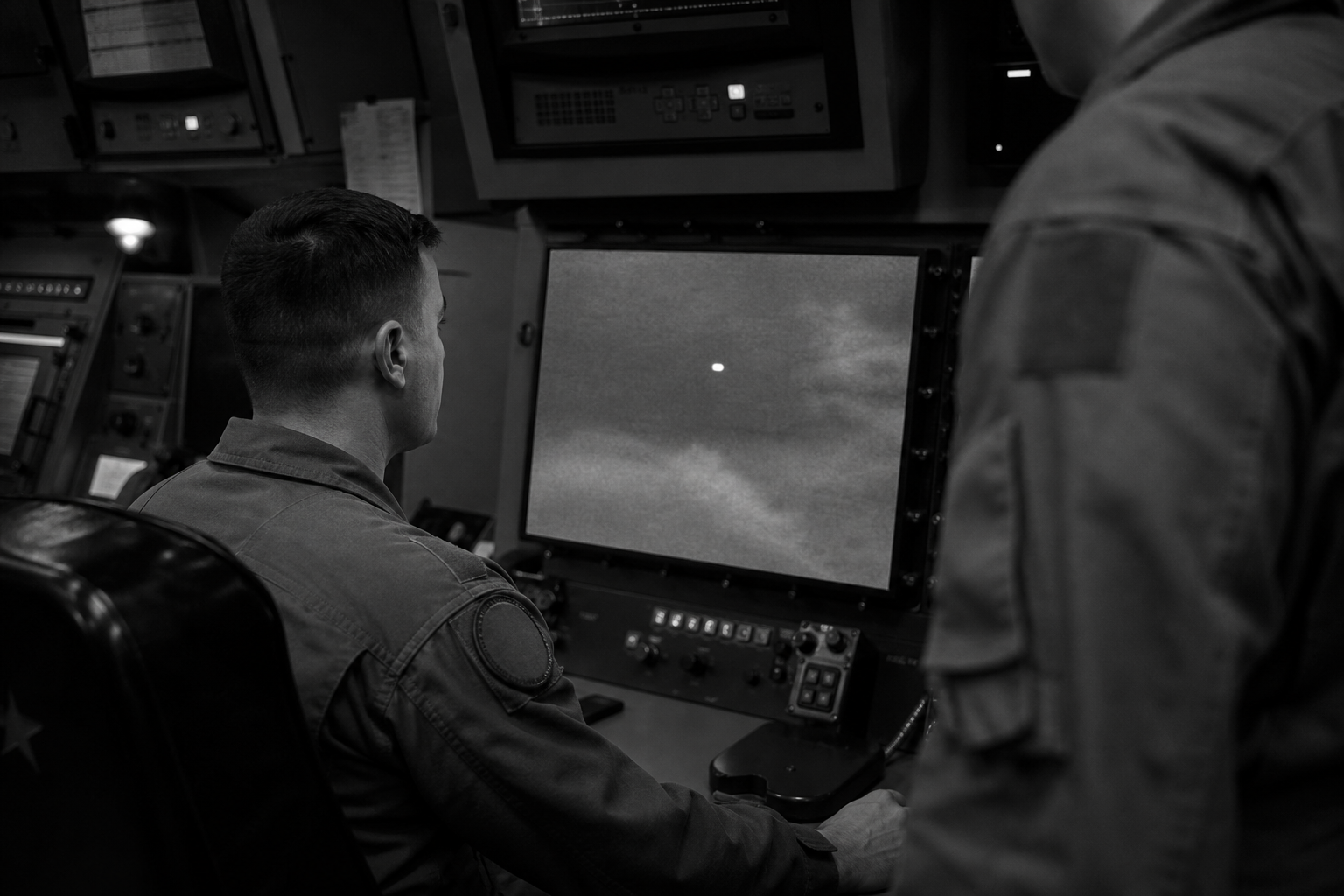
The Navy videos associated with unusual encounters mattered because they offered material the public could examine alongside the pilots’ descriptions, rather than asking readers to accept an unexplained observation on testimony alone. Subsequent Pentagon acknowledgment that the footage was authentic government-recorded material strengthened the case that the encounters deserved serious attention. Authentication, however, answers a narrow question, whether the government recorded and retained the video, not the much larger question of what every object depicted was.
That distinction is central to responsible UAP disclosure. “Unidentified” describes an observation not resolved from the information available; it is not a finding that the object was extraterrestrial, non-human, or beyond known technology. The reporting raised legitimate aviation-safety and intelligence questions: military crews had described encounters that could affect training airspace, and analysts needed to determine whether a sighting reflected equipment limits, atmospheric effects, foreign activity, or another explanation. Those questions justify investigation without predetermining an extraordinary answer.
Nor did the news break establish a government UFO cover-up or reveal an alien program. Its lasting significance was more concrete: it made a previously obscure Pentagon-linked effort publicly discussable, gave military witnesses a mainstream audience, and created sustained pressure for clearer institutional reporting about unresolved aerial incidents.
The Documented Takeaway: Reid Helped Enable Scrutiny, Not a Proven Alien Program
A defensible historical account rests on sequence rather than sensational inference. Harry Reid used his senior Senate position to encourage defense-intelligence attention to unusual aerospace reports, with support from fellow senior senators Ted Stevens and Daniel Inouye. That advocacy helped create institutional backing; it did not make Reid the Pentagon’s contracting authority.
The executable government action was DIA’s AAWSAP contract, awarded to Bigelow Aerospace Advanced Space Studies for roughly $22 million over 2008–2012. AAWSAP is therefore the firmest anchor in the record: a dated procurement, a named agency, a named recipient, and a defined performance period. AATIP belongs in the account as the more publicly familiar label associated with later descriptions of Pentagon UAP work, and differs from the later, separately mandated Pentagon UAP office framework; public accounts have not described its relationship to AAWSAP with equal consistency.
December 2017 matters because contemporaneous reporting, led by The New York Times, brought those broad outlines to a mass audience years after the contract period. It did not transform an investigation into proof of an extraordinary conclusion.
Readers assessing later UAP claims should apply the same hierarchy. Contract records and official statements establish what an institution funded, retained, or acknowledged. Contemporaneous reporting can establish what was reported at the time. Testimony can illuminate participants’ experiences but requires corroboration. Anonymous claims, alleged materials, and assertions about non-human intelligence remain allegations unless independently supported. The documented record demonstrates government interest in investigating unresolved reports, not a proven alien program or government UFO cover-up.
Frequently Asked Questions
-
Did Harry Reid fund AATIP or AAWSAP?
Harry Reid helped build Senate support for the DIA-funded AAWSAP contract, not a personally controlled Pentagon program. AAWSAP ran from 2008 through 2012, while AATIP was the better-known label used in later public accounts of Pentagon UAP work.
-
How much money did Harry Reid help secure for Pentagon UFO research?
The DIA awarded roughly $22 million for AAWSAP to Bigelow Aerospace Advanced Space Studies. The contract performance period ran from 2008 to 2012.
-
Was the Pentagon UFO program funded in 2017?
No. The AAWSAP funding trail began years earlier, with the DIA contract running from 2008 through 2012. December 16, 2017 was the public disclosure moment when The New York Times brought the effort to national attention.
-
What is the difference between AAWSAP and AATIP?
AAWSAP was a Defense Intelligence Agency contract program with a named contractor, roughly $22 million in funding, and a 2008 to 2012 performance period. AATIP was the label prominently associated with later Pentagon UAP activity and the 2017 public narrative, but it should not be treated as identical to every AAWSAP task.
-
What should you look for when evaluating claims about Pentagon UAP research?
Separate contract records, official statements, contemporaneous reporting, and participant testimony from unsupported allegations. A DIA contract confirms that research was funded, but it does not prove extraterrestrial origins, non-human technology, or a government cover-up.