Unspecified Object Sighting Reported in Valley City, North Dakota on January 23, 2020
Examine the Valley City North Dakota UFO sighting January 23 2020, its limited record, evidence gaps, and possible conventional explanations.
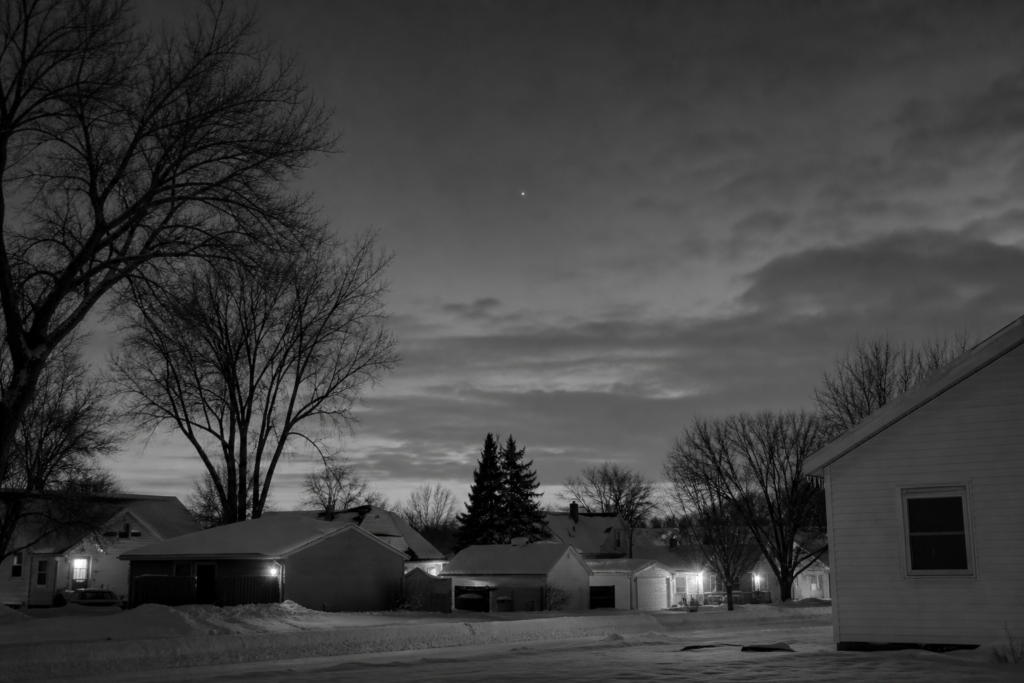
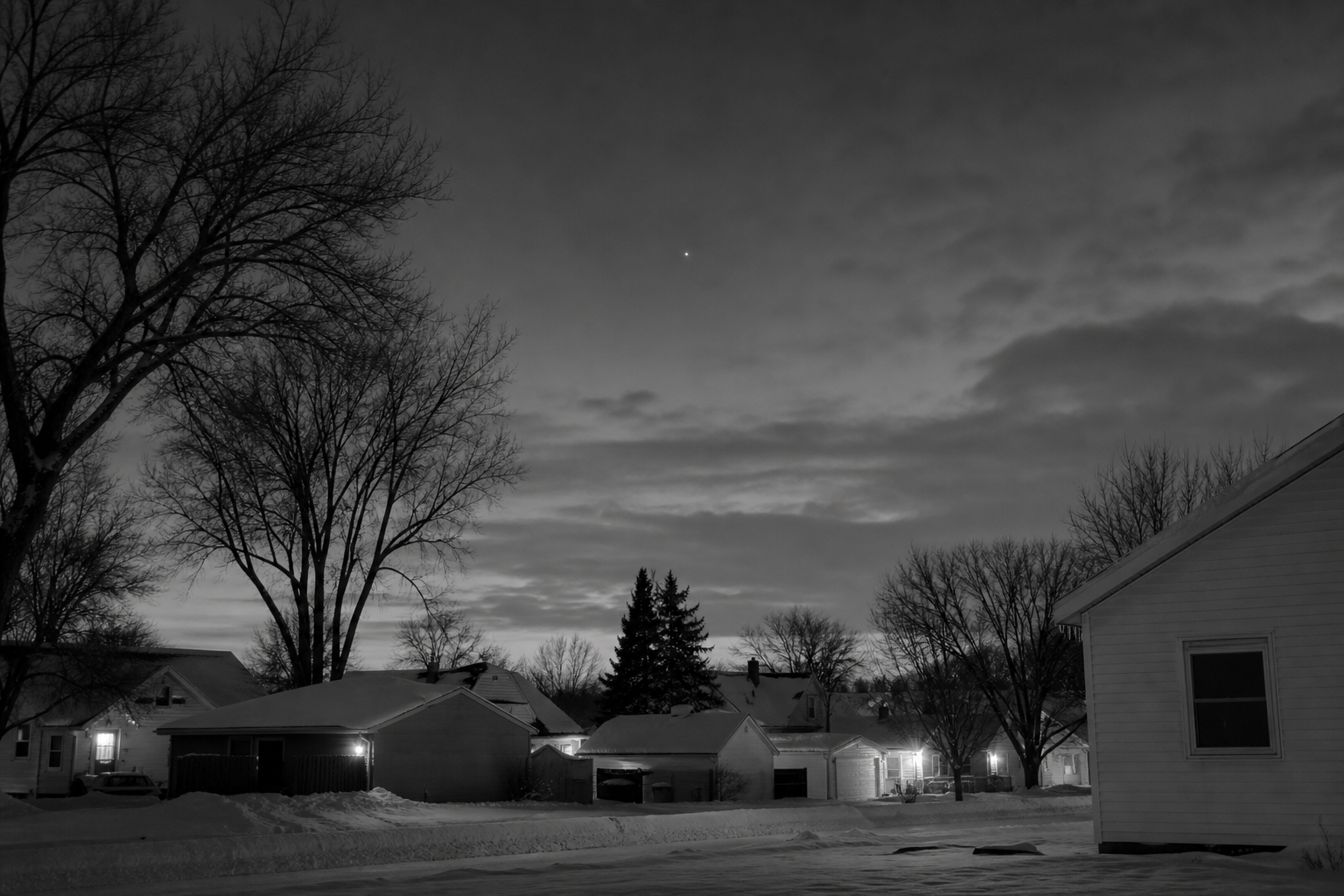
This article examines an unidentified-object report described as occurring in Valley City, North Dakota, on January 23, 2020. In reader shorthand, it may be found as a Valley City North Dakota UFO sighting January 23 2020; “UFO” and “UAP” mean only that an observer did not identify what they saw. Neither label establishes an extraordinary origin, a physical craft, or even a single confirmed object.
No primary witness narrative, submission metadata, or earliest attributable database entry has been supplied with the material available for this introduction. The date, locality, and existence of a reported sighting therefore remain the starting claim to trace, not a verified identification. Likewise, photographs, video, additional witnesses, police material, radar data, flight records, and a formal investigation should be treated as undocumented unless an attributable record is located and examined. A report that an observer saw a light or object records an experience; an identification requires observable details that can be compared with independent information.
The sections that follow separate the reported claim from checkable context and editorial inference. They will look for essentials such as observation time, direction, apparent motion, duration, sound, elevation, and viewing conditions. For example, a sustained light moving steadily in a known direction can be compared with aviation or satellite activity, while a brief fast streak calls for a different comparison, such as a meteor. Without such details and corroboration, the case may remain unresolved, not because it proves an unusual event, but because the surviving record may not support a reliable identification.
What Was Reported in Valley City on January 23, 2020
The key missing checkpoint is an attributable narrative: the surviving material identifies a sighting reference, but preserves neither a witness submission nor an archived entry containing the observer’s words.
There is therefore no exact account to quote, no recorded description of shape, color, brightness, motion, direction, duration, altitude, sound, distance, or number of objects. “Reported unidentified object” is the narrowest accurate description of the available reference. It denotes an observation the reporter did not identify; it does not establish what was observed.
The listed date and locality function only as report metadata: they indicate when and where the sighting was said to have occurred or was indexed. They do not independently confirm that an object was present, or establish whether the observation occurred within Valley City’s limits rather than the surrounding area. No submission timestamp, witness identity, photograph, video, second account, law-enforcement record, aviation record, radar data, or investigative finding is preserved in the material reviewed here.
Accordingly, the Valley City UFO sighting 2020 record can be described as an unresolved, minimally documented report. Metadata alone cannot support a specific identification because the observable features needed to compare it with ordinary aerial or astronomical possibilities are absent.
The Available Record: What the Report Documents and What It Does Not
The evidentiary hierarchy begins with the missing item: no accessible primary record shows that a named witness submitted an account, and no identifiable organization is shown to have collected, investigated, or published one. The material is therefore not verifiable as a self-submitted witness report, a preserved sighting-database entry, or a contemporaneous media account. It is best treated as an unattributed date-and-place reference rather than a transcription whose wording and provenance can be audited.

What the record documents is limited but distinct: an unspecified-object report was associated with Valley City and dated January 23, 2020. It does not preserve a submission date separate from the event date, a publication date, an entry number, a reporter or investigator name, or the report narrative. Those omissions matter because an original narrative permits readers to distinguish an observer’s own description from a later summary; here, no such comparison is possible.
- A precise local time would allow comparison with aircraft movements, satellites, bright planets, and weather conditions. No time is available.
- Direction, elevation above the horizon, apparent movement, and duration would describe where the observer looked and how the object appeared to behave. None is retained.
- Photos or video can preserve visual information, while an independent second witness can test whether the observation was shared rather than solitary. Neither is documented.
- Police or emergency-dispatch logs, airport or flight records, radar information, and a formal follow-up could supply corroborating context. The available material records no such agency evidence or investigation.
Absence from this surviving record does not prove that every form of supporting material never existed. It means only that no identified copy is available for evaluation here. The practical result is narrow: the entry supports the existence of a reported, unresolved observation, but its evidentiary quality does not permit a reliable reconstruction or identification.
What Can Be Established, and What Cannot
Established: The available reference supports only a narrow proposition: an unspecified-object report was associated with the locality and dated January 23, 2020. It does not establish what was seen, who saw it, or whether the event occurred at a precise point within or near the city.
Reasonable inference: “Unidentified” describes an unresolved identification, not a confirmed class of object. In civilian UFO sightings, the label ordinarily means that the observer, or the surviving record, did not supply enough information to settle on an explanation. That can result from incomplete observation, incomplete reporting, or missing records; it does not itself indicate unusual performance or origin.
Not established: Nothing available supports an extraterrestrial explanation, non-human intelligence, military activity, or a physical craft of any kind. Nor does the reference demonstrate an official UAP case. A formal unidentified aerial phenomenon assessment would involve an identifiable agency process and evidence evaluated beyond an unattributed local date-and-place entry.
The distinction matters because a reported observation and a verified event are different evidentiary categories. This reference remains unresolved not because it defeats conventional explanation, but because it lacks the observable details and independent material needed to compare competing explanations. Any stronger conclusion would go beyond the available record.
Conventional Context: Possible Explanations That Require Specific Details
Identification depends on pattern rather than on a single impression of brightness or distance. Astronomical objects such as bright planets and stars normally remain fixed relative to the landscape over short viewing periods; apparent flickering can result from turbulent air. A steady point that holds position is more consistent with that category than one that crosses the sky or changes direction, provided the observer’s own movement is known.
Aircraft traffic commonly presents one or more navigation lights, a regular blinking sequence, and a track that is broadly straight or gradually turning. Sound, visible wing lights, and a known direction of travel would make that possibility easier to test. Satellites generally appear as silent, steadily moving points that cross the sky without flashing, whereas a meteor is usually a brief streak or rapidly moving flare rather than a light watched for minutes. Precise local time, viewing direction, elevation above the horizon, and duration are the practical inputs needed to compare either pattern with an ephemeris or pass prediction.
Balloons and drones can seem unusual because their apparent speed and direction vary with wind, distance, and viewing angle. A balloon may drift or hover; a drone may maneuver, stop, or display colored lights, but identifying either requires some basis for estimating range, motion, and environmental conditions. Atmospheric effects, including haze, cloud reflections, and distortions near the horizon, can alter a familiar light’s apparent color, shape, or steadiness.
The Valley City reference preserves none of those discriminating observations: no usable time of day, direction, duration, color, motion description, sound, or image is available. Each category is therefore a conventional explanation to test if a fuller account emerges, not a candidate that can responsibly be assigned to this report.
How Weather, Aviation, and Local Records Could Be Checked
A useful reconstruction would begin by fixing an observation time, ideally to the minute, and a viewing location. Without those anchors, later comparisons can only describe general conditions rather than test whether a particular light, aircraft, or weather effect matched the reported view.
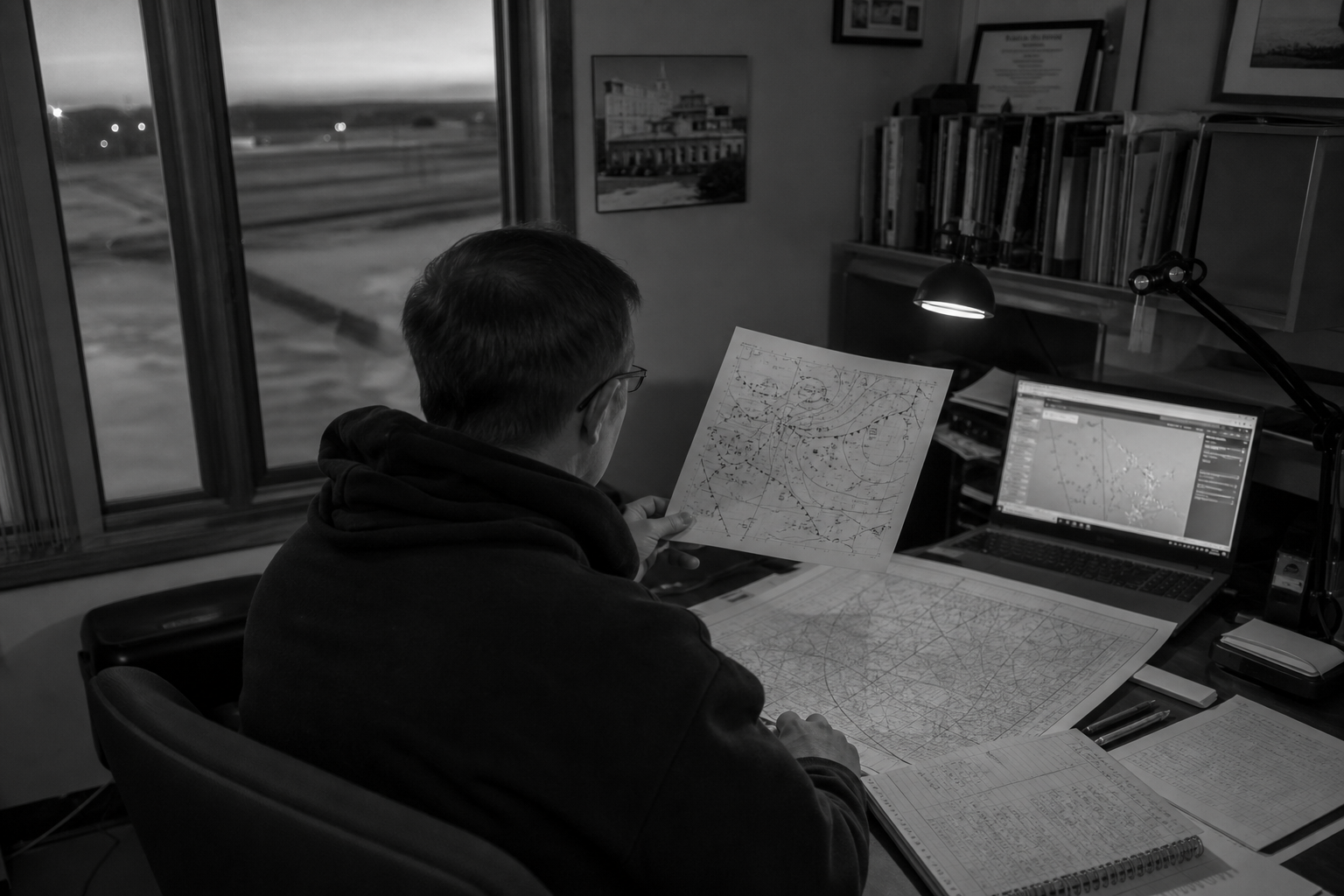
National Weather Service station observations and archived airport weather reports can supply timestamped visibility, cloud layers, wind, temperature, and precipitation information. Those records can indicate whether low cloud, haze, blowing snow, or clear skies might have affected what a person could see. They cannot show what an observer actually viewed, and a station reading may differ from conditions at a specific spot in or outside Valley City.
Archived aircraft-position data and, where available, FAA-related records can be compared against the time window, compass bearing, and direction of travel. A close positional and timing match would make an aircraft hypothesis more plausible; no displayed track would not eliminate aviation, because coverage can be incomplete and not every flight is represented in public tracking archives.
Local emergency-dispatch logs, law-enforcement incident records, and contemporaneous newsroom archives could reveal whether other callers, officers, or reporters documented an unusual light at roughly the same time. Such material would corroborate that people noticed something, not identify the object by itself. The available Valley City record does not preserve a usable time or direction, so these checks remain a defined research method rather than completed tests of this report.
Why Civilian Unidentified-Object Reports Often Remain Unresolved
A durable investigation starts by preserving the first available version of an account, including its submission date, exact wording, attached files, and any later edits. A contemporaneous note that gives a time, viewing point, compass direction, and duration is more useful than a recollection written years later, because those details permit independent comparisons without asking the witness to reconstruct them from memory.
Corroboration also has levels. Two people who independently describe the same light from different locations can establish that more than one observer noticed something; they do not automatically establish its distance, size, or identity. Original photos or video may preserve timing and visual behavior, but are strongest when the unedited file, metadata, and a known camera position are available. A reposted image without those elements is a lead for inquiry, not confirmation.
An explanation becomes plausible when it matches several particulars at once, for example, an aircraft track matching the reported direction and minute, or a bright celestial object matching a stationary bearing. It becomes a confirmed identification only when the match accounts for the observation without material contradictions. Civilian UAP sightings often remain unresolved because the discriminating particulars, independent witnesses, original media, or reliable time record are absent. For the Valley City reference, the surviving metadata cannot support that comparison, so its unresolved status reflects an evidentiary limit rather than evidence for an extraordinary cause. These UAP reporting procedures help document, assess, and check reports against available evidence.
Bottom Line: A Reported Sighting, Not a Confirmed Identification
What would change the assessment is a recoverable observation record: a stated time, viewing point, direction, duration, or original image could allow a comparison with the relevant weather, astronomical, aviation, or local material. None is presently attached to the surviving reference. It also does not document photographs, video, independent witnesses, police records, radar, flight-track matches, or a formal investigation. “Unresolved” therefore describes an evidentiary limit, not support for an extraordinary explanation.
The appropriate conclusion is limited to an unspecified-object report associated with Valley City on January 23, 2020, rather than a confirmed identification of what was seen. Readers pursuing the January 23 2020 UFO report in North Dakota should give greatest weight to an original submission or earliest attributable archive, then keep public-record comparisons separate from editorial inference in a transparent source list. Searches for UFO sightings 2025 or 2026 concern later events and should not be folded into this historical Valley City North Dakota UAP sighting.
What the Valley City Report Can, and Cannot, Show
The key distinction is between a lead and a conclusion. A date-and-place reference is a lead: it preserves enough information to justify searching for an original account or independent records. It is not a conclusion about the object’s nature, because it supplies none of the observations by which competing explanations could be compared.
An unresolved entry is not evidence that an extraordinary explanation is more likely; it means the available material cannot discriminate among explanations. Conversely, the lack of a preserved photograph, witness statement, flight match, or official record does not demonstrate that nothing was observed. It limits what can responsibly be claimed about the observation.
The most useful future find would be a contemporaneous, attributable primary record with a specific time, viewing position, direction, duration, and description of motion or lights. Those details could be tested against records from the same interval, while an undated retelling or a bare database label would add far less. Until such material appears, the Valley City North Dakota UFO sighting of January 23, 2020 remains a historically noted but evidentially indeterminate report, not a confirmed object, event, or extraordinary occurrence.
Frequently Asked Questions
-
What was reported over Valley City, North Dakota, on January 23, 2020?
An unspecified-object sighting was associated with Valley City and dated January 23, 2020. No preserved witness narrative identifies the object’s shape, color, motion, duration, altitude, or number of objects.
-
Is there evidence that the Valley City object was a UFO or UAP?
No evidence identifies the reported object as a physical craft, extraterrestrial object, military activity, or official UAP case. In this context, UFO and UAP only mean the observer or surviving record did not identify what was seen.
-
Where can I find the original Valley City UFO sighting report?
No original witness submission, attributable database entry, entry number, or archived narrative is available in the surviving material. The most useful source would be a contemporaneous primary record with the witness’s exact wording, submission date, and any attached media.
-
What details are needed to identify a bright object seen over North Dakota?
Useful identification details include the exact local time, viewing location, compass direction, elevation, duration, apparent motion, color, sound, and original photos or video. These details allow comparisons with aircraft tracks, satellite passes, bright planets, meteors, weather, balloons, drones, and atmospheric effects.
-
How can a civilian UFO sighting be verified or compared with ordinary explanations?
Start with a contemporaneous account that records the time, location, direction, duration, and description of lights or motion. Then compare those details with timestamped weather observations, aviation and FAA-related records, satellite or astronomical predictions, emergency-dispatch logs, and independent witness accounts.