This article examines a reported unspecified-object sighting associated with Valley City, North Dakota, on March 1, 2020. A report of an object is evidence that an observation was recorded or submitted; it is not, by itself, confirmation of an aircraft, astronomical object, satellite, unknown technology, or extraordinary craft.
The distinction matters in a case with limited publicly established detail. A strong evidentiary record would connect the observation to such independently assessable material as a precise time, direction of travel, duration, photographs or video with provenance, additional witnesses, and relevant weather, aviation, or sky data. A weak record may preserve only the reporter’s account and a location-date association. Neither circumstance justifies filling gaps with certainty.
The following review separates reported claims from corroborated facts and documented context. It examines the available source record, looks for public evidence of other witnesses or official response, and considers ordinary explanations only where the reported details permit a meaningful comparison. Broader UFO or UAP discussions can explain terminology, but they cannot establish what was seen over Valley City. The resulting classification will therefore reflect the evidence available for this individual report, not an assumption about its cause.
What Was Reported in Valley City on March 1, 2020
The first checkpoint is whether a record preserves more than a place-and-date association. Here, the usable starting point is only an entry connected with Valley City and the stated observation date of March 1, 2020; it does not establish when the account was submitted or posted, or whether an agency examined it.
No original database entry, archived report page, record identifier, or preserved witness narrative has been supplied for review. “Unspecified object” therefore functions only as a descriptive label for the event listing, rather than an identification of what the observer saw.
The available material provides no time of day, appearance, brightness, apparent size, direction, altitude, movement, or duration. It does not name a witness, establish how many people observed the event, or retain wording that could be quoted or accurately paraphrased. No photograph, video, radar record, law-enforcement record, FAA record, or formal-investigation file has been supplied in connection with the entry.
Those gaps limit the Valley City North Dakota UFO sighting March 1 2020 to a location-and-date report with unknown observational characteristics. The source-record review that follows separates traceable metadata from details that later summaries or database listings may add.
The Source Record: Details That Are Documented and Details That Are Not
A usable source record normally has three layers: the witness’s own account, the reporting system’s metadata, and later retellings. In this case, the material available for this review preserves only the location-date association and the “unspecified object” label; it does not identify the organization, database, archive, or record number from which that association originates.

| Record layer | What can be retained | What cannot be attributed |
|---|---|---|
| Direct witness report | No preserved wording is available. | No statement about shape, color, brightness, sound, motion, duration, distance, or the witness’s viewing position can be presented as a witness claim. |
| Database-style metadata | Valley City, North Dakota, and March 1, 2020 are the reported place and observation date; “unspecified object” is the available category. | There is no demonstrated submission date, posting date, classification method, or named reporting organization. |
| Later summaries | No later summary has been provided with traceable sourcing. | Any added narrative detail would be unsupported unless it can be tied back to an archived entry or original report. |
The distinction between incident date and record date matters. March 1, 2020 may mark when the observation allegedly occurred, while a submission date would show when someone filed it and a publication date would show when a database made it visible. None of those latter dates is presently established, so the record cannot show whether the report was contemporaneous or submitted later.
Likewise, “unspecified object” does not supply physical characteristics. It may be a database category used when an entry lacks a more detailed type, rather than the witness’s exact description. Without a reported time, viewing direction, elevation above the horizon, or movement track, there is no factual basis here to compare the sighting to a particular aircraft route, celestial object, satellite pass, or weather condition.
No photo, video, radar return, additional witness account, law-enforcement record, aviation record, or formal investigation is included in the available material. That is an evidentiary limitation, not evidence that such material never existed. For this Valley City ND UFO sighting, the defensible source-level description remains a minimally documented reported observation with an undetermined object category.
What Can Be Independently Established
Independent support would require a record created apart from the unidentified listing and capable of matching it on more than location and date. A contemporaneous news item, for example, could establish that a witness contacted a newsroom; a dispatch log could establish that a call was received; and a photograph with recoverable time and location data could preserve an observation. None of those forms of independent evidence is available in the material reviewed for this case.
The reported date and Valley City association remain the only retained event markers, but they do not independently confirm that an unusual aerial object was present. They are metadata attached to an untraceable entry, not a dated municipal, aviation, or scientific observation. In particular, the absence of a time window prevents a meaningful match to a nearby flight, a sky event, or a weather observation.
- Contemporaneous local coverage: no attributable local-news article or broadcast record has been provided that describes this incident, identifies a witness, or preserves an observation account.
- Public official response: no police, sheriff, fire, emergency-dispatch, municipal, FAA, or airport record is available here that connects an aerial-object call or aviation occurrence to Valley City on the reported date.
- Corroboration: no named second witness, independently filed matching report, photograph, video, radar data, or formal investigation is publicly documented in the available material.
These are not interchangeable signals. A second report with the same time, direction, and description would be stronger than a second report sharing only a date; radar or an identified aircraft track could establish that something was in the air but would not, by itself, establish what a witness saw. Conversely, a photo without provenance might show an image but cannot reliably connect it to this event.
The proper classification at this stage is therefore a reported sighting with no located independent evidence beyond its location-date association. That limitation does not disprove the observation or rule out the possibility that records exist elsewhere. It does mean the case cannot be elevated from the broader pool of UAP sightings into a corroborated aerial event, and it leaves conventional explanations as well as more unusual interpretations untested rather than supported.
Ordinary Explanations to Test Against the Available Facts
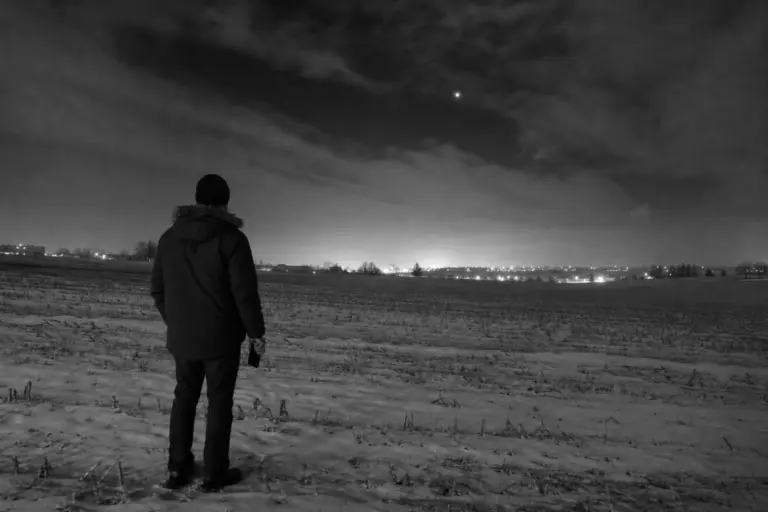
A conventional identification begins with a geometry test, not a label. A planet or bright star normally remains fixed relative to the horizon during a short observation, although cloud movement, autofocus, or a viewer’s own motion can make a steady light appear to shift. Testing that possibility would require an observation time, viewing direction, approximate elevation above the horizon, duration, and a description of whether the light held a constant position. None is retained here, so an ephemeris comparison cannot responsibly identify, or eliminate, a particular celestial object.
Aircraft require a different comparison. Navigation lights commonly present as separated red, green, and white lights; a landing light can look like a single bright, nearly stationary point when an aircraft is approaching head-on, then appear to move or dim as its angle changes. A useful match would pair a time window and direction of travel with historical flight data, while recognizing that public tracking does not necessarily capture every aircraft or every usable detail. The available Valley City record supplies neither a time nor reported motion, brightness, or direction, leaving an aircraft explanation plausible in the abstract but untestable for this event.
- Satellites and satellite trains: a single satellite typically crosses the sky smoothly and without blinking; a train would involve several lights following a similar path at close intervals. A date- and minute-specific pass prediction, plus direction and duration, is necessary before linking either pattern, including a possible Starlink train, to this sighting.
- Drones: these can hover, reverse direction, or show colored blinking lights, features unlike a distant satellite. Distance, sound, altitude estimate, and movement description would be especially important; none is preserved.
- Atmospheric effects: haze, thin cloud, ice crystals, and reflections can alter the apparent size, color, steadiness, or position of lights. Historical weather records are informative only when they can be tied to a known observation window and viewing conditions.
The practical distinction is between a hypothesis that fits a described pattern and a guess applied to an undescribed object. Because this entry lacks the observation data needed for evidence-based UAP analysis, timing, direction, appearance, duration, and sky conditions, no planet, aircraft, satellite, drone, or atmospheric effect can be specifically assigned to it. The same missing facts also prevent the report from being treated as a defined unidentified aerial phenomenon rather than an unresolved, minimally described observation.
Government Records, UAP Disclosure, and What They Do Not Establish Here
Government involvement would leave a different kind of trail from a sighting listing: an agency case number, dispatch entry, public statement, records-release response, or an identifiable military or aviation inquiry. No such item is preserved in the material reviewed for the Valley City incident. Nor does that material identify the originating report as a submission to a police department, the FAA, a military office, or any other government body; its submission route remains unknown.
An official case file would show that an institution received and handled a report. It would not, on its own, establish the object’s identity. Conversely, the absence of a publicly available file in this limited record cannot establish that no call, report, or internal note was ever made. It establishes only that no agency investigation, military connection, public response, or official incident record can be documented here.
Modern UAP reporting frameworks have made government collection and assessment of some aerial reports a subject of public interest. Those frameworks concern intake, review, and the limits of available data: a report can be recorded, categorized, or remain unresolved because key information is missing. They do not convert this minimally described Valley City entry into evidence of non-human intelligence, classified activity, or a government UFO cover-up.
The practical dividing line is therefore straightforward. A named office, dated record, and case identifier would be a concrete lead; national disclosure news without a tie to this event is not. On the evidence available, government involvement in this particular report remains unknown rather than documented.
Why the Valley City Case Remains a Reported, Not Confirmed, Sighting
The decisive issue is not whether the label “unresolved” sounds suggestive, but what the surviving record can actually support. Here, it supports a narrow conclusion: an unspecified-object report was associated with Valley City, North Dakota, on March 1, 2020. It does not preserve the original submission, a witness narrative, a reporting route, or a record number that would allow the entry to be traced and assessed in greater detail.
Several potentially decisive facts remain unknown: the observation time, the observer’s precise location, viewing direction, elevation, duration, apparent motion, shape, color, brightness, and local sky conditions. No publicly available corroborating witness account, original photo or video file, radar or flight-data match, media coverage, law-enforcement record, FAA record, or formal investigation is included in the material reviewed. Their absence from this record should not be mistaken for proof that they never existed; it means they cannot presently strengthen the case.
The most useful new evidence would be independently archived material that can be tied to the event. A media file with intact capture metadata could establish when and where it was made; a precise observer location, compass direction, and time window could permit comparison with aircraft, satellites, planets, and weather; and a contemporaneous dispatch, newsroom, or additional-witness record could test whether separate observers described the same event. Those are stronger signals than a later label because they make independent comparison possible.
The appropriate classification for this North Dakota UFO report from March 2020 is therefore reported and unresolved because information is insufficient for identification. That status neither confirms nor disproves that an observer saw something unusual. It is not evidence of an extraterrestrial craft, non-human intelligence, classified technology, or a government cover-up. Until traceable, event-specific evidence emerges, the Valley City North Dakota UAP sighting remains a limited historical report rather than a confirmed incident.
Frequently Asked Questions
What was reported in the Valley City, North Dakota UFO sighting on March 1, 2020?
The available record associates an unspecified object report with Valley City, North Dakota, on March 1, 2020. It preserves no witness narrative, observation time, appearance, motion, duration, photo, video, or record identifier.
Is there independent evidence for the Valley City UFO report?
No independent evidence is documented in the available material. There is no attributable news coverage, second witness account, photo or video, radar data, FAA record, law-enforcement record, or formal investigation tied to the report.
What details are needed to identify an unexplained light in the North Dakota sky?
Useful identification details include the observation time, viewing direction, elevation above the horizon, duration, apparent motion, brightness, shape, color, and local weather conditions. These details allow comparisons with aircraft tracks, satellite passes, planets, drones, and atmospheric effects.
Was the Valley City sighting investigated by a government agency?
No government investigation is documented for this report. The available material includes no agency case number, dispatch entry, FAA record, military inquiry, public statement, or identifiable reporting route.
Does the unresolved Valley City UFO report prove the object was extraterrestrial?
No. The report is classified as reported and unresolved because the available information is insufficient for identification, not because it supports an extraterrestrial, non-human, classified-technology, or cover-up conclusion.