The 1561 Nuremberg Celestial Broadsheet: Primary Source, Woodcut, and Competing Explanations
Explore the 1561 Nuremberg sky battle, Hans Glaser's woodcut, its religious context, and why solar halo displays offer the likeliest explanation.
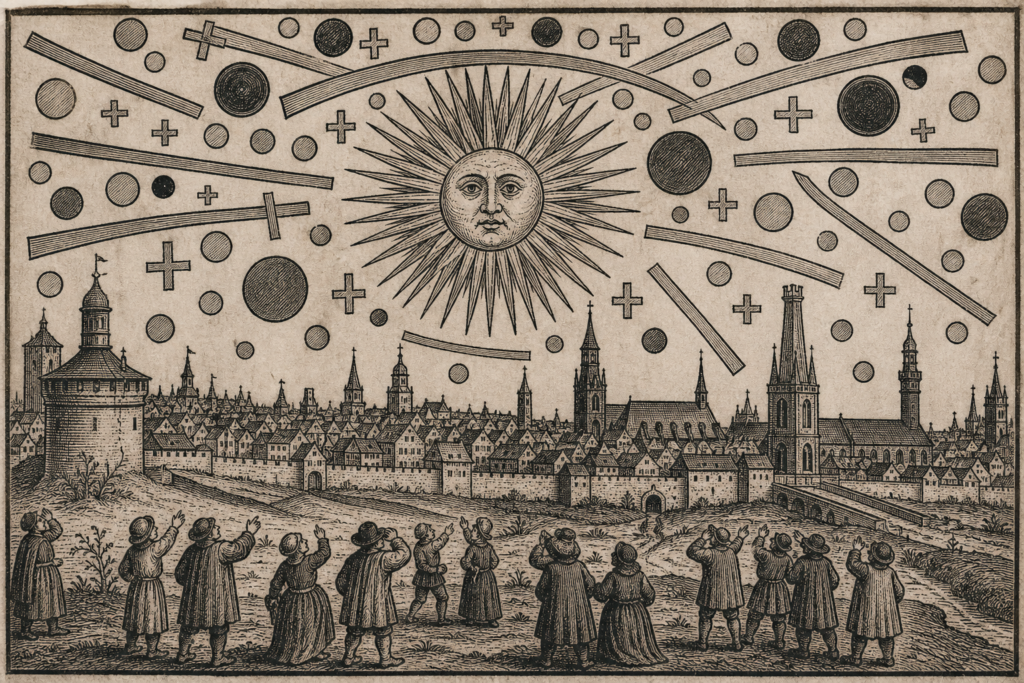
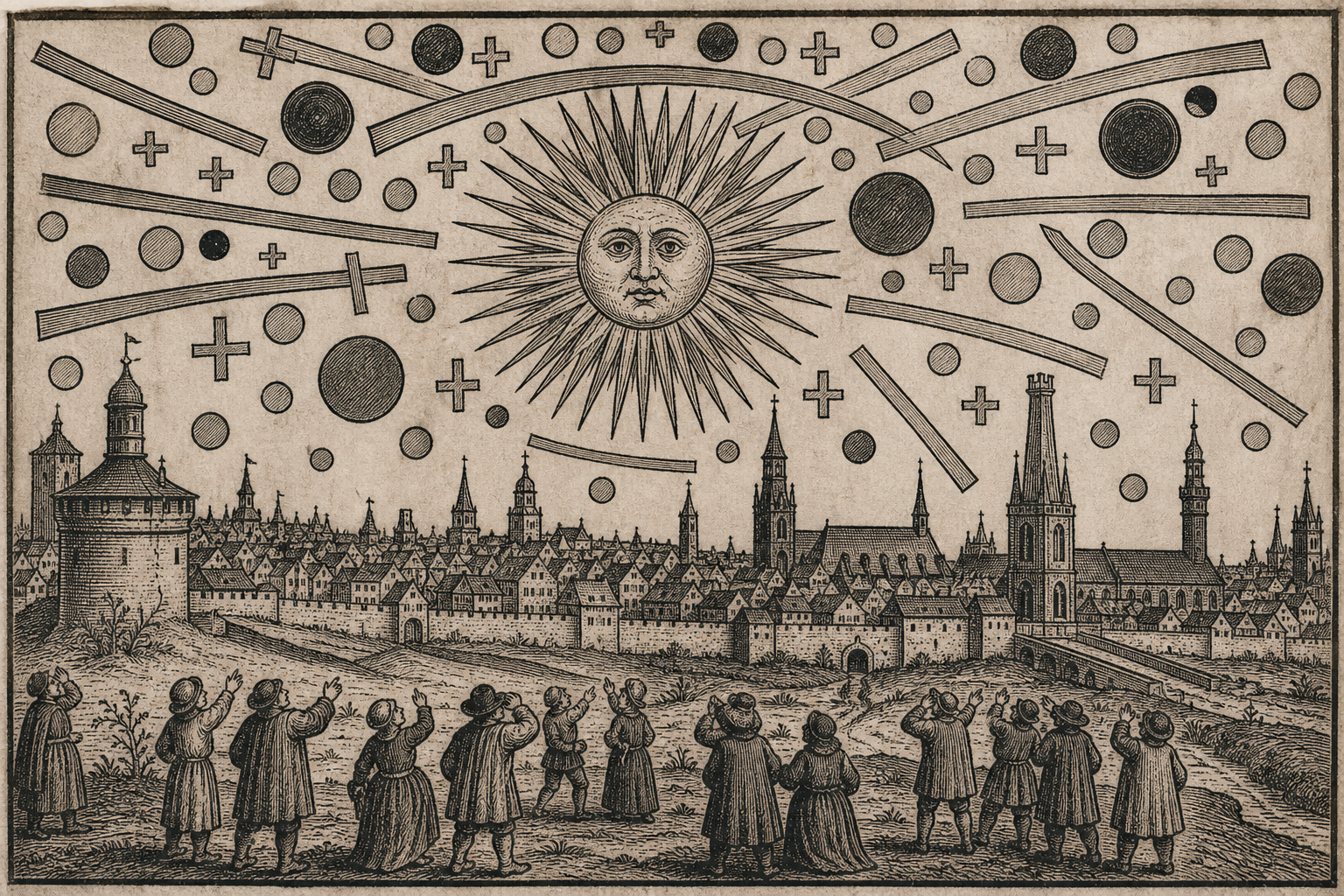
The image is hard to forget: above sixteenth-century Nuremberg, a bright sun is surrounded by disks, crosses, rods, and darker forms that seem to collide in the sky. That spectacle is now commonly called the 1561 Nuremberg sky battle, and it is often recast in UFO retellings as evidence of an aerial encounter. The historical starting point is narrower, and more interesting.
What survives is a printed broadsheet associated with Hans Glaser and illustrated with the famous woodcut. A broadsheet is not a modern incident report: it joins a written account, a designed image, and an intended moral interpretation for a public readership. Its existence securely establishes that Nuremberg readers encountered this extraordinary report in print. It does not, by itself, turn every pictured shape, apparent motion, or dramatic relationship into a literal record of what witnesses saw.
This article therefore reads the text and image together while keeping their jobs distinct. It examines the report’s religious framing, the visual choices in the Hans Glaser woodcut, and the extent to which complex solar halo phenomena, especially parhelia, or sun dogs, can account for brilliant forms around the Sun. The aim is not to replace one certainty with another, but to rank explanations by how well they fit both the surviving artifact and the sky it describes.
The 1561 Nuremberg “Sky Battle”: What Is Actually Documented
The key datum is a printed sheet dated 1561, not a contemporaneous dossier of separately preserved witness interviews. Its heading places the occurrence over Nuremberg on 14 April 1561, and it is associated with the Nuremberg printer Hans Glaser, whose name appears on the sheet. That gives the episode a firm historical anchor: people in the city could buy or encounter a report that presented an extraordinary morning sky as meaningful public news.
It gives less than modern retellings sometimes imply. The report preserves a claimed observation, while the woodcut organizes that claim into legible forms, large central Sun, repeated disks, crosses, rods, and a dark elongated object, suited to printing and interpretation. Repetition, scale, color, direction, and apparent collision in such an image are not instrument readings. They may retain visual memory, but they also make the event readable as a portent.
The analysis that follows therefore keeps three layers apart: what the German broadsheet reports; what Glaser’s designed image chooses to show; and what later readers, including UFO writers, infer from both. This distinction matters because a complex display of sunlight and ice crystals can be physically plausible without allowing an exact reconstruction from one sixteenth-century printed account. The Nuremberg celestial phenomenon of 1561 is documented as a publication and a reported spectacle; its precise atmospheric configuration remains uncertain.
What the Surviving Broadsheet Says, and What It Cannot Establish
The German text fixes its account at dawn on 14 April 1561, “between four and five o’clock,” when “many men and women” were said to have seen a frightening apparition around the rising Sun. In a close modern rendering, it describes red semicircles or arcs, numerous round forms, some red, some dark or bluish, crosses, and long tube- or rod-like shapes. It then narrates the round forms as moving among one another and “fighting,” before some seemed to fall earthward “as if burning” and vanish.
That wording preserves important observational clues: the display was associated with the Sun, occurred in early morning, and involved luminous, repeated, and differently shaped forms. But “fighting” is not a neutral measurement of motion. It converts an uncertain visual sequence into a comprehensible drama. Nor does the claim that forms fell establish that physical objects struck the ground; the sheet gives no recoverable object, location, named observer, or independent report of an impact.
The final image is especially resistant to literal reading. The text describes something “like a black spear” falling beyond the city with a great sound. “Like” signals comparison rather than a technical identification, while the reported sound and destination cannot be tested from the printed narrative alone. A woodcut and a short report can preserve what people thought they saw without preserving its scale, duration, direction, or exact order.
Hans Glaser’s name identifies the producer associated with the 1561 Nuremberg broadsheet, not a securely documented eyewitness taking statements from a known group. The sheet does not explain who supplied its details, whether Glaser observed the event himself, or how accounts were selected, combined, and shaped for print. Such gaps matter because a striking report still requires careful evaluation of its provenance, genre, and evidentiary limits; a printed report is a transmission of testimony and interpretation, not the testimony itself.
Its closing purpose is unambiguous. The apparition becomes a warning from God, urging readers toward repentance and obedience rather than curiosity about celestial mechanics. That devotional conclusion does not erase the possibility of a real atmospheric display. It does mean that the account deliberately presents the display as a moral sign, and that its most dramatic language belongs to that interpretive task as well as to any underlying observation.
How to Read the Hans Glaser Woodcut
The composition directs the eye from the city at the bottom to an oversized radiant Sun and a crowded field of signs above it. Circular forms are scattered in light and dark variants; cross-shaped figures hang near the Sun; long, narrow bars project across the sky; and a cluster of dark spheres appears amid the brighter shapes. Below, small groups of people look upward from a carefully recognizable Nuremberg cityscape.
Those elements are evidence of what the Hans Glaser Nuremberg woodcut chose to communicate, not measured diagrams of altitude, distance, size, or trajectory. A woodcut transfers an image from a carved block to paper through strong outlines and repeatable marks. That format makes a disk, cross, or rod legible at a glance, but it cannot preserve the unstable edges, changing brightness, and spatial ambiguity of a dawn sky.
Scale and placement serve the narrative. The enlarged Sun establishes the scene’s celestial center; repeated circles make the event seem numerous and sustained; bars and crosses cut across the page in ways that suggest movement and opposition. The apparent combat is therefore partly a compositional effect: separate motifs are arranged as a confrontation, rather than recorded as a sequence of precisely located observations.
The image still need not be invented from nothing. Its clustered forms, solar focus, and visual variety can plausibly draw on reported appearances, while their emphatic arrangement turns those appearances into a providential warning suitable for print. The Nuremberg 1561 woodcut is strongest as evidence that an extraordinary display was publicly represented as meaningful, and weakest when treated as though it were a photograph captured at the scene.
Why “Battle” May Be a Storytelling Frame Rather Than a Literal Description
“Battle” supplies a moral plot: disorder appears in the heavens, humanity is warned, and repentance is offered as the proper response. That is the logic of early modern prodigy literature, a form of popular print that made extraordinary events intelligible as signs with consequences rather than as neutral curiosities.
The Hans Glaser sheet follows that pattern in its closing exhortation. Its religious interpretation turns the reported apparition into a warning against sin and an appeal to reform. In a contemporary translation, words of conflict, punishment, and omen therefore do more than describe visible forms; they tell readers what those forms were meant to signify. A dramatic account of objects “fighting” may preserve an impression of shifting, intersecting, or vanishing lights, yet it also gives that impression the narrative force of a providential struggle.
This is not a license to dismiss the event as fiction. It is a distinction in evidentiary weight. The dawn setting, the concentration around the Sun, and the report of multiple bright forms are potential observational material. The battle sequence, moral warning, and implied divine punishment are interpretive material: they frame the display within the expectations of its audience. For the 1561 Nuremberg sky battle, the strongest historical reading keeps both layers in view without treating either one as a literal transcript of the other.
The Most Likely Explanations: Halo Displays First, With Important Limits
The best physical fit is a complex solar-halo display: sunlight interacting with suspended hexagonal ice crystals, usually in high, thin cloud. Such displays are organized around the Sun, can be especially conspicuous when it is low, and can present several bright features at once rather than a single neat ring. That combination matches the report’s dawn timing and its concentration of luminous forms near the rising Sun better than any interpretation requiring independent objects in the sky.
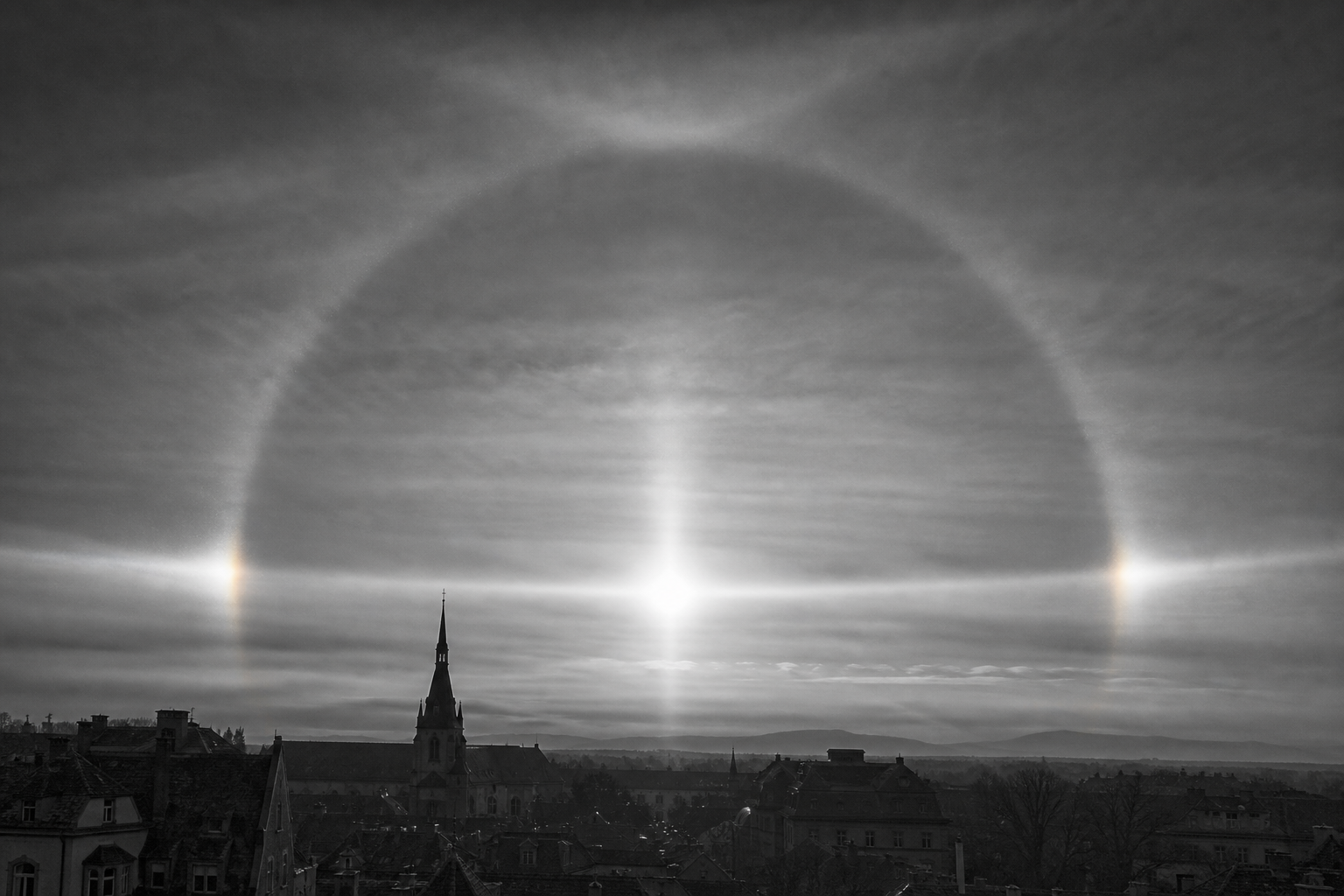
- Parhelia and the 22-degree halo rank first. Parhelia, commonly called sun dogs, are bright patches that form to either side of the Sun when plate-like crystals refract light. The same crystal population can also produce a 22-degree halo, a circular ring at a fixed angular distance from the Sun. To an observer confronting a changing, partly obscured display, bright spots and segments of a ring could plausibly be described as circles, balls, or red semicircles rather than as a single geometric system.
- Additional arcs and pillars can account for some of the stranger geometry. Differently oriented plate and column crystals produce distinct halo arcs; a vertical light pillar can arise when light reflects from relatively flat crystal faces. A pillar intersecting a horizontal solar feature, or several arcs meeting near the Sun, can create cross-like configurations. Elongated luminous bands likewise offer a better physical analogue for the reported rods than solid tubes traveling through the air.
- A combined display is more plausible than one exact label. The broadsheet’s variety, bright and dark circles, arcs, crosses, and long forms, need not map one-for-one onto a single optical effect. Layers of ice cloud, shifting crystal orientations, glare, and partial cloud cover can make several atmospheric optical phenomena appear, fade, or overlap during the same morning.
The fit weakens at the point where the narrative becomes choreography. Halo features remain fixed relative to the Sun or alter gradually as clouds and crystals change; they do not literally duel, chase one another, or fall burning to the ground. Perception of intermittent bright patches, recollection after an alarming spectacle, the report’s charged language, and the woodcut’s crowded composition can all help explain why changing lights acquired apparent motion and conflict.
This ranking is therefore not a retrospective diagnosis of every mark in the Hans Glaser image. It is an evidentiary judgment: solar halos and parhelia explain the strongest observational anchors, the low Sun, clustered brilliance, arcs, spots, crosses, and elongated light, while leaving the most theatrical details as historically meaningful but physically unreconstructable.
Why the Broadsheet Does Not Demonstrate UFOs or Spacecraft
“Unidentified” is a limit on identification, not evidence for a particular cause. Calling this a 1561 Nuremberg UFO incident therefore adds a modern category without supplying the evidence that a technological claim requires.
A spacecraft interpretation would need more than suggestive circles, rods, and apparent motion in a designed woodcut: independent observations with separable testimony, physical traces, instrumental records, or evidence that the forms behaved as manufactured objects. The Hans Glaser sheet supplies none of those. It preserves one printed account, shaped for an early modern readership by a visual and religious language that made celestial irregularity morally significant.
Nor does uncertainty about every feature reverse that burden of proof. An imperfect atmospheric reconstruction leaves some details unresolved; it does not positively identify non-human intelligence. That distinction is especially important in historical UFO sightings, where later labels can make an anomalous report seem more technologically specific than its original evidence permits.
The broadsheet also offers no evidentiary path to a government cover-up: it predates modern state institutions, aviation, and UFO investigation frameworks. Its value lies elsewhere, as a vivid record of how Nuremberg printed, interpreted, and remembered an extraordinary dawn display.
Nuremberg 1561 Is Not Basel 1566: The Careful Conclusion
Later retellings often merge two different printed prodigy reports. The Hans Glaser sheet concerns Nuremberg on 14 April 1561, with bright circles, crosses, rods, and a crowded solar composition; Basel 1566 belongs to a separate Swiss report tradition, centered on dark globes said to appear before the Sun. Different cities, dates, imagery, and texts mean that one account cannot supply missing details for the other.
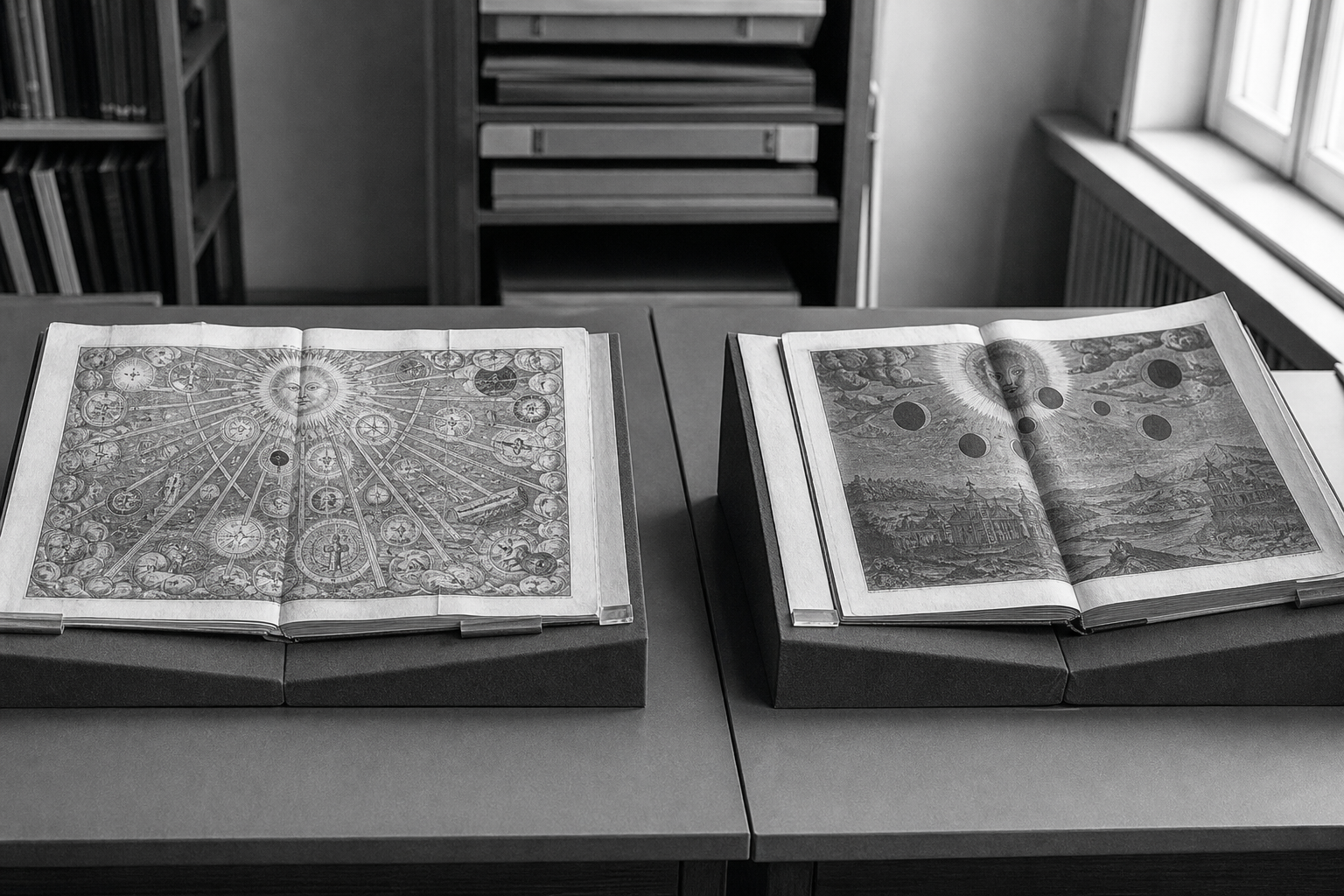
The careful conclusion is consequently limited but firm. The 1561 Nuremberg broadsheet is a real and valuable historical artifact, while its woodcut records a crafted interpretation rather than a literal sky map. A complex halo display, including parhelia, remains the strongest broad explanation for its solar-centered luminous forms. It cannot settle every printed detail, and the surviving evidence does not warrant certainty beyond that.
Sources
Frequently Asked Questions
-
What happened over Nuremberg in 1561?
A broadsheet dated 1561 reported that many people in Nuremberg saw an unusual dawn display on 14 April between 4 and 5 a.m. The account described forms around the rising Sun, including red arcs, circles, crosses, rod-like shapes, and a dark spear-like object.
-
Is the 1561 Nuremberg sky battle a real historical document?
Yes. The event is documented by a surviving printed broadsheet associated with Nuremberg printer Hans Glaser and dated 1561. It establishes that an extraordinary sky report was published, but it is not a modern incident report or a set of independently preserved witness interviews.
-
Who made the Hans Glaser Nuremberg woodcut?
The famous woodcut is associated with Hans Glaser, whose name appears on the 1561 Nuremberg broadsheet. His name identifies the producer connected with the printed sheet, not a confirmed eyewitness who personally collected testimony from named observers.
-
Could sun dogs explain the Nuremberg sky battle?
Yes, a complex solar-halo display is the strongest physical explanation for the solar-centered lights. Parhelia, or sun dogs, and a 22-degree halo can create bright spots and arcs near a low Sun, while additional halo arcs and light pillars can produce cross-like and rod-like forms.
-
How is the Nuremberg 1561 sky event different from the Basel 1566 event?
Nuremberg concerns a 14 April 1561 broadsheet showing bright circles, crosses, rods, and forms around the Sun. Basel 1566 is a separate Swiss report tradition focused on dark globes appearing before the Sun, so the two accounts should not be combined to fill gaps in either report.