The 1896-1897 Mystery Airship Wave: Contemporary Reports Before Powered Airplanes
Explore the 1896-1897 mystery airship wave, its reports, hoaxes and technology, and learn why historians compare it to modern UFO flaps.
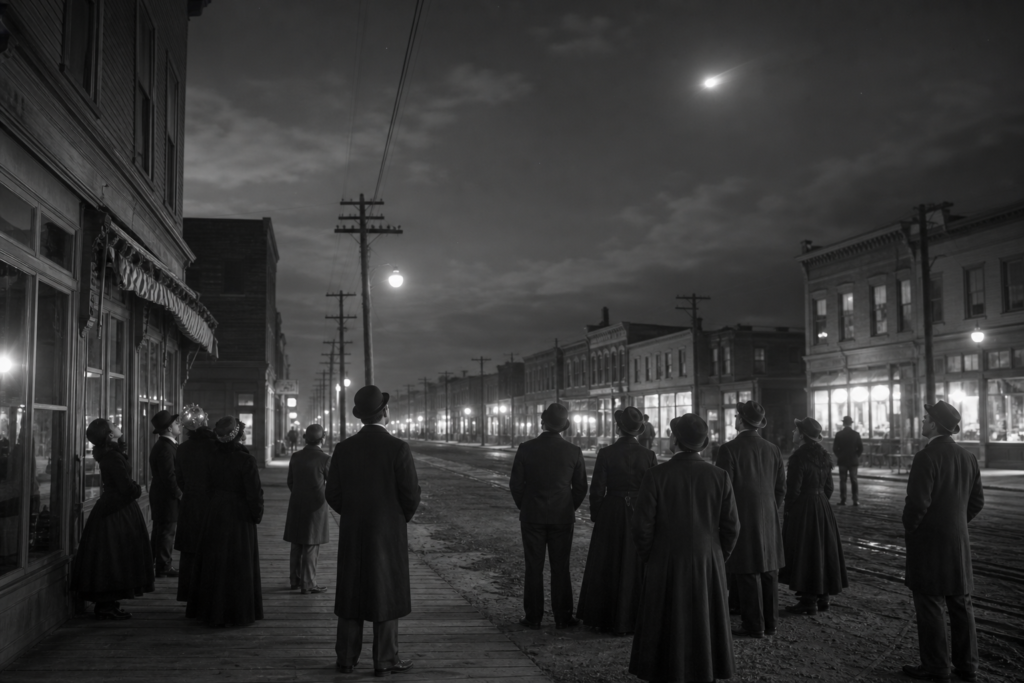
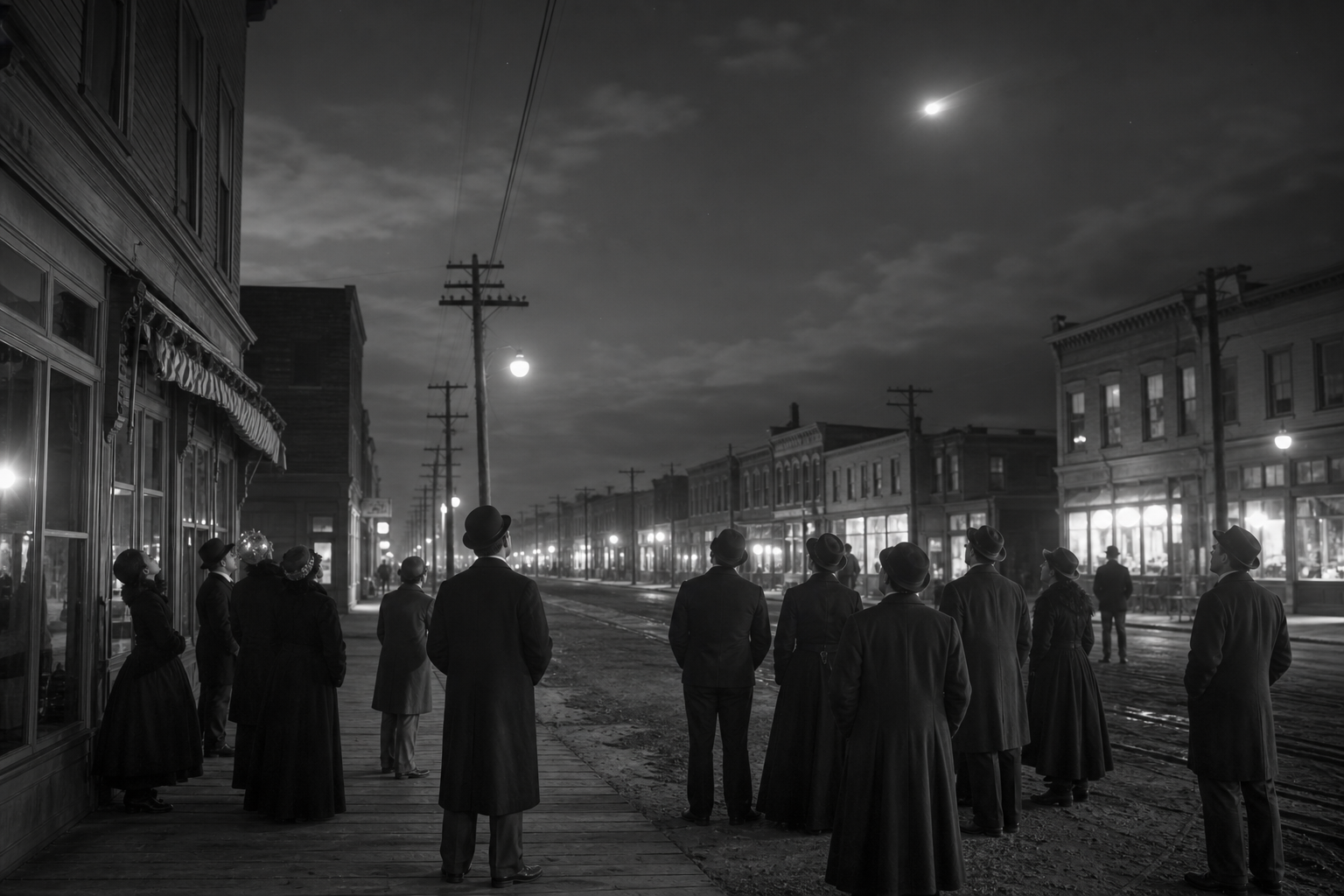
In 1896 and 1897, Americans described bright lights and cigar-shaped, propeller-bearing craft in the sky, years before the Wright brothers’ 1903 powered flight made the airplane a practical reality. The 1896–1897 mystery airship wave was not one confirmed machine crossing the country. It was a documented public and press phenomenon: clusters of reports, rapidly shared newspaper stories, accumulating embellishments, and intense speculation about who might have built an astonishing new vessel.
That distinction matters. Balloons existed, and inventors were pursuing steerable dirigibles; neither fact automatically explains every report, nor do unusual reports establish an extraterrestrial origin. The historical question is narrower and more revealing: why did so many pre-airplane sightings take a similar form, spread across regions, and acquire increasingly dramatic narratives?
This account follows the reports from California into the Midwest and Texas while separating contemporary local testimony from copied items, anonymous inventions, later folklore, and modern reinterpretation. A repeated newspaper story is evidence that a story circulated, not necessarily independent confirmation that an airship passed overhead. Read that way, the episode becomes an early example of the social pattern later called a UFO flap: a real wave of attention around aerial anomalies, with the identity of the alleged objects still unresolved.
The Mystery Airships: A Nationwide Aerial-Sighting Wave Before the Airplane
The pattern acquired national force through both geography and print. Reports began around Sacramento on November 17, 1896, then appeared around the San Francisco Bay Area later that month; by April 1897, similar accounts were being printed in widely separated Midwestern and Texas communities. Telegraph dispatches, reprints, conversation, and local follow-up linked these episodes. A published description of a bright light, elongated body, propellers, or a hidden inventor could supply a template for a later report. An original local observation and a copied wire item are therefore different evidence: the first may preserve testimony, while the second chiefly demonstrates circulation.
“First modern U.S. UFO flap” is useful only in this limited sense. A flap is a clustered or recurring run of anomalous-sighting reports whose publicity can amplify further reports and alter their details. The airship episode shows that feedback loop, geographic spread, repeated aerial claims, changing narratives, and public speculation, but the label does not identify the objects’ cause. It is not evidence of extraterrestrial craft, a secret government project, or non-human intelligence.
The chronology is the essential constraint. Balloons and proposed steerable airships were familiar nineteenth-century technologies, yet the Wright brothers’ first successful controlled, powered airplane flights came on December 17, 1903. These reports therefore belong to early UFO history not because they prove an impossible machine, but because they arose before powered airplanes became a routine feature of American skies.
What Could Fly in 1896–1897, and What Could Not
A balloon could unquestionably rise above a town in 1896. Its lift came from gas or heated air, but an ordinary balloon went where the wind carried it, a distinction relevant to later scrutiny of balloons and unidentified aerial objects. A dirigible added an elongated gas envelope, propulsion, and steering surfaces so that its operator could attempt to navigate rather than merely drift. Such experiments had a real history: Henri Giffard flew a steam-powered airship in 1852, and the French military airship La France completed a controlled circuit under electric power in 1884.
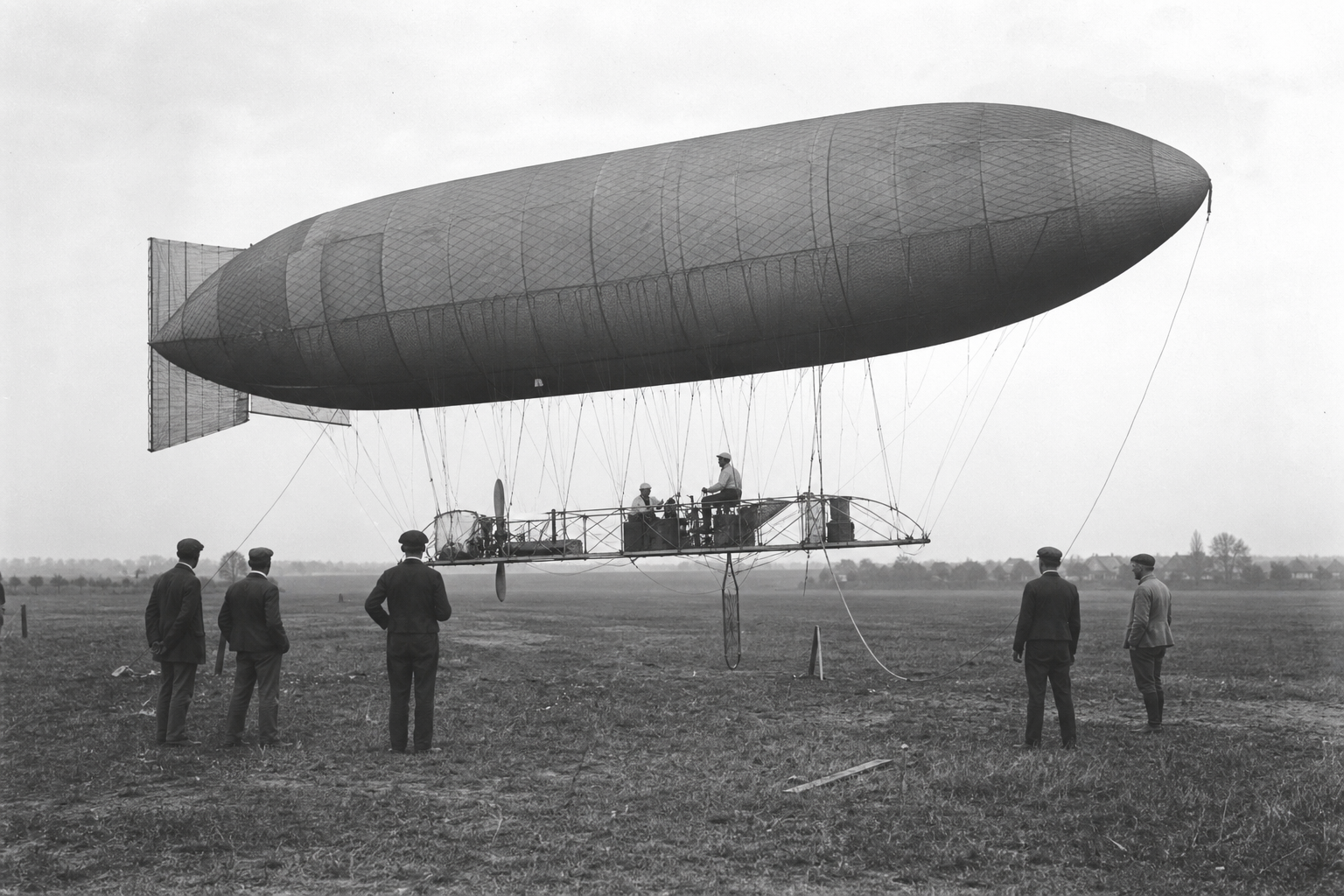
That distinction made an airship a credible subject of speculation. Electricity was visibly transforming cities, compact engines were improving, and aeronautical invention attracted inventors and promoters. A witness who described a lighted body, a propeller, and purposeful movement was not necessarily describing an impossible category of machine. Lamps could illuminate a gondola or envelope; a propeller could provide thrust; rudders could help a lighter-than-air craft turn. But each addition imposed a tradeoff in weight, power, fuel or batteries, and reliability.
Many reported performances crossed the line from plausible idea to unproven accomplishment: rapid travel over long distances, sustained operation through changing winds, precise maneuvering at night, and repeated appearances without an identified launch site or crew. A fixed-wing powered airplane works differently, gaining lift from wings moving through the air rather than from a buoyant envelope. That practical form of controlled powered flight still lay ahead in 1896–1897. The useful test is therefore not whether an airship could be imagined, but whether a particular account describes capabilities that contemporary machines had actually demonstrated.
The 1896 California Reports: How the Wave Began
The California story took shape through a sequence of short, competing newspaper items rather than a single decisive observation. On November 17, 1896, the Sacramento Bee printed reports of a bright, apparently moving object seen after dark; descriptions emphasized its light and unusual motion more than a settled mechanical design. Within days, Bay Area papers treated similar claims as the possible appearance of an airship, supplying a name for an object that witnesses had not consistently described in the same terms.
The San Francisco Chronicle, the San Francisco Call, and Oakland papers became part of the mechanism that made the San Francisco mystery airship a public event. They mixed local sightings with speculation that a secretive Californian inventor had solved powered aerial navigation and was conducting night trials. That was an important shift: an unidentified light became a purported machine with an implied builder, purpose, and test program. None of those editorial possibilities established that such an inventor or craft existed.
The distinction between named observation and anonymous explanation matters. A printed account identifying a place, time, and witness preserves evidence that somebody made a claim close to the event. An item attributing the object to an unnamed inventor, or repeating a rumor from another paper, chiefly records the spread of an interpretation. The latter could make later observers expect propellers, cabins, passengers, and colored lights before they looked skyward.
Later summaries often compress the 1896 California reports into a neat first sighting followed by a known “airship scare.” The contemporary record is messier: shifting details, speculative editorials, and assertions of private inventors circulated together. That interaction, not a verified California aircraft, is what gave the early reports their momentum.
From the Midwest to Texas: The 1897 National Airship Wave
By April 11, 1897, Chicago newspapers were carrying airship accounts that gave the story a portable script. Reports from Iowa, Nebraska, Kansas, and Missouri soon added a long body, wings, propellers, or the sound of machinery. Each feature made a briefly glimpsed light more machine-like, although the details did not settle into a consistent design.
The 1897 Midwest reports ranged from sparse observations to elaborate narratives. Some emphasized colored lamps and extraordinary speed; others supplied a cabin, passengers, audible voices, or a secret local inventor. That difference is a useful evidentiary checkpoint: a report of a distant light preserves a limited observation, while a claimed close encounter with crewmen and machinery contains more particulars to test, and more openings for embellishment as it is retold.
Print moved this template faster than any investigator could. A local item could be telegraphed, condensed for a column, and reprinted beside a report from another state within days. Repetition therefore records circulation and expectation, not independent confirmation that one craft had traveled from Illinois through Iowa and Nebraska to Texas.
Texas airship reports produced the wave’s most durable tale. On April 19, 1897, the Dallas Morning News printed S. E. Haydon’s Aurora account of a claimed April 17 crash into Judge J. S. Proctor’s windmill, with a purported pilot and wreckage. Its dramatic specificity made it memorable, but also marks the uneven record: the 1897 mystery airship wave included both brief regional sightings and highly narrativized newspaper stories.
How to Read the Evidence: Eyewitnesses, Reprints, Hoaxes, and Aurora
Evidence becomes more useful when its chain of transmission is visible. A strong report is a local, near-contemporaneous account that names its observer, fixes a place and time, and preserves a description that does not materially change across separately gathered accounts. Eyewitness testimony can establish that someone reported seeing something; it does not, by itself, establish the object’s size, distance, mechanism, or origin.

Weaker material performs a different historical function. An anonymous letter, an alleged inventor hoax, or a dramatic account reprinted without clear attribution may show what readers found plausible or entertaining, but not that a fresh observation occurred. Treat matching newspaper language as a warning sign when one item appears to be a shortened or embellished version of another. Multiple papers are independent corroboration only when they identify separate witnesses or separate local reporting paths.
- Prefer the earliest accessible local version over a later summary.
- Separate an observer’s stated perception from a reporter’s mechanical interpretation.
- Note whether names, dates, locations, and core details remain stable.
- Downgrade claims that add occupants, conversations, wreckage, or impossible performance only in subsequent retellings.
Aurora, Texas, illustrates the distinction. The alleged crash is historically important because an April 1897 newspaper story made it part of the airship narrative and later folklore made it famous. But the story’s vivid claims should not be converted into an established crash merely because later accounts repeat them. The practical question is not whether Aurora is memorable; it is whether the original attributed report is independently supported by contemporaneous witnesses, records, or physical evidence. Without that corroboration, it remains a disputed newspaper narrative, a revealing artifact of the 1896–1897 mystery airship wave, not proof of an alien event.
Why Historians Compare It With Later UFO Flaps
A useful checkpoint is whether a report cluster generated a self-reinforcing public conversation, rather than whether every account describes the same object. A “flap” is not a verdict on what was in the sky; it is a concentrated cycle in which reports, commentary, speculation, and demands for explanation reinforce one another. The 1896–1897 episode displays that cycle in an unusually early American setting.
- A visible initial cluster gave newspapers and readers a shared subject to watch for.
- Rapid circulation supplied a common descriptive script, while repetition could make related stories appear more independent than they were.
- Technological expectation shaped interpretation: an age fascinated by dirigible possibilities supplied airships as the likely machine; later eras, including the 1947 UFO wave, have supplied their own frontier technologies.
- Sincere observation, uncertain distance and light conditions, rumor, deliberate invention, and hoaxes could coexist within the same stream of reports.
- Each new account renewed the central public question: who, if anyone, could explain the object?
Those are similarities in social process, not evidence of a shared underlying cause. “Mass suggestion” need not mean that every witness fabricated an experience; it describes how prior stories can influence attention, memory, and the language applied to an ambiguous sight. Folklore then preserves the most dramatic versions long after quieter, less spectacular accounts disappear.
For readers following UFO news or anomalous aerial phenomena, the lesson is methodological. A wave can be historically real as an event of reporting and belief even when individual cases remain unresolved and the collection does not establish one extraordinary explanation, as comparisons with the Belgian UFO wave of 1989–1990 also suggest. The airship episode therefore sharpens questions about evidence, transmission, and interpretation; it does not retroactively validate present-day disclosure claims.
The Most Defensible Conclusion: A Pre-Airplane Media Mystery, Not a Solved UFO Case
A decisive distinction is between a documented national conversation and a demonstrated aircraft. Americans did describe unusual lights and machine-like forms, while newspapers turned those claims into a widely shared story. That makes the episode significant in early UFO history.
It is not enough to identify a single object behind every report. Some observations remain indeterminate because darkness, distance, changing retellings, and copied newspaper items leave too little information to resolve them. Indeterminate does not mean extraordinary. The surviving record does not demonstrate an extraterrestrial visitation, a concealed state or private program, or a technological breakthrough that escaped all other confirmation.
The chronology remains central: ballooning and dirigible ambitions supplied a plausible imaginative frame, while the Wright brothers’ successful powered airplane flights still lay ahead in 1903. The 1896 airship flap therefore records a pre-airplane encounter between technological expectation and an expanding mass press.
For this and later historical UFO claims, begin with the earliest obtainable account. Then distinguish a report’s circulation from independent corroboration: a copied article shows that a story travelled, whereas separately gathered, near-contemporaneous testimony may strengthen the underlying observation. Where the record cannot support a firmer conclusion, preserve that uncertainty.
What the Mystery Airships Still Tell Us
The enduring value of the episode lies less in pinning a name on a light or silhouette than in seeing how an aerial mystery acquires momentum. California notices, Midwestern recurrences, and Texas tales did not form a controlled investigation; they formed a public conversation in which each printed airship made the next ambiguous observation easier to describe as one.
That distinction gives the 1896–1897 mystery airship wave its proper place in history. It was an early nationwide, media-driven aerial-sighting episode before practical airplanes, yet it emerged in a culture already familiar with balloons, proposed dirigibles, invention publicity, and spectacular newspaper storytelling. Those conditions allowed sincere perception, ordinary misidentification, deliberate invention, rumor, and copied reporting to coexist in the same archive.
Its surviving evidence is therefore uneven by design. A dated local account with named witnesses preserves a claim made at a particular moment; an anonymous interview, a colorful reprint, or a later crash legend chiefly shows how the narrative travelled and changed. Neither category can be treated as a shortcut to the object’s identity.
Calling the episode an early U.S. UFO flap is useful when it describes that process of clustered reports, widening circulation, and evolving explanation. It becomes misleading when it implies a solved extraterrestrial case. The better lesson is methodological: historical evidence can establish a remarkable social event while leaving many individual sightings, and the ultimate identity of what, if anything, was seen, unresolved.
Sources
Frequently Asked Questions
-
What was the 1896-1897 mystery airship wave?
The 1896-1897 mystery airship wave was a nationwide U.S. cycle of reports describing bright lights and machine-like, often cigar-shaped aerial objects. It became a major press phenomenon through local sightings, telegraph dispatches, reprinted stories, speculation about secret inventors, and increasingly elaborate narratives.
-
Did airplanes exist during the 1897 mystery airship sightings?
Practical powered airplanes had not yet become a reality during the 1896-1897 sightings. The Wright brothers made their first successful controlled, powered airplane flight on December 17, 1903, although balloons and experimental dirigibles already existed.
-
Where were mystery airships reportedly seen in 1896 and 1897?
Reports began near Sacramento on November 17, 1896, then spread through the San Francisco Bay Area later that month. By April 1897, similar accounts appeared in Chicago and across Iowa, Nebraska, Kansas, Missouri, and Texas.
-
What should you look for when evaluating a 1896-1897 airship report?
Prioritize the earliest local account with named witnesses, a specific date and location, and details that remain stable across independently gathered reports. Treat anonymous letters, copied newspaper items, and later stories adding crew, wreckage, conversations, or extraordinary performance as weaker evidence of an actual observation.
-
Why do historians compare the mystery airship wave with later UFO flaps?
Historians compare them because both involve clustered sightings amplified by media coverage, public speculation, and shared descriptive expectations. The comparison describes a social process of reporting and belief, not proof that the 1896-1897 objects were extraterrestrial craft or a single unknown machine.