The useful starting point is the record’s specificity: a named patrol officer, a definite roadside-to-arroyo sequence, and a location investigators could inspect. On April 24, 1964, Officer Lonnie Zamora reported a bright, egg-shaped object, a loud departure, and brief glimpses of two small figures outside Socorro, New Mexico. His account became the central firsthand record in what is commonly called the 1964 Socorro UFO case.
This account keeps three categories separate. First are Zamora’s reported observations: what he saw, heard, and later described. Second are physical-trace reports from the arroyo, including ground impressions and disturbed vegetation. Third are the official responses by local police, the FBI, the U.S. Air Force, and Project Blue Book, the Air Force program that collected and evaluated unidentified-flying-object reports. An unresolved report meant investigators did not assign a satisfactory identification; it did not establish an extraterrestrial origin.
A police officer reporting an event while on duty drew prompt attention because investigators could obtain a contemporaneous account, inspect a specific site, and compare later retellings with early records. Those features give the Socorro UFO incident historical weight, while making precision essential: later interpretations of the figures, insignia, sound, and traces cannot be substituted for what the record actually shows.
What Lonnie Zamora Reported Seeing Near the Arroyo
Zamora’s earliest account places the episode in motion while he was pursuing a speeding car through Socorro. During that pursuit, he reported hearing a sudden, very loud roar and seeing a bluish flame or exhaust-like burst in the distance. He later said the sound and light drew his attention away from the traffic stop he had been attempting, and he turned toward the area southwest of town. These are reported sensory impressions, not observations independently recorded by another witness: the precise appearance of the flame, its source, and the timing of the sound have varied slightly in subsequent summaries of the Lonnie Zamora UFO sighting.
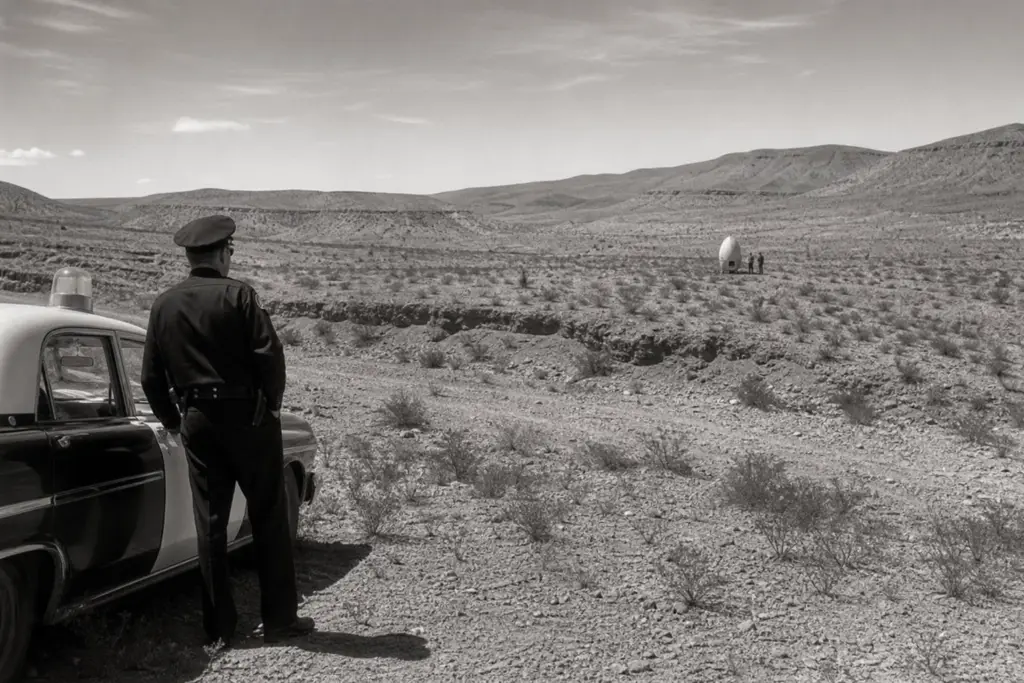
Driving toward the apparent source, Zamora described approaching uneven ground near an arroyo, a dry wash or ravine that limited his line of sight. He reported that the terrain initially concealed much of the scene. After stopping and proceeding on foot, he said he saw a white object on the far side of the arroyo. In his initial descriptions, it appeared oval or egg-shaped rather than like a conventional airplane, helicopter, or automobile. Estimates of its dimensions and distance should be treated cautiously: they were visual judgments made during a brief, unexpected encounter across irregular ground.
Zamora’s account also distinguishes the object at rest from its departure. He reported no visible wings, rotors, or ordinary landing gear while viewing the white form, then described a renewed loud sound and a flame-like effect as it rose and moved away. The important historical point is narrow: Zamora reported an object whose shape and apparent movement he could not identify, not a demonstrated origin or technology. The later label “Lonnie Zamora egg-shaped craft” summarizes his description, but it should not replace the more careful record of what he said he saw from the arroyo.
The Reported Figures and the Mark on the Craft
The two figures entered Zamora’s view only briefly. In his early account, he described two small, human-like forms near the white object and initially wondered whether they might be children; he later characterized them as appearing to wear white coveralls. Their apparent height, clothing, and exact position remain uncertain because he observed them across uneven ground during a fast-moving, stressful episode.
The mark on the craft deserves the same restraint. Zamora’s early sketch and descriptions recorded a red insignia on the object’s side: a simple geometric figure rather than readable lettering. That contemporary drawing is the useful historical anchor, because it preserves what he tried to depict soon after the sighting, not an independently identified logo, language, or emblem.
Published versions of the symbol do not always match. Some renderings alter the proportions, orientation, or number of lines, and later retellings sometimes present a cleaner, more elaborate design than the early sketch supports. Those differences matter: a copied illustration can look precise even when the original observation was necessarily approximate.
Nothing in the Zamora UFO report establishes that the figures were nonhuman or that the red insignia was an alien symbol. They are reported visual details, significant because they were included early, but limited by distance, duration, and the witness’s rapidly changing viewpoint.
What Investigators Found at the Reported Landing Site
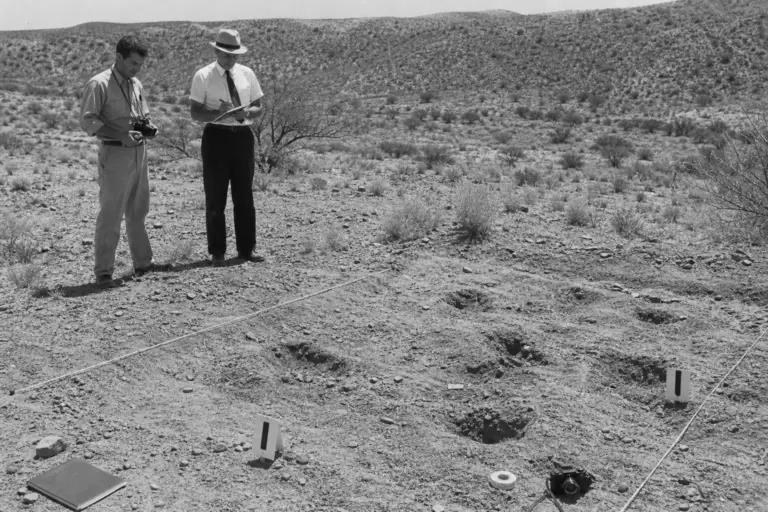
At the arroyo site Zamora pointed out on April 24, officers could examine the ground rather than rely solely on the rapidly changing view he had had from his patrol car. Zamora and Socorro police sergeant Sam Chavez observed disturbed soil in the small landing area, including darkened or damaged vegetation and several discrete depressions.
Contemporaneous case summaries and later reproductions of the site photographs describe four impressions, commonly treated as possible landing-gear marks, around a central disturbed area. The marks were photographed and sketched; published descriptions generally give individual impressions as roughly rectangular and only a few inches across, although the surviving copies and later retellings do not preserve a single uncontested measurement set. That distinction matters: photographs document that marks were present, while the “landing gear” label is an interpretation of their pattern.
The reported burn marks require equal care. Investigators noted blackened ground and singed brush near the impressions, observations consistent with something having disturbed or damaged the surface. Neither a photograph of dark soil nor a field description of scorching establishes a temperature, fuel, exhaust source, or duration of exposure. The available record does not show that collected soil, plants, or residue were subjected to laboratory analysis capable of identifying a chemical or thermal cause.
These Socorro UFO landing traces therefore strengthened one limited point: responders found a localized area whose condition appeared unusual enough to record shortly after Zamora’s report. They did not supply a unique signature. Foot traffic, placed objects, vehicle activity, fire, and deliberate fabrication can all leave soil impressions or damaged vegetation; assessing any such explanation depends on whether it can reproduce the photographed layout, the reported timing, and the site’s condition before investigators arrived.
The physical evidence was consequential because it gave the inquiry a fixed location, sketches, and photographs to compare against Zamora’s account. It was not conclusive because no tested material or trace pattern identified the object that allegedly stood there.
The Immediate Police, FBI, Air Force, and Project Blue Book Response
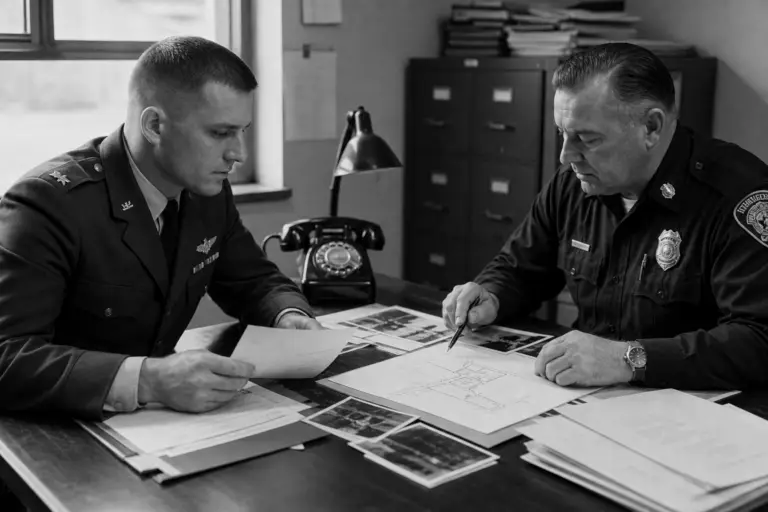
The response widened quickly because the report identified a precise location, an on-duty officer, and a scene that could be examined. Local police preserved the initial law-enforcement channel: Zamora’s account and the arroyo site supplied the starting point for later interviews, photographs, sketches, and comparisons with possible local activity.
The FBI’s involvement is best understood as information gathering rather than a separate scientific determination. FBI file material and interagency correspondence trace contacts concerning the report and efforts to determine whether a security, aviation, or military matter could explain it. An FBI investigation in this setting meant that federal officials recorded and relayed leads; it did not amount to an FBI finding that the object had an extraordinary origin.
The U.S. Air Force had the formal UFO-reporting role through Project Blue Book, its public-facing investigative program. Nearby military and defense facilities were relevant because investigators could ask a concrete eliminatory question: had an aircraft, test, vehicle, or other authorized operation occurred in the relevant place and time? A negative or incomplete answer narrows an explanation; it does not demonstrate what Zamora saw.
Project Blue Book Socorro records treated the episode as an unresolved case rather than assigning it a conventional identification. That classification is often overstated. “Unidentified” described the limits of the information and explanations available to the program; it was not a conclusion that the craft was extraterrestrial, secret military hardware, or any other specific thing.
Astronomer J. Allen Hynek, the Air Force’s scientific consultant to Project Blue Book, became involved in the inquiry and later regarded the Socorro report as unusually important. His role was evaluative: he considered witness testimony, the site report, and possible ordinary explanations. The surviving record is substantial but incomplete, later recollections, reproduced documents, and competing interpretations do not supply a definitive identification that the original investigation did not reach.
Could It Have Been a Hoax, Test Activity, or Misidentification?
Each conventional explanation has to account for more than one striking feature of the report without treating every uncertainty as proof of a single alternative.
A student-prank hypothesis could, in principle, explain a staged object, people in light clothing, and deliberately made ground impressions. Its strength would depend on direct links: identified participants, a workable prop or vehicle, access to the arroyo, and a contemporaneous admission or corroborated account. No such chain is established by the surviving public record. The absence of a proven prank does not establish an extraordinary cause; it means the hoax remains an unverified proposal rather than an identification.
Military or experimental activity is a different proposition. A vehicle or test could potentially fit the reported roar and flame-like departure, but it would require evidence that a relevant operation occurred near Socorro at the right time and could produce the reported stationary form, figures, and ground disturbance. Inquiries into nearby facilities did not yield a documented operation that resolved those details. “Possibly experimental” therefore describes a gap in the record, not evidence that a secret craft was present.
An aircraft-related event most readily addresses the loud sound or distant exhaust-like light, especially if terrain distorted direction and distance. It fits less comfortably with Zamora’s close-range report of a white object on the ground and the later-observed disturbed area. Misperception can also affect perceived size, shape, color, and sequence during a brief, stressful encounter, but it cannot by itself specify what was misperceived. For the 1964 Socorro UFO sighting, the careful conclusion is narrower: plausible conventional categories were considered, yet none was documented well enough to settle the case.
Why the Socorro Incident Remains Historically Significant
Historical importance and evidentiary certainty are not the same thing. The Socorro case carries unusual weight because an identifiable officer made the report while on duty, investigators reached a defined location quickly, and early accounts, interviews, photographs, and trace descriptions preserved material that can still be compared rather than merely retold.
That record supports a limited conclusion: Lonnie Zamora made a serious April 24, 1964 report near Socorro, and the responding inquiry did not produce a documented conventional identification that accounted for every reported element. It does not establish what the craft was, who or what the figures were, or that any non-human agency was involved. “Unresolved” describes an evidentiary outcome, not proof.
The 1964 Socorro UFO therefore remains a useful benchmark for later UAP sightings. A named witness, prompt statements, a locatable scene, and independently recorded observations are stronger signals than an anonymous story or a much-later recollection. Those standards help separate a historically substantial case from claims that go beyond its surviving evidence.
Frequently Asked Questions
What did Officer Lonnie Zamora report seeing near Socorro in 1964?
On April 24, 1964, Socorro police officer Lonnie Zamora reported seeing a white, oval or egg-shaped object near an arroyo southwest of town. He also reported a loud roar, a bluish flame or exhaust-like burst, and two small human-like figures near the object.
What was the red symbol reported on the Socorro UFO?
Zamora’s early sketch showed a red, simple geometric insignia on the side of the object rather than readable letters or a known logo. Later published versions vary in line count, proportions, and orientation, so the original sketch is the most reliable record of the mark.
Were physical traces found at the Socorro UFO landing site?
Investigators reported disturbed soil, darkened or damaged vegetation, and four discrete, roughly rectangular ground impressions only a few inches across. The marks were photographed and sketched, but no laboratory-tested soil, plant, or residue evidence identified a cause.
Did Project Blue Book explain the Lonnie Zamora UFO sighting?
Project Blue Book classified the Socorro case as unresolved and did not assign it a conventional identification. The U.S. Air Force, FBI, local police, and scientific consultant J. Allen Hynek considered possible aircraft, military activity, hoax, and misidentification explanations without documenting one that settled the report.
What should you look for when evaluating whether the Socorro UFO incident was a hoax or test activity?
A hoax claim needs direct evidence such as identified participants, a workable prop, access to the arroyo, and a contemporaneous admission or corroborated account. A military-test explanation needs records of a relevant operation near Socorro on April 24, 1964 that could account for the reported object, figures, roar, flame, and ground traces.