The key distinction is between explaining every sighting and judging whether a new, extensive program would repay the scientific effort. Published in 1968 as Scientific Study of Unidentified Flying Objects, the University of Colorado’s U.S. Air Force-sponsored assessment, widely known as the Condon Report, concluded that further extensive UFO research was not likely to yield major scientific advances.
That conclusion did not purport to demonstrate that every report had been explained, or that no unusual event could occur. It was a forecast about the likely return from a continuing large-scale research program, based on the committee’s review of investigations and the character of the evidence available to it. This article examines how that judgment was reached, where its wording and scope set limits, and why critics challenged aspects of the study’s independence and handling of cases. It also traces its policy importance: the report helped shape the context for the Air Force’s 1969 closure of Project Blue Book, without serving as the sole explanation for that decision.
What the 1968 Condon Committee Study Actually Concluded
In its summary, the committee framed the issue as a forecast about the value of another major research effort: “our general conclusion is that nothing has come from the study of UFOs in the past 21 years that has added to scientific knowledge,” and that “further extensive study of UFOs probably cannot be justified in the expectation that science will be advanced thereby.” The 1968 Condon Report, produced at the University of Colorado under U.S. Air Force sponsorship, was directed by physicist Edward U. Condon.
Those sentences set a decision threshold for a continuing program, not a test of whether any particular observation was genuine. The report did not declare that witnesses had imagined what they saw, that each case had a conventional solution, or that an extraordinary explanation had been logically disproved. Its narrower finding was that an extensive, organized investigation was unlikely to produce major advances in scientific knowledge. A case could remain unresolved because its record was incomplete while still offering too little reliable, repeatable evidence to support a broad, long-term research enterprise.
The Condon Committee study therefore evaluated expected scientific return rather than issuing a universal verdict on individual reports. Its recommendation grew from the committee’s appraisal of the investigative record and the prospects of obtaining more useful evidence through continued large-scale work. Read at that level, the conclusion does not support the stronger claim that no unexplained aerial observation could ever warrant attention.
Why the Air Force Commissioned the University of Colorado UFO Study
The institutional arrangement was deliberately two-track. The U.S. Air Force funded the University of Colorado project under contract, assigning it a scientific review of the UFO question rather than simply expanding the Air Force’s own investigative machinery. Edward Condon’s university-based team could assess whether the accumulated subject warranted sustained research and could conduct or commission selected investigations of its own.
That made the University of Colorado UFO study an Air Force-sponsored study, not an enterprise detached from government sponsorship. At the same time, it was not Project Blue Book under another name. Project Blue Book remained the Air Force program that received reports, collected case information, and evaluated sightings in the course of its continuing operations. The Colorado group used case material and pursued selected reports, but its assignment was broader and more evaluative: to judge the scientific promise of the field and the adequacy of investigating it as an organized activity.
This distinction changes how the final recommendation should be read. A case-collection program asks what happened in a particular report and whether it raises a defense or identification issue. An outside scientific review asks whether the resulting body of reports is capable of generating reproducible knowledge worth a major continuing investment. The Condon Committee study was commissioned to address the second question amid persistent public and scientific criticism of the existing Air Force approach.
The Air Force therefore did not hand Project Blue Book over to Colorado. It sought an independent-style academic assessment while retaining its own reporting and evaluation function. The eventual report could influence later U.S. UFO research policy because it addressed whether a large-scale scientific program remained justified, but the separate institutions, duties, and records should not be collapsed into one operation.
The Evidence and Reasoning Behind the Finding of Low Scientific Return
The decisive question was not whether any one sighting could remain puzzling, but whether the accumulated record could reliably produce new scientific knowledge. The Colorado team reviewed selected case investigations rather than treating the mere volume of reports as evidence in itself. Those files drew on the kinds of material available to investigators at the time: eyewitness accounts, photographs, radar observations, aircraft and weather information, and occasional claims of physical traces.
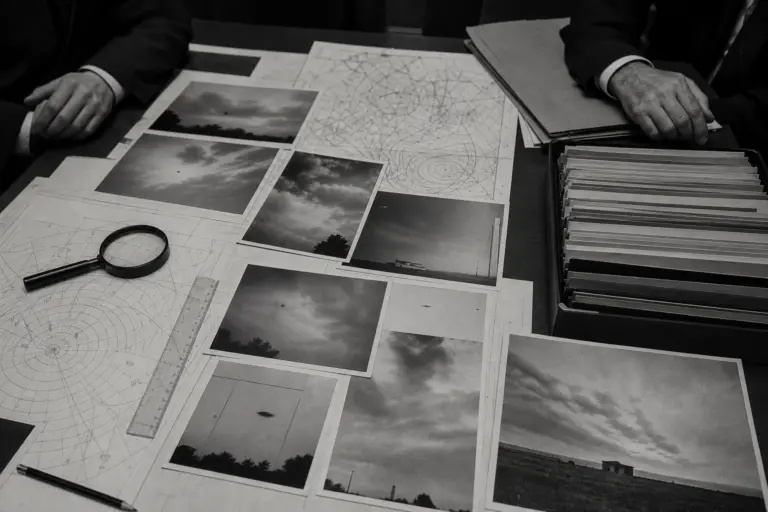
Each category had a different evidentiary strength. A witness account could establish that someone saw something unusual, yet usually could not preserve enough measurements to identify its distance, speed, size, or origin. A photograph might provide a physical record, but its value depended on such particulars as camera settings, negatives, viewing geometry, and independent corroboration. Radar could offer instrumental data, but interpretation required knowing the equipment’s operation, possible interference, and whether a visual observation actually matched the plotted return. In many case investigations, ordinary objects or phenomena supplied plausible explanations; in others, the information was too incomplete to support a confident conclusion.
That distinction shaped the Condon Committee UFO conclusions. An unresolved report was one for which the available evidence did not permit a satisfactory identification. It was not automatically a positive finding of a new phenomenon. Scientific return would require observations that could be independently assessed, measured with sufficient precision, and ideally repeated or compared under controlled conditions. Episodic reports, often made after the event and without calibrated instruments, seldom met that threshold.
The committee did not deny that unexplained cases existed. Instead, it treated unresolved status as an evidentiary limitation: missing data can prevent an explanation without establishing an extraordinary one. A small residue of cases that resisted classification therefore did not, in the committee’s judgment, demonstrate a pattern likely to justify a much larger research program. Its reasoning rested on the expected yield of the investigative process, whether additional reports were likely to convert uncertainty into reproducible results, not on a claim that every individual observation had already been solved.
What the Condon Report Did Not Claim
An unresolved file is not a verdict on the reality or origin of what was reported. The 1968 University of Colorado assessment, commonly called the Condon Report, did not establish that unidentified flying objects did not exist. “Unidentified” described the state of an observation or record: investigators lacked sufficient information for a reliable identification. It was not a finding that the reported object was imaginary, ordinary, or extraordinary.
Nor did the report prove that every sighting had a conventional explanation. Some investigations ended with a likely identification; others remained inconclusive because crucial observations, measurements, or corroborating evidence were absent. An inconclusive case is a limit on what can be inferred from the file, not affirmative evidence either for a mundane cause or for an exotic one.
Most importantly, the committee did not conduct a scientific disproof of alien visitation. Its recommendation did not test every conceivable hypothesis about the origin of reported phenomena, and it made no final determination about life elsewhere in the universe. Modern arguments about alien disclosure therefore ask a different question from the one the Colorado project was organized to answer.
The report’s practical conclusion concerned research priorities: whether a broad, continuing program devoted to collecting and investigating reports was likely to produce major advances in science. That is a decision about the expected return from an investigative method. It differs from declaring every past case resolved, or from claiming that no future observation could present stronger, more measurable evidence. Keeping those distinctions intact prevents the Condon Report from being treated as either a universal debunking or a final adjudication of every possible explanation.
Why the Condon Report Was Controversial, and How Its Limits Should Be Read
The sharpest dispute concerned not whether every file had an answer, but whether the inquiry had been framed with an open enough mind to assess the residue fairly. Air Force sponsorship did not by itself establish that the University of Colorado team lacked independence: the contract placed the work in an academic setting and the report was publicly issued. Yet the sponsor’s interest in obtaining a recommendation on the future of UFO investigation made independence, case selection, and the treatment of uncertainty central questions for critics.
The controversy intensified after circulation of the Robert J. Low memorandum, an internal 1966 proposal written by the project’s coordinator. Its language suggested that the investigation could appear objective while being conducted by people who expected no extraordinary result. Critics took that passage as evidence that the outcome had been prejudged. Defenders of the project treated it as an ill-phrased planning document rather than proof that every investigation or the final report had been manipulated. The document warrants skepticism about the project’s early posture; it does not, on its own, demonstrate that the published conclusion was fraudulent.
Other objections were methodological. Some researchers and UFO organizations argued that potentially significant cases received too little sustained analysis, that investigators applied uneven standards to witness testimony and technical data, or that unresolved cases were too readily treated as unpromising. Those are criticisms of sampling and inference: selecting a limited number of reports can test whether available files support productive research, but it cannot guarantee that every strong case has been examined equally well.
The National Academy of Sciences Condon Report review gave the study substantial institutional weight, finding its broad conclusion reasonable and supporting the judgment against a major continuing program. That review did not erase disagreement over particular cases, the Low memorandum, or whether the committee gave adequate attention to anomalous evidence. The sound historical reading is therefore neither that the Condon Committee was conclusively discredited nor that its methods became immune from criticism: its influential recommendation survived contemporaneous review, while its process left enduring grounds for qualified debate, and for later calls for more systematic UFO study.
How the Finding Shaped Project Blue Book’s Closure, and Differs From Modern UAP Inquiry
The Air Force translated that judgment into policy in December 1969, when it announced the termination of Project Blue Book. The Condon Report and the National Academy of Sciences review supplied an important basis for that decision, but the service also gave its own operational reasons: its investigations had found no evidence that reported objects threatened national security, represented technological developments beyond contemporary scientific knowledge, or were extraterrestrial vehicles. The Air Force termination of Project Blue Book thus joined a scientific-return assessment to the service’s stated defense and technology findings; it was not a declaration that every report had been identified.
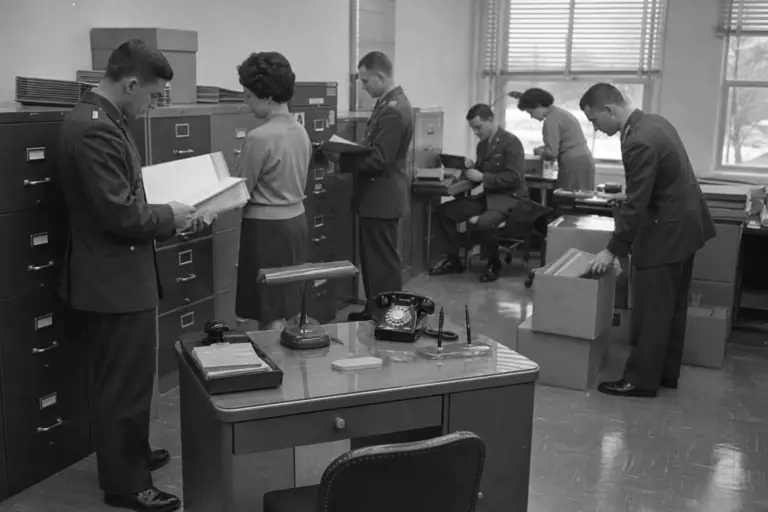
The 1969 Project Blue Book closure ended the Air Force’s standing public program for receiving and evaluating such reports, rather than ending all government interest in unusual aerial observations. Its practical effect was to remove a broad, continuing case-investigation system whose value the Colorado study had found unlikely to justify further extensive investment. The historical record remains available through the National Archives’ Project Blue Book files, allowing readers to distinguish the report’s recommendation, the Air Force’s formal rationale, and the underlying case material rather than treating any one of them as interchangeable.
Later Pentagon UAP efforts operate in a materially different setting; a 2022 UAP study offers a further institutional comparison. Organizations such as the All-domain Anomaly Resolution Office are oriented toward identifying and assessing anomalous observations that may bear on military operations, intelligence, airspace safety, or national security. Their potential inputs can include instrumented military systems, intelligence reporting, and classified operational data, sources and missions unlike Blue Book’s public-facing Cold War-era reporting program. That difference matters in debates over UAP disclosure: an unresolved contemporary military sensor event is not automatically comparable to a 1968 civilian sighting, nor does the Condon conclusion automatically settle its significance.
The durable lesson is institutional rather than extraterrestrial. A useful inquiry needs defined questions, preserved raw data, stated standards for uncertainty, and oversight that can test whether an unresolved observation reflects an anomalous phenomenon or merely incomplete information. The Condon Committee study remains consequential because it forced a decision about the expected return from a particular research design; modern programs should be judged by whether their different data and mandates support a different answer.
What the Condon Report’s Conclusion Means in Historical Context
Its lasting importance is therefore less a final judgment on anomalous observations than a benchmark for deciding when a reporting system merits sustained scientific investment. Scientific Study of Unidentified Flying Objects, the 1968 Air Force-sponsored University of Colorado report, weighed the available case record against the prospect of major new knowledge and found that another extensive program was unlikely to produce it. That was a conclusion about the expected yield of a particular body of evidence and investigative approach, not a claim that every remaining unknown had been resolved.
That distinction explains both the report’s influence and the resistance it continues to attract. Critics questioned whether the project’s internal assumptions, including those revealed by Robert J. Low’s memorandum, could have affected its treatment of difficult cases; defenders pointed to the breadth of the review and the National Academy of Sciences’ support for its overall recommendation. Neither position turns the report into a universal rule. A case can be unresolved because its data are thin, while a carefully instrumented event may warrant analysis even if earlier files did not.
The Condon Committee study chiefly mattered because it helped make the 1969 end of Project Blue Book institutionally defensible. It remains an essential historical reference point, but modern UAP evidence must be assessed on its own data quality, collection systems, and national-security context rather than treated as already answered by a 1968 forecast.
Frequently Asked Questions
What did the 1968 Condon Committee conclude about UFO research?
The University of Colorado committee concluded that nothing from 21 years of UFO study had added to scientific knowledge. It said further extensive UFO research was unlikely to be justified because it probably would not produce major scientific advances.
Did the Condon Report say all UFO sightings were explained?
No. The report did not claim that every sighting had a conventional explanation or that witnesses imagined what they saw. It treated unresolved cases as records with insufficient evidence for reliable identification, not proof of an extraordinary phenomenon.
Was the Condon Committee independent of the U.S. Air Force?
The study was conducted by the University of Colorado under U.S. Air Force sponsorship and was directed by physicist Edward U. Condon. It was separate from Project Blue Book, but critics questioned its independence after a 1966 memorandum by coordinator Robert J. Low suggested investigators expected no extraordinary result.
Why did Project Blue Book end after the Condon Report?
The Air Force ended Project Blue Book in December 1969 after the Condon Report and a National Academy of Sciences review supported ending a major continuing UFO research program. The Air Force also said its investigations found no evidence that reported objects threatened national security, represented advanced technology, or were extraterrestrial vehicles.
How should modern UAP investigations differ from the Condon Report’s approach?
Modern UAP programs should evaluate evidence based on preserved raw data, calibrated sensors, clear uncertainty standards, and independent oversight. Unlike the largely public, case-reporting era of Project Blue Book, current efforts can use military sensor data, intelligence reporting, and operational information relevant to airspace safety and national security.