The Ariel School UFO incident remains compelling because it combines a striking report by pupils in Ruwa, Zimbabwe, with accounts that have continued to be told long after September 1994. But persistence is not the same as proof, and differences between accounts are not, by themselves, proof of fabrication. The narrower question is how the earliest available reports compare with recollections recorded years or decades later.
This article treats the case as a problem of sources. It distinguishes near-contemporaneous interviews, drawings, school and press records, and investigator notes from later filmed conversations, memoir-like retellings, and documentary editing. Those formats preserve different things: an early account is closer in time to the event, while a later account may show which central impressions remained meaningful to the witness.
The comparison will be specific rather than rhetorical: what was described about the object, figures, location, communication, and number of people involved, and when each detail entered the record. Memory is reconstructive; repeated discussion, questioning conditions, shared narratives, and later interpretation can reshape recall without demonstrating dishonesty or establishing an extraordinary explanation. Witness testimony deserves careful attention, but it must remain separate from an interviewer’s inference, a film’s framing, and independently verifiable evidence.
The Ariel School Case Is a Test of Sources, Not a Shortcut to a Verdict
The event under examination is the report associated with Ariel School in Ruwa, Zimbabwe, in September 1994: pupils said they had seen an unusual object and figures in an area near the school during a break. That basic description identifies the Ariel School incident; it does not, on its own, identify what was seen or explain why multiple children reported it.
The evidentiary question is narrower. Testimony records what people reported seeing, feeling, or understanding at a particular time. Independently verified physical evidence would be material that can be examined apart from those recollections. The available record is principally testimonial: interviews, drawings, recollections by adults around the school, press treatment, and later filmed accounts. Each can illuminate the report, but none automatically turns a description into a settled identification.
Accordingly, the comparison that follows will place dated early material beside later recollections and track where details endure, diverge, or acquire added meaning. Agreement can show continuity without proving an extraterrestrial event; variation can reflect ordinary memory, interviewing conditions, group discussion, or changing interpretation without establishing deceit. The article will not choose among extraterrestrial visitation, hoax, or mass hysteria. Its purpose is to show what the record can, and cannot, bear.
Start With the Record: Which Sources Are Closest to September 1994?
A usable chronology begins by sorting material by its distance from the schoolyard report, not by how vivid it is. The strongest starting tier is material produced in or close to September 1994: pupils’ own drawings and statements, notes or recollections recorded by teachers and parents, and contemporaneous investigation and reporting published while the event was still new. These contemporaneous accounts can show which descriptions entered the record early; they cannot by themselves establish what caused the experience.
Early interviews occupy a distinct tier. Their value depends on the interview date, the interviewer’s role, whether children were interviewed singly or in groups, and whether the original audio, video, transcript, or contemporaneous notes survive. A preserved, uncut recording permits readers to distinguish a child’s words from a questioner’s prompt or interpretation. A quotation repeated later without its recording date, surrounding questions, or chain of custody is weaker archival reporting, even when it is memorable.
Press coverage is useful chiefly as a dated record of what journalists chose to publish, whom they quoted, and how quickly particular language circulated. It is not a neutral transcript of the playground. Headlines, paraphrase, editorial framing, and reliance on second-hand accounts can enlarge or simplify the story.
Later filmed interviews, podcasts, books, and documentary compilations belong in a separate column. They may preserve a witness’s adult recollection, but editing can remove hesitation, interviewer cues, and competing detail; retrospective narration can also blend personal memory with years of discussion and public retelling. Before comparing the Ariel School UFO incident across decades, each claim should be labeled by date, format, speaker, and whether the full original is available. That discipline makes a changed detail interpretable rather than automatically suspicious.
What the Children Reported in 1994: The Core Account and Its Early Variation
The earliest surviving material places the report during a school break at Ariel School in Ruwa on 16 September 1994. In pupil drawings and early filmed interviews, the recurring minimum is an unusual object and one or more human-like figures in the bushy area beyond the school grounds; the material does not preserve a single, child-by-child transcript from that day.
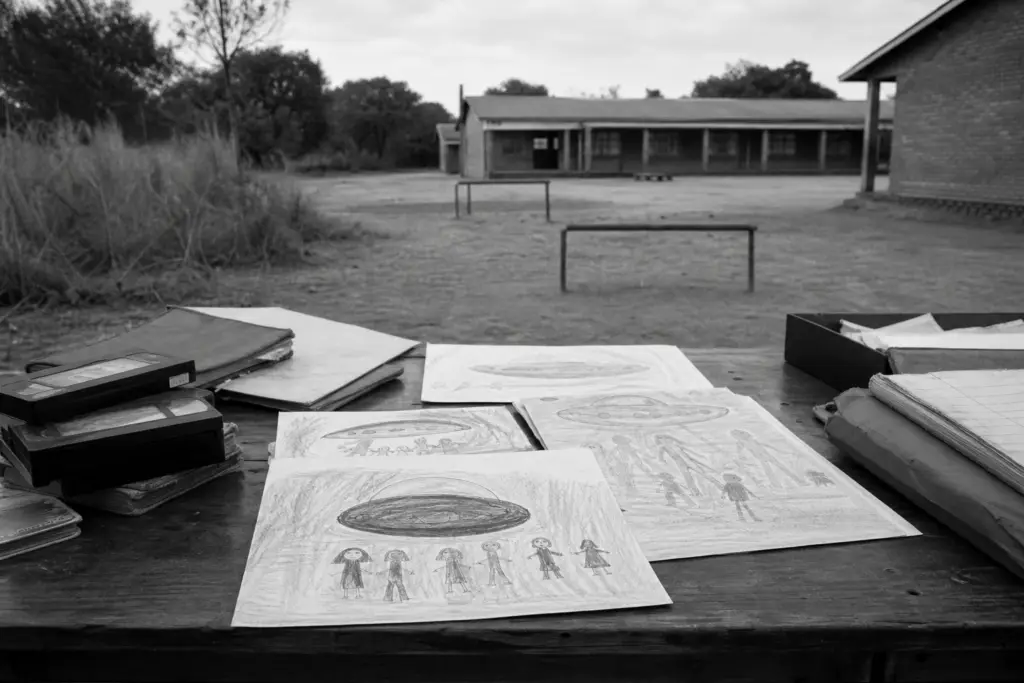
- Object: Several early drawings depict a rounded or disc-like object, sometimes with legs or a lower structure. Shape, colour, size, and whether it was on the ground or above it were not recorded identically. “Craft” is an interpreter’s label; a child’s drawing is evidence of the form that child chose to depict.
- Figures and location: Early accounts commonly placed figures near the object in the area beyond the playground. The reported number, clothing, height, and facial features varied, so agreement on a location near the school does not establish an identical description of who, or what, was there.
- Duration and movement: Children described a brief break-time episode, but the available early material does not yield a reliable shared duration. Accounts that imply hovering, appearing, or moving must be separated from estimates of how long a child watched.
- Perceived communication: Some early interview material contains reports of an intense impression or thought-like contact. That differs from hearing spoken words, seeing a gesture, or later describing a fully articulated message; those are not interchangeable forms of child eyewitness testimony.
- Number of reporters: The frequently repeated total of 62 pupils should not be treated as a verified contemporaneous headcount of identical observations. It may combine children who reported seeing an object or figures with children who were present, heard the account, or were interviewed afterward.
These contemporaneous accounts support a shared early claim that multiple pupils reported something unusual near the school during the 16 September break. They do not identify the cause, and they do not provide physical evidence that independently resolves it. Differences in peripheral detail were present early; that is compatible with ordinary variation in children’s observation, expression, and recall, not a basis by itself for calling any child dishonest.
What Later Witnesses Recall: Continuity, Expansion, and Retrospective Meaning
The most useful later account is one that can still be matched to a 1994 feature: the school-break setting, the object near the bushy area, or figures seen beyond the playground. When an adult witness retains those elements, it shows continuity in the central report. It is not a verbatim preservation of a child’s account, because the surviving 16 September record consists of drawings and filmed interviews, not a complete pupil-by-pupil transcript.
Later recollections can add layers that the early material does not consistently preserve. Adult witnesses may describe the figures’ eyes, movement, or apparent intention more sharply; articulate fear, awe, or isolation; or connect a thought-like impression with environmental, spiritual, or life-changing meaning. Such additions may faithfully convey what the experience means to the person now. But when an early report of an intense impression becomes a later account of a detailed message, the two should not be treated as identical: the detailed message needs its own traceable appearance in the record.
An edited documentary clip is therefore less useful for comparison than an identifiable, dated interview with the full exchange available. A clip can show present conviction, yet omit the interviewer’s wording, pauses, follow-up questions, and any discussion of classmates’ versions. Without a later recording paired with a relevant 1994 drawing, interview, or statement, it is not defensible to declare that a particular detail either never changed or first emerged at a known date.
John Mack’s early interviews occupy an important but bounded place in the record. The John Mack Ariel School interviews document what particular pupils reported in his interview setting, including figures and nonverbal communication. His clinical interest also shaped the experiences he explored and the interpretations he considered. Neither his credentials nor an adult witness’s evident sincerity independently establishes the cause of the reported Ariel School alien encounter. The practical checkpoint is to keep three things separate: a witness’s dated words, Mack’s interpretation of them, and a later film’s narrative construction.
Then vs. Now: Compare Claims by Category Instead of Hunting for a Perfect Story
A comparison grid prevents a memorable later detail from being silently treated as part of the original report. Here, the available materials do not provide a claim-level archive that pairs attributable 1994 statements with complete, dated adult interviews; the responsible classification for most categories is therefore insufficiently documented, not “unchanged” or “disproved.”
| Category | Working classification | What the comparison can show |
|---|---|---|
| Object appearance | Insufficiently documented | Compare shape, colour, movement, and landing claims only where each witness’s early words and later words are preserved. A shared broad description is stronger than an exact match in every visual detail. |
| Beings | Insufficiently documented | Separate the reported presence of figures from particulars such as height, eyes, clothing, or actions. Later specificity is not evidence that a feature was absent in 1994, but neither establishes that it was reported then. |
| Location and distance | Variable / insufficiently documented | These are testable descriptive claims when maps, drawings, and independently recorded accounts exist; they should not be harmonized after the fact. |
| Sequence and duration | Variable | Differences in order, movement, and elapsed time may reflect ordinary recall limits, yet they matter when a later narrative depends on a precise sequence. |
| Communication or message | Later-emerging unless traceable early | Distinguish a witness’s reported impression from an interviewer’s interpretation and from a later environmental or spiritual meaning attached to it. |
| Witness count and emotional aftermath | Insufficiently documented | A number repeated in retellings is not independent testimony. Fear, fascination, or lasting significance can be genuine without identifying the cause of the experience. |
“Broadly stable” would mean the same central feature appears in separately recorded accounts across time; it does not prove the feature’s external cause. “Variable” identifies differences worth preserving rather than explaining away. Strong witness consistency depends most on source chronology and initial witness interviews: whether accounts were recorded independently before extensive peer discussion, media exposure, or repeated interviewing. This record does not permit that test to be applied comprehensively.
Why Decades of Memory Make the Ariel School Record Hard to Assess
A remembered event is not retrieved like an unedited recording. Reconstructive memory means that each act of recall draws on surviving impressions, later knowledge, language, and the setting in which the person is asked to remember. Over thirty years, peripheral features, exact distance, order, duration, colour, who spoke first, are especially liable to fade or be reorganized, while a striking central image or feeling may remain highly accessible.
That does not make a later account false. It does mean that a detail introduced after the event has a different evidentiary status from one recorded near September 1994. Post-event information can enter recollection through conversations with classmates, family discussion, news coverage, books, documentaries, and online retellings. Memory conformity is the relevant risk when people who shared an experience also share accounts: one person’s wording or interpretation can become part of another person’s remembered narrative without deliberate imitation.
Interview conditions matter as well. An open prompt such as “Tell me everything you remember” leaves more room for a witness’s own account than a question that presupposes a feature, such as “What did the figure communicate?” Repeated interviews can preserve testimony, but they can also reward elaboration, encourage a coherent story, and make prior answers feel more familiar. Editing adds another layer: a documentary may present the most vivid portions of several interviews while omitting uncertainty, pauses, alternative descriptions, or the interviewer’s prompts.
Emotion complicates rather than resolves the issue. Fear, amazement, or lasting distress can make an experience feel unusually vivid and personally important; vividness and confidence, however, do not independently establish precise factual accuracy or identify an external cause. Trauma-informed care should take reported distress seriously as a human and clinical matter, without converting distress into proof of what occurred. For UFO witness testimony, the fair inference is narrower: durability may reflect genuine significance, while changes in surrounding detail remain unsurprising and require careful source-by-source comparison.
A Careful Bottom Line: Durable Testimony, Real Limits, and No Final Identification
The most defensible conclusion is deliberately limited. The available record supports that multiple Ariel School pupils reported an extraordinary experience in 1994, and that some former pupils have continued to describe central elements of that experience in later life. It does not allow testimony alone to identify an object or figures, determine whether every later detail was present at the outset, or establish an extraterrestrial or other non-human explanation.
That limit is not a judgment on sincerity. A witness may be candid, emotionally affected, and consistent about the central experience while still being unable to supply a complete, independent account of its cause. The evidentiary limits are especially important for extraordinary claims: a durable narrative is evidence of reported experience, not physical corroboration of its interpretation.
When encountering a new Ariel School claim, apply four questions:
- When was it recorded? A 1994 account and a recollection made decades later answer different evidentiary questions.
- Who asked the questions? Open interviewing, leading prompts, group settings, and documentary editing can shape what is preserved.
- What earlier record does it match? Match the specific feature, object, figures, location, communication, or number, not merely the overall story.
- What independent corroboration exists? Separate another witness repeating a shared account from evidence that does not depend on the witnesses’ later retelling.
What the Ariel School Record Can Tell Us
The record is most useful when it is treated as layered rather than either perfectly fixed or wholly unreliable. Near-1994 material has special value because it preserves reports before years of interviews, media circulation, and shared interpretation could affect recall. Later accounts matter differently: they show that some people retained a striking central experience, while any more elaborate description must be dated to the occasion on which it was recorded.
That distinction applies across every category. A continuing recollection of an unusual object or figures near the school is stronger evidence of a durable reported memory than a later claim about exact appearance, sequence, communication, or meaning is evidence that those details were present from the start. Added detail may reflect genuine recall, ordinary reconstructive memory, language acquired later, or influence from discussion and interviewing. The available record cannot reliably sort those possibilities feature by feature.
For that reason, the Ariel School UFO incident warrants serious attention as a substantial body of eyewitness testimony, not as a solved identification. The witnesses’ reports deserve neither ridicule nor automatic conversion into proof of an extraterrestrial explanation. What they establish most securely is that pupils described an unusual and consequential experience; what happened externally remains unresolved without independent physical evidence capable of deciding between interpretations.
Sources
Frequently Asked Questions
What happened at Ariel School in Zimbabwe in 1994?
On 16 September 1994, multiple pupils at Ariel School in Ruwa, Zimbabwe, reported seeing an unusual object and one or more human-like figures near a bushy area beyond the school grounds during a break. The available evidence consists mainly of drawings, interviews, school-related accounts, press coverage, and later recollections.
What did Ariel School witnesses say immediately after the incident?
Early drawings and filmed interviews commonly described a rounded or disc-like object and figures near it beyond the playground. Details such as the object’s colour, size, movement, the figures’ appearance, and the duration of the event varied among accounts from the beginning.
Did John Mack interview Ariel School witnesses?
Yes. Psychiatrist John Mack conducted early interviews with particular Ariel School pupils and documented reports involving figures and nonverbal or thought-like communication. His interviews record what children reported in that setting, but they do not independently establish the cause of the experience.
Why is eyewitness memory difficult to evaluate decades after an event?
Memory is reconstructive, so later recall can combine original impressions with later conversations, media coverage, repeated interviews, and shared narratives. Central images or emotions may remain vivid for more than 30 years, while details such as sequence, duration, distance, colour, and wording can change.
What should you look for when comparing early and later Ariel School witness accounts?
Check when the claim was recorded, who conducted the interview, whether the full recording or notes survive, and whether the specific detail matches a dated 1994 source. Treat later details about exact appearance, messages, sequence, or meaning separately from the stable core report of an unusual object and figures near the school.