Roswell (1947): Contemporary Records, Later Testimony, and the Claims Added Over Time
Explore the Roswell incident 1947 through public records, from the flying disc press release to Project Mogul and later alien claims.
The Roswell incident 1947 endures because a brief, confusing sequence of events became a durable symbol of secrecy, extraterrestrial possibility, and official contradiction. Its legend, however, is much larger than any single set of records.
This article treats Roswell as a public-record question. It begins with the dated material available from July 1947: the Army’s announcement that it had recovered a “flying disc,” its swift public identification of the object as a weather balloon, and the reports surrounding a debris recovery near Roswell. It then examines the later Project Mogul explanation, distinguishing an official retrospective conclusion from a contemporaneous explanation.
Just as importantly, the chronology separates those records from accounts that entered the story years or decades afterward, including claims of recovered craft, bodies, and a broader recovery operation. Later testimony can be historically significant without carrying the same evidentiary weight as a dated dispatch, photograph, memorandum, or press statement. The aim is not to manufacture certainty where the surviving record is incomplete, nor to treat uncertainty as proof of a cover-up. It is to show what the record establishes, what officials later concluded, what witnesses later alleged, and where the evidence stops.
Roswell as a Public-Record Question, Not a Verdict
A public record answers a narrower question than a verdict: what identifiable materials show, when they were created, and how directly they connect to the event. For Roswell, those materials document a debris recovery, the Army’s July 1947 announcement that it had recovered a “flying disc,” a rapid public correction identifying a weather balloon, and the dispute that followed. They do not, on their face, establish an extraterrestrial craft, alien bodies, or a covert UFO crash-retrieval program.
The order of proof matters. Contemporaneous primary sources, 1947 press releases, newspaper dispatches, photographs, and correspondence, record what participants and institutions said or did at the time. Archival records preserve those materials with a traceable origin. Retrospective testimony instead records a person’s later recollection or allegation; it can show when a claim entered the story, but it does not automatically demonstrate that the recalled event occurred as described.
Corroboration means more than several accounts repeating the same narrative. The stronger signal is independent support from records or witnesses with clear timing and provenance. The Air Force’s later Project Mogul conclusion therefore requires examination as a retrospective official explanation, not automatic acceptance; body and craft allegations require the same discipline. The Roswell public record leaves real uncertainty, but uncertainty alone does not supply the missing proof.
What Happened in July 1947: The Documentary Core
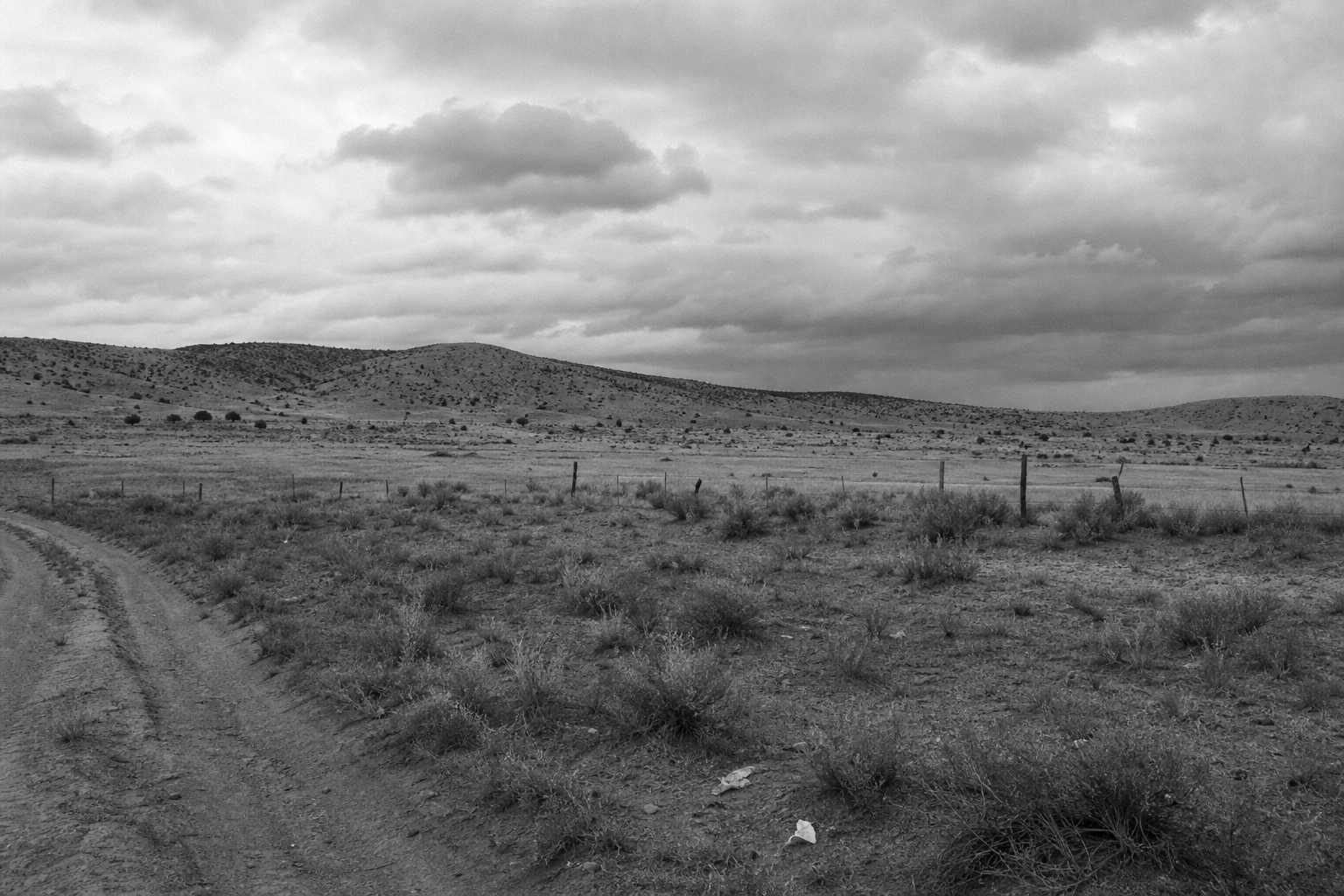
The first recoverable sequence is short. Rancher W. W. “Mac” Brazel reported finding scattered, unfamiliar debris on the Foster ranch northwest of Roswell; the timing and exact route from ranch to base are reconstructed from 1947 press accounts rather than a single complete operational file.
What is directly visible in the surviving press record is that the Roswell Army Air Field entered the matter, with Major Jesse Marcel associated with the debris recovery effort. On July 8, public-information officer Walter Haut issued the statement that gave the episode its lasting name: the 509th Bombardment Group had “come into possession of a flying disc” with the cooperation of a local rancher and the Chaves County sheriff’s office. The Roswell Daily Record printed the announcement that afternoon; wire services rapidly carried versions beyond New Mexico.
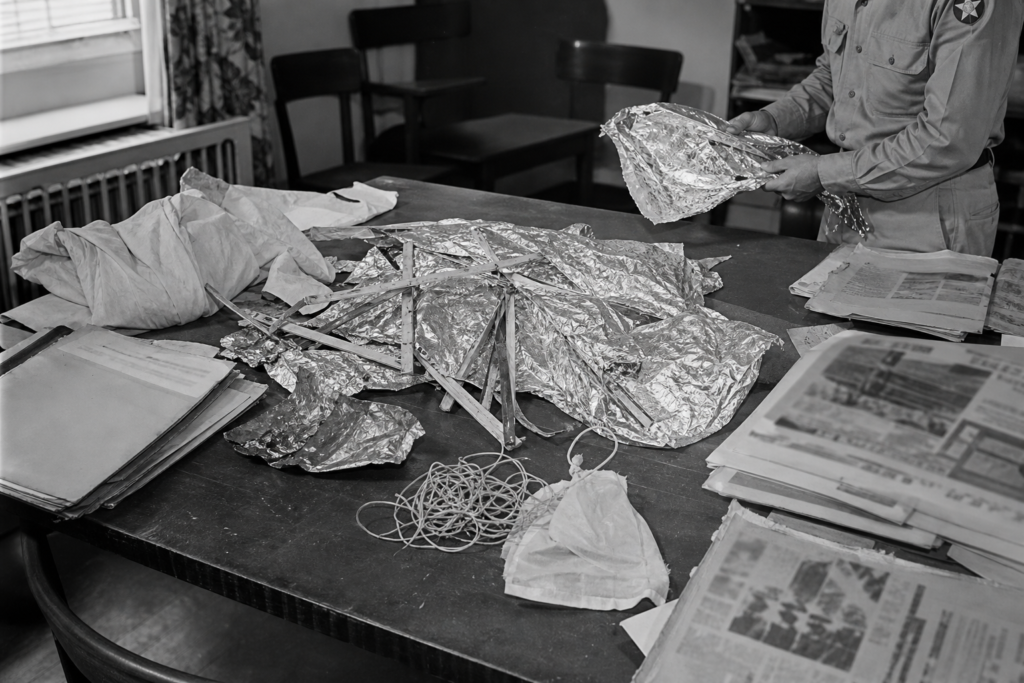
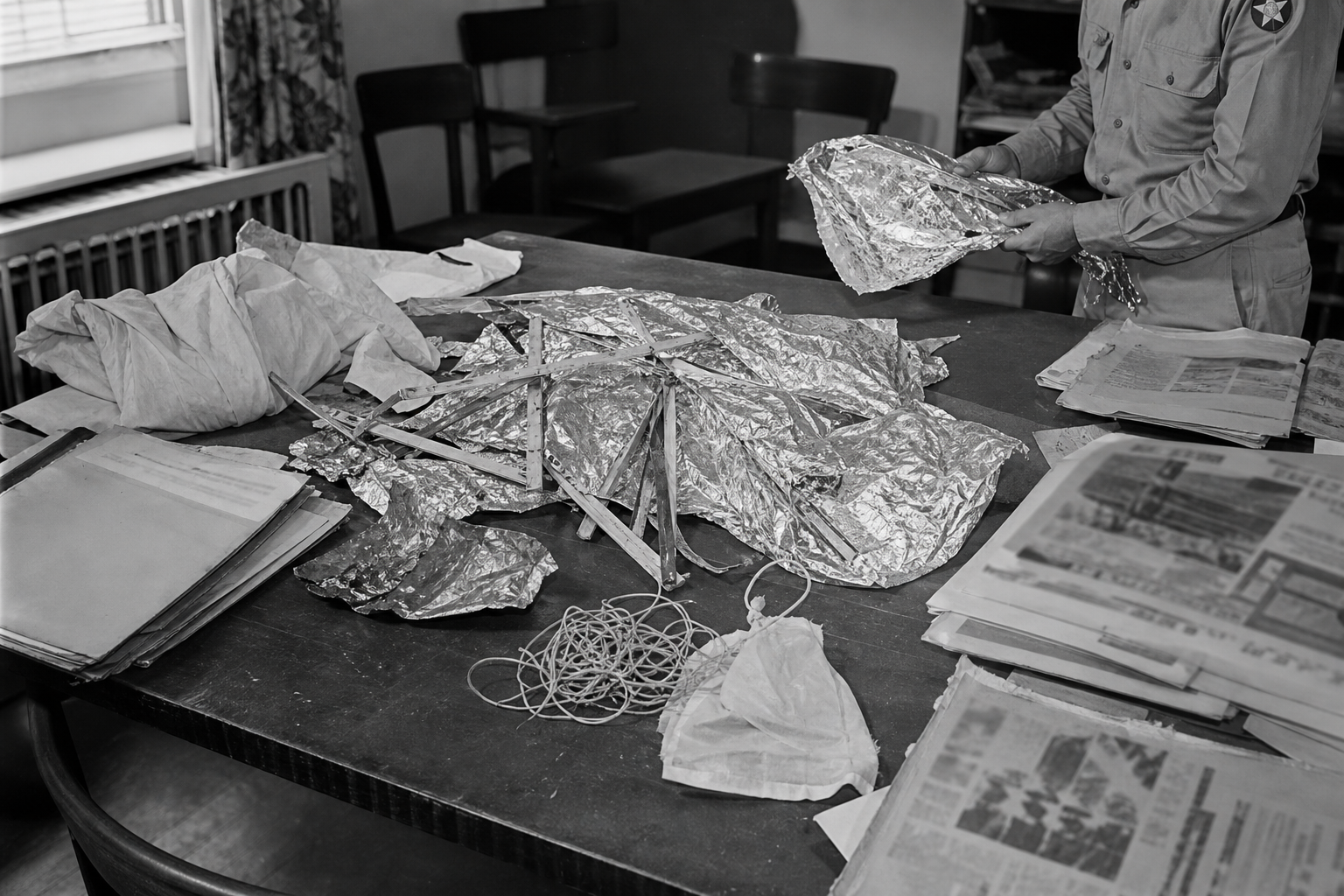
That wording established only the Army’s initial public characterization, not the physical identity of the material. Later on July 8, Fort Worth Army Air Field announced that Brig. Gen. Roger Ramey had identified the object as a weather balloon. Newspaper photographs from Fort Worth show Marcel and other officers posing with foil, sticks, and rubber-like material presented as the recovered wreckage.
Readers can inspect the July 8 Roswell Daily Record, Associated Press and United Press dispatches, the Fort Worth photographs, and the military statements reproduced in archival and newspaper collections. Together, they document a debris report, a dramatic initial release, and a rapid reversal, not a contemporaneous public report of bodies or an intact craft.
Why the Army Said “Flying Disc” and Then Said Weather Balloon
In the language of July 1947, “flying disc” was a headline-ready public label, not a technical finding that a spacecraft had been identified. The phrase had spread during that summer’s national saucer wave, so Haut’s release used the vocabulary readers already recognized. Its wording did not describe propulsion, occupants, origin, or even a complete object; it announced possession of material characterized as a disc.
At Fort Worth, Brig. Gen. Roger Ramey publicly replaced that characterization with a weather balloon and radar target. A radar target was a lightweight, reflective assembly, commonly foil-like material mounted on sticks or supports, used to make a balloon more visible to radar. That explanation matters because it accounts for the ordinary-looking components displayed to reporters, rather than merely applying a different name to the same mystery.
The Fort Worth photographs are therefore important contemporary artifacts. They show Ramey, Marcel, and other personnel with crumpled reflective material, wooden pieces, and rubber-like remnants presented as the recovered debris. They establish that officials displayed material and gave reporters the balloon explanation; photographs alone cannot establish whether every item recovered from the ranch was on the office floor.
The reversal itself is not disputed: the Army’s July 8 “flying disc” announcement was followed within hours by Ramey’s weather-balloon identification. What caused the first description remains less settled. It may reflect hurried reporting, uncertainty at Roswell, or a misunderstanding of unfamiliar equipment. The documented change in public messaging shows confusion and correction; by itself, it does not demonstrate either an extraterrestrial recovery or a deliberate concealment.
Project Mogul: The Later Official Explanation and Its Fit With the Record
Project Mogul offered a more specific alternative to the 1947 weather-balloon description. Begun in 1947, the classified project used long trains of high-altitude balloons, microphones, lines, and radar reflectors to detect low-frequency sound from possible Soviet atomic tests. Its equipment was designed to remain aloft at altitude, not to resemble a conventional weather-balloon package on the ground.
In The Roswell Report: Fact versus Fiction in the New Mexico Desert (1994), the U.S. Air Force Roswell report concluded that the recovered material was most likely associated with a Mogul balloon train, especially a June 1947 New Mexico flight. The report’s reasoning was concrete: such arrays could leave scattered lightweight remnants, including rubber balloons, cord, tape, and radar-target material. To a rancher or base personnel who did not know the program existed, those pieces could plausibly have seemed unfamiliar.
That explanation has an important strength beyond the generic label “weather balloon.” Project Mogul was a real, documented secret program operating in the relevant place and period, and its known components overlap with the recovered debris and balloon-based explanation, including the reflective, stick-like, and rubbery materials publicly displayed at Fort Worth. It therefore provides a historically grounded account of why ordinary debris might have acquired an extraordinary description.
It is not absolute proof of the identity of every item collected. Surviving launch documentation is incomplete, and researchers disagree over whether the particular Mogul flight identified by the Air Force can be tied securely to the Foster-ranch debris. The U.S. Air Force Roswell report is consequently best read as the strongest developed official reconstruction: it fits substantial parts of the record, while leaving the precise chain from a specific launch to a specific debris field less completely documented than its conclusion suggests.
What Got Added Later: Bodies, Craft Claims, and Expanded Narratives
The story’s most dramatic elements arrived on a markedly later schedule. The principal July 1947 newspaper reports followed the Army’s “flying disc” announcement and its balloon correction; they did not report occupants, autopsies, an intact spacecraft, or a second recovery location.
In 1978, former intelligence officer Jesse Marcel gave radio interviews to researcher Stanton T. Friedman and described the debris he remembered as unusually durable and unlike familiar military material. Those interviews revived public interest, but they were retrospective recollections made more than three decades after the recovery, not contemporaneous records of a craft or bodies.
Charles Berlitz and William L. Moore’s The Roswell Incident (1980) broadened the account into a crash-and-retrieval narrative. It assembled interviews, leads passed between researchers, and claims attributed to witnesses or their relatives to argue for multiple sites, recovered occupants, and official concealment. The book was historically consequential: it supplied much of the narrative architecture later associated with a government UFO cover-up. Its evidence, however, mixed firsthand memory with secondhand and hearsay reporting, accounts of what someone said they saw, which cannot independently establish the original event.
Body narratives expanded further in late-1980s and 1990s interviews, including claims connected to mortician Glenn Dennis and alleged military personnel. Such Roswell witness claims deserve to be preserved as testimony about what people recalled or were told. Their limits are equally material: long time gaps, differing versions, uncertain chains of transmission, and little independent contemporary corroboration. Repetition in books and television programs can show how alien-disclosure lore spread; it does not convert a later allegation into a 1947 document.
How the Evidence Compares: Proximity, Provenance, and Corroboration
The useful question is not which item sounds most dramatic, but what each item can actually establish. Apply three tests: proximity, provenance, and corroboration. Proximity asks how near a record or recollection was made to July 1947. Provenance asks whether its path is identifiable, who created it, when, where it was preserved, and whether the version being quoted can be traced. Corroboration asks whether independent material supports the same specific point.

Contemporaneous newspaper coverage and military statements score highly on proximity, while an archival record with a traceable collection history can also score strongly on provenance. Neither quality makes its contents automatically correct: a hurried press release may repeat an initial misunderstanding, and a newspaper can compress or misquote. Its value is that it fixes what officials and reporters publicly said at that moment.
Photographs require the same discipline. A dated image with an original caption, identifiable participants, and a clear route into an archive is stronger evidence of what was displayed or photographed than an uncited reproduction. It does not, by itself, establish that every recovered item appears in the frame or that a caption’s identification was accurate.
- Stronger signal: an affidavit, memo, or photograph whose original, date, custody, and connection to a named event can be examined alongside independent records.
- Weaker signal: a memoir or documentary interview recounting a conversation decades earlier without a contemporaneous note, identifiable intermediary, or independent support.
Later testimony should not be discarded merely because it is late. A witness may be sincere and may preserve details absent from surviving files. But sincerity does not resolve memory change, conflation, or hearsay. For the Roswell incident 1947, the most responsible reading keeps early public records, retrospective official analysis, and later recollections in their distinct evidentiary lanes rather than allowing any one category to do all the work.
The Bottom Line: What Roswell’s Public Record Supports, and Does Not
The defensible answer to what happened at Roswell is limited but clear. In July 1947, a rancher reported scattered debris, Roswell Army Air Field personnel collected material, and the base briefly announced that it had recovered a “flying disc.” That description was withdrawn within hours after Fort Worth officials identified the material publicly as a weather balloon.
- The public record supports: a real debris-recovery episode, contradictory Army messaging during a fast-moving news cycle, and a later official conclusion that Project Mogul equipment was the most likely source of the unusual material.
- The public record does not establish: extraterrestrial occupants, an alien vehicle, a second crash site, or a demonstrated government operation to conceal recovered extraterrestrial technology.
Project Mogul is not a magic solution to every uncertainty: incomplete records leave room to dispute the precise flight or material involved. But an unresolved point of identification is not affirmative evidence of extraterrestrial origin. The body and intact-craft narratives entered the public story decades after 1947 through retrospective interviews, books, and documentaries, rather than through the surviving July press record.
That distinction remains useful amid modern UFO disclosure and UAP disclosure claims. An impressive title, dramatic testimony, or official acknowledgment that an object was unidentified can justify further inquiry; it does not settle origin. The stronger signal remains a dated record, traceable provenance, and independent corroboration for the specific claim being made.
Roswell’s Record Is Smaller Than Its Legend
A useful checkpoint is whether a claim can be placed in July 1947 or only in a later retelling. The July material consists of a debris report, military handling, a brief public characterization of recovered material as a “flying disc,” and a rapid balloon correction. Project Mogul supplies a documented, though not perfectly item-by-item provable, explanation for why unusual balloon-train debris might have prompted that confusion.
The claims that most transform the episode into an extraterrestrial recovery, occupants, intact craft, multiple sites, and a sustained concealment operation, rest chiefly on accounts publicized years or decades later. Their lateness does not demonstrate dishonesty; it changes what they can prove. A recollection can preserve a lead worth investigating, but it cannot by itself supply the contemporaneous records, physical chain of custody, or independent confirmation absent from the 1947 record.
That is the practical standard for future Roswell claims: separate the claim from the evidence offered for it, then ask whether the evidence was created near the event, can be traced to a known origin, and independently supports the precise detail asserted. An unexplained gap remains a gap, not proof of Project Mogul, extraterrestrial technology, or a cover-up. The Roswell incident 1947 is historically significant precisely because the surviving record is narrow, contradictory, and finite; its legend grew in the space beyond it.
Sources
Frequently Asked Questions
-
What does the 1947 Roswell public record actually show?
It documents a debris recovery near Roswell, a July 8 Army announcement that it had recovered a “flying disc,” and a same-day correction identifying the material as a weather balloon. It does not establish an extraterrestrial craft, alien bodies, or a UFO crash-retrieval program.
-
Why did the Army first say it had recovered a flying disc at Roswell?
Roswell Army Air Field used the popular 1947 “flying disc” label in its July 8 public statement after recovering debris with a local rancher and sheriff’s office. The wording did not identify a spacecraft, propulsion system, occupants, or an intact object.
-
Was the Roswell debris from Project Mogul?
The U.S. Air Force concluded in its 1994 Roswell report that the debris was most likely from a June 1947 Project Mogul balloon train. Mogul equipment included balloons, cords, microphones, tape, and radar reflectors, which fit the foil-like, stick-like, and rubbery materials displayed at Fort Worth.
-
When did claims of alien bodies and an intact craft at Roswell become public?
The main July 1947 newspaper reports did not mention bodies, autopsies, an intact craft, or a second recovery site. Expanded crash and occupant narratives entered public discussion decades later, beginning with Jesse Marcel’s 1978 interviews and Charles Berlitz and William L. Moore’s 1980 book.
-
What evidence should you look for when evaluating Roswell claims?
Prioritize proximity, provenance, and corroboration: records created near July 1947, with a traceable origin and independent support for the specific claim. Dated press releases, photographs, memos, and archival documents carry stronger evidentiary weight than interviews or memoirs recorded decades later.