Jesse Marcel and the 1947 Roswell Incident: Key Figure in Claims About Unusual Debris Recovered
Explore Jesse Marcel Roswell Incident claims, 1947 records, debris testimony and Project Mogul to assess what evidence supports.
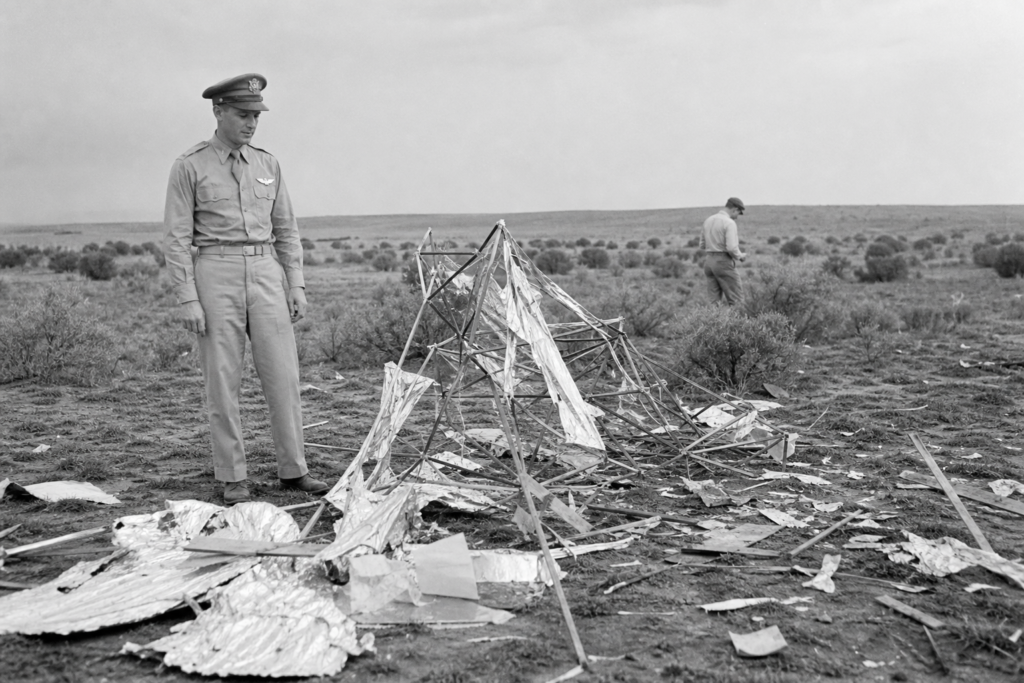
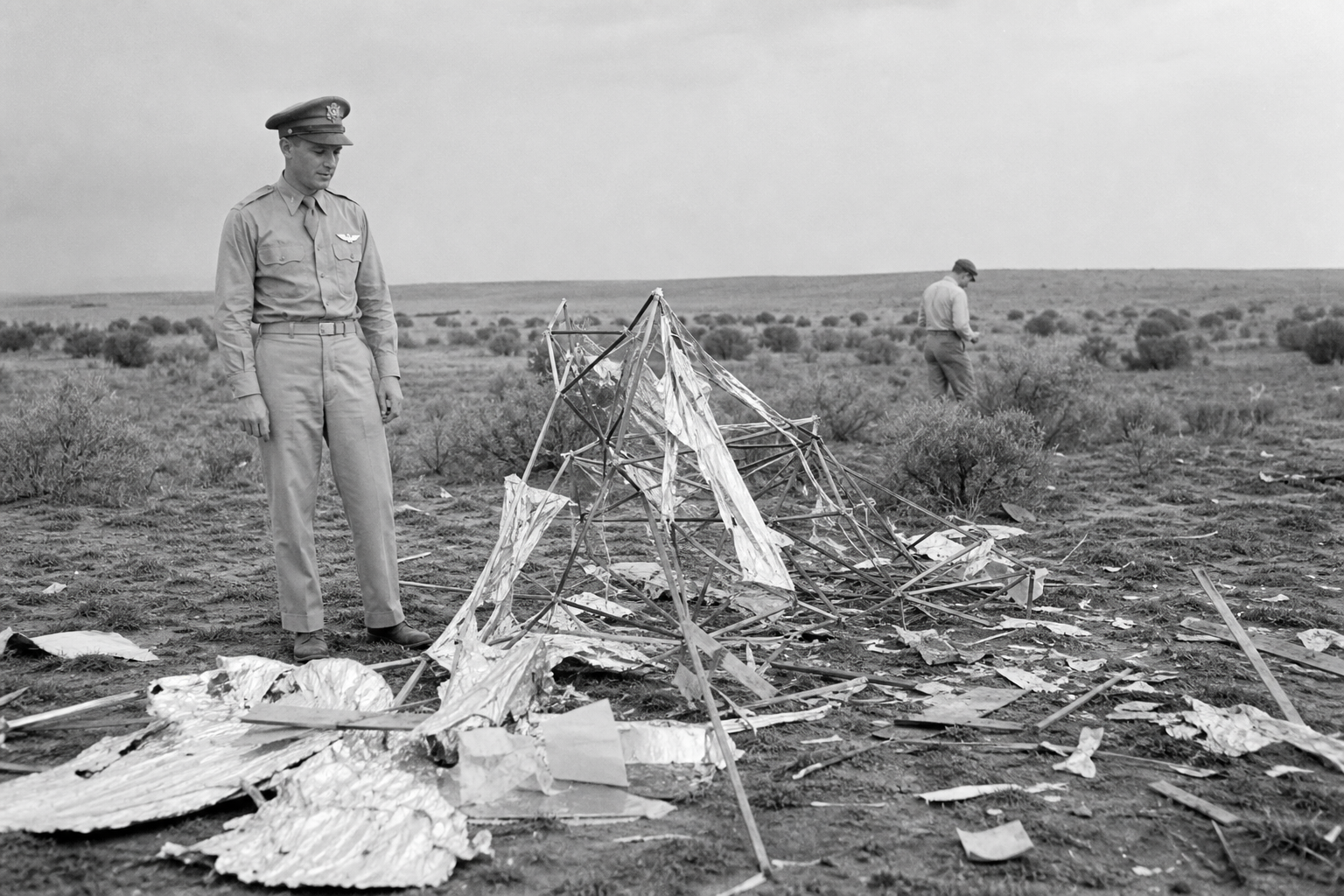
The Jesse Marcel Roswell Incident endures because its first public version and its later legend point in sharply different directions. Marcel, an intelligence officer at Roswell Army Air Field, took part in the military response to debris recovered from a ranch outside Roswell, New Mexico. On July 8, 1947, the base announced that it had recovered a “flying disk”; within hours, higher military authorities identified the material as a weather balloon.
That rapid reversal made Marcel a pivotal witness. He was not a distant observer repeating a rumor: he handled material connected to the recovery and appeared in the immediate public episode. Yet the most remarkable descriptions associated with him, claims made decades later about debris unlike ordinary balloon equipment, belong to a different evidentiary category from 1947 press accounts, photographs, and military records.
This article separates those records rather than treating them as interchangeable. It examines Marcel’s position, the sequence of the 1947 Roswell Incident, his later testimony, and the official Project Mogul explanation: a classified balloon program designed to detect signs of Soviet nuclear testing. That explanation accounts for the debris in the Air Force’s view, but it has not ended debate among people who find Marcel’s later account persuasive. The surviving record establishes his importance; it does not, by itself, establish an extraterrestrial crash or a cover-up.
Why Jesse Marcel Remains Central to the Roswell Story
Chronology is the first checkpoint: Major Jesse Marcel of the 509th Bombardment Group participated while the recovery was still unfolding, rather than entering the story as a later interpreter of Roswell lore. His name figured in the initial public episode, which shifted within days from a military announcement of a recovered “flying disk” to press coverage identifying the material as a weather balloon. That proximity gives Marcel unusual historical weight, but it does not make every later version of his account equally probative.
A disciplined reading separates four layers. Contemporaneous military statements, newspapers, and photographs establish what officials said and displayed in July 1947. Marcel’s interviews decades later preserve his recollections, including his characterization of the debris as unusually light, strong, and unlike familiar equipment. Civilian investigations can assemble that testimony and expose conflicts, but they chiefly depend on memories recorded long after the recovery. Official Air Force accounts provide a competing reconstruction centered on Project Mogul, the classified balloon effort. These categories answer different questions: the first documents the immediate episode; the later accounts explain why claims about Roswell unusual debris remain disputed.
Who Jesse Marcel Was in July 1947
Marcel’s assignment helps explain the response: in July 1947, Major Jesse A. Marcel was the intelligence officer for the 509th Bombardment Group at Roswell Army Air Field. Intelligence personnel assessed reports and material that could bear on military security and relayed findings to commanders. That function made Marcel a logical officer to send when an unfamiliar field of debris was reported, but it does not independently establish what the material was.
The report began with W. W. “Mac” Brazel, the rancher associated with the Foster ranch northwest of Roswell. Brazel had encountered scattered material on the property and brought the matter to local authorities, drawing military attention. Marcel went to the ranch as part of the response. Sheridan Cavitt, a Counterintelligence Corps officer assigned in the area, is also closely associated with the trip and recovery activity. The distinction is useful: Brazel was the civilian discoverer, Cavitt represented Army counterintelligence, and Marcel represented the 509th’s intelligence function.
Contemporary records and press coverage establish the narrower point that Marcel handled or helped collect material during the response and was subsequently linked to the military’s public handling of the episode. They do not preserve a full technical inventory, laboratory analysis, or verbatim field report in which Marcel identified an extraordinary object. Those omissions matter when weighing Jesse Marcel Roswell accounts. His more dramatic descriptions belong to a separate evidentiary category: firsthand recollections offered decades later, not settled findings recorded in July 1947.
What Happened During the 1947 Debris Recovery
On July 8, the public account changed by the hour. The base issued a press release announcing that personnel of the 509th Bombardment Group had recovered a “flying disk” from a ranch near Roswell and that the object had been turned over for higher-level examination. The phrase reflected the uncertain “flying disc” language of the moment; it announced a recovery rather than supplying a technical identification of the material.
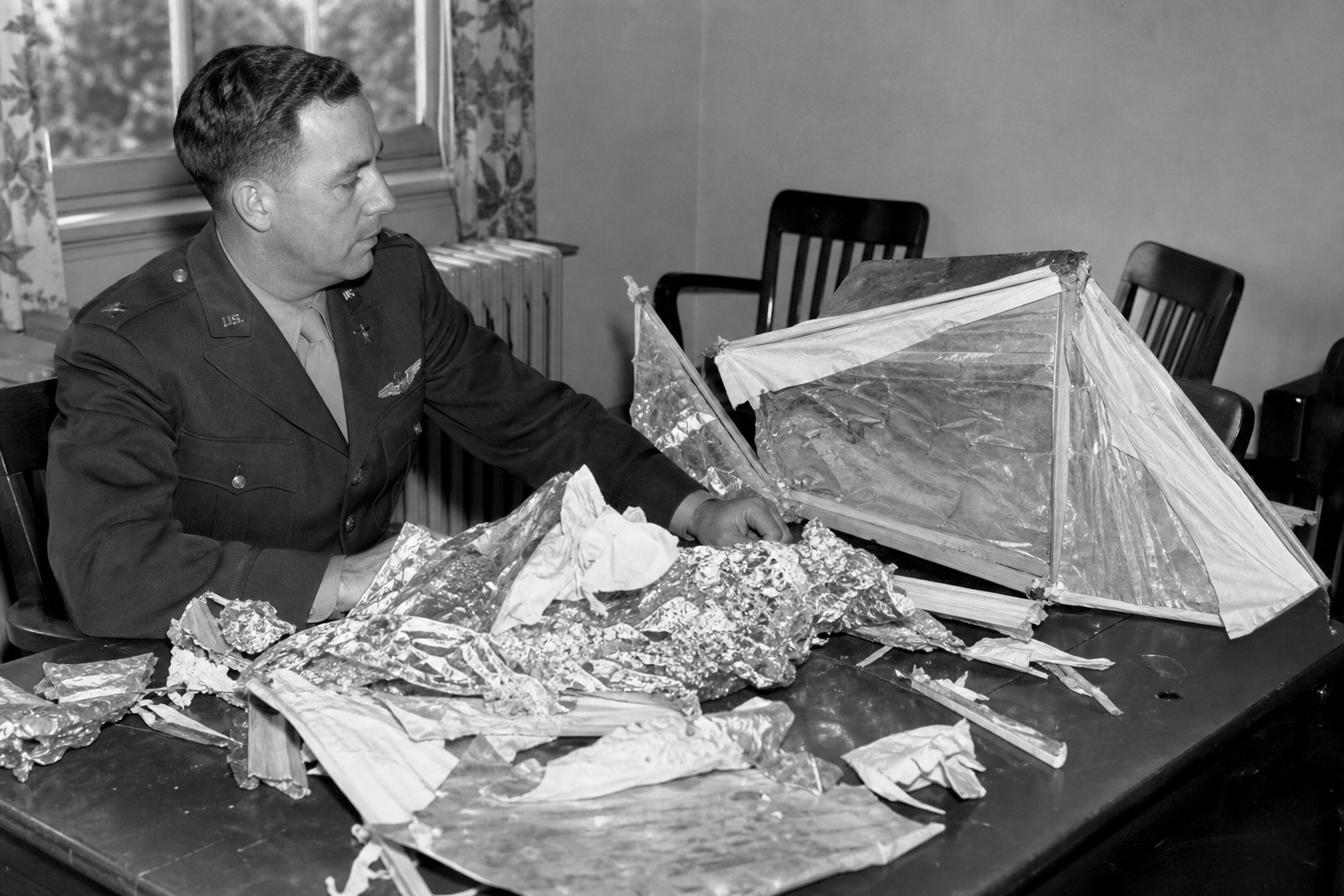
The debris was then sent to Fort Worth Army Air Field, headquarters of the Eighth Air Force, and Marcel traveled there in connection with the transfer. That same day, Brig. Gen. Roger Ramey told reporters that the material was a weather balloon and radar target, the reflective, kite-like apparatus used to help track a balloon’s position. This identification displaced the initial announcement in press coverage within hours, but the speed of the correction alone does not establish why the first description had been made.
Newspaper photographs from Fort Worth show Ramey, Marcel, and other officers with strips of foil-like material, paper, wood, and a radar target. They are valuable contemporaneous evidence of what military authorities displayed publicly after the transfer. Their limit is equally important: the images document the items presented to reporters, not a complete chain-of-custody inventory of every piece collected on the ranch. They therefore support the weather-balloon explanation for the displayed debris without independently settling whether the display represented all of the Roswell debris Marcel later recalled handling.
Marcel’s Later Debris Claims, and Their Limits
More than three decades later, Marcel gave the episode its most influential second life. In late-1970s interviews publicized by UFO researcher Stanton Friedman, he described material he remembered as exceptionally light yet difficult to damage: foil-like pieces that could be crumpled and then return to shape, along with unusual fragments he did not recognize. He also characterized the field as containing a broad scatter of debris rather than the ordinary remnants implied by the public explanation.
Those Jesse Marcel debris claims became more consequential because he maintained that the material displayed at Fort Worth was not the material he had recovered near Roswell. In this version, the foil, paper, wood, and radar-target components shown to reporters represented a substitution. Marcel’s interviews helped shape The Roswell Incident, the 1980 book that brought the case to a much wider audience, and later retellings often treated his recollection as evidence of an extraordinary recovery.
The evidentiary distinction is crucial. Marcel was a firsthand participant, so his witness testimony bears directly on what he believed he handled. But his detailed descriptions were recorded decades after 1947, not preserved in a contemporaneous field report, technical inventory, laboratory result, or surviving sample linked to the ranch. A strong historical signal would be a dated record that independently identifies the unusual properties he later described; the weaker signal is a retrospective account whose wording, emphasis, and interpretation can change as interviews, books, and public controversy accumulate.
That does not make Marcel’s recollections irrelevant. His proximity to the recovery and his insistence that the public display was incomplete explain why the Roswell debris remains disputed. It does mean that his later account must be weighed alongside, rather than used to replace, the July 1947 statements, photographs, and other surviving records.
Project Mogul, Official Explanations, and the Evidence Conflict
The most fully developed official explanation identifies the debris as part of Project Mogul, a secret postwar research effort that lofted long chains of balloons, radar reflectors, microphones, and associated equipment high in the atmosphere. Its purpose was to listen for acoustic evidence of a Soviet nuclear test. Because the program was classified in 1947, personnel could publicly describe recovered material in the familiar terms of a weather balloon and radar target without disclosing the larger mission.
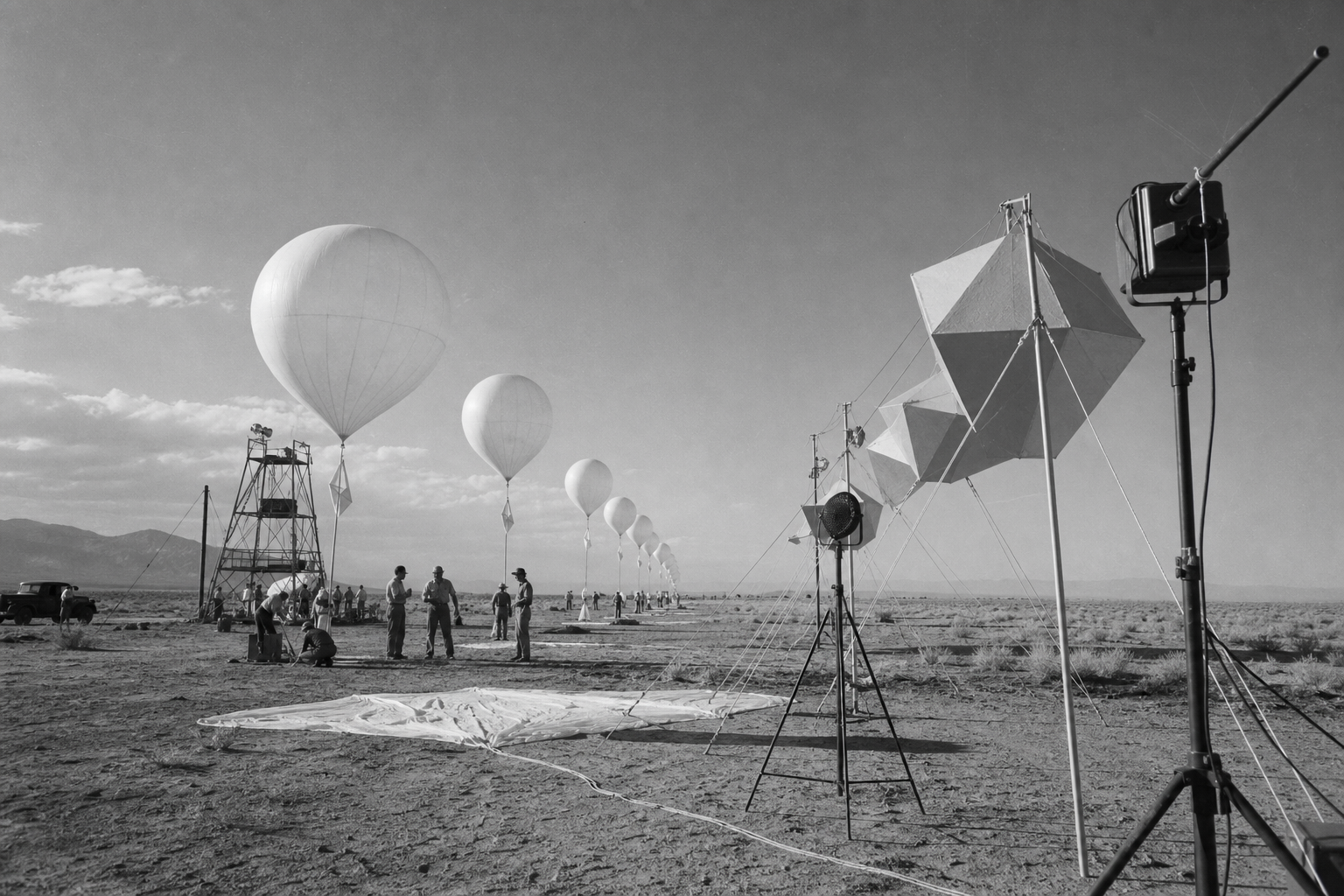
This explanation matters because a Mogul train could leave a wide, irregular debris field after breaking apart. Its lightweight balloon fabric, foil-like reflector material, tape, string, and balsa-wood supports resemble the kinds of items visible in the Fort Worth photographs. The 1994 U.S. Air Force Roswell report connected the recovery to a Mogul flight series; the 1997 report separately addressed later stories of bodies by linking them to other military activities and recollections from different periods. Together, the U.S. Air Force Roswell reports offer a conventional account built around a documented classified program rather than an extraterrestrial craft.
Critics find the identification incomplete for a narrower reason: Marcel’s late-1970s descriptions do not neatly match the ordinary-looking material displayed to reporters. His claim that the displayed debris was substituted turns the dispute into a question of provenance, whether the photographs show the whole recovery, only part of it, or different material altogether. That allegation is central to cover-up interpretations, but it rests principally on retrospective testimony rather than a contemporaneous inventory showing that an exchange occurred.
The two positions therefore rely on different kinds of evidence. The official explanation draws strength from the known purpose and construction of Project Mogul, surviving program records, and the physical character of the publicly displayed debris. Marcel’s defenders give greater weight to his firsthand involvement, his later insistence that the material was extraordinary, and the initial confusion reflected in the July 1947 announcement.
Neither side can fill the record’s largest gaps. No independently verified sample with exotic properties has been tied by a documented chain of custody to the Foster ranch. Nor is there a complete contemporaneous recovery inventory, laboratory file establishing a nonhuman craft, or contemporary proof that bodies were recovered. Project Mogul supplies a plausible official explanation; Marcel’s conflicting recollection explains why it has not ended the argument.
Why Marcel’s Testimony Still Shapes UFO and UAP Disclosure Debates
For modern UFO disclosure debates, the key checkpoint is the gap between the July 8, 1947 announcement and Marcel’s late-1970s interviews. Fort Worth photographs showed him beside foil-like material, paper, wood, and a radar target, while his later account described far more unusual debris. That roughly three-decade interval distinguishes an immediate public reversal from a retrospective interpretation.
The useful distinction is between disclosure of a classified program and proof of an object’s origin. Declassified Project Mogul material and the Air Force’s 1994 Roswell report explain why a balloon train intended to detect Soviet nuclear tests was not fully described in 1947. They do not independently disprove Marcel’s allegation that different debris was displayed at Fort Worth; however, no contemporaneous inventory or documented physical sample establishes such an exchange. An unresolved inconsistency is not, by itself, evidence of non-human intelligence.
For UAP disclosure, Roswell is therefore a historical example rather than a settled precedent for current reports. Officials, journalists, and the public can weigh dated records, identifiable material, and independently testable claims more heavily than later retellings. Marcel’s direct role keeps the question alive, but the divide between his 1947 public record and his later testimony prevents historic crash-retrieval allegations from being merged with modern sightings into one conclusion.
The Historical Verdict: Important Witness, Unproven Extraordinary Claim
The fairest historical judgment is therefore narrow but consequential. Jesse Marcel’s participation makes him an essential Roswell witness: he was present in the military response and later insisted that some recovered debris was unlike the mundane material publicly displayed. That proximity gives his recollections real historical weight.
It does not turn a decades-later recollection into independently established proof of an extraterrestrial crash or a cover-up. The decisive missing link is testable material with an unbroken provenance from the recovery site, supported by contemporaneous records and declassification and independent witnesses rather than interpretation alone.
Use the same standard for Roswell and for UFO sightings 2025 or UFO sightings 2026: primary records outweigh retellings; verifiable physical evidence outweighs descriptions; and corroboration from separate sources outweighs repetition. Marcel explains why the case endures, not what the debris conclusively was.
Why Jesse Marcel’s Account Still Matters
The enduring value of Marcel’s account lies in the tension it preserves. He was not a distant storyteller: his military assignment connected him to the initial collection and handling of the Roswell debris. That firsthand connection makes his later insistence that the material was extraordinary historically significant, particularly because it conflicted with the ordinary debris shown publicly in 1947.
Yet the evidentiary weight changes with time. The July 1947 press record, photographs, and military statements capture events close to their occurrence but do not supply a complete technical account. Marcel’s late-1970s descriptions add the perspective of a participant, but memory recorded decades later cannot independently establish an extraterrestrial craft or a concealed recovery. Project Mogul remains the leading official explanation because its classified balloon arrays could account for an unfamiliar, scattered collection of material; it does not satisfy every reader who finds Marcel’s recollections difficult to reconcile with the public display.
That is the useful takeaway from the Jesse Marcel Roswell Incident: direct testimony deserves attention, but its strongest interpretation must be tested against chronology, independent corroboration, and surviving records. The remaining gaps explain the case’s lasting place in UFO disclosure debates; they do not convert an unresolved historical record into proof of any particular origin.
Frequently Asked Questions
-
Who was Jesse Marcel in the Roswell incident?
Major Jesse A. Marcel was the intelligence officer for the 509th Bombardment Group at Roswell Army Air Field in July 1947. He participated in the military response to debris found on the Foster ranch and traveled with material transferred to Fort Worth Army Air Field.
-
What did Jesse Marcel say he found at Roswell?
In late-1970s interviews, Marcel described debris that was exceptionally light, difficult to damage, and unlike familiar balloon equipment. He recalled foil-like material that could be crumpled and then return to its original shape, plus fragments he did not recognize.
-
Did Jesse Marcel claim the Roswell debris was alien?
Marcel later maintained that the debris publicly displayed at Fort Worth was not the same material he recovered near Roswell. His account supported claims of an extraordinary recovery, but no verified sample, technical inventory, or contemporaneous laboratory record established an extraterrestrial origin.
-
What was Project Mogul and why is it connected to Roswell?
Project Mogul was a classified postwar program that used balloon trains, radar reflectors, microphones, string, and balsa-wood supports to detect acoustic evidence of Soviet nuclear tests. The U.S. Air Force’s 1994 Roswell report linked the recovered debris to this program, whose equipment could produce a broad, scattered debris field.
-
What evidence should you look for when judging Marcel’s Roswell claims versus the Project Mogul explanation?
Give greatest weight to dated primary records, a complete chain of custody, independently testable material, and corroboration from separate witnesses. Fort Worth photographs show foil-like material, paper, wood, and a radar target, while Marcel’s more extraordinary descriptions were recorded more than 30 years after the 1947 recovery.