How Jesse Marcel Became a Key Figure in the 1947 Roswell Incident and the Balloon Explanation
Learn how Jesse Marcel shaped the Roswell incident, from the 1947 balloon explanation to Project Mogul and disputed evidence.
Few episodes in American history traveled as far from their original news cycle as Roswell. In July 1947, Roswell Army Air Field briefly announced recovery of a “flying disc” before military officials replaced that claim with a weather-balloon explanation. The reversal came within days; disagreement over what the debris represented has endured for decades.
The Jesse Marcel Roswell incident matters because Marcel links those two timelines. An intelligence officer at Roswell Army Air Field, he took part in the 1947 response to debris recovered from a New Mexico ranch. Nearly 30 years later, his public recollections, including his view that the material was unlike an ordinary balloon, helped make Roswell a defining UFO-crash controversy.
This article separates the contemporary record from retrospective testimony. It follows the press release, reversal, and Marcel’s documented role before considering his later account. It also distinguishes the 1947 weather-balloon explanation from the Air Force’s later Project Mogul explanation, which identified the debris as part of a balloon train associated with a then-secret surveillance effort. The distinction does not erase every uncertainty; it clarifies what each explanation sought to account for and where the record remains disputed.
Why Jesse Marcel Connects the 1947 Roswell Story to Its Modern Reputation
A useful checkpoint is to separate Marcel’s place in the 1947 sequence from the weight later assigned to his memory of it. The first rests on the short July 1947 paper trail: military involvement in recovering debris, a public announcement, and the rapid substitution of a balloon explanation. That record establishes Marcel’s proximity to the episode and the speed with which its public account changed; it does not preserve a complete inventory of every item recovered.
The second is Marcel’s later testimony. In interviews given during the late-1970s revival of interest in the Roswell incident 1947, he described debris that he believed did not resemble ordinary balloon material. Those recollections made him far more than a participant in an obscure military news event: he became a principal witness in the modern argument over what the debris was.
That distinction sets the standard for the pages that follow. Contemporary newspapers and surviving military records provide the firmest chronology. Marcel’s retrospective statements matter as attributable eyewitness testimony, but they remain recollections offered decades afterward. The 1947 weather-balloon account and the Air Force’s later Project Mogul conclusion will likewise be considered as different explanations, each addressing the debris in a different way. Where records, memories, and interpretations diverge, the disagreement will be identified rather than converted into certainty.
Jesse Marcel’s Documented Role at Roswell Army Air Field
Major Jesse A. Marcel served as the intelligence officer for the 509th Bombardment Group at Roswell Army Air Field, placing him in the unit’s channel for assessing information with possible security or operational significance. The 509th was associated with the atomic bombing mission, but that notable history does not authenticate any particular interpretation of the debris; it helps explain why an intelligence officer, rather than a civilian investigator, entered the response.
Rancher W. W. “Mac” Brazel brought news of scattered, unfamiliar material from his ranch northwest of Roswell to local authorities and then to the base. Marcel later recalled traveling to the site with Captain Sheridan Cavitt of the Counter Intelligence Corps. Their reported task was recovery and preliminary assessment, rather than a public scientific investigation. Marcel’s account places Brazel at the field and describes debris spread across a broad area, but the surviving contemporary record does not provide a complete item-by-item recovery log or a settled timetable for each visit.
What can be traced more securely is the movement of material into the military chain of command. Marcel participated in bringing debris from the Roswell area to the base, where it was handled as an intelligence matter and forwarded for higher-level review. Accounts differ over the precise route, quantities, and whether all material followed the same path. That limitation establishes Marcel’s direct connection to the recovery while leaving important details of the sequence unresolved. The next public steps, especially how the Army described the debris, therefore carry unusual weight.
The Flying Disc Press Release and the First Weather-Balloon Explanation
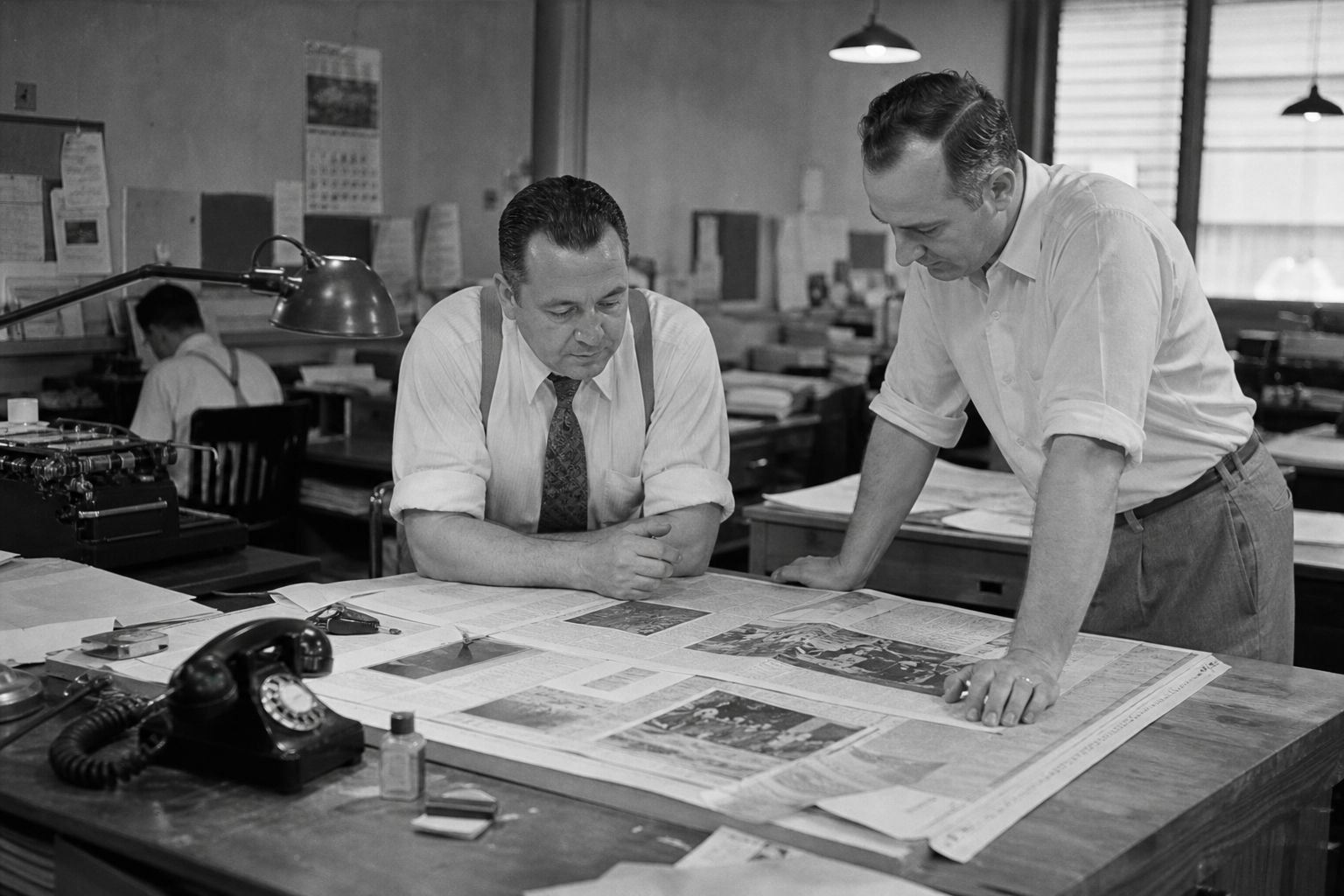
The public turning point came on July 8, 1947, when the Roswell Daily Record reported that personnel from the 509th had recovered a “flying disc” from a ranch near Roswell. In the language of the moment, “flying disc” was a news label for an unidentified reported object, not a demonstrated finding that it was an aircraft from another world. The release nevertheless gave the story its explosive first form: the Army appeared to say it possessed material connected to the national wave of disc sightings.
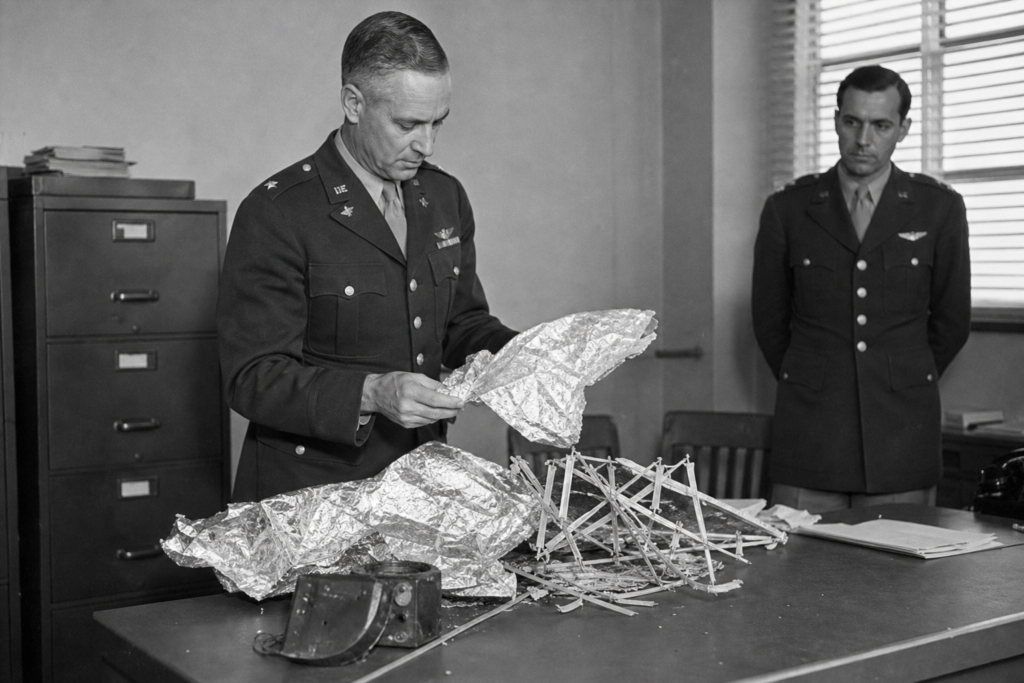
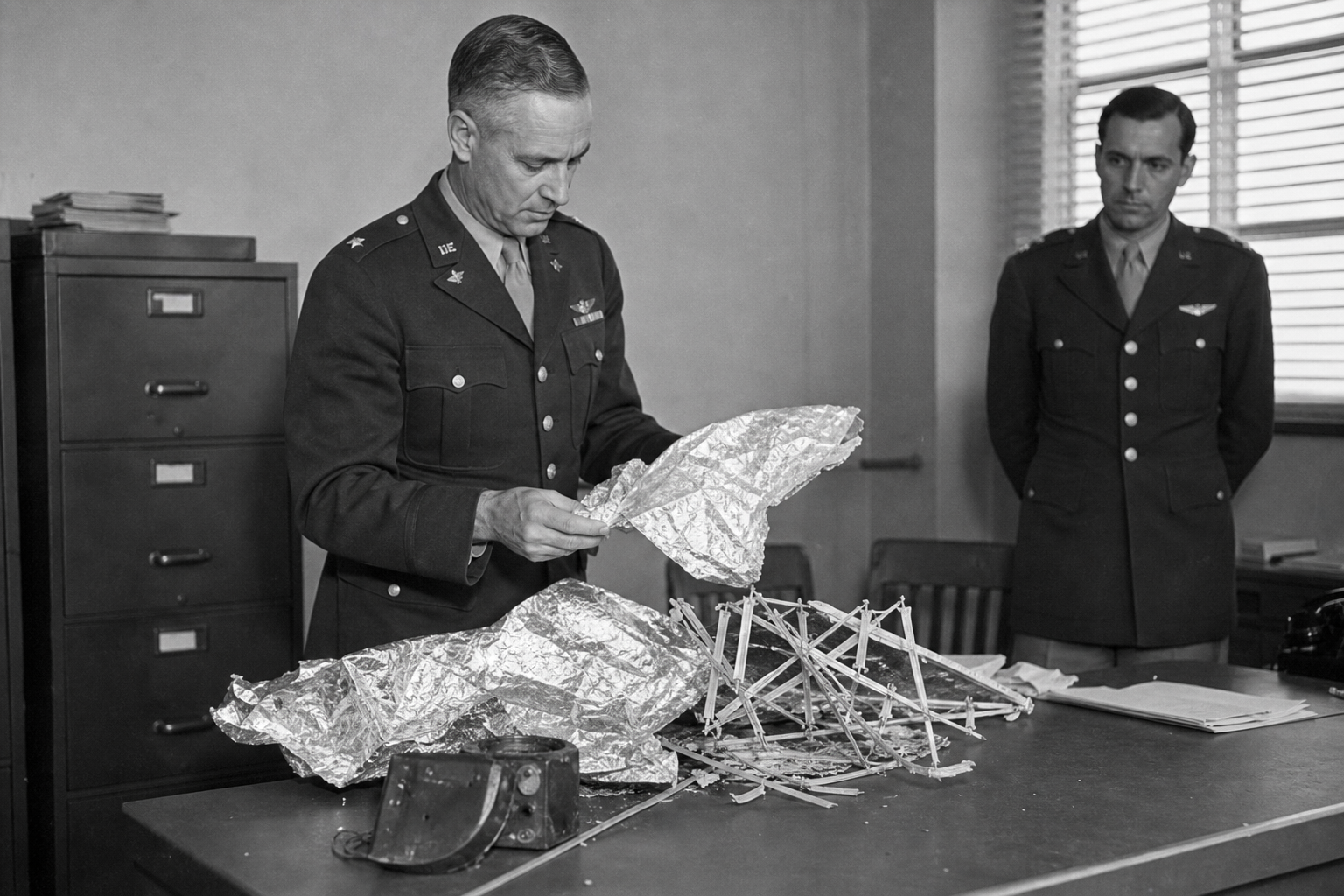
Within hours, the public description changed. The material had been sent to Fort Worth Army Air Field, where Brig. Gen. Roger Ramey told reporters it was the remains of a weather balloon and its radar target. A weather balloon was an instrument-carrying balloon used to observe atmospheric conditions; its radar target was a lightweight reflective assembly, commonly incorporating foil-like surfaces and balsa-wood supports, designed to make the balloon visible on radar. Fort Worth photographs show Ramey, Marcel, and others with debris presented as that ordinary equipment. This was the initial 1947 weather-balloon explanation, not the later argument that the debris came from Project Mogul.
The abrupt reversal became central to later suspicion because the surviving coverage preserves a stark contrast: an Army installation first publicized a disc recovery, then senior officers characterized the episode as routine balloon debris. That contrast documents an announcement and correction, however, not the nature of the recovered object. A photographed message held by Ramey, often called the Ramey memo, has been repeatedly enlarged and interpreted, but its text remains disputed and cannot serve as a definitive decoded account of the Roswell debris. The narrowest contemporary conclusion is that officials publicly replaced the flying-disc claim with a balloon account almost immediately.
How Marcel’s Later Recollections Made Him Central to Roswell Lore
Three decades after the recovery, Marcel gave the episode a far more consequential second life. Researcher Stanton Friedman interviewed him in 1978, when renewed interest in the 1947 UFO wave was beginning to turn Roswell from a brief newspaper mystery into a sustained UFO controversy. Marcel’s account was subsequently carried to a wider audience through interviews, documentaries, and Charles Berlitz and William L. Moore’s 1980 book The Roswell Incident.
In those retrospective interviews, Marcel said the debris he had handled was not consistent with an ordinary weather balloon. He described extremely light, foil-like material that could be crumpled but seemed to spring back into shape; thin, lightweight beam-like pieces; and markings on some of those pieces that he did not recognize. He also described the ranch-site debris as spread across a broad area. These details supplied a vivid alternative to the material displayed at Fort Worth in 1947 and became the foundation of the modern Jesse Marcel Roswell incident narrative.
The distinction between the two records is essential. The 1947 photographs show Marcel beside debris presented by the Army as balloon and radar-target material. His later statements maintained that the photographed material was not what he had originally recovered, an assertion that supporters treated as evidence of substitution and, in some accounts, a government UFO cover-up. Yet the interviews did not produce a newly located 1947 inventory, laboratory report, or chain-of-custody record establishing that claim. They are eyewitness recollections given roughly thirty years after the event.
That time gap does not make Marcel irrelevant; it defines how his testimony should be used. His military role gives his account unusual proximity to the recovery, while the delay, changing public context, and mismatch with the public photographs limit what it can independently prove. The Jesse Marcel balloon explanation debate therefore turns not simply on whether he believed the debris was extraordinary, but on how much weight retrospective memory can bear against the surviving contemporary record.
Weather Balloon vs. Project Mogul: What Changed in the Official Explanation?
The two official accounts were related, but they were not the same explanation. In July 1947, Fort Worth officials publicly identified the displayed debris as a conventional weather balloon and radar target: a relatively familiar arrangement in which a balloon carried a reflective target used to track upper-air conditions. That description fit the balsa-wood struts, tape, and foil-like reflector visible in the press photographs, but it offered little detail about why an intelligence officer might have treated the recovery as unusual.
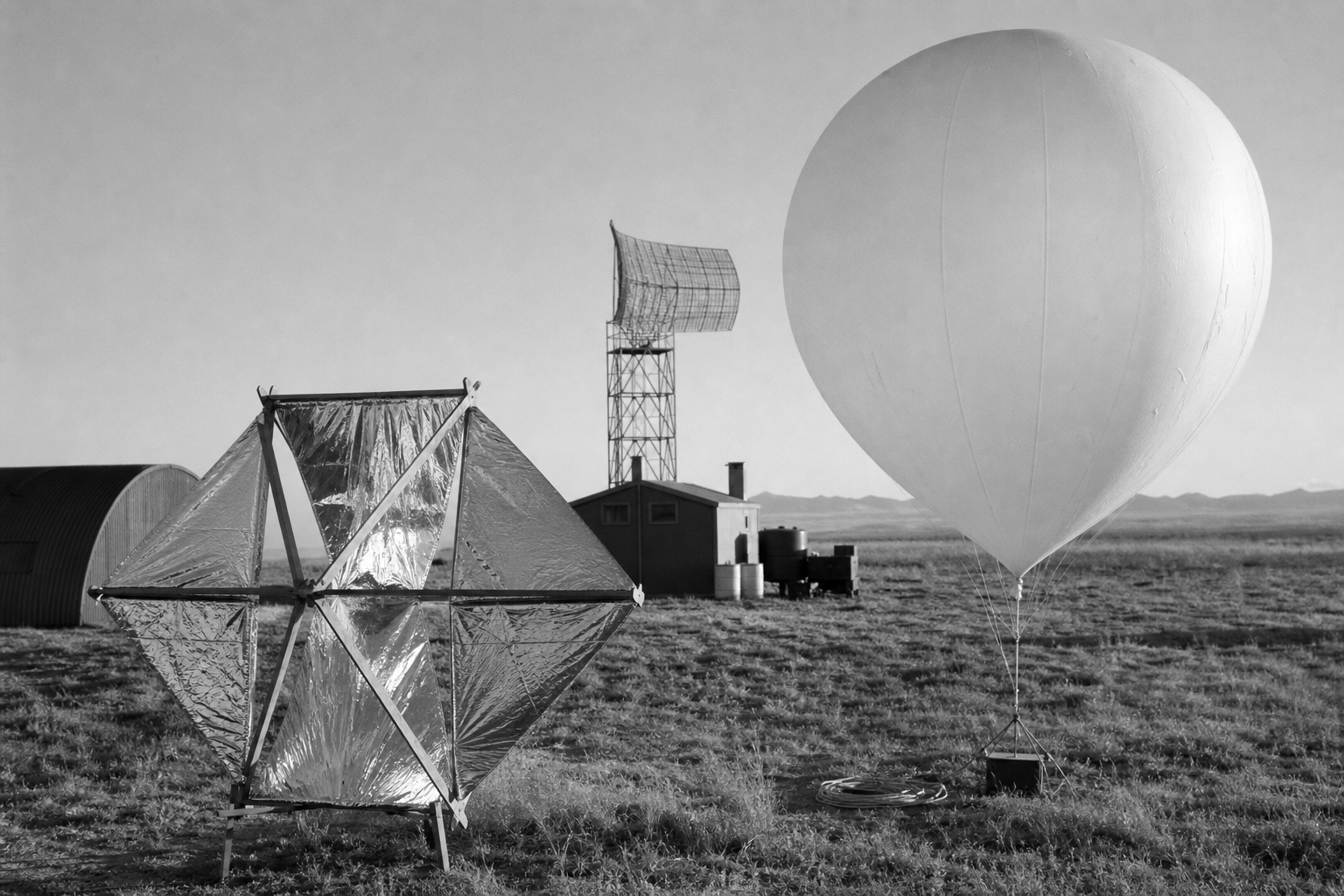
The Air Force’s 1994 report, The Roswell Report: Fact versus Fiction in the New Mexico Desert, proposed a more specific reconstruction. It concluded that the material was likely associated with Project Mogul, a then-classified effort to loft long balloon trains equipped to detect acoustic evidence of Soviet nuclear tests. Rather than one balloon and one target, such an array could include multiple neoprene balloons, radar reflectors, balsa supports, cords, tape, and instruments spread over a larger area after descent or breakup. That added scale and variety are why the Roswell Project Mogul explanation can account more readily than the 1947 weather-balloon explanation for reports of extensive, mixed lightweight debris.
It does not, however, turn every later detail into a demonstrated match. Marcel’s descriptions of exceptionally resilient foil-like material and unfamiliar markings were recorded decades after the event, while the surviving Project Mogul records do not provide an uncontested, item-by-item inventory tied to the precise debris he handled. The 1994 report treated a lost or unaccounted-for Mogul flight as the most plausible source, not as a recovery documented in 1947 by a complete chain of custody. The difference matters: Mogul supplies a historically grounded reason for unusual-looking balloon-related material and official secrecy, while the exact connection between a particular flight and Marcel’s recollection remains an inference rather than a conclusive identification.
What the Evidence Can, and Cannot, Establish About Marcel’s Account
A decisive checkpoint is whether a claim identifies an event in the 1947 record or interprets what that event ultimately meant. Contemporary reporting and military records place Marcel in the recovery response, preserve the Army’s brief “flying disc” announcement amid the 1947 flying-saucer era, and show senior officials replacing it with a balloon explanation. That record establishes the public reversal and Marcel’s involvement; it does not preserve a complete inventory of the recovered material.
Marcel’s later interviews form a separate evidentiary layer. He rejected the view that the material he handled was an ordinary weather balloon, a position that made him central to the Jesse Marcel Roswell incident narrative. But testimony recorded about three decades after an event cannot independently settle such details as the debris’s appearance, quantity, transfer route, or source. His proximity gives the recollection importance; elapsed time and the lack of a contemporaneous item-by-item record limit what it can prove.
The Air Force’s 1994 Roswell Report should likewise be read as an official historical reconstruction, not a recovered 1947 chain of custody. Its Project Mogul explanation offered a reason why dispersed balloon-related equipment could have looked unfamiliar and why its purpose had not been publicized. It did not establish an uncontested match between a particular Mogul flight and every feature Marcel later described.
The Air Force’s 1997 report addressed reported bodies and personnel-related accounts rather than supplying a further identification of the debris. Keeping that narrower subject separate prevents body narratives from being treated as evidence that resolves the material Marcel handled.
Roswell’s place in discussions labeled UFO disclosure or UAP disclosure reflects its enduring cultural significance, not independent proof of non-human intelligence. The restrained conclusion is that Marcel’s participation and later dissent are well supported, while the debris’s precise source, and whether Project Mogul explains every later claim, remains disputed.
Why Jesse Marcel Still Matters to the Roswell Story
The decisive point is Marcel’s position between the original recovery and the story’s later public life. His participation in the 1947 military response made him more than a distant commentator; his late interviews made the recovery a lasting public controversy rather than a short-lived news story.
That dual role supplies a standard for reading the record. The July 1947 weather-balloon account identified familiar balloon-and-radar-target debris. The Air Force’s 1994 Roswell Report advanced Project Mogul, a classified balloon train designed to detect evidence of Soviet nuclear testing. That later explanation was more specific and could account for equipment unfamiliar to the public, but it remained a historical reconstruction rather than a recovered, complete inventory tied beyond dispute to the material Marcel handled.
Marcel’s recollections remain indispensable because he personally rejected the ordinary-balloon identification and described material he considered exceptional. They cannot, however, carry the same evidentiary weight as records created during the recovery. Memory can preserve the significance a participant attached to an event without reliably preserving every physical detail decades later.
The lasting takeaway is disciplined rather than dismissive: a real military recovery occurred, the public explanation changed, and Jesse Marcel helped give Roswell its modern meaning in UAP disclosure interest. Neither his testimony nor the balloon-based explanations resolves every disputed claim attached to the story.
Frequently Asked Questions
-
Who was Jesse Marcel in the Roswell incident?
Major Jesse A. Marcel was the intelligence officer for the 509th Bombardment Group at Roswell Army Air Field. He participated in the military response to debris recovered from a New Mexico ranch in July 1947 and helped move material into the Army chain of command.
-
What did Jesse Marcel say he found at the Roswell debris field?
In interviews beginning in 1978, Marcel described very light foil-like material that could be crumpled and seemed to return to shape, along with thin beam-like pieces and unfamiliar markings. He also said the debris was scattered over a broad area and did not resemble an ordinary weather balloon.
-
Why did Jesse Marcel reject the weather balloon explanation?
Marcel later maintained that the balloon and radar-target debris shown in Fort Worth photographs was not the same material he had recovered. His objection was based on his recollection of unusual lightweight, resilient material and unfamiliar markings, given roughly 30 years after the event.
-
Was the Roswell debris from Project Mogul?
The Air Force’s 1994 Roswell Report concluded that the debris was most likely connected to Project Mogul, a classified balloon train designed to detect acoustic evidence of Soviet nuclear tests. Mogul arrays could contain multiple neoprene balloons, radar reflectors, balsa supports, cords, tape, and instruments, but no uncontested item-by-item record ties a specific flight to everything Marcel described.
-
What should you look for when comparing the Roswell weather balloon and Project Mogul explanations?
The 1947 explanation described conventional weather-balloon and radar-target debris, including foil-like reflector material, balsa supports, and tape. The later Project Mogul explanation involves a larger classified balloon array, so it better accounts for dispersed mixed debris, but it remains a historical reconstruction rather than a complete 1947 chain of custody.