Jesse Marcel and the 1947 Roswell Incident: Key Claims About Recovered Debris and Balloon Explanation
Explore the Jesse Marcel Roswell incident, compare his debris claims with 1947 records, and assess the Project Mogul balloon explanation.
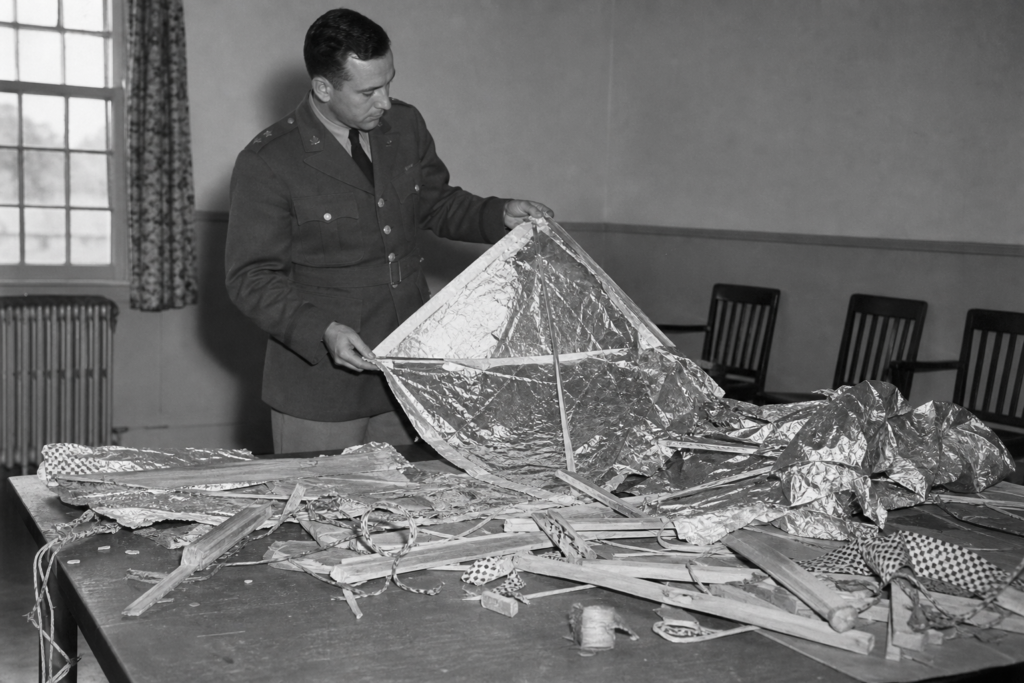
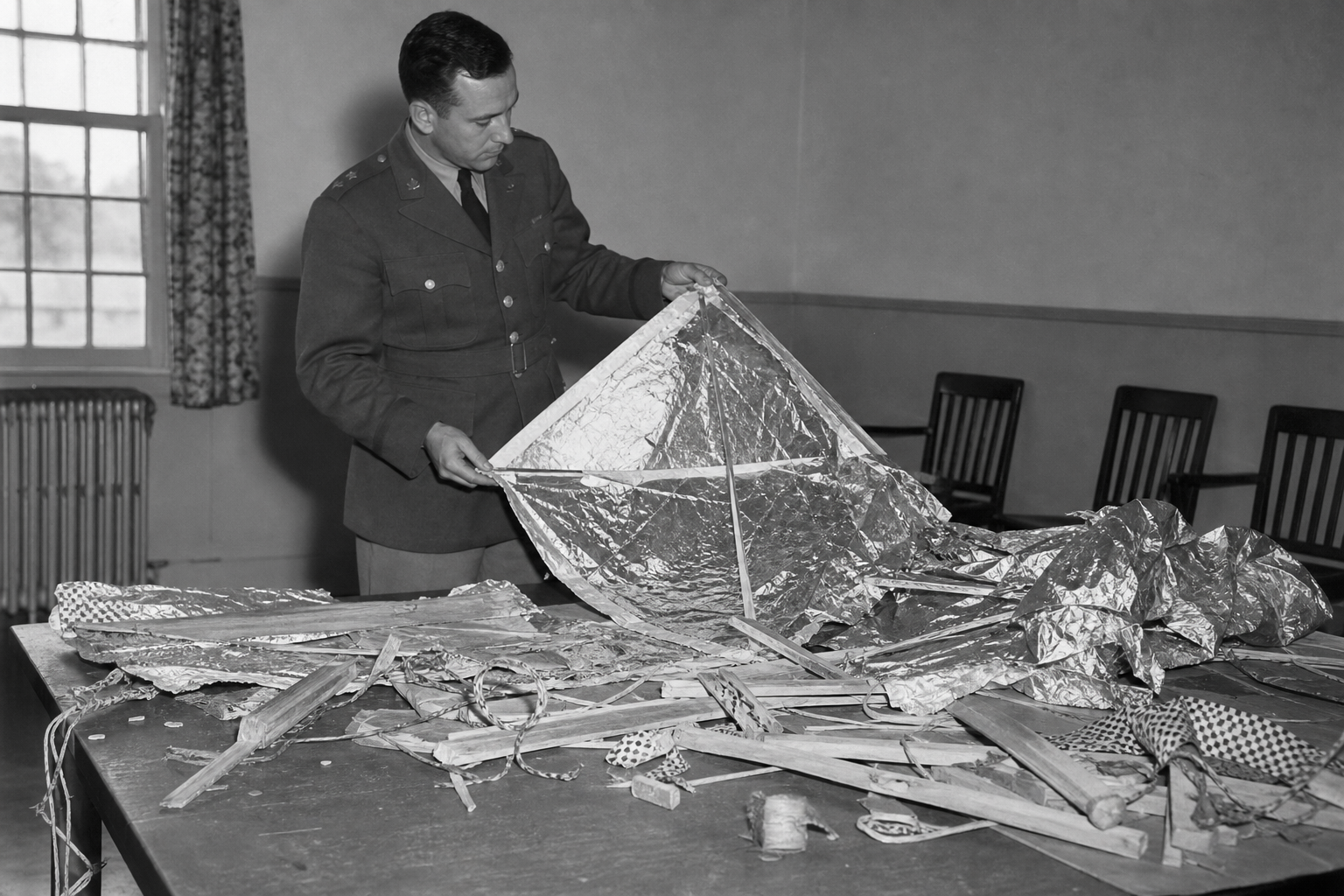
In July 1947, Roswell Army Air Field first announced recovery of a “flying disc,” then identified the displayed material as a balloon and radar target. Jesse Marcel, an intelligence officer who helped handle debris gathered from a ranch outside Roswell, later described some of it as remarkably light, strong, and unlike familiar military material.
Those accounts are not interchangeable. Newspaper reports, photographs, and military statements made in July 1947 are contemporaneous records: they show what officials said and displayed at the time, but do not preserve every item collected from the ranch. Marcel’s detailed descriptions come chiefly from interviews given decades later; they are important firsthand recollections, yet their distance from the event affects what they can establish.
This article follows that distinction rather than treating Roswell as a test of belief. It compares Marcel’s claims about the recovered debris with the Army’s initial balloon account and the later Project Mogul explanation, a classified balloon-and-radar-target system designed for high-altitude detection work, not simply an ordinary weather balloon. The public record documents a disputed recovery and competing interpretations; it does not publicly verify recovery of an extraterrestrial craft.
Jesse Marcel, Roswell, and the Evidence Question
The useful question is narrower than the mythology that later grew around Roswell: what can be learned from Marcel’s own account of the ranch debris when it is weighed against records made in July 1947 and against the military explanation that developed over time?
Four kinds of evidence require different weight. Contemporaneous documentation includes the Army’s press statements, newspaper reporting, and photographs produced during the recovery; it is strongest for establishing the public sequence of events, though incomplete about every object gathered. Later recollections include Marcel’s interviews decades afterward, which offer detailed firsthand memories but cannot be treated as a verbatim 1947 record. Official interpretations are the Army’s initial balloon-and-radar-target identification and the later Air Force Project Mogul conclusion; these explain what officials believed the material was, rather than independently proving that every reported fragment came from one source.
Unverified allegations, especially claims of recovered craft, bodies, or a wider concealment operation, remain outside what the public physical record establishes. The analysis therefore stays focused on the July 1947 Roswell UFO incident: Marcel’s role in the recovery, the characteristics he later attributed to the debris, and whether a high-altitude balloon train with radar reflectors plausibly accounts for those descriptions. Uncertainty in particular details is not evidence for either an extraterrestrial recovery or a complete official reconstruction.
What the 1947 Record Says Happened
A scattered field of lightweight wreckage on the Foster ranch northwest of Roswell set the documented episode in motion. Rancher W. W. “Mac” Brazel brought the matter to Chaves County Sheriff George Wilcox, who notified the military; Maj. Jesse Marcel, the base intelligence officer, joined the response and handled material recovered from the ranch. That role makes Marcel a central witness to the Roswell 1947 debris, but the surviving record contains neither a complete inventory nor a forensic map of the field.
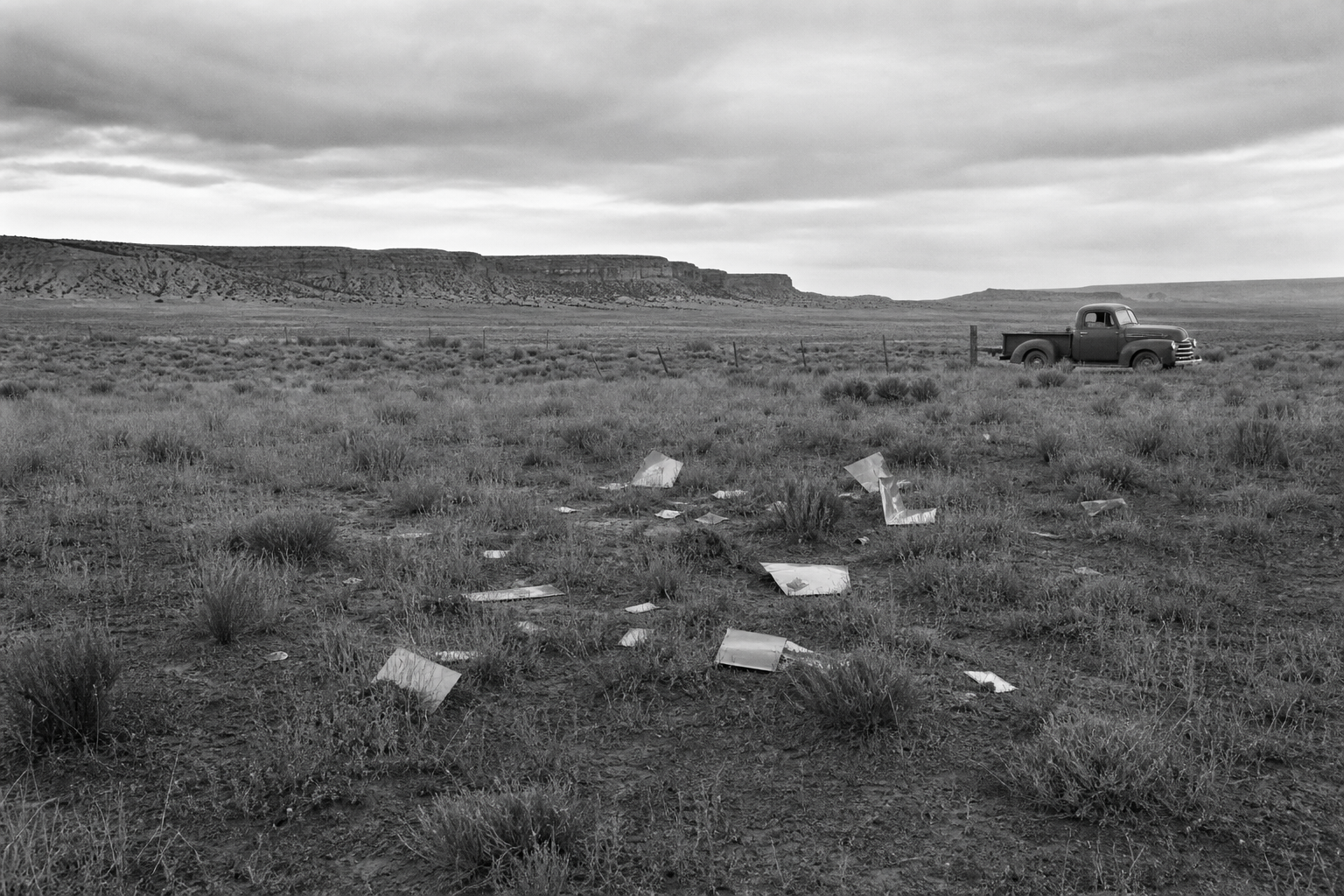
On July 8, public information officer Walter Haut issued a short, extraordinary release from Roswell Army Air Field. It said personnel had “come into possession of a flying saucer” with the cooperation of a local rancher and the sheriff’s office, and that the object had gone to higher headquarters. The language recorded the Army’s initial public characterization, not a technical identification. Contemporaneous newspaper accounts, including the Roswell Daily Record, preserve the announcement and show how rapidly it became national news.
Within hours, the public account changed in Fort Worth. Brig. Gen. Roger Ramey, commander of the Eighth Air Force, told reporters that the recovered object was a weather balloon and radar target. Published photographs show Ramey and Marcel in Ramey’s office with foil-like strips, broken sticks, rubber, and portions of a kite-shaped radar reflector. Their evidentiary value is narrow but important: they document what Fort Worth reporters were shown during the reversal and Marcel’s participation in that presentation.
The photographs do not establish that every displayed item came from the Foster ranch, that the display represented the full recovery, or what was spread across the original debris field. Likewise, the “flying disc” headline does not identify an extraterrestrial object; next-day reporting records the balloon-and-target explanation. The 1947 record securely fixes the sequence, ranch report, military collection, dramatic release, and Fort Worth reclassification, while leaving the original field’s composition and extent incompletely documented.
What Jesse Marcel Said About the Debris
Marcel’s fuller account emerged not in the July 1947 press coverage but in interviews and publications roughly three decades later. In those retrospective statements, he described material he believed was exceptionally light for its apparent strength: thin, foil-like pieces that could be crumpled yet seemed to recover their shape, along with small beam or structural members. He also recalled markings on some pieces that he regarded as unfamiliar, sometimes characterizing them as unlike ordinary writing.
Those Jesse Marcel debris claims went well beyond the limited public posture visible in 1947. The Fort Worth presentation associated the recovered material with a conventional balloon and radar target; Marcel’s later testimony instead emphasized properties that, in his view, did not resemble anything he recognized from his military experience. That is a meaningful difference in description, but it is not the same as a preserved 1947 technical finding that the material possessed those properties.
The distinction turns on evidentiary type. Marcel was a firsthand participant in the recovery, so his recollections deserve attention as witness testimony. Yet the detailed descriptions were recorded decades after the event, rather than in a contemporary inventory, laboratory report, or sworn 1947 statement. A long interval can affect eyewitness memory through later discussion, repeated retelling, and the tendency to consolidate separate impressions into a coherent narrative; it does not automatically mean that a witness is insincere or wholly mistaken.
Nor do Marcel’s later remarks publicly establish an extraterrestrial origin for the debris. They establish that he later believed parts of the recovery were extraordinary and distinct from the balloon explanation presented to reporters. The evidentiary checkpoint is therefore specific: unusual-material descriptions are retrospective testimony, while the surviving 1947 record documents the Army’s public balloon-and-target identification without preserving a complete physical record capable of independently testing Marcel’s recollections.
The Balloon Explanation: Weather Balloon in 1947, Project Mogul Later
The material displayed in Fort Worth included crumpled reflective pieces, wooden frame members, string, and tape, the sorts of remnants the Army publicly identified in 1947 as a weather balloon and its radar reflector. A radar target was a lightweight reflective structure carried aloft so ground stations could follow the balloon; once broken apart, it could leave foil-like panels, sticks, and fastening material. That public identification was simple and contemporaneous, but it was not a full technical reconstruction of the debris field.
In its 1994 Roswell report, the U.S. Air Force offered a more specific later conclusion: the likely source was a Project Mogul balloon train. Project Mogul was a classified postwar effort that lofted acoustic equipment to detect distant Soviet nuclear tests. Unlike a single meteorological balloon, a train linked multiple balloons, instruments, lines, and radar targets into a larger airborne array. The program’s secrecy explains why the 1947 public account did not name it.
That distinction matters when comparing the Roswell balloon explanation with Marcel’s later recollections. Project Mogul-related equipment could include neoprene balloons, balsa-wood struts in radar-target frames, thin reflective foil, and decorated tape used in target construction. Foil and lightweight structural members broadly match categories Marcel later described. Printed or colorful tape also provides a mundane possible counterpart to his reports of unfamiliar markings, particularly because tape decoration was associated with a New York manufacturer.
The fit is not exact on every point. A balloon-train explanation can account for a scattered mixture of light, fragile materials and for components that might appear unfamiliar after weather exposure and recovery. It does not independently demonstrate that every property Marcel later recalled, especially material said to resist damage or resume its shape, was present in the 1947 debris. The evidentiary categories remain distinct: the weather-balloon identification is a contemporaneous public record; Project Mogul is the Air Force’s later explanatory conclusion; Marcel’s exceptional-material account is retrospective testimony.
Project Mogul should not be reduced to “just a weather balloon.” Its multi-part, classified apparatus was more elaborate than the 1947 shorthand suggests. Yet documented components alone do not settle every uncertainty about the Roswell recovery, and the public record has not produced verified physical evidence establishing an extraterrestrial craft.
How Well Does Project Mogul Fit Marcel’s Account?
The comparison is strongest when it stays with material categories rather than asking one explanation to account for every later detail at once. The 1994 Air Force report treated a June 4, 1947 Project Mogul flight as the likely origin of the ranch debris, but that attribution is an official reconstruction, not a chain of custody linking a particular recovered fragment to a particular launch.
| Marcel’s later description | Project Mogul fit | Limit on the comparison |
|---|---|---|
| Foil-like material | Strong: radar targets used reflective foil surfaces. | Foil alone cannot identify a specific flight or recovery site. |
| Small, light structural pieces | Strong: balsa-wood framing and attached lines would create light mixed wreckage. | No publicly testable artifact ties Marcel’s recollection to those components. |
| Tape and unusual-looking marks | Plausible: decorated tape on radar-target assemblies offers a mundane counterpart to reported symbols. | It does not establish that every mark Marcel later recalled was tape decoration. |
| Material that resisted damage or resumed its shape | Partial at best: thin foil and balloon material can look unfamiliar after outdoor exposure. | Known Mogul materials do not independently reproduce the more exceptional properties Marcel described. |
This is why the Project Mogul account is more substantive than the 1947 shorthand “weather balloon”: it offers identifiable categories of equipment that correspond to several reported debris types. Its weak point is attribution. Surviving launch records, recovery accounts, and later reconstructions do not provide an unbroken documentary record from the proposed Mogul flight to the Foster-ranch material.
Later allegations of a government UFO cover-up, craft, or non-human occupants add claims but not independently authenticated physical evidence; decades-old recollection has less weight than a contemporaneous inventory or preserved specimen. Neither the available documentary record nor Marcel’s testimony verifies recovery of an extraterrestrial craft.
Bottom Line: A Compelling Witness, but Not Conclusive Proof
A key evidentiary checkpoint is timing: Marcel handled the 1947 recovery, but his most striking claims, unusually resilient material and unfamiliar markings, were recorded decades later, not in a preserved inventory from the event. The July record establishes a real debris recovery and a swift shift from “flying disc” publicity to an ordinary military explanation; it does not establish the nature of every item Marcel later remembered.
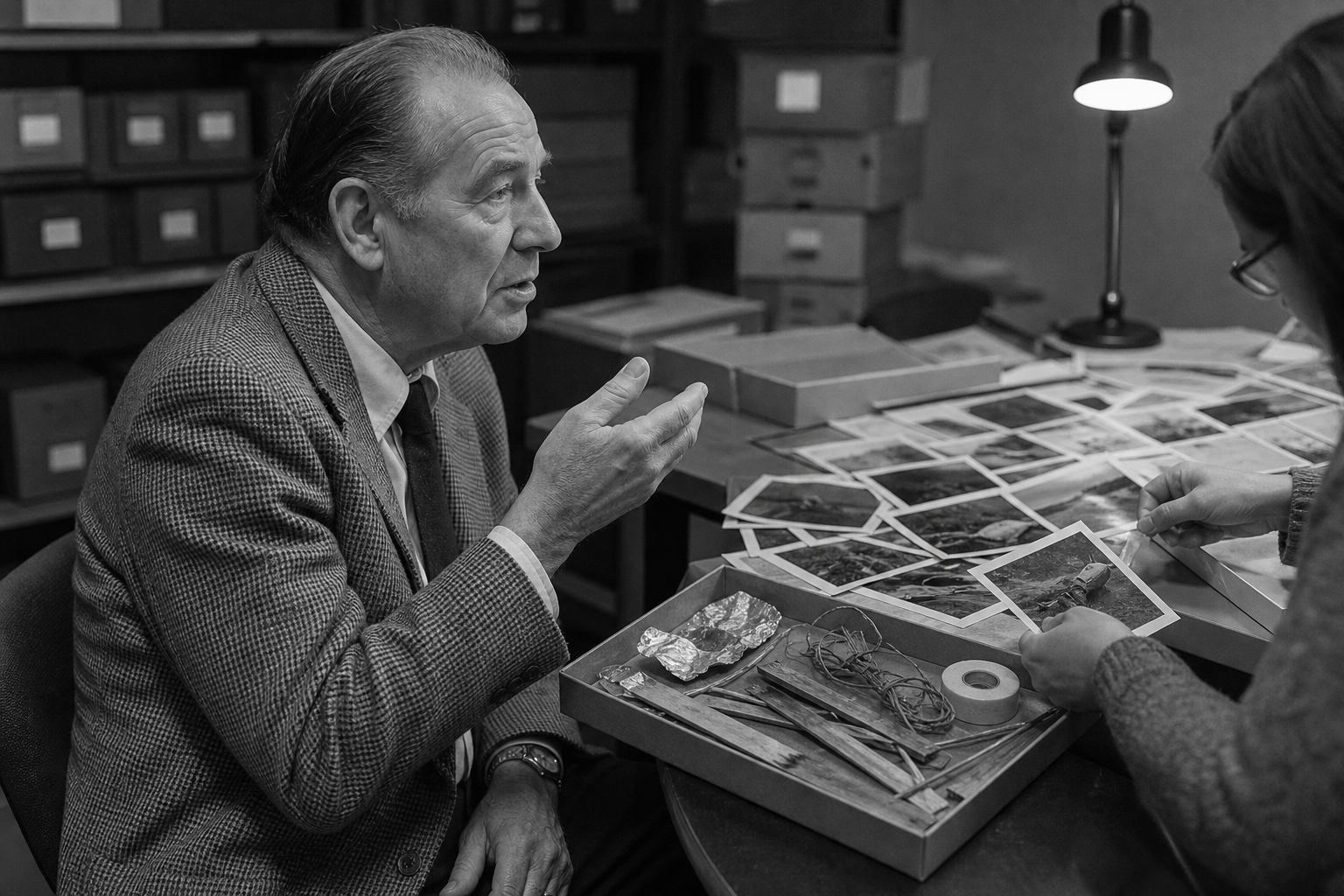
Project Mogul provides a materially plausible account of foil, light framing, line, and decorated tape, though the proposed link between a particular flight and the Foster-ranch debris remains a reconstruction rather than a complete chain of custody. The Jesse Marcel Roswell incident therefore shows why firsthand testimony matters most when it is supported by timely records or physical specimens. Publicly verified evidence does not establish an extraterrestrial recovery, alien craft, non-human intelligence, or a proven Roswell cover-up, limits that remain central to responsible UFO disclosure debates.
What the Jesse Marcel Evidence Can, and Cannot, Show
The decisive gap is evidentiary rather than rhetorical: no preserved, publicly authenticated fragment links Marcel’s later descriptions of unusually resilient material or unfamiliar markings to an extraterrestrial vehicle, or, for that matter, conclusively to a particular Mogul flight.
His direct participation gives his recollections real historical value. But the record is strongest where it was created closest to the event: the July 1947 recovery, Roswell Army Air Field’s “flying disc” announcement, and the rapid Fort Worth identification of balloon-and-radar-target material. Marcel’s more extraordinary characterizations entered the public record much later, leaving memory, intervening retellings, and absent physical specimens as substantial limits on what they can prove.
The military’s balloon explanation also has two evidentiary levels. The 1947 statement identified ordinary balloon equipment; the later Project Mogul account supplied a more detailed candidate system whose foil reflectors, balsa elements, cord, and patterned tape can account for several debris categories. That stronger material match does not create a complete recovery trail from the Foster ranch to one documented launch.
The appropriate conclusion is therefore bounded. The public record confirms an unusual and confused military recovery episode involving a witness who later rejected the simple explanation offered in 1947. It does not publicly verify an extraterrestrial craft, non-human occupants, or a proved concealment operation. Uncertainty about individual details remains historical uncertainty, not affirmative proof for either side.
Frequently Asked Questions
-
What did Jesse Marcel say he found at the Roswell debris field?
Jesse Marcel later described thin, foil-like material that was unusually light and strong, small structural members, and markings he considered unfamiliar. His detailed descriptions were recorded roughly three decades after the July 1947 recovery rather than in a contemporary inventory or laboratory report.
-
Did Jesse Marcel initially identify the Roswell debris as a weather balloon?
In July 1947, Marcel appeared with Brig. Gen. Roger Ramey in Fort Worth as reporters were shown foil-like strips, broken sticks, rubber, and parts of a kite-shaped radar reflector. The military publicly identified the displayed material as a weather balloon and radar target, while Marcel’s later interviews rejected that simple explanation.
-
What was Project Mogul and why is it connected to Roswell?
Project Mogul was a classified postwar balloon system designed to carry acoustic equipment for detecting distant Soviet nuclear tests. Its balloon trains used multiple balloons, instruments, lines, radar targets, reflective foil, balsa-wood framing, and tape, making it a more detailed explanation than a single weather balloon.
-
How well does Project Mogul match Jesse Marcel’s debris description?
Project Mogul strongly matches foil-like material and lightweight structural pieces because its radar targets used reflective foil and balsa-wood frames. It offers a plausible explanation for unusual-looking tape markings, but known Mogul components do not independently reproduce Marcel’s claims that some material resisted damage or returned to its original shape.
-
What evidence would be needed to prove an extraterrestrial craft was recovered at Roswell?
Proof would require a preserved, publicly authenticated specimen with a documented chain of custody linking it to the Foster ranch recovery and analysis showing nonhuman origin. No such physical evidence is publicly verified, and the available record does not establish an extraterrestrial craft, non-human occupants, or a proven cover-up.