Jesse Marcel and the 1947 Roswell Incident: Key Claims About Recovered Debris and Balloon Explanations
Explore the Jesse Marcel Roswell incident: compare 1947 debris reports, later testimony, and weather balloon and Project Mogul explanations.
The Jesse Marcel Roswell incident endures because its public record begins with a sharp reversal: the Army initially announced a recovered “flying disc,” then identified the material as balloon-related debris. Marcel, an intelligence officer involved in the recovery, later became central to the story when he described what he handled in far more unusual terms than the material displayed to reporters in 1947.
That gap does not, by itself, settle what lay on the ranch. It defines the historical problem. The closest records include press reports, military statements, and photographs showing foil-like material, lightweight sticks, rubber, and tape. Decades later, Marcel described exceptionally light and strong pieces, including markings he regarded as unfamiliar. Supporters treat those later details as evidence that the public display was incomplete or substituted; skeptics regard the contemporary record as a better guide to the recovered material.
This article separates those categories of evidence rather than treating them as interchangeable. It compares the Army’s immediate weather-balloon explanation with the later Project Mogul account, which linked the debris to a classified balloon-borne detection system. The aim is not to force an extraordinary conclusion, but to establish what each account explains, where the accounts conflict, and what the surviving record cannot conclusively resolve.
Roswell, Jesse Marcel, and the Limits of the Historical Record
Historical weight depends partly on proximity to the event. July 1947 Army statements, newspaper dispatches, photographs made for reporters, and surviving military records show what officials publicly described at the time and what material was displayed. They do not automatically establish that every item collected from the ranch reached the press. Later interviews with Jesse Marcel, given decades after the recovery, preserve his personal recollections but require a different assessment: memory, interview context, and corroboration matter alongside the details he supplied.
The disputed features are specific. Marcel later characterized some debris as extraordinarily light and resistant to damage, with foil-like pieces and unfamiliar markings; advocates see those descriptions as inconsistent with ordinary balloon equipment. The public 1947 account instead involved foil, lightweight sticks, rubber, and tape, materials compatible with a balloon and radar target. The later Air Force Project Mogul conclusion offers a more elaborate balloon-based interpretation than the immediate weather-balloon explanation, but it is itself a retrospective reconstruction rather than a 1947 identification.
The useful question, then, is where these records converge and where they do not, not which narrative feels most satisfying in hindsight. Gaps in chain of custody, conflicting recollections, or uncertainty over displayed debris can leave questions open. They do not, without independent supporting evidence, demonstrate an extraterrestrial object, non-human intelligence, or a deliberate cover-up.
What Happened in July 1947: Recovery, Press Release, and Retraction
The public sequence moved quickly. Rancher W. W. “Mac” Brazel reported scattered material from his property northwest of Roswell to Sheriff George Wilcox in early July; personnel from the 509th Bombardment Group at Roswell Army Air Field then examined and collected material. Major Jesse Marcel, the group’s intelligence officer, was among the officers associated with that recovery.
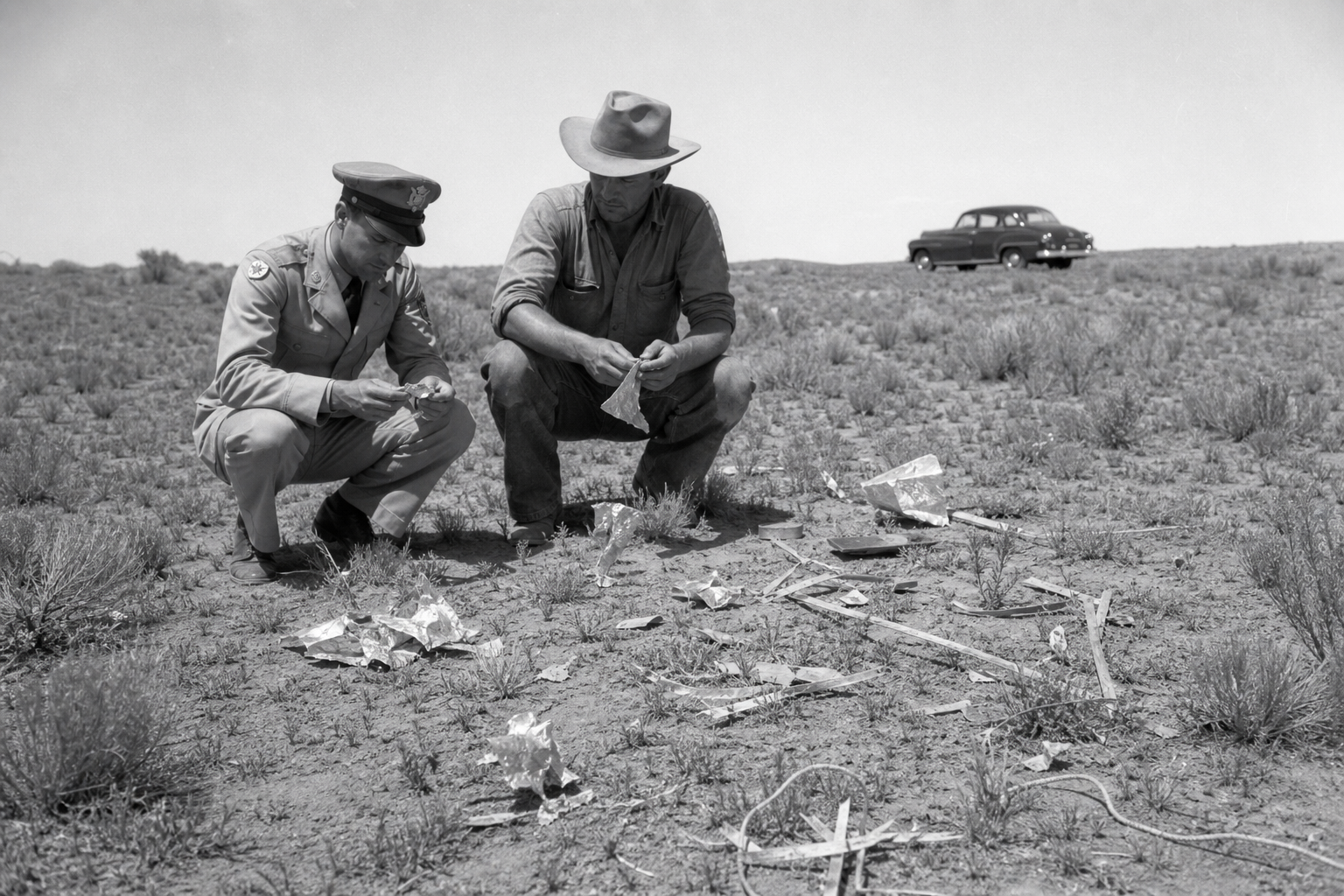
On July 8, Roswell Army Air Field issued a press release declaring that it had “come into possession of a flying disc” and that the object had been sent to higher headquarters for examination. In the language of the moment, “flying disc” reflected the nationwide 1947 wave of disc reports; the announcement did not describe a craft, occupants, a crash site, or an extraterrestrial origin. Its significance is narrower but substantial: the base publicly characterized the recovered material before specialists at Fort Worth presented a different identification.
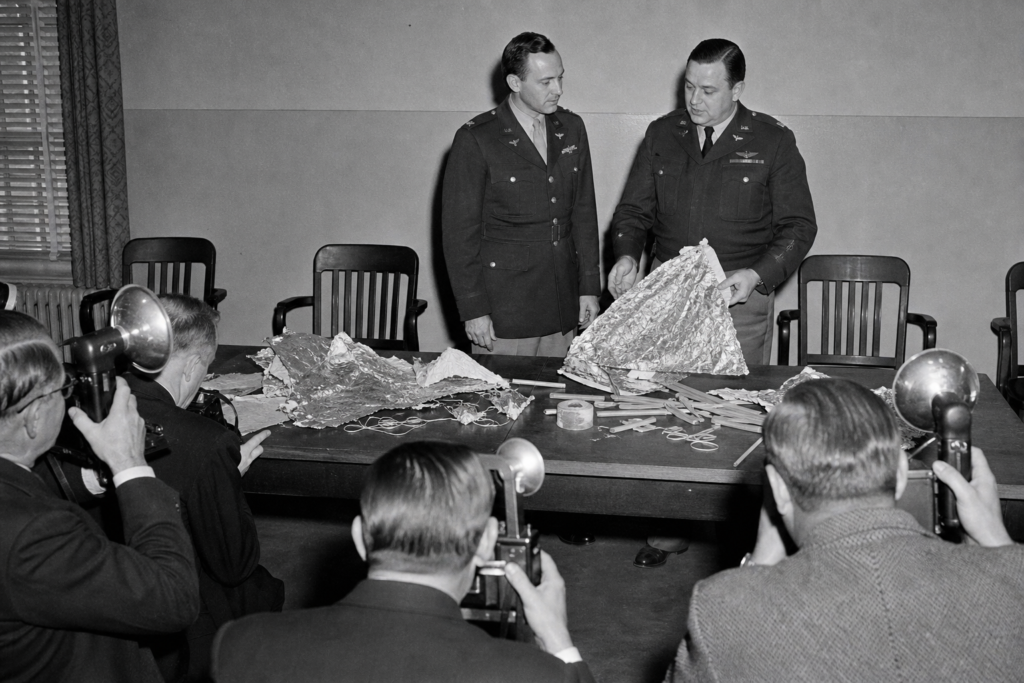
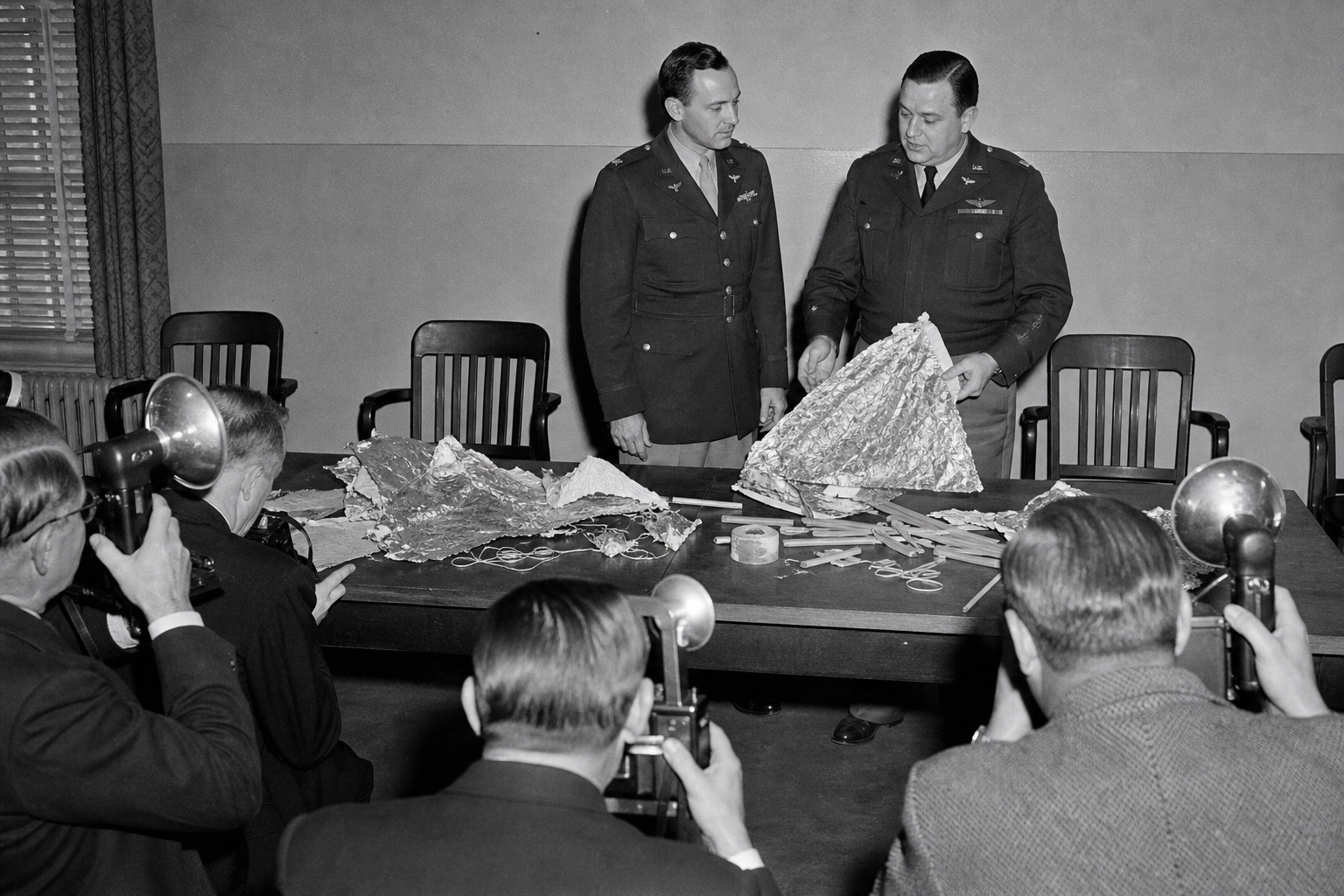
The material was flown to Fort Worth Army Air Field, where Brig. Gen. Roger Ramey’s office told reporters later on July 8 that it was the remains of a weather balloon and radar target. A radar target was a lightweight reflective device suspended beneath a balloon so radar operators could track it; its foil-like surfaces, sticks, tape, and rubber components fit that explanation. Newspaper photographs made at Fort Worth showed debris officials presented as balloon-target material. The same-day reversal therefore records an official reclassification, not a documented explanation of every item anyone may later have recalled from the ranch.
What Contemporary Reports and Photographs Said About the Debris
Contemporaneous newspaper reports narrowed the public description to ordinary-looking components rather than a complete object. Accounts from Roswell, Fort Worth, and wire services described pieces identified in the official briefing as rubber, foil or paper-like reflective material, lightweight sticks, and parts of a radar target. Those descriptions matter because they record what reporters were told within hours of the reversal; they are not independent inventories made at the ranch.
The photographs taken at Fort Worth Army Air Field provide a different kind of near-time evidence. They show Major Jesse Marcel and other officers with crumpled reflective material, narrow wooden members, and other fragments laid out for the press. A radar target used a light framework and reflective surfaces to make a balloon more visible to radar, so the displayed combination was consistent with the Army’s announced identification. The images establish that this material was presented to reporters. They do not establish that every photographed piece came from the same location, represented the entire collection, or was identical to every fragment Marcel had handled.
That distinction is central to interpreting the Roswell incident debris. A strong reading of the 1947 record separates direct visual evidence, the items visible in the photographs, from official characterization, the claim that they were balloon-target remains, and from later inferences about substitution or missing material. A weak reading treats either the press display as a complete chain-of-custody record or the gaps in surviving coverage as proof that it was not. The available newspapers and photographs are incomplete, but they are still the closest public evidence of how the debris was described and displayed in July 1947.
What Jesse Marcel Later Said He Handled and Observed
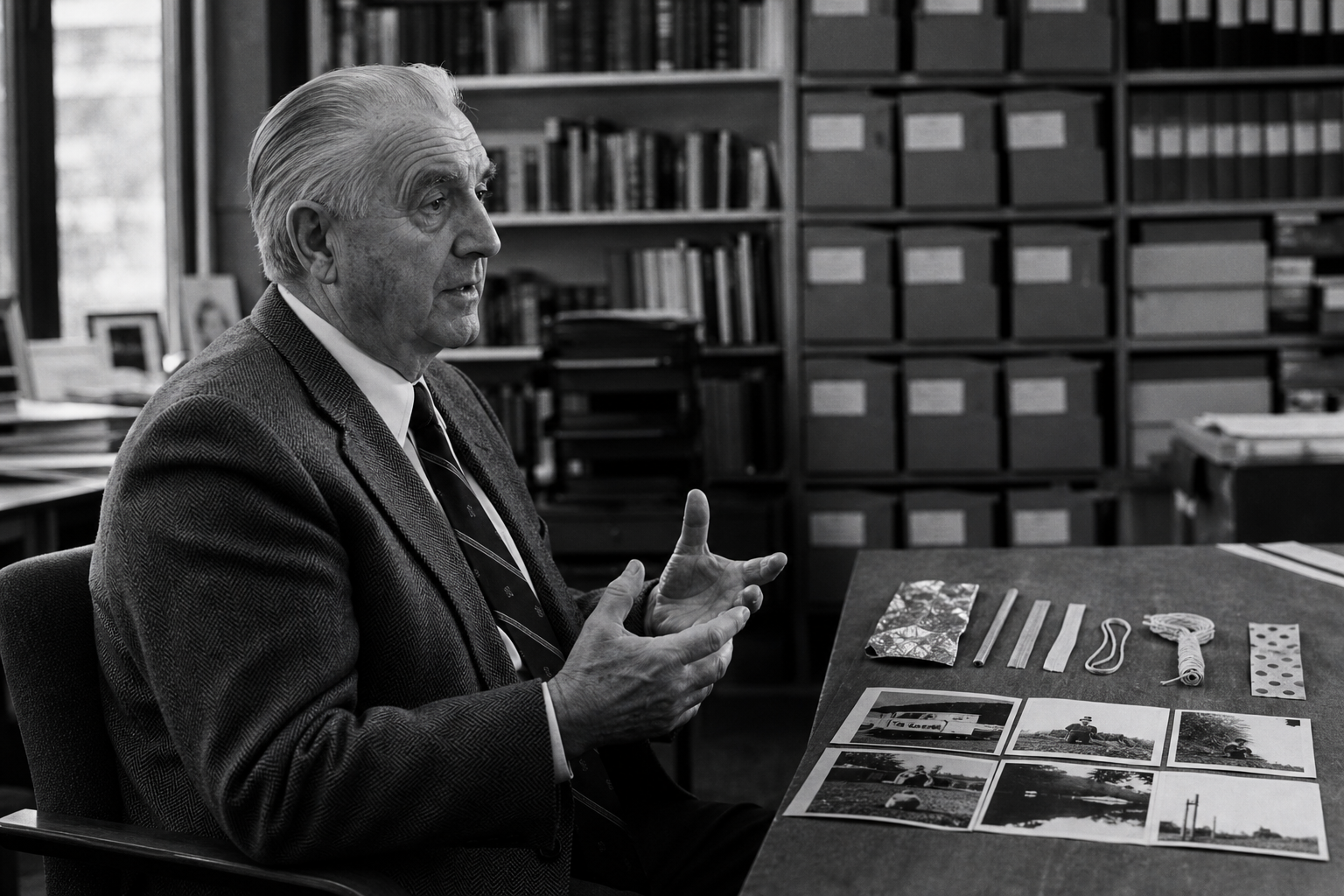
Marcel’s public recollections emerged more than three decades after the recovery. In interviews beginning in 1978, he described Jesse Marcel debris as far stranger than the material displayed at Fort Worth: extremely light pieces that he said could not be burned, cut, or permanently bent, including thin, foil-like sheets that resumed their shape after being crumpled. He also recalled small, lightweight structural members and tape-like strips bearing what he characterized as unusual purple or pink markings.
His later witness interviews also enlarged the setting. Marcel portrayed the ranch material as a broad scatter rather than a compact bundle of wreckage, and said he and others collected fragments over a substantial area. That detail matters because a dispersed debris field can be understood in more than one way: it may reflect a wind-borne balloon train breaking apart, or, in Marcel’s interpretation, something more consequential. His descriptions were personal recollections, however, not a contemporaneous inventory, and their precise dimensions and individual features were not consistently fixed across later tellings.
Marcel repeatedly maintained that the weather-balloon explanation did not match what he believed he had handled. At times he framed the material as beyond ordinary human manufacture, a conclusion that went further than simply saying it was unfamiliar military equipment. That was Marcel’s retrospective judgment about origin, not a demonstrated identification of origin. The historical significance of his account lies in the contrast between that judgment and the 1947 public presentation, not in treating his belief alone as proof of what the debris was.
Weather Balloon First, Project Mogul Later: Why the Explanations Differ
Two balloon-based accounts occupy different places in the record. On July 8, 1947, Fort Worth Army Air Field presented the recovered material as an ordinary weather balloon with a radar target: a simple, immediate identification intended to explain the foil-like sheets, light sticks, rubber, and string shown to reporters. That contemporaneous Roswell balloon explanation did not publicly mention a secret program, a long instrument train, or a particular launch.
The more specific account arrived nearly five decades later. In its 1994 report, the U.S. Air Force concluded that the debris was likely associated with Project Mogul, a classified postwar effort to detect acoustic signatures from possible Soviet nuclear tests. Mogul systems used strings of high-altitude balloons carrying instruments and radar reflectors. Unlike a standard weather balloon assembly, a train could spread components over a wide area after breaking up or descending, a feature relevant to Marcel’s later account and the balloon-based explanation.
The equipment also gives the later explanation a concrete basis for comparison. Radar targets commonly used lightweight balsa-wood framing, reflective foil-like material, and tape; some targets made by the toy company Gilmore incorporated decorative printed tape. Those components offer a conventional interpretation of the sticks, reflective fragments, and reported markings at issue. They do not independently establish that every item Marcel remembered decades later came from such equipment, particularly his claims about exceptional strength or shape recovery.
Classification complicates the identification. The 1947 officers publicly describing a weather balloon were not disclosing Project Mogul, while the 1994 Air Force reconstruction relied on later records, launch information, and an assessment of which flights could have reached the ranch area. Its conclusion was therefore more detailed than the original explanation, but not a recovered, item-by-item inventory tied conclusively to one named Mogul flight. The distinction matters: Project Mogul Roswell is a retrospective official attribution, not proof that the July 1947 public account was unchanged.
Where the Accounts Match, Conflict, and Remain Uncertain
The comparison is strongest when each feature is kept separate. Foil-like material, fragile-looking sticks, rubber, cord, and patterned tape fit the kind of radar-target components associated with balloon equipment; a dispersed field is also compatible with a broken-up balloon train. Those points explain why the 1994 U.S. Air Force Roswell report could offer a coherent conventional reconstruction.
Marcel’s later account conflicts most sharply on material behavior. He did not merely recall lightweight fragments or marked tape: he described pieces he believed resisted cutting, burning, bending, and crushing, and he regarded the public display as unrepresentative of what he recovered. No surviving 1947 inventory independently records those exceptional properties. The photographs establish that some material was shown at Fort Worth, but not a complete chain of custody from the ranch to the press room.
Timing shapes the weight of the evidence. Contemporary descriptions from the 1947 flying-disc wave are closer to the recovery but reflect official handling and explanation; Marcel’s detailed claims came decades later, when memory can consolidate, alter, or be shaped by later discussion. Secrecy surrounding Mogul likewise helps explain why the original public account was incomplete, but secrecy alone does not demonstrate substitution or concealment.
The source chronology therefore leaves real evidentiary limits. The balloon and Mogul explanations plausibly address several reported physical features and the reported spread of debris; they do not conclusively disprove Marcel’s personal recollections. Conversely, those recollections do not establish a non-balloon origin without contemporaneous, traceable material or corroborating records. The 1997 Air Force report addressed later body-related stories separately; such claims are outside the debris question and remain unestablished by this record.
What Can Be Said Responsibly About Marcel and Roswell
The enduring importance of Marcel’s testimony lies in the distance between his later recollection and the material presented to reporters in Fort Worth. His interviews, beginning in 1978, described foil-like fragments, light structural pieces, marked tape, and exceptional strength as evidence of something outside ordinary manufacture. The July 1947 photographs and press accounts instead show material officials identified as balloon and radar-target components. Neither record can simply replace the other: one preserves a later participant’s account; the other preserves the public evidence and official identification nearest the event.
The official narrative also requires precision. The Army’s 1947 explanation was a weather balloon and radar target. The U.S. Air Force’s 1994 account was more specific, identifying Project Mogul, a then-classified balloon-borne acoustic detection effort, as the likely origin. A later, fuller explanation can reflect declassification and archival reconstruction; it does not, by itself, prove either that the first explanation was complete or that officials concealed an extraterrestrial recovery.
That is the responsible boundary for the Jesse Marcel Roswell incident. The documented record supports scrutiny of conflicting descriptions, incomplete custody records, and changing official accounts. It does not establish alien technology, non-human intelligence, or a government UFO cover-up. Modern debates about UFO disclosure ask broader questions than this historical episode can answer; Roswell’s surviving evidence leaves important uncertainty, but uncertainty is not affirmative proof of the extraordinary conclusion.
Frequently Asked Questions
-
What did Jesse Marcel say the Roswell debris looked like?
In interviews beginning in 1978, Jesse Marcel described extremely light foil-like pieces, small structural members, and tape-like strips with unusual purple or pink markings. He said some fragments could not be burned, cut, permanently bent, or crushed and would return to their original shape.
-
Why did the military first describe Roswell debris as a weather balloon?
On July 8, 1947, Fort Worth Army Air Field identified the material as a weather balloon and radar target after Roswell Army Air Field had announced a recovered flying disc. The displayed debris included reflective foil-like material, lightweight sticks, rubber, tape, and string, which matched balloon radar-target components.
-
What do the 1947 Roswell newspapers and photographs show about the debris?
Contemporary reports described rubber, foil or paper-like reflective material, lightweight sticks, and radar-target parts. Fort Worth photographs showed Jesse Marcel and other officers with crumpled reflective material and narrow wooden members presented as balloon-target debris.
-
What was Project Mogul and why is it connected to Roswell?
Project Mogul was a classified postwar program that used high-altitude balloon trains, instruments, and radar reflectors to detect possible Soviet nuclear-test acoustic signatures. In 1994, the U.S. Air Force concluded that Roswell debris was likely linked to Mogul, whose balsa framing, reflective material, and printed tape could explain several reported debris features.
-
How should you evaluate the weather-balloon and Project Mogul explanations against Jesse Marcel’s account?
Look for independently documented features: foil-like material, light sticks, rubber, cord, patterned tape, and a dispersed field are compatible with balloon and radar-target equipment. Marcel’s later claims of exceptionally strong, shape-recovering material lack a surviving 1947 inventory or traceable physical evidence, while the photographs do not prove that all recovered material was displayed.