Roswell Incident: 1947 Army Press Release Claimed Capture of a “Flying Saucer” Near Roswell, New Mexico
Explore the Roswell Incident 1947 Army press release, its swift balloon reversal, and the later Project Mogul explanation.
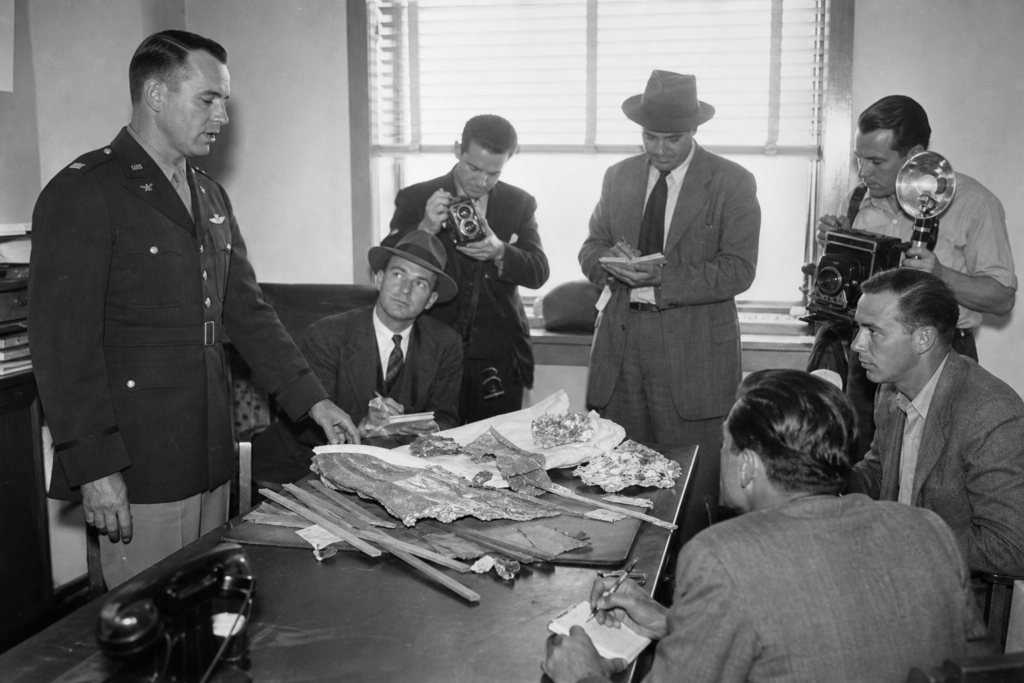
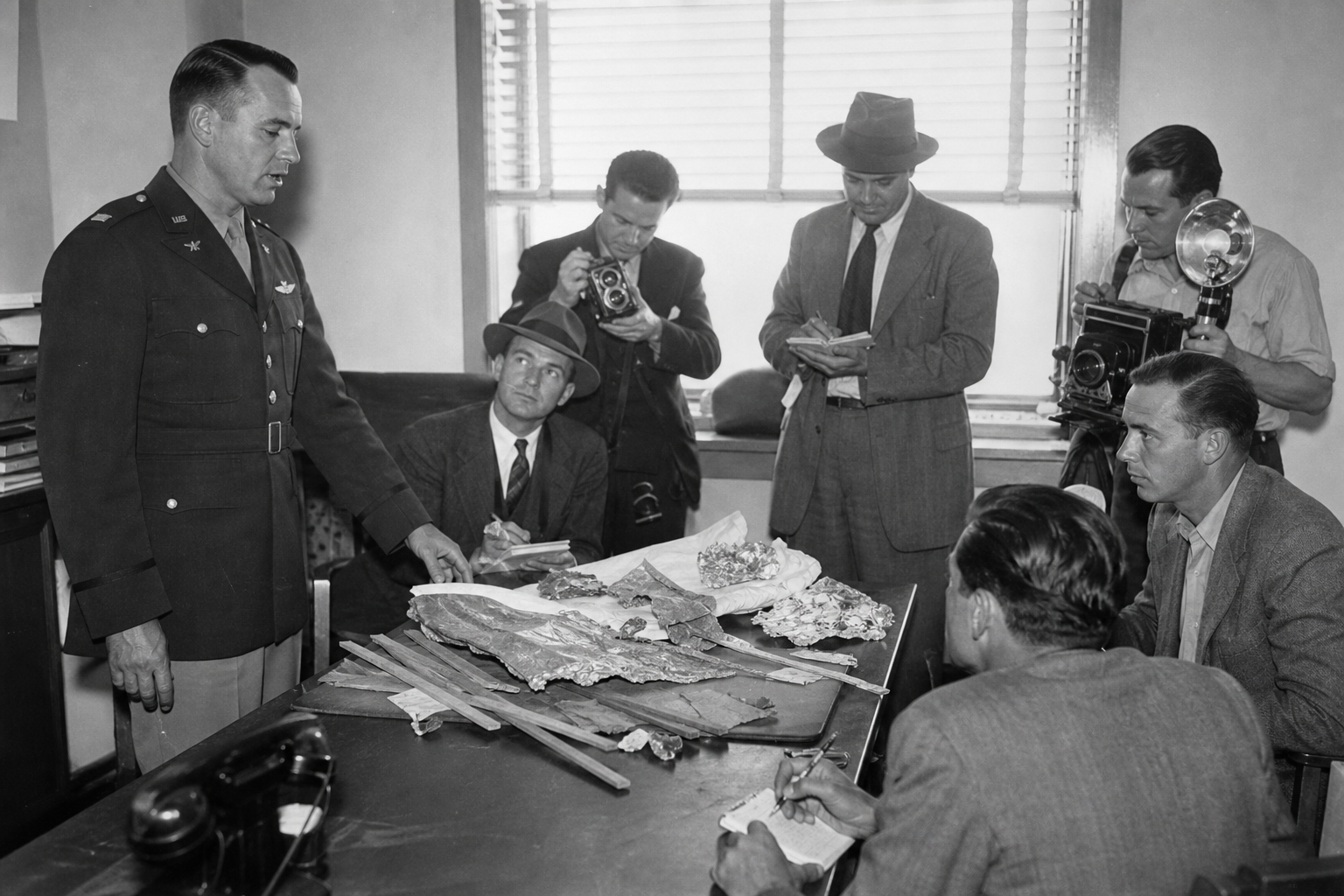
On July 8, 1947, Roswell Army Air Field publicly announced that it had recovered a “flying disc,” language widely rendered in headlines as a flying saucer. That confirmed public statement is the essential starting point of the Roswell Incident 1947 Army press release, not evidence that the Army had established an extraterrestrial origin.
The account changed with remarkable speed. By July 9, Army officials at Fort Worth were presenting the recovered material as the remains of a weather balloon. This article follows that shift through dated releases, contemporary newspaper coverage, official records, and surviving photographs, separating what the 1947 record documents from claims that emerged years later.
One distinction matters throughout: the original Roswell announcement used “flying disc” language, while the more detailed Project Mogul account came decades afterward in official Air Force investigations. Project Mogul is therefore a later explanation for the debris, not wording contained in the July 8 release. The historical question is not whether every later interpretation can be settled here; it is how and why an Army installation made an extraordinary public claim, then saw it replaced almost immediately by a far more ordinary one.
Why the July 1947 Roswell Release Still Matters
What matters first is the evidentiary boundary: the surviving public language records an official claim, not the nature of the object claimed. The July 8 announcement described recovery of a “flying disc”; it did not identify an extraterrestrial craft, alien occupants, or non-human intelligence.
Within roughly a day, that public account had changed. On July 9, Fort Worth Army Air Field presented the material as a weather balloon, creating a dated contradiction at the center of the Roswell incident. The reversal makes the episode a communications history as well as a mystery: the initial announcement, replacement explanation, newspaper coverage, and photographs can be weighed by date and provenance rather than merged into one undifferentiated narrative.
This article therefore uses a deliberately narrow method. A July 1947 release or newspaper page establishes what officials publicly represented at that moment; it does not settle later allegations about the debris, its origin, or an alleged concealment. Later testimony can illuminate how people remembered events and why Roswell persisted in UFO news, but it cannot substitute for the original wording, chronology, or limits of the contemporary record.
What the July 8 Roswell Army Air Field Statement Said
“The many rumors regarding the flying disc became a reality yesterday” is the release’s crucial opening claim. Dated July 8, 1947, the announcement continued that the intelligence office of the 509th Bombardment Group had gained possession of a disc through the cooperation of a local rancher and the Chaves County Sheriff’s Office.
Walter Haut, the installation’s public information officer, issued the statement. The 509th Bombardment Group was the unit named in its text, but the claimed recovery was attributed specifically to its intelligence office, not to a civilian investigator or to a publicly described scientific examination. This is the documentary core of the Roswell 1947 flying saucer press release.
The remaining language gave a short chain of custody. It said the object had come down on a ranch near Roswell “sometime last week”; the rancher retained it because he lacked telephone facilities, then contacted the sheriff’s office, which notified Maj. Jesse A. Marcel of the 509th intelligence office. Personnel collected the disc at the rancher’s home, inspected it at the base, and sent it to higher headquarters for inspection.
“Flying disc” was contemporary language for reports of unusual aerial objects then filling news coverage; newspapers commonly rendered the phrase as “flying saucer.” The wording characterized the reported material without identifying it as a manufactured spacecraft. Haut’s statement gave no dimensions, material description, account of construction, occupants, bodies, or extraterrestrial origin.
The distinction is between what the release actually claimed, possession of material called a flying disc, and later assertions about what that material may have been. The weather-balloon account issued the following day replaced the initial public explanation; it was not part of the Walter Haut press release.
How Ranch Debris Became a National Flying-Disc Story
The local account began with rancher W. W. Brazel, whose reported discovery of scattered debris became the human link in the short chain described by the base. Contemporaneous newspaper coverage identified Brazel as the rancher who found unusual material on the Foster ranch, northwest of Roswell, after a period of stormy weather. Those reports are evidence of what Brazel and local officials told reporters in July 1947; they are not, by themselves, a verified technical classification of the material.
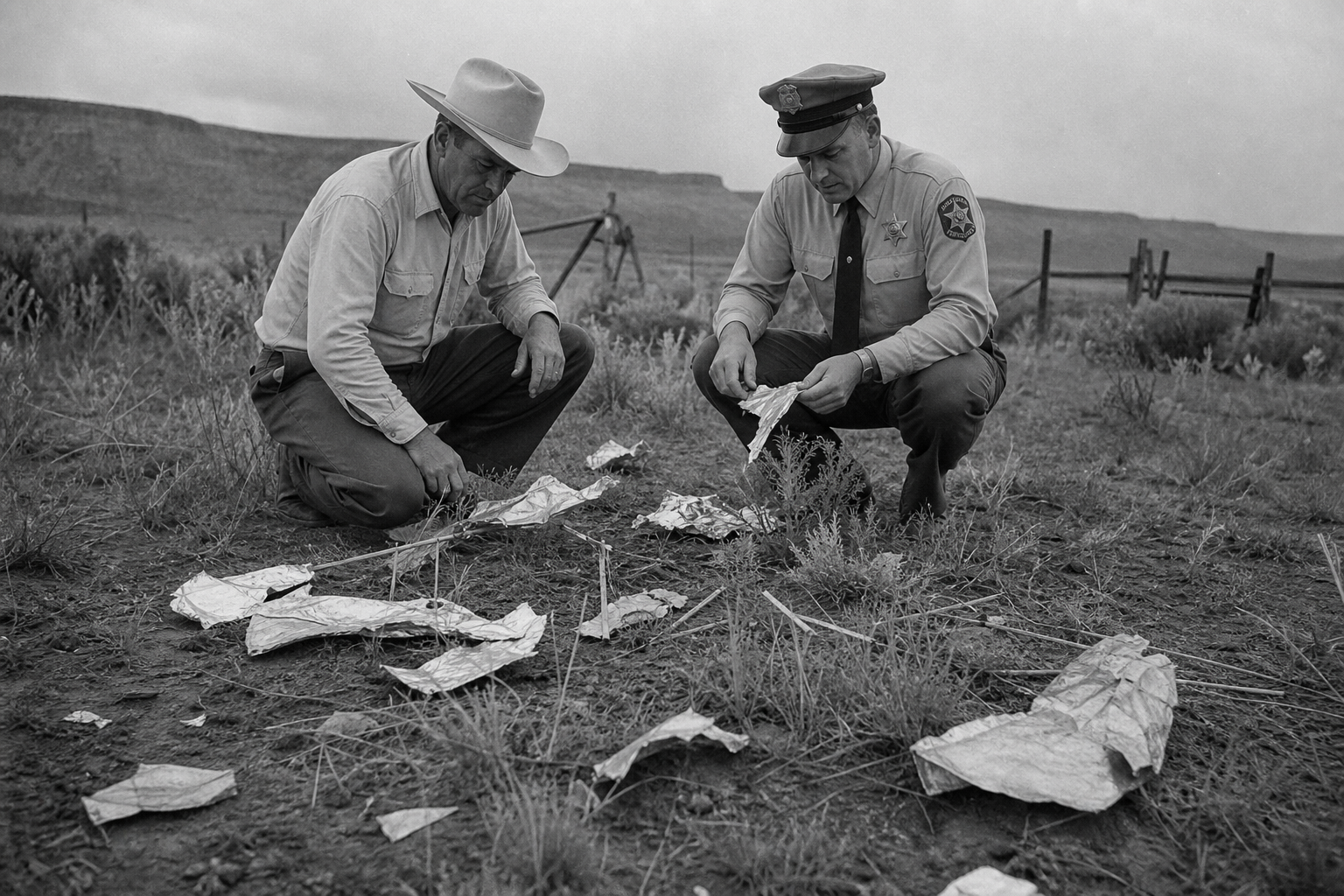
The reporting path was ordinary enough to make the later headline striking. Brazel brought the matter to Chaves County Sheriff George Wilcox, and the sheriff’s office notified Roswell Army Air Field. The Army release then converted a local report about debris into a national story by characterizing the recovered item as a “flying disc.” That description carried far more public force than a report of unidentified ranch material, even though the release supplied few physical particulars.
The phrase also landed in an unusually receptive news environment. On June 24, 1947, pilot Kenneth Arnold reported seeing nine fast-moving objects near Mount Rainier, Washington. Wire-service stories spread his account across the country, and the press’s vivid “flying saucer” label became a catchall for a wave of aerial sightings. In that vocabulary, “flying saucer” described a news phenomenon and reported appearance; it did not establish what any particular object was.
That context explains the speed of the Roswell story’s circulation. A military installation’s ambiguous announcement supplied institutional authority to a subject already filling front pages, while the rancher–sheriff–base sequence gave readers a concrete narrative. The July 1947 record supports that rapid transformation from local debris report to national flying-disc news; it does not supply the later layers often attached to the event.
The July 9 Reversal: From “Flying Disc” to Weather Balloon
The material moved to Fort Worth Army Air Field in Texas, headquarters of the Eighth Air Force, placing Brig. Gen. Roger Ramey at the center of the Army’s new public account.
On July 9, 1947, wire reports relayed Ramey’s conclusion that the recovered material was a weather balloon and its radar target, not a flying disc. A weather balloon was a routine instrument platform; the radar target was a lightweight reflective assembly attached to make the balloon visible to radar. That identification replaced the earlier characterization with a conventional explanation for scattered, unfamiliar-looking debris.
Newspaper photographs taken in Ramey’s Fort Worth office are a major part of the contemporaneous record. They show Ramey and other officers handling crumpled metallic-looking material, sticks, and paper-like fragments, while captions and accompanying reports identified the display as remnants of a balloon and radar target. The photographs establish what officials presented to reporters in Fort Worth; they do not independently prove the complete origin or chain of custody of every item photographed.
The confirmed point is narrow but consequential: higher-level Army authorities publicly rejected the installation’s flying-disc description within about a day and substituted the weather-balloon account through Eighth Air Force channels. That reversal explains why the July 8 announcement cannot be read as a settled Army determination that an extraordinary craft had been found.
It also does not, by itself, resolve every later Roswell allegation. A rapid official change demonstrates that the public account changed; it does not automatically authenticate later claims about additional wreckage, secret recoveries, or occupants. Those claims require their own dated, attributable evidence rather than being inferred either from the original flying-disc language or from the Fort Worth replacement explanation.
Project Mogul: The Later Official Explanation for the Debris
Project Mogul entered the Roswell record much later, through the U.S. Air Force Roswell reports of the 1990s rather than through the Army Air Forces’ public statements of July 1947. It was a classified Cold War research effort that used long, high-altitude balloon trains carrying acoustic equipment intended to detect distant Soviet nuclear tests.
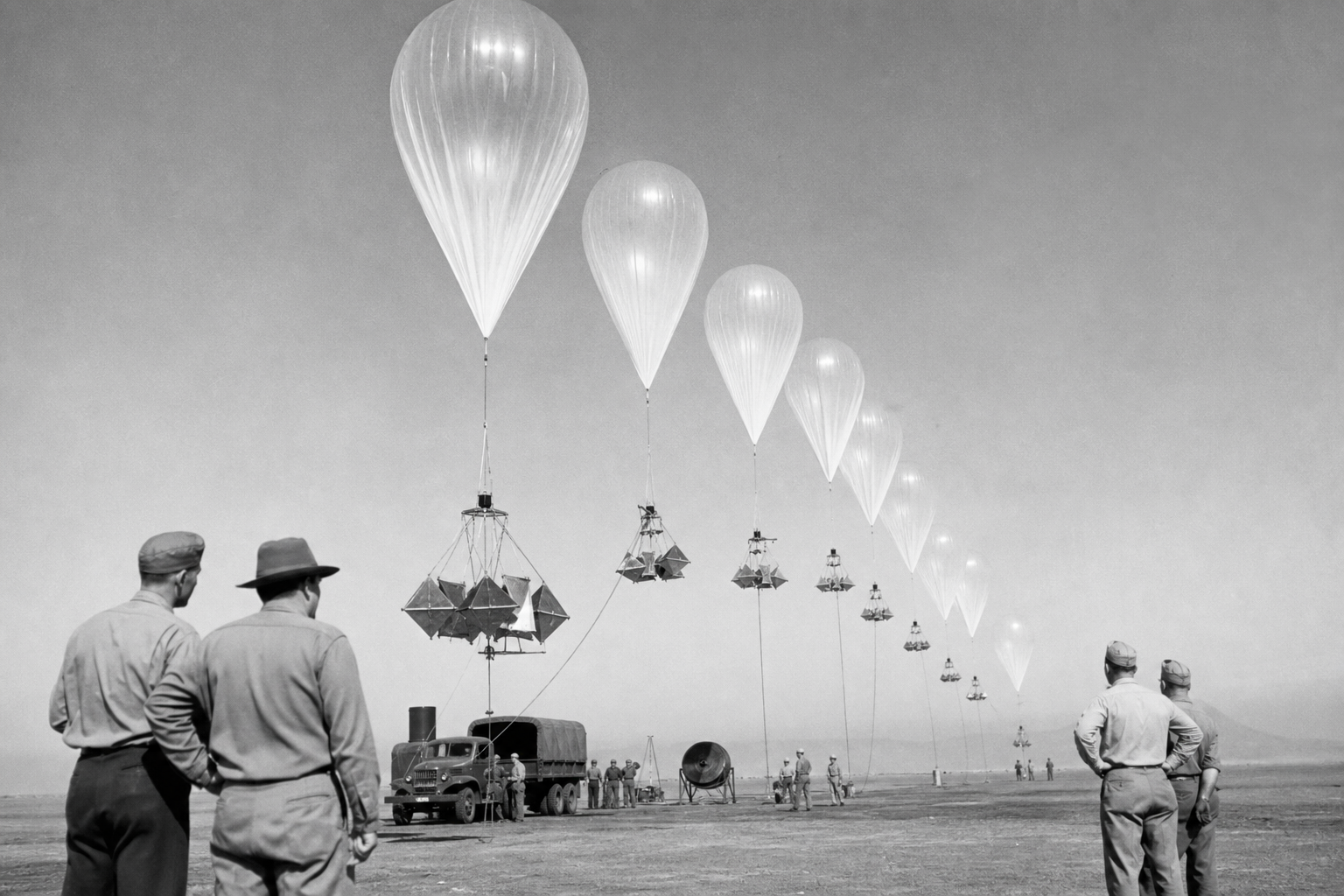
The distinction from the July 9 explanation is important. Ramey’s public account described an ordinary weather balloon and radar target; it did not name Project Mogul or explain an atomic-test-detection mission. The Air Force’s 1994 The Roswell Report: Fact versus Fiction in the New Mexico Desert argued retrospectively that the debris was most consistent with a Mogul array, particularly a flight associated with the New Mexico test program.
A Mogul train could leave a more confusing debris field than a single routine balloon. Its linked balloons, cords, instrument packages, and radar reflectors included lightweight foil, paper, tape, and balsa-wood supports, components that could resemble the balloon-and-target material displayed at Fort Worth while still representing a more specialized project. That overlap explains the logic of the later identification: the 1947 public description could be broadly accurate without disclosing a classified program.
The conclusion is not the same as a complete contemporaneous identification. The 1994 analysis assembled surviving project papers, personnel accounts, launch information, and comparisons between reported debris and Mogul hardware. Flight documentation was incomplete, however, and the report acknowledged uncertainty over the precise flight history, including whether the particular array linked to the Roswell debris could be reconstructed conclusively from the records.
That evidentiary posture matters. Project Mogul is the later official explanation with a technical and historical rationale; it is not proof that every detail of the Roswell episode was documented in 1947, nor is it language that appeared in the original press cycle. The Air Force’s 1997 follow-up addressed later stories about bodies separately, rather than treating them as part of the Mogul debris record.
What the Confirmed 1947 Record Establishes, and What It Does Not
A useful boundary is to distinguish what a record can prove from what it can only report. A July 1947 press release and newspaper photograph are contemporaneous evidence of official statements and the material displayed to reporters; they do not independently establish the material’s ultimate origin or rule on events not described in those records.
| Documented record | What it does not establish |
|---|---|
| Roswell Army Air Field’s July 8 release used the term “flying disc,” said the 509th Bombardment Group had gained possession of material, and identified a rancher and the Chaves County Sheriff’s office in the reporting chain. | It did not describe an extraterrestrial vehicle, occupants, bodies, a second crash site, or a recovery program. |
| The material went to Fort Worth, where Army officials publicly characterized it on July 9 as balloon-and-radar-target debris. | The speed of that reversal demonstrates a changed public account, not proof by itself of a government UFO cover-up. |
| Air Force investigations in 1994 and 1997 later connected the debris episode to Project Mogul and addressed body stories separately. | Those retrospective reports are not contemporaneous 1947 identifications and do not make every detail of the episode conclusive. |
Later Roswell narratives belong to a different evidentiary category. Charles Berlitz and William L. Moore’s The Roswell Incident (1980), followed by witness accounts, crash-retrieval allegations, and body stories amplified the case well after the event. Such testimony is historically significant: it explains how Roswell became a lasting public controversy. But a recollection recorded decades later cannot be read back into Walter Haut’s short release as though it had been present there.
The disciplined conclusion is narrow. The surviving record supports the fact of an Army “flying disc” announcement, a next-day balloon explanation, and a later Project Mogul interpretation. It does not establish alien disclosure, non-human intelligence, or a concealed retrieval operation.
Roswell’s Enduring Lesson: Follow the Dated Record
The lasting value of the Roswell record is methodological: dates, issuers, and contemporaneous wording prevent a sensational headline from becoming more expansive than the evidence permits. On July 8, Roswell Army Air Field publicly described recovered material as a “flying disc”; on July 9, Eighth Air Force officials presented it as balloon-and-radar-target debris. The later U.S. Air Force Project Mogul account supplied a more specific retrospective explanation, rather than reproducing the language of the 1947 announcement.
That sequence is notable because an Army account changed publicly and rapidly. It is not, standing alone, evidence that the material was extraterrestrial technology. Readers testing any version of the story should start with the release as reproduced in July 1947 newspaper archives, Fort Worth photographs and wire coverage, relevant National Archives holdings, and the Air Force’s 1994 and 1997 Roswell reports. The precise evidentiary takeaway is clear: the Roswell incident press release documents a brief official “flying disc” claim and its reversal, not proof of what the debris ultimately was.
Frequently Asked Questions
-
What did the 1947 Roswell Army press release actually say?
On July 8, 1947, Roswell Army Air Field announced that the 509th Bombardment Group’s intelligence office had gained possession of a “flying disc.” The release said the material came from a ranch near Roswell through a rancher and the Chaves County Sheriff’s Office, but it did not mention aliens, bodies, or extraterrestrial technology.
-
Who issued the Roswell flying saucer press release?
Walter Haut, the public information officer at Roswell Army Air Field, issued the July 8, 1947 release. Its text identified the 509th Bombardment Group and said its intelligence office had taken possession of the reported disc.
-
Did the Army say it captured a flying saucer at Roswell?
The Army’s July 8 announcement used the term “flying disc,” which newspapers commonly rendered as “flying saucer.” It claimed possession of recovered material but did not identify that material as an alien spacecraft or provide technical details about its construction.
-
Why did the Roswell story change from a flying disc to a weather balloon?
By July 9, 1947, Fort Worth Army Air Field and Brig. Gen. Roger Ramey publicly identified the material as a weather balloon and radar target. Newspaper photographs from Ramey’s office showed crumpled metallic-looking material, sticks, and paper-like fragments presented as balloon debris.
-
What should you look for when comparing the Roswell weather-balloon and Project Mogul explanations?
Check the date and source of each explanation: the July 9, 1947 account named a routine weather balloon and radar target, while Project Mogul appeared in Air Force investigations in 1994 and 1997. Project Mogul involved long balloon trains with acoustic equipment, foil, paper, tape, balsa-wood supports, and radar reflectors, but its flight documentation was incomplete.