Kenneth Arnold’s 1947 Sighting Near Mount Rainier That Coined the Term “Flying Saucer”
Explore the Kenneth Arnold 1947 sighting near Mount Rainier, learn how his words became flying saucer and shaped UFO history.
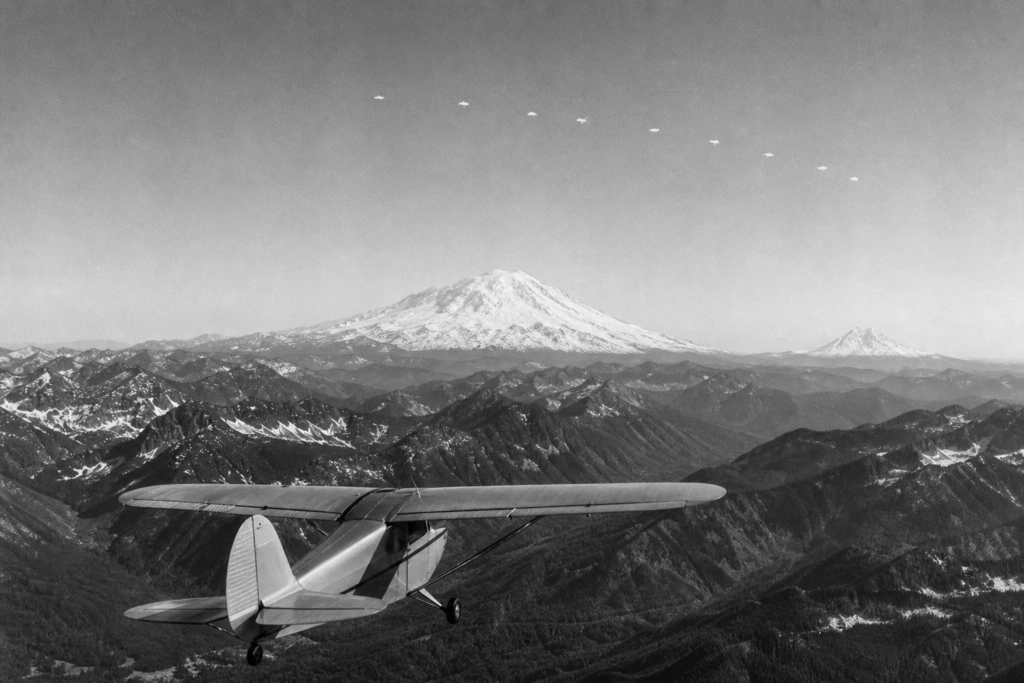
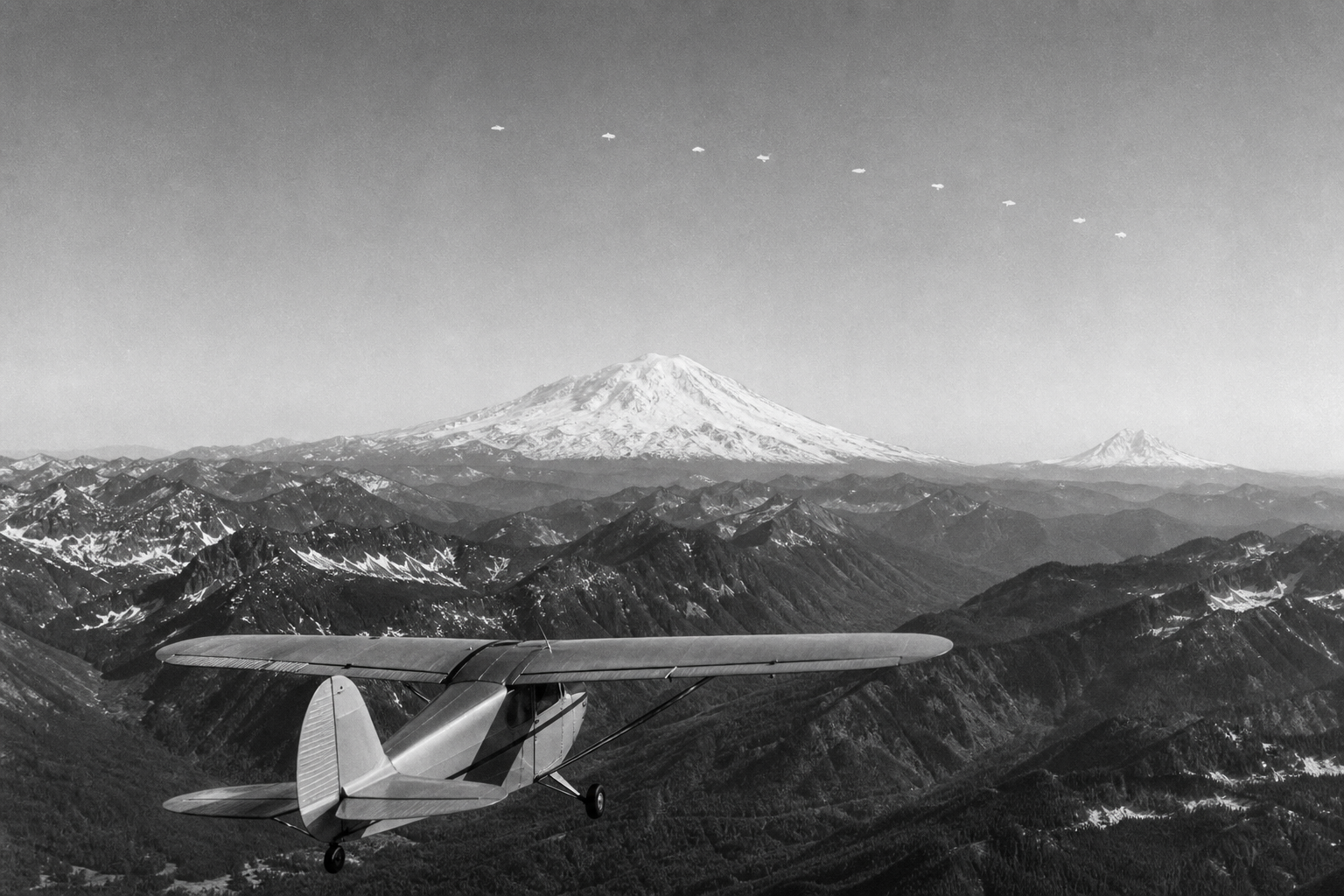
The phrase “flying saucer” carries a visual assumption that Kenneth Arnold’s original account does not neatly support. On June 24, 1947, Arnold, a civilian pilot flying near Mount Rainier in Washington’s Cascade Range, reported seeing nine unusual objects moving at extraordinary speed. The Kenneth Arnold 1947 sighting became a foundational episode in UFO history, not because it settled what the objects were, but because the language used to describe them reshaped public imagination.
Arnold’s famous comparison concerned movement: he said the objects traveled like saucers skipping across water. That image was soon compressed by reporters and headline writers into a memorable label, encouraging readers to picture literal round dishes in the sky. The distinction matters. A description of an object’s motion is not automatically a description of its form, yet later illustrations and retellings often treated the popular phrase as if it were Arnold’s precise visual report.
This account follows the record from Arnold’s observation through the press coverage that made the wording endure. It separates his reported details from journalistic shorthand and later UFO lore, while leaving the larger question of what he saw open rather than supplying an answer the evidence cannot establish.
The June 24, 1947 Sighting That Shaped Modern UFO Vocabulary
What turned a brief airborne observation into a landmark of 1947 UFO history was not a resolved identification, but the speed with which the report acquired a public vocabulary. During a private flight in the Cascade airspace near Mount Rainier on June 24, Arnold said he had seen nine unusual objects. His account entered a postwar news environment ready to amplify a striking aviation mystery, and the resulting shorthand gave later witnesses, editors, and readers a ready-made way to describe unfamiliar things in the sky.
That shorthand should not be mistaken for Arnold’s technical name for a kind of aircraft. His memorable image described an observed action, objects seeming to skip or flash through the air in a way he likened to saucers skipping across water. Newspaper treatment converted that comparison into a noun, “flying saucer,” and national repetition made it culturally durable. The change matters because a motion analogy invites one picture, while a fixed label suggests a particular shape. Arnold’s report remains historically consequential as an eyewitness claim and a linguistic turning point; neither status establishes what the nine objects were.
Kenneth Arnold, His CallAir A-2, and the Flight Near Mount Rainier
Arnold’s position in the story was that of a civilian aviator, not a military observer. A Boise businessman with substantial flying experience, Kenneth Arnold was piloting his own CallAir A-2, a small, single-engine light aircraft suited to private cross-country travel, over Washington’s Cascade country on June 24, 1947.
His route placed him in the wide, mountainous airspace around Mount Rainier, whose snow-covered summit and surrounding ridges offered prominent visual reference points but also made distance and scale difficult to judge from an aircraft. Arnold later described diverting from his trip to look for a missing Marine Corps transport, a search that had drawn public attention and offered a reward. That reported purpose provides the immediate context for why he was scanning the terrain and sky; it does not establish any connection between the missing transport and the objects he reported.
The practical setting is important because later retellings can make the Mount Rainier flying saucer sighting sound like a formal patrol or an encounter over a single fixed landmark. It was instead an observation made during a private flight through Cascade airspace, with Arnold using the mountain landscape as part of his effort to estimate direction, position, and movement. Those are the circumstances in which the nine objects entered his account, not proof of their identity, but the setting needed to understand how he tried to describe them.
What Arnold Reported Seeing: Nine Fast-Moving Objects
Arnold’s account began with a flash of reflected light near Mount Rainier. He said that, after first noticing what he took to be sunlight glinting from an object, he saw nine objects traveling together across the Cascade sky. In his descriptions, they appeared in a loose, chain-like or echelon arrangement rather than as isolated lights: a line of objects that shifted in coordinated motion as it passed northward toward Mount Adams.
He attempted to turn that impression into an aviation calculation. Using the distance he believed lay between Mount Rainier and Mount Adams as a baseline, Arnold timed the group’s passage and arrived at an extraordinary speed estimate, well beyond the performance of aircraft then known to him. That figure was an estimate, not an instrument reading. It depended on his assumptions about the objects’ distance, their route, and the landmarks they crossed, all of which are difficult to establish from a moving light airplane over mountainous terrain.
The Kenneth Arnold UFO sighting is also frequently reduced to a report of nine perfect discs. Arnold’s own language was less tidy. Early accounts characterized the objects as flat and thin; other descriptions compared aspects of their appearance to crescents, wings, or shapes with a curved leading edge. He also indicated that their changing angle could alter how they looked, with bright flashes appearing as they tilted or moved.
That variation does not make every later rendering false, but it does make the familiar row of identical circular craft a weak summary of what Arnold actually reported. The durable elements of his account are the number, the apparent grouped movement, the flashes, and his effort to calculate a remarkable transit across the mountains. The exact form, size, distance, and speed remained matters of observation and inference rather than settled measurements.
How a Description of Motion Became “Flying Saucer”
The crucial verb in Arnold’s comparison was not looked but moved. In early accounts, he described the objects’ travel as resembling a saucer skipped across water: a rapid, skipping or bounding action in which a flat object seems to flick, tilt, and flash. The image gave reporters a vivid way to convey an unfamiliar aerial movement, but it was easily shortened when retold.

That shortening produced the flying saucer term. Newspaper stories and headlines increasingly treated the comparison as a noun for the objects themselves, “flying saucers”, rather than preserving it as Arnold’s analogy for their motion. Not every report used identical wording, and no single headline can be credited with creating the label alone. Yet the repeated journalistic compression made the phrase portable: readers could immediately picture a recognizable kind of thing in the sky, even if that picture went beyond what the witness had described.
That linguistic shift matters because a saucer is first of all a shape. Once the label took hold, it encouraged illustrations and later recollections centered on neat, circular discs. Arnold’s descriptions, however, were not confined to that simple silhouette. He spoke at different times of flat, thin forms and of outlines that could suggest crescents or winglike shapes, while also stressing the changing flashes and motion that had made the sight striking. The origin of the term flying saucer therefore records a transformation in public language: a simile about how nine objects appeared to move became a presumed description of what they were shaped like.
The Kenneth Arnold flying saucer sighting remains historically consequential for that reason without resolving the underlying observation. The popular name preserved the drama of his report, but it also narrowed it. Reading Arnold’s comparison as a motion image, not a literal catalog of identical dishes, keeps the record closer to the ambiguity he actually conveyed.
How Newspaper Coverage Turned a Local Report Into a National Story
Regional reporting gave the account its first public form, and wire-service distribution gave it reach. After Arnold described the encounter to journalists, editors could condense a complicated airborne observation into a striking, easily repeated news item: a pilot, nine unexplained objects, extraordinary apparent speed, and a memorable household image. That format allowed the report to move quickly beyond the Pacific Northwest without carrying every qualification of Arnold’s longer descriptions.

Newspaper headlines were especially influential because they favored brevity over the distinctions an eyewitness account required. A headline label works as a sorting device: it tells readers what kind of story they are reading before they reach the details. Repetition of the saucer shorthand therefore did more than publicize Arnold’s report. It supplied a ready category for later accounts of unusual things in the sky, encouraging readers and reporters to fit varied descriptions into a familiar visual frame.
Follow-up stories amplified that frame. Once the phrase became recognizable, reports of additional sightings could be presented as part of the same developing phenomenon, the early stream of 1947 UFO news, rather than as wholly separate claims needing their own vocabulary. Such coverage records a change in public attention and journalistic language, not independent verification of what Arnold saw. The distinction is essential: widespread circulation made the Kenneth Arnold 1947 sighting culturally consequential, but newspaper repetition could not settle the identity, distance, speed, or shape of the objects he reported.
The Sighting’s Legacy: Roswell, Official Investigations, and the UFO Era
Within days, the new vocabulary was available for the next major 1947 episode: the Roswell incident in New Mexico. Arnold’s June 24 report had already made “flying saucer” a familiar journalistic label when the Army Air Forces announced on July 8 that it had recovered a “flying disc,” then retracted that description the same day in favor of a weather balloon. The proximity in time encouraged the public to treat disparate reports as parts of one story.
That connection was cultural rather than evidentiary. Roswell did not corroborate Arnold’s observation, and Arnold’s report did not explain what was recovered near Roswell. What linked them was a rapidly established language of mysterious aerial objects, reinforced by press coverage and public attention.
Official interest also developed through a sequence of broader inquiries, not as a direct institutional response to one pilot’s account. The U.S. Air Force created Project Sign in 1948 to assess reports of unidentified aerial phenomena; Project Grudge succeeded it in 1949; and Project Blue Book began in 1952. Blue Book was an Air Force investigative program that collected and evaluated many reports over years, whereas the Arnold case was one prominent early report within the larger postwar wave.
This distinction preserves the sighting’s real legacy. It helped inaugurate the UFO era as a shared public category, but neither official investigation nor repeated public interest established an extraordinary explanation for the nine objects Arnold reported.
Why the “Flying Saucer” Distinction Still Matters
Words do more than summarize an observation: they supply a picture that later audiences may mistake for evidence. In this case, the familiar label encouraged disc-shaped illustrations and expectations, although Arnold’s memorable image concerned the objects’ skipping motion rather than a simple declaration of their form.
The same discipline helps with modern UAP terminology. “UAP” is a neutral category for an unidentified aerial observation, not a conclusion about origin; it keeps the reported event separate from claims about what produced it. For the Kenneth Arnold 1947 sighting, the secure record is a private pilot’s report of nine fast-moving objects near Mount Rainier on June 24. Their identity remains unresolved, while the press-made phrase remains historically decisive.
A Phrase That Outlasted the Sighting
One useful checkpoint is the difference between a verb and a noun: “skipping” conveyed the objects’ reported behavior, while “saucer” became a name that encouraged readers to picture their form. On June 24, 1947, during a private flight around Mount Rainier, Kenneth Arnold reported nine fast-moving objects; in the ensuing news cycle, newspapers and wire services compressed his image of motion into the durable label “flying saucer.” That label gave the early UFO era a memorable public vocabulary.
The distinction is small in phrasing but large in meaning. A comparison of movement reports how an observer believed objects behaved; a shape label implies what they were like. Once the latter prevailed in headlines and popular retellings, later audiences could reasonably, but inaccurately, picture nine identical discs. The historical record supports the report, its rapid circulation, and the linguistic transformation; it does not settle the objects’ identity.
That is why the Kenneth Arnold 1947 sighting still warrants careful reading. Ambiguous observations often survive through the shortest available description, especially when journalism turns a vivid comparison into a reusable name. Preserving the difference between Arnold’s words and the public shorthand neither diminishes the episode nor supplies an extraordinary answer. It identifies what made the report last: not a demonstrated solution, but a phrase powerful enough to shape how a generation looked at the sky.
Frequently Asked Questions
-
What did Kenneth Arnold report seeing near Mount Rainier in 1947?
On June 24, 1947, civilian pilot Kenneth Arnold reported seeing nine unusual, fast-moving objects near Mount Rainier in Washington. He saw them traveling together in a loose chain-like or echelon formation toward Mount Adams.
-
How many objects did Kenneth Arnold say he saw?
Kenneth Arnold reported seeing nine objects. He described them as moving in a coordinated group rather than as separate, isolated lights.
-
Did Kenneth Arnold invent the term flying saucer?
Kenneth Arnold did not use “flying saucer” as a technical name for the objects. He compared their motion to saucers skipping across water, and newspaper coverage compressed that motion comparison into the phrase “flying saucer.”
-
What did Kenneth Arnold say the objects looked like?
Arnold described the objects as flat and thin, with accounts also comparing aspects of their appearance to crescents, wings, or curved leading edges. He did not simply describe nine identical circular discs, and he said their angles could produce bright flashes.
-
Did the Kenneth Arnold sighting lead directly to Project Blue Book?
No, the Kenneth Arnold sighting did not directly create Project Blue Book. The U.S. Air Force began Project Sign in 1948, followed by Project Grudge in 1949 and Project Blue Book in 1952 to examine many unidentified aerial reports.