Kenneth Arnold 1947: Pilot’s Sightings of Nine Saucer-Like Craft North of Mount Rainier
Explore the Kenneth Arnold 1947 sighting, nine objects near Mount Rainier, the birth of flying saucers, and why their identity remains unknown.
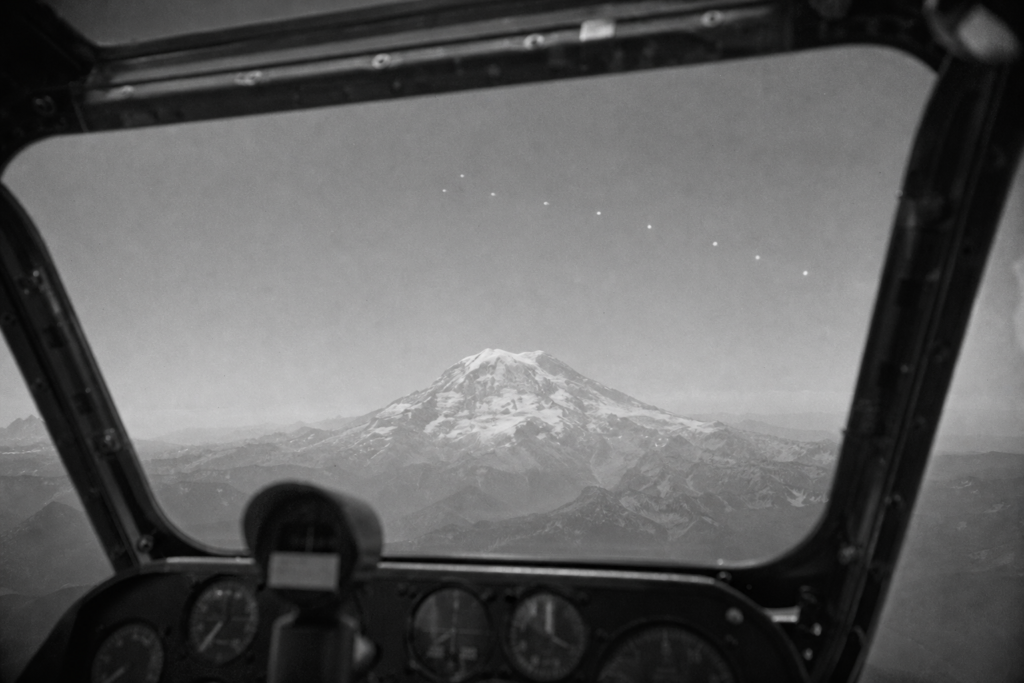
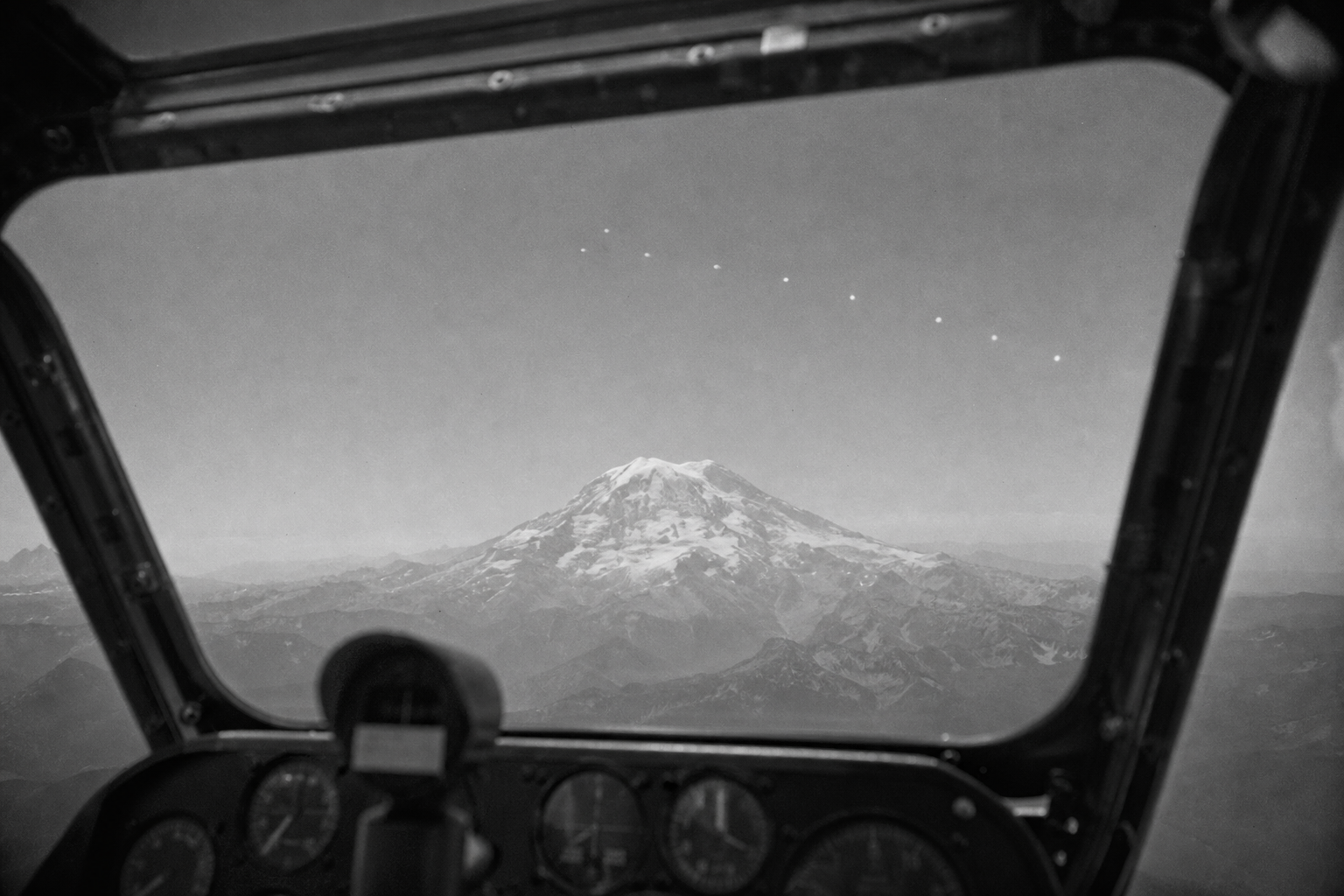
On June 24, 1947, private pilot Kenneth Arnold reported an observation that would give the modern UFO era much of its vocabulary and momentum: nine fast-moving, bright objects in the skies near Mount Rainier. The Kenneth Arnold 1947 sighting was extraordinary not because it established what the objects were, but because a named, experienced civilian aviator described the event publicly and reporters carried the account across the United States.
What followed was a lasting linguistic twist. Arnold’s comparison invoked the way the objects seemed to move, like saucers skipping across water, yet headlines helped turn that motion description into the image of disc-shaped flying saucers. His own descriptions of form were more complicated than the shorthand that became famous.
This account follows the historical record as closely as it allows: Arnold’s reported route, his view north of the mountain, the formation of nine objects, and the estimate that made the encounter seem so startling. It also separates three different things that later retellings often merge: an eyewitness report, a newspaper label, and an explanation. The first two are well documented. The third remains unresolved; an unidentified sighting is not, by itself, proof of any particular craft, technology, or origin.
Kenneth Arnold’s June 24, 1947 Sighting at a Glance
Arnold was a Boise businessman and an experienced private pilot, flying his CallAir A-2 light aircraft through Washington’s Cascade country on the afternoon of June 24. He had also joined the search for a missing U.S. Marine Corps transport, a reward-supported effort that gave him a reason to be looking across the high mountain terrain rather than simply traveling directly home.
Near Mount Rainier, Arnold later said he saw a group of nine bright objects to the north of the mountain. His account was an observation made from one small civilian aircraft: it recorded what he believed he saw, the direction of travel he perceived, and his attempt to make sense of an unfamiliar aerial display. It did not establish the objects’ distance, size, construction, operator, or origin.
That distinction is central to the Kenneth Arnold UFO sighting. A pilot’s experience can make an eyewitness account historically significant and worthy of close attention; it cannot by itself turn an unidentified observation into a verified military project, an extraterrestrial vehicle, or any other settled explanation. Arnold’s report became consequential because he gave his name, described the encounter publicly, and prompted unusually broad press attention, not because the objects were conclusively identified.
The basic 1947 Mount Rainier UFO sighting is therefore straightforward in one sense: a private aviator reported nine unusual airborne objects during a daylight flight. The harder questions, what their appearance meant, how fast or far away they were, and how a motion comparison became the phrase flying saucer, belong to the evidence and interpretation that followed.
What Arnold Reported Seeing North of Mount Rainier
What drew Arnold’s attention was not a single isolated flash but a coordinated-looking group. He described nine objects that appeared bright in the sun, at times highly reflective, and said they traveled in a stretched, echelon-like arrangement rather than a compact V. An echelon formation is a diagonal line, with each position set behind and to one side of the next; Arnold compared the spacing and order to a formation of geese, while emphasizing the objects’ unusual apparent speed and motion.
In his account, the objects crossed the Cascade landscape in the direction of Mount Adams after appearing north of Mount Rainier. The mountain setting mattered to Arnold because it supplied the landmarks by which he tried to follow their path and later calculate their movement. It does not, however, establish how far from his aircraft the objects actually were. Their apparent course, size, and speed all depended on an eyewitness estimate made across a large and visually complex expanse of sky and terrain.
Their outlines are less tidy than the standard image of nine identical dinner plates. Early descriptions associated some of the objects with a flat, disc-like or crescent-like appearance; Arnold also used comparisons suggesting a wing or a curved, swept-back profile. In later drawings and interviews, he portrayed an irregular, crescent or boomerang-like silhouette, sometimes with a more pointed or rounded rear portion. Those descriptions may reflect changing efforts to put a fleeting visual impression into words and images; they should not be treated as a measured technical sketch.
This is the useful dividing line for the Kenneth Arnold Mount Rainier sighting: the number, brightness, formation, and reported route belong to Arnold’s testimony, while the familiar “saucer” picture is largely a public shorthand. Newspaper illustrations, later artwork, and popular retellings often regularized the objects into matching circular discs. Arnold’s own descriptions were more variable, and the historical record preserves a reported observation rather than a verified identification of the nine objects.
How a Motion Comparison Became “Flying Saucers”
The phrase that endured came from a simile about movement, not a precise name for the objects’ shape. In interviews after his June 24 flight, Arnold compared their progress to a saucer skipped across water: they seemed to skip, bounce, or flutter as they moved in sequence. That image described changing motion and apparent attitude. It did not mean that he had simply looked up north of Mount Rainier and identified nine ordinary circular plates in the sky.

That distinction was easily lost as Arnold’s account moved from interviews into short newspaper dispatches. Reporters needed a compact expression for nine bright, fast-moving objects, and wire-service coverage carried “flying saucers” from the Pacific Northwest to a national audience within days. The label made an unfamiliar report immediately imaginable, but it changed the emphasis: a comparison for water-skipping motion became a noun suggesting a standardized round disc.
“Kenneth Arnold flying saucers,” then, describes a media legacy as much as an eyewitness description. Arnold’s shape language was not confined to a conventional saucer; his accounts also used flat, curved, wing-like, and crescent-like comparisons. A careful reading of what is often called the first flying saucer sighting keeps the sequence straight: Arnold reported unusual objects and likened their motion to a skipped saucer, while headlines and newswire shorthand made “flying saucer” the durable public term. Neither the phrase nor the later circular-disc imagery identified what the nine objects were.
Arnold’s Speed Estimate and Why the Objects Remained Unidentified
Arnold’s most dramatic figure came from a landmark-to-landmark calculation rather than from an instrument reading. He said he timed the group’s passage from the vicinity of Mount Rainier toward Mount Adams at about one minute and 42 seconds, then applied an assumed distance of roughly 50 miles between the peaks. That produced a reported speed near 1,700 miles per hour, far beyond the performance of known propeller-driven aircraft in 1947.
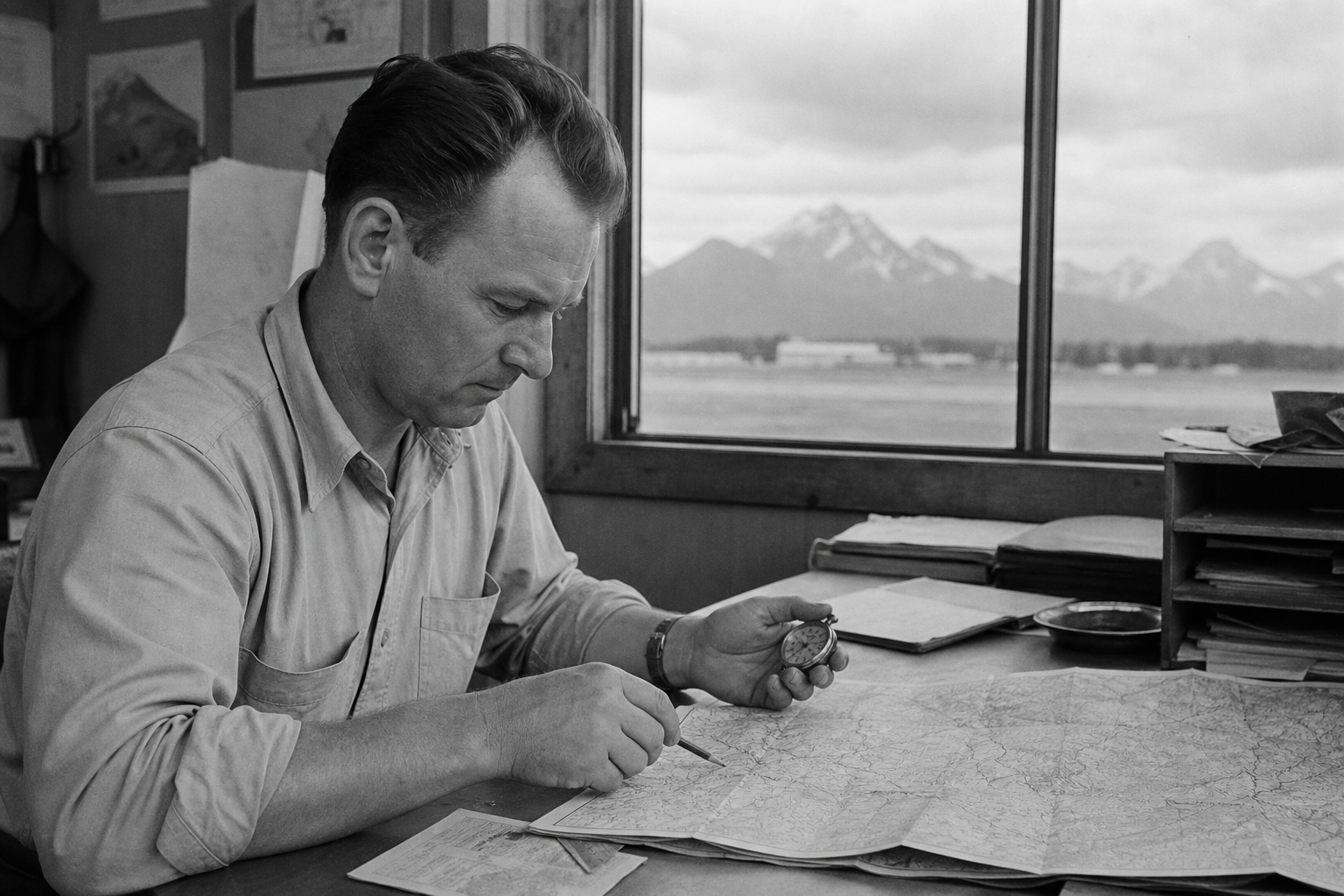
The arithmetic follows from those assumptions; the uncertainty lies in them. Arnold was flying his own aircraft, observing objects whose distance and dimensions he did not know. A small nearby object and a large distant one can occupy the same apparent size, while a route that seems to run between two mountains may lie well in front of, behind, or at an angle to them. A short timing interval also magnifies small errors: changing the assumed path length or the moment when the objects passed each visual reference changes the resulting speed sharply.
That does not make the observation meaningless. It explains why the speed should be treated as Arnold’s estimate of apparent travel across a mountain backdrop, not as a measured velocity. The Kenneth Arnold 1947 sighting preserves a specific witness account and calculation, but neither supplied the independent range, altitude, or object size needed to determine speed with confidence.
Investigators nevertheless took the report seriously enough to examine it amid the wave of 1947 flying-saucer reports. Proposed explanations have included conventional aircraft, optical effects, clouds, and flocks of birds, especially pelicans, whose bright undersides and changing alignment might account for flashes and an unusual apparent motion. Each proposal addresses some features better than others: a bird hypothesis can reduce the distance and speed problem, for example, but must also account for Arnold’s reported formation and sustained view.
No contemporaneous inquiry or later reconstruction produced decisive physical evidence tying the nine objects to one identified cause. In modern language, they remained unidentified aerial phenomena in the limited historical sense: reported airborne objects not securely resolved from the surviving record, rather than demonstrated extraterrestrial craft.
Why the Kenneth Arnold Report Matters in UFO History
The lasting consequence was not a settled identification but a new public story about the skies. Once newspapers and wire services circulated Arnold’s account, the compact “flying saucer” label made an ambiguous aerial observation easy to repeat, illustrate, and recognize. That shorthand traveled more readily than the distinctions in his testimony: nine objects, uncertain distance, varied reported outlines, and a motion comparison that had been converted into a name.
The resulting 1947 flying-saucer wave gave the report its historical weight. People around the United States began reporting unusual lights, discs, formations, and fast-moving objects, often using the vocabulary that Arnold’s case had helped popularize. These later reports were not independent confirmation of what he saw; they were evidence of a rapidly shared cultural frame. A useful distinction is between a corroborating observation, which can be tied to the same event by time and location, and a similarly described report made elsewhere after publicity. Most of the wave belonged to the second category.
That publicity also made unidentified aerial reports a matter of broader official and public attention. The Kenneth Arnold 1947 sighting became a reference point for reporters, military inquiries, and later UFO history because it supplied a memorable witness, a dramatic setting, and a durable image. Its importance is therefore historical and linguistic as much as observational: it helped establish the recurring public vocabulary through which UFO sightings would be reported for decades. Modern UFO news and UAP news may use updated terms, but neither changes the essential limit of the record: Arnold documented an experience he could not identify, not proof of what the objects were.
Kenneth Arnold and Roswell: Two Different 1947 Stories
Roswell belongs beside Arnold’s report only as a separate episode in the same summer, not as its evidentiary sequel. Arnold described an airborne observation on June 24 near Mount Rainier in Washington: nine distant objects seen during his own flight. The Roswell story emerged later in New Mexico from reports concerning material recovered from a ranch. One account rests chiefly on a pilot’s visual testimony and an attempted estimate of movement; the other concerns the identity and handling of alleged physical debris.
That difference matters. Neither the later prominence of Roswell nor debates over recovered material can supply the missing measurements, photographs, or physical samples from Arnold’s observation. Conversely, Arnold’s sighting does not establish what was found, or was not found, in New Mexico. Folding the two together turns two distinct historical records into a single, stronger-sounding narrative than either supports.
Terms such as UFO disclosure or a government UFO cover-up are later interpretive frameworks, not evidence that identifies Arnold’s nine objects. The enduring significance of the Kenneth Arnold 1947 sighting lies in the report he made, the “flying saucer” wording that news coverage popularized, and the public era that followed. The historical record preserves an extraordinary eyewitness claim; it does not resolve what crossed the sky.
A Sighting That Defined the Flying-Saucer Era
Its power lies in the way three elements reinforced one another: a named pilot’s detailed recollection, a startling calculation based on the objects’ apparent passage across familiar mountain landmarks, and a newspaper phrase vivid enough to outlive the qualifications behind it. Arnold’s estimate made the episode seem urgent; “flying saucer” made it instantly legible to a mass audience.
That combination gave the Kenneth Arnold 1947 sighting an influence far beyond the few minutes he described in the air. Reports of unusual aerial objects could now be grouped under a memorable label, while Arnold himself became the reference witness against whom later accounts were compared. The label was culturally powerful precisely because it simplified a more complicated testimony about motion, brightness, formation, and uncertain distance.
The lasting historical lesson is narrower than many retellings suggest. The record preserves an influential eyewitness report and the beginnings of a durable vocabulary in UFO history; it does not turn unidentified objects into evidence for any particular extraordinary explanation. Arnold’s nine objects remain unresolved, but the consequences of his report, for headlines, public imagination, and the study of aerial mysteries, are unmistakable.
Frequently Asked Questions
-
What did Kenneth Arnold see over Mount Rainier in 1947?
On June 24, 1947, private pilot Kenneth Arnold reported seeing nine bright, fast-moving objects north of Mount Rainier while flying a CallAir A-2. He said they traveled in a stretched, echelon-like formation toward Mount Adams.
-
Did Kenneth Arnold describe the objects as saucer-shaped?
Not consistently. Arnold compared their motion to saucers skipping across water, while his shape descriptions also included flat, curved, wing-like, crescent-like, and boomerang-like forms.
-
How fast did Kenneth Arnold estimate the nine objects were traveling?
Arnold estimated a speed of about 1,700 miles per hour. He based it on a reported 1 minute 42 second passage between the Mount Rainier and Mount Adams area, assuming a distance of roughly 50 miles.
-
Were Kenneth Arnold’s flying saucers ever identified?
No decisive physical evidence or reconstruction identified the nine objects. Proposed explanations included conventional aircraft, optical effects, clouds, and flocks of birds such as pelicans, but none conclusively resolved the report.
-
What is the difference between Kenneth Arnold’s sighting and the Roswell incident?
Arnold’s case involved a pilot’s visual report of nine airborne objects near Mount Rainier on June 24, 1947. Roswell was a separate New Mexico episode involving reports of material recovered from a ranch, not a corroboration or explanation of Arnold’s sighting.