Kenneth Arnold Sighting: Pilot Reported Nine Unusual Objects Near Mount Rainier on June 24, 1947
Explore the Kenneth Arnold sighting near Mount Rainier, his 1947 report, the origin of flying saucers, and what remains uncertain.
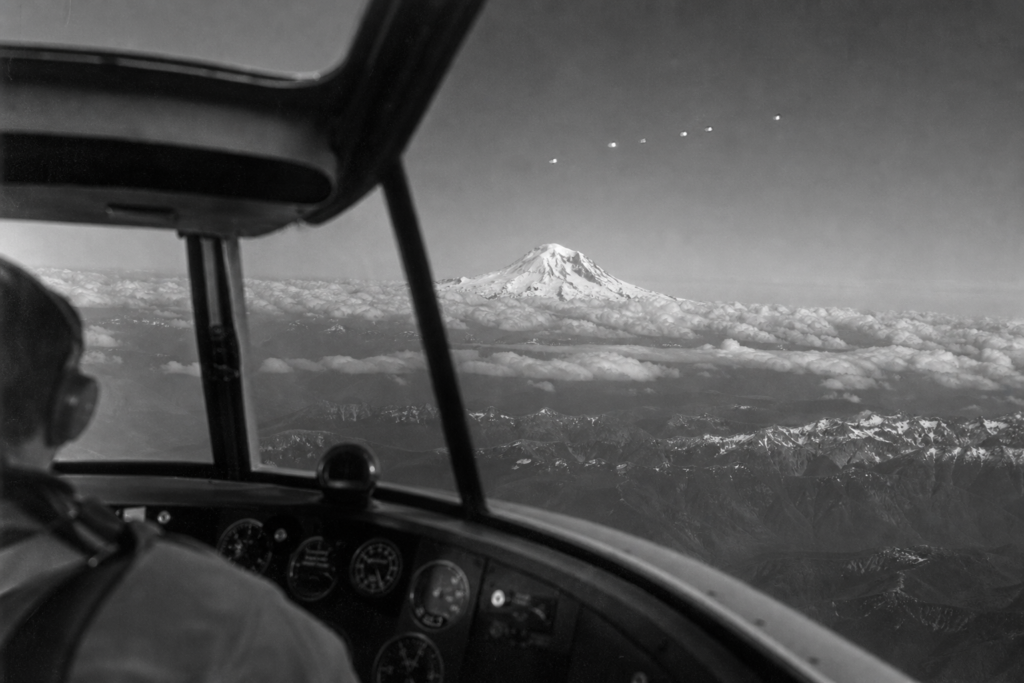
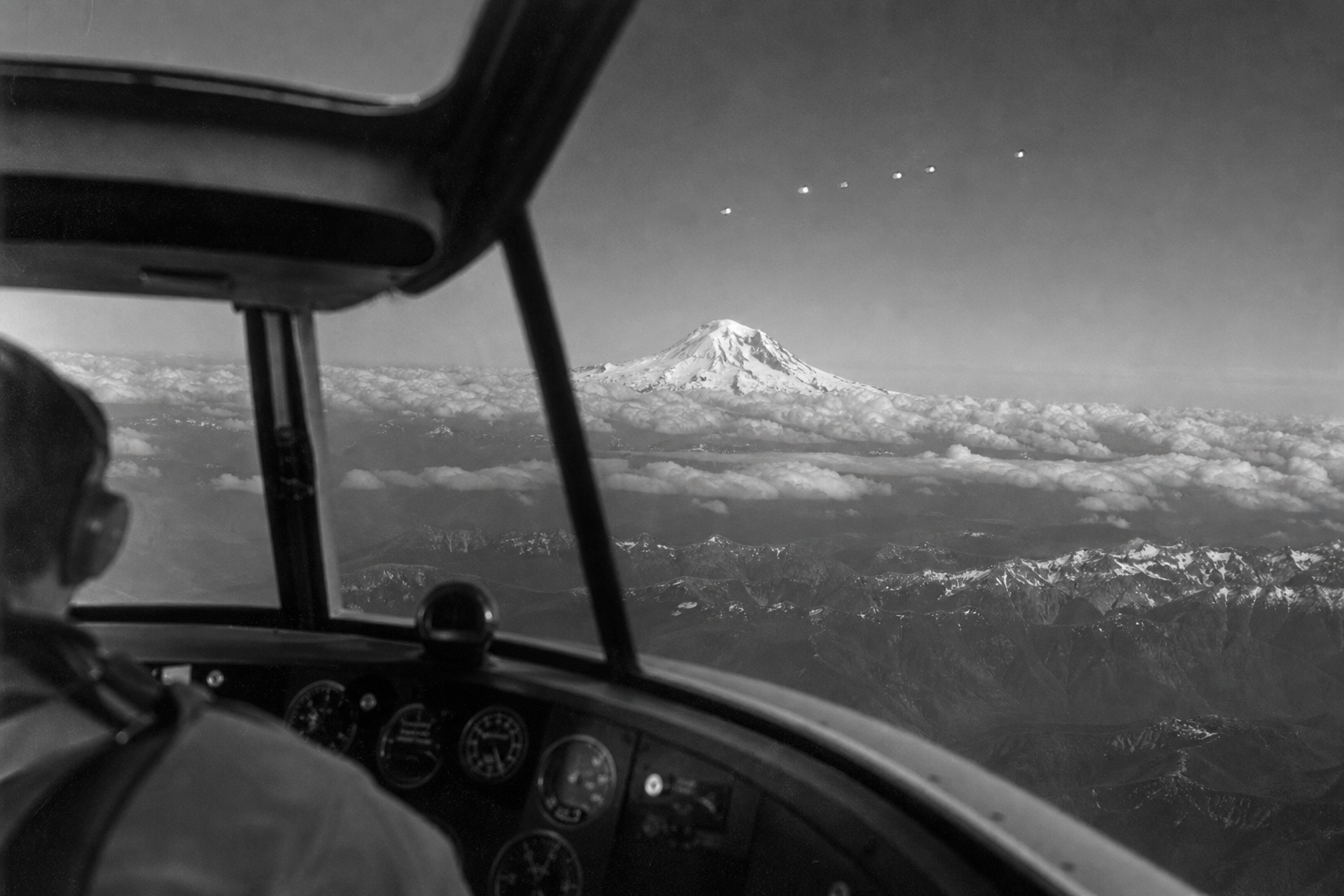
On June 24, 1947, private pilot Kenneth Arnold reported seeing nine unusual airborne objects near Mount Rainier, Washington. The observation was brief, but its public afterlife was not: the Kenneth Arnold sighting helped establish the language and expectations through which Americans would soon discuss unidentified things in the sky.
This account begins with the narrow historical record, what Arnold reported, where and when he reported it, and how his description entered the news, rather than treating an unresolved observation as proof of a particular cause. The familiar label flying saucer is central to that distinction. It grew from press treatment of Arnold’s comparison for the objects’ motion, like a saucer skipping over water; it did not simply preserve a settled claim that every object had the literal shape of a dish.
Later retellings have also varied in details such as shape, distance, speed, and the meaning of Arnold’s estimates. Those differences matter. They separate a documented pilot’s report from journalists’ shorthand, official interest, and decades of proposed explanations. The pages that follow trace that chain of evidence and identify where the record remains uncertain.
Why the June 24, 1947 Report Still Matters
What gave the episode its lasting force was not a settled identification, but the speed with which a named pilot’s report became national news. Kenneth Arnold, a private pilot, said that he saw nine unusual objects during a June 24, 1947 flight in the Mount Rainier area. That is the firm historical checkpoint: a specific witness made an observation claim, not a demonstration that the objects were spacecraft, secret weapons, or any other identified thing.
Within days, newspaper and wire coverage carried the account well beyond Washington State. The attention made Arnold’s report a reference point for the wider run of 1947 UFO sightings. “UFO” became the enduring historical category, while UAP is a newer label sometimes used in modern discussion; changing the term does not resolve the older observation.
The case also shows how coverage can alter an observation’s public meaning. Arnold’s comparison concerned a skipping, saucer-like motion; headlines and later retellings encouraged an image of literal saucer-shaped craft. Motion describes reported behavior, whereas shape asserts physical form. The record establishes an extraordinary report and its rapid circulation, but not a conclusive explanation for what Arnold saw.
Arnold’s Flight, His Search, and the Mount Rainier Setting
Arnold was not on a military mission. A Boise businessman and experienced private pilot, he was flying his CallAir aircraft over Washington’s Cascade country when he diverted attention to a practical concern: the search for a missing Marine transport aircraft. That search supplied the immediate context for his presence near Mount Rainier; it does not, by itself, establish a precisely documented flight track or observation position.
In later accounts, Arnold used prominent terrain to describe where he was and where the objects appeared to travel. Mount Rainier was the principal reference point, while Mount Adams to the south became important to his estimates of their apparent path, distance, and speed. These volcanic peaks are useful geographic anchors, but they do not turn his visual estimates into surveyed measurements. An observer in a light aircraft could identify distant landmarks clearly while still facing substantial uncertainty in judging the range, altitude, and size of objects seen against a vast mountain horizon.
That distinction is essential to the Kenneth Arnold Mount Rainier sighting. The Cascade landscape helps reconstruct the scene: high, snow-covered terrain, long sightlines, and separated landmarks. It also explains why later reconstructions can disagree. A route inferred from Arnold’s recollections is not identical to a contemporaneous position record, and an estimated line from Rainier toward Adams is not a fixed map coordinate.
The missing-aircraft search therefore belongs in the account as reported context, not as an explanatory shortcut. It places Arnold in the Mount Rainier area on June 24, 1947 and helps clarify what he was doing before the observation; the question of what he saw requires separate treatment.
What Arnold Said He Observed: Nine Fast-Moving Objects
In his July 12 written statement to the Army Air Forces, Arnold described nine objects travelling together in what he called a “chain-like formation.” He recalled a bright flash that first drew his attention, then a connected or echelon-like arrangement moving rapidly across the distant skyline. Their luminosity was central to his account: he compared it to sunlight reflecting from a mirror, a description of appearance rather than evidence that the objects emitted light.

Arnold made striking numerical estimates, but they were deductions from a brief visual observation. Using the apparent passage between Mount Rainier and Mount Adams and the time he believed it took, he calculated a speed of roughly 1,200 to 1,700 miles per hour in different tellings. He also placed the objects at an estimated 20 to 25 miles away and inferred dimensions of about 45 to 50 feet. Those figures were not tracked, instrument-recorded measurements. They depend on his assumed distance, elapsed time, and interpretation of the objects’ apparent path, each uncertain when viewed from a light aircraft over mountainous terrain.
The Kenneth Arnold report is similarly less uniform on shape than later shorthand suggests. Early newspaper coverage emphasized flat, disk- or pie-pan-like forms. Arnold’s later written and spoken descriptions included a crescent-like or curved object among the nine, and subsequent retellings often used boomerang-like language. These are not necessarily identical claims: “disk,” “crescent,” and “boomerang” describe different visual outlines. The variation may reflect changing attempts to convey a difficult, distant sight rather than a settled physical design.
What remains consistent is narrower but important: Arnold said he saw nine unusually bright objects moving as a group at extraordinary apparent speed. The arrangement, brightness, motion, range, size, and speed all belong to his perception and calculations. They document what he reported seeing; they do not independently establish what the objects were.
How “Flying Saucer” Entered the Story, and What It Did Not Mean
The enduring label arose from a comparison, not from a settled sketch. In interviews after the June 24 report, Arnold likened the objects’ movement to a saucer skipped across water: a sequence of rapid, dipping or skipping motions. That image gave reporters a compact, memorable expression, “flying saucers”, and it soon became the public name for both this report and many unrelated later claims.
The distinction changes how the Kenneth Arnold 1947 sighting should be read. A motion analogy describes apparent behavior: how something seemed to move across the observer’s view. A shape description describes an outline. Neither automatically supplies the other. Calling the nine objects “flying saucers” may suggest round, dish-like craft to a modern reader, but Arnold’s accounts did not preserve one fixed literal form for all nine.
Contemporary reporting often favored “saucer,” “disk,” or “pie-pan” language, while Arnold later tried to clarify that he had meant the skipping action. His own shape language also varied, including curved or crescent-like descriptions that later writers rendered as boomerang-like. Those terms are not interchangeable: a disk implies a circular outline, whereas a crescent or boomerang implies an open curved profile. The useful historical checkpoint is therefore to ask whether a quotation concerns movement or appearance. The famous phrase records how the story was compressed for mass circulation; it does not resolve what Arnold saw or prove that he described nine literal circular objects.
How a Local Interview Became National UFO News
The route to national attention ran through Pendleton, Oregon. On June 25, Arnold discussed the previous day’s observation at the Pendleton airport, where East Oregonian reporter Bill Bequette interviewed him. The newspaper’s June 26 account gave readers the essentials that would travel widely: a named pilot, a sighting near Mount Rainier, nine fast-moving objects, and an extraordinary estimated speed.
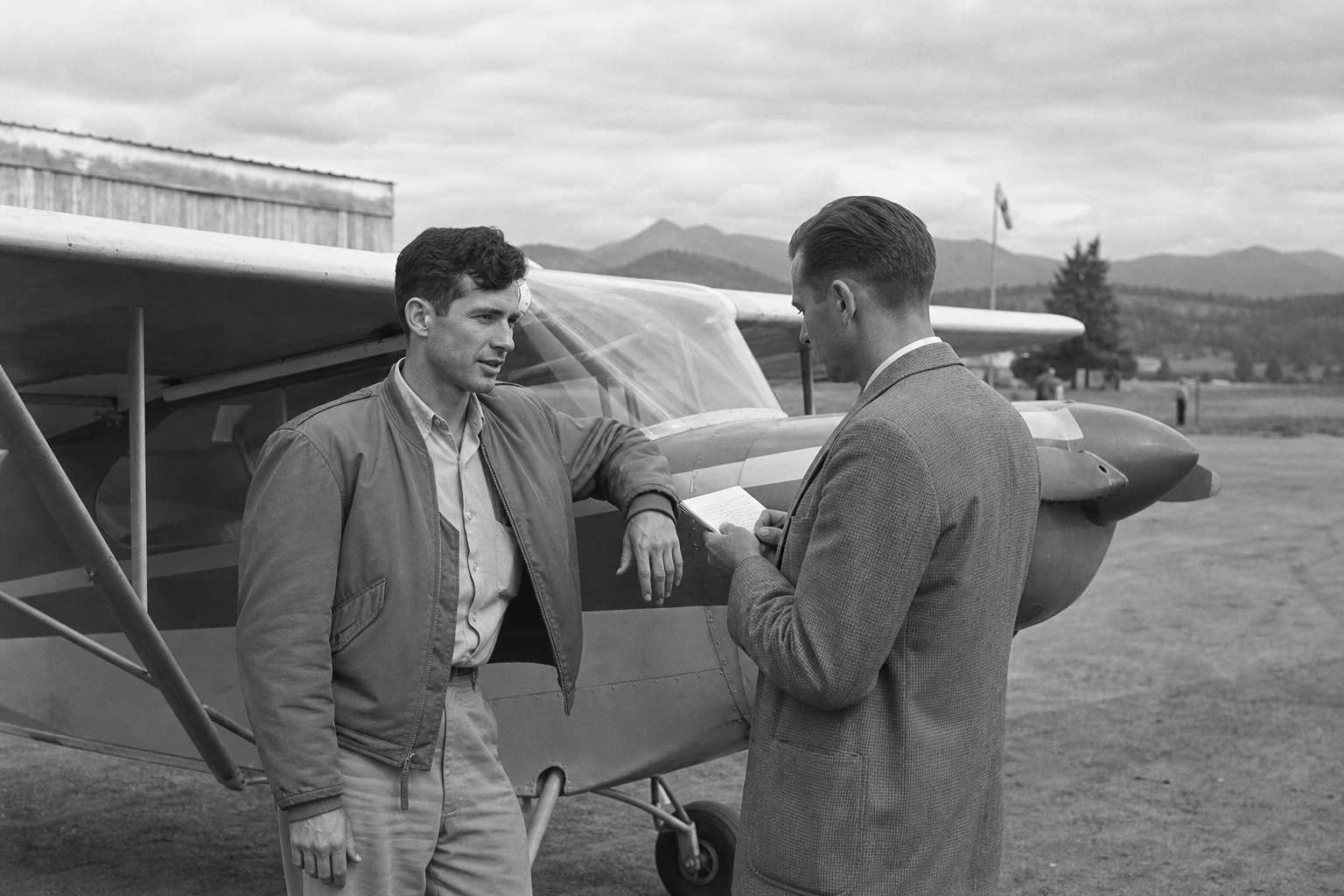
Wire-service distribution changed the scale of the story. Associated Press versions carried the account beyond the Pacific Northwest, but compression also favored the most vivid language. A local report could preserve more of Arnold’s qualifications and comparisons; a wire item had to identify the phenomenon in a few memorable phrases. “Flying saucer” was ideal headline language, even though it encouraged a more literal image of shape than Arnold’s motion comparison required.
Newspapers soon printed accounts from other witnesses who thought they had seen similar aerial objects. Those reports belong to a broader 1947 reporting wave, not to a demonstrated chain of identical events. Publicity may have supplied a shared vocabulary and made readers more likely to report unusual sights, while it cannot establish that Arnold’s story created every later case or that all reports had one cause.
That is why the Kenneth Arnold sighting remains a foundational media event in the modern UFO era. It was not the first report of something puzzling in the sky. Its distinctive historical role was to make an ambiguous aerial observation nationally legible as a recurring public category, one that newspapers, witnesses, and eventually officials could describe, compare, and debate.
Official Interest, Later Investigations, and the Limits of the Record
Military attention followed the expanding 1947 report wave, but it should not be mistaken for a contemporaneous solution to Arnold’s observation. Arnold submitted a written statement to Army Air Forces personnel on July 12, 1947; it preserved his account for official consideration, including the claimed number, formation, brightness, and extraordinary apparent movement of the objects.
The later investigative structure came in stages. The Air Force’s Project Sign began in 1948, followed by Project Grudge and, in 1952, Project Blue Book. These programs collected, screened, and attempted to classify UFO reports, separating cases with an identifiable conventional explanation from those left insufficiently resolved in the available file. Their existence shows sustained institutional interest in aerial reports, particularly where public concern, aviation, or national-security questions were involved; it does not establish that every earlier report received a definitive investigation.
The Robertson Panel, convened by the CIA in 1953, reviewed the broader UFO problem rather than conducting a fresh, event-by-event inquiry into the Mount Rainier report. Its recommendations addressed how agencies should handle reports and public interest. Neither that panel nor the later Air Force programs retroactively identified Arnold’s nine objects as extraterrestrial or non-human.
A useful distinction is between an unresolved report and a verified extraordinary cause. The surviving record documents Arnold’s report and subsequent official attention, but gaps, changing descriptions, and limited observational data prevent the file from proving a government UFO cover-up. Modern UAP disclosure debates may revive interest in old cases, yet they add no automatic evidentiary weight to the 1947 observation itself.
Possible Explanations, and What Remains Uncertain
Proposed explanations should be judged against the particulars Kenneth Arnold reported on June 24, 1947: nine bright objects near the Mount Rainier area, moving together with an unusual apparent motion. An aircraft explanation would need to account for the reported number, formation, brightness, and estimated traversal; merely noting that military and civilian aircraft existed in the region does not do that. A bird explanation similarly depends on whether distance, reflected light, grouping, and apparent speed can plausibly produce the observation Arnold described.
Reflections, cloud effects, and other visual phenomena address a different possibility: that changing light, terrain, or atmospheric conditions altered the appearance of an ordinary stimulus. Such explanations can be useful where they reproduce the reported flashes or motion, but they remain hypotheses unless they fit the viewing direction, conditions, duration, and linked movement of all nine objects. Estimation error is also relevant. Arnold’s range, size, and speed figures were interdependent calculations from a brief observation, so an error in assumed distance would substantially change the implied performance without establishing what the objects were.
Was the Kenneth Arnold sighting ever explained? No single account can responsibly be treated as a universally settled resolution on the surviving record. Nor does an unresolved identification constitute proof of non-human intelligence or a UFO disclosure claim. The durable facts are narrower: Arnold made the report, it was recorded and circulated, and its language helped shape a lasting public category. The identity of the objects remains uncertain.
Why the Kenneth Arnold Report Still Resists a Simple Answer
Three layers of evidence must be kept separate. Arnold’s testimony records what one pilot believed he observed; newspaper accounts record how editors and wire services selected, condensed, and sometimes recast that testimony for a mass audience; later books, investigations, and reconstructions interpret a record already shaped by both. A strong reading gives greatest weight to points that recur in Arnold’s early accounts, while treating memorable additions, especially literalized imagery of a flying saucer, as possible products of transmission rather than direct observation.
Official attention establishes that the report was taken seriously enough to preserve and consider, not that officials identified its cause. Retrospective explanations face the opposite limit: they may show how perception, light, distance, or an ordinary object could have produced an unusual impression, but they cannot recover measurements that were never independently recorded. The surviving material supports confidence about the report’s occurrence and its rapid public circulation, not confidence in a single physical solution. That is the enduring significance of the Kenneth Arnold sighting: its documentation and cultural influence are far stronger than any definitive identification of the nine objects, placing it among historically significant unresolved UAP cases.
Frequently Asked Questions
-
What did Kenneth Arnold report seeing on June 24, 1947?
Kenneth Arnold reported seeing nine unusually bright objects moving together near Mount Rainier, Washington. He described them as traveling in a chain-like or echelon-like formation at extraordinary apparent speed.
-
How many objects did Kenneth Arnold say he saw near Mount Rainier?
Arnold said he saw nine objects during his June 24, 1947 flight near Mount Rainier. He was flying a CallAir aircraft while searching the area for a missing Marine transport plane.
-
Did Kenneth Arnold actually call the objects flying saucers?
Arnold’s famous saucer comparison referred primarily to the objects’ skipping motion, like a saucer skipped across water. Newspaper and wire coverage turned that motion comparison into the lasting phrase “flying saucers,” which suggested literal dish-shaped objects.
-
How fast did Kenneth Arnold estimate the objects were moving?
Arnold estimated speeds of roughly 1,200 to 1,700 miles per hour in different accounts. His estimate was based on the apparent time the objects took to travel between the Mount Rainier and Mount Adams area, not on instrument-recorded measurements.
-
Was the Kenneth Arnold sighting ever explained, and how should it be evaluated?
No single explanation is universally accepted as a final resolution of Arnold’s sighting. Evaluate proposed explanations by whether they account for all reported details, including nine objects, their group movement, bright reflections, viewing conditions, and the uncertainty in Arnold’s distance and speed estimates.