Kenneth Arnold Sighting: Pilot Saw Nine Objects Near Mount Rainier on June 24, 1947 and Coined “Flying Saucer”
Explore the Kenneth Arnold sighting of June 24, 1947, near Mount Rainier, and learn how it inspired the term flying saucer.
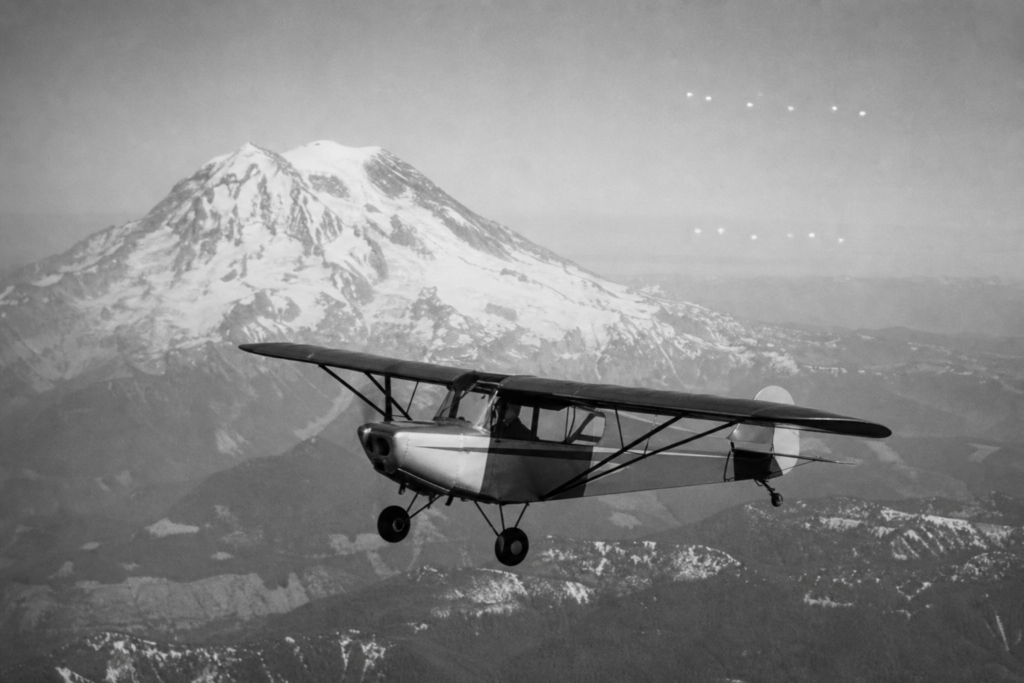
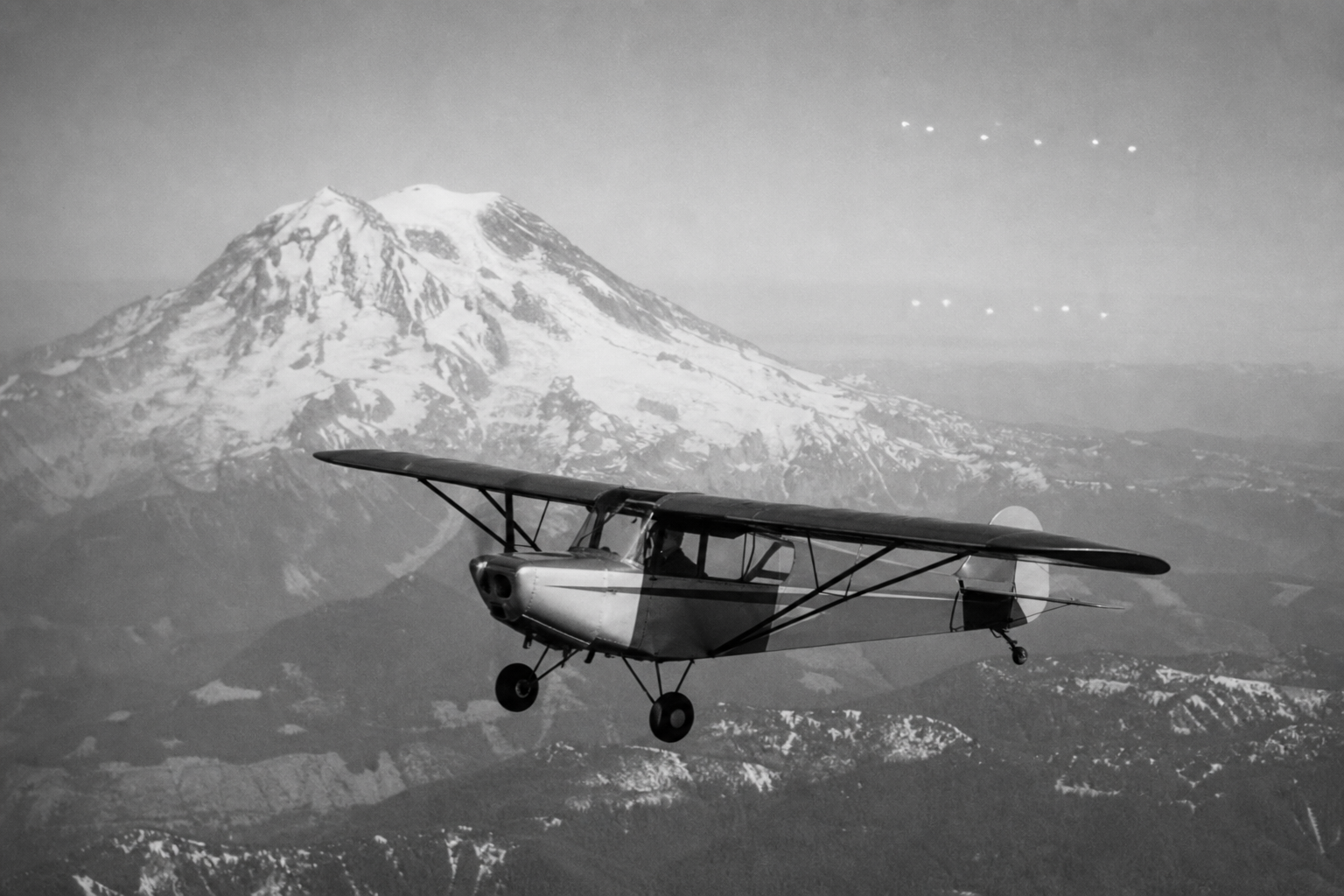
On June 24, 1947, private pilot Kenneth Arnold reported seeing nine fast-moving unidentified objects near Mount Rainier in Washington while flying his CallAir A-2. The Kenneth Arnold sighting did not establish what the objects were. It did, however, produce a detailed, widely circulated account from an experienced flyer at a moment when newspapers could turn a local report into a national sensation.
Arnold’s description contained two elements that later retellings often blur: what he thought the objects looked like and how he said they moved. His comparison for their motion, rather than a simple declaration that he had seen round spacecraft, helped journalists and the public settle on the memorable phrase “flying saucer.” That wording quickly supplied an image for a new category of 1947 UFO sightings, even though it did not capture every feature of Arnold’s account.
This history therefore begins with the report itself: a date, a flight, a place, nine reported objects, and a witness’s attempt to describe an unexpected aerial observation. It then follows the route from that uncertain observation to headline language and enduring mythology, keeping Arnold’s perceptions, his estimates, press interpretation, and later speculation distinct.
Arnold’s Flight Near Mount Rainier: What He Was Doing and Where He Was
The flight had an ordinary destination: Arnold was traveling from Chehalis, Washington, to Yakima, on the east side of the Cascade Range. Mount Rainier rose north of his general course, a conspicuous landmark above the surrounding high country rather than an isolated point in empty airspace. His aircraft, a small CallAir A-2, gave him the visibility and maneuverability of a private pilot flying in daylight, not the equipment or mission of a scientific observer.
He had made a detour toward Rainier for a practical reason. A U.S. Marine Corps C-46 transport had reportedly gone down in the mountain area, and publicity about a reward for locating the wreckage had drawn attention to the search. Arnold later said he looked around the mountain in hopes of spotting it before continuing toward Yakima. That effort matters because it places his attention on terrain, weather, and possible signs of an aircraft accident, not on a prearranged search for unexplained aerial objects.
The setting also clarifies the geography of the June 24, 1947 UFO sighting. Rainier is part of the Cascade Range, whose volcanic peaks and ridges create long sightlines but can make distance difficult to judge from the air. Arnold’s report emerged during a daylight cross-state flight in a region he was already scanning, after an unsuccessful look for the missing transport. The later importance of the episode should not obscure that immediate context: a pilot on the way to Yakima encountered something he could not readily identify and tried to describe it afterward.
What Arnold Said He Saw: Nine Objects, Unusual Motion, and an Uneven Shape
Arnold’s account centered on a sequence rather than a single stationary shape. He said he saw nine unidentified objects traveling in a loose, chainlike formation, generally on the same course, with one object set apart in appearance from the others. Sunlight seemed to flash from them as they moved, an observation that made their surfaces appear bright and intermittent rather than continuously visible.
He described their motion as abrupt, coordinated, and exceptionally rapid. His best-known comparison was to a saucer skipped across water: not a claim that the objects were saucer-shaped, but an attempt to convey a skipping or bounding flight path. That distinction matters because the public label that followed emphasized an imagined object design, while Arnold was initially struggling to describe movement.
The reported forms were not simply nine round discs. In early descriptions and later recollections, Arnold compared most of them to flat, crescent-like or heel-shaped objects, sometimes likened to a wing or boomerang profile; one seemed differently shaped. “Crescent-shaped craft” is therefore a useful shorthand for part of his description, not evidence of a settled, uniform design. The changing language also reflects the difficulty of recalling an unexpected, distant visual event in ordinary geometric terms.
Arnold estimated an extraordinary speed by timing the objects’ apparent passage between prominent Cascade peaks and combining that interval with his own judgment of their distance. The calculation was consequential, but it was an estimate built on uncertain range, size, and perspective, not an instrument reading. The durable historical fact is narrower: a pilot reported nine objects whose formation, flashes, motion, and uneven outlines he could not identify. The next step in the story is how those reported movements became the headline phrase “flying saucer”.
How “Flying Saucer” Entered the Headlines
A metaphor changed the story’s visual meaning. In interviews after landing at Pendleton, Oregon, Arnold tried to convey the objects’ erratic progress by comparing it to a saucer skipping across water. The comparison described action: a flat object bouncing, tilting, and flashing as it moves. It was not a tidy name for the objects themselves.
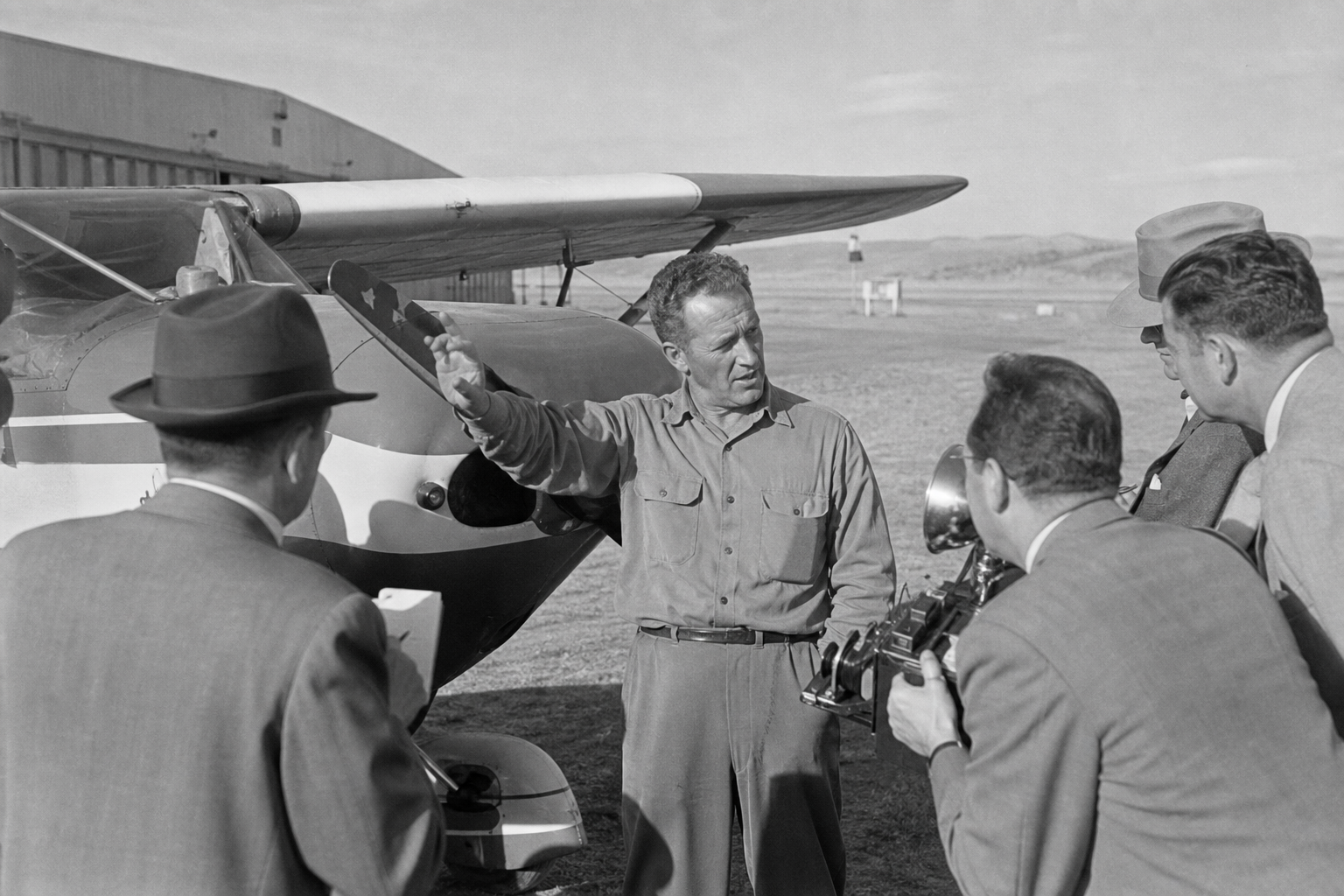
Reporter Bill Bequette helped carry that description into public circulation, and United Press coverage condensed the image into the far more portable phrase “flying saucer”. That shorthand worked as headline language because it gave editors and readers an immediate picture. But it also shifted attention from the reported motion to an implied form: a round dish flying through the sky. In that sense, the flying saucer origin was press-mediated. Arnold supplied the memorable analogy; reporters transformed it into a label.
The distinction is important when reading accounts of the Kenneth Arnold flying saucer report. A strong summary preserves both parts of the record: Arnold reported an unusual sequence of movement and gave varied, uneven descriptions of the objects’ outlines. A weak summary treats “saucer” as his definitive description of nine identical circular craft. Once the phrase appeared in headlines, illustrations and later retellings could readily favor the simpler disc image, even though it left out much of what Arnold had tried to communicate.
Why the Report Became a National Sensation
Wire-service treatment gave the story a reach that a local aviation report would not otherwise have had. As newspapers reprinted and adapted the account, the compact “flying saucer” label made it easy to headline, illustrate, and repeat. Readers were no longer encountering only one pilot’s difficult description of light, motion, and distance; they were being offered a vivid category into which later observations could be placed.

That category helped produce a feedback loop. In the days and weeks after Arnold’s report circulated, newspapers carried increasing numbers of reports from people who believed they had seen similar things. Those follow-on reports did not independently establish what Arnold observed: they varied in setting, number, shape, and quality of observation. Their significance lies instead in showing how quickly an unfamiliar aerial report became a national subject of conversation and UFO news.
Military concern formed part of the same setting, though it was not proof of a shared cause. In 1947, reports of unexplained objects arrived amid postwar attention to air defense, new aircraft, and the possibility of foreign technology. The emerging official interest concerned the practical problem of identifying reports, whereas popular coverage turned them into a broad public mystery. That difference matters in UFO cultural history: investigation and sensation could reinforce one another without reaching the same conclusions.
The Maury Island episode, reported in the Puget Sound area that summer, soon became attached to the flying-saucer story as well. Its contested claims and later lore make it a separate, disputed episode, not corroboration for Arnold’s nine-object observation. The first flying saucer report was therefore influential less because it settled an aerial mystery than because it supplied the language through which countless subsequent reports were understood.
Was the Kenneth Arnold Sighting Explained?
No explanation has conclusively reconciled every element of Arnold’s account: nine bright objects, their apparent formation and changing visibility, and the speed estimate produced from an uncertain judgment of distance. Proposed ordinary causes have included birds catching sunlight, conventional aircraft, cloud or snow reflections, and perceptual effects created by glare, motion, and the difficult geometry of viewing distant objects against Cascade peaks.
Those proposals address different parts of the observation rather than supplying a universally accepted reconstruction. Birds, for example, could help explain intermittent flashes and shifting apparent shapes but must also account for the reported coordinated travel; a reflection or atmospheric effect may address brightness yet fit less easily with an observer’s impression of separate moving bodies. Conversely, Arnold’s speed calculation depended on assumptions about range and size, so its startling result cannot by itself establish the objects’ actual velocity. The surviving report leaves too few independently measured details to decisively choose among such possibilities.
The episode belonged to the wider military problem of sorting aerial reports. Project Sign, followed by Project Blue Book, collected and assessed reports of unidentified flying objects in part because misidentification, foreign technology, and air-defense concerns all mattered. An “unidentified” label described the limits of available information; it was not a finding that a report involved extraterrestrial or non-human intelligence. The Kenneth Arnold sighting remains historically unresolved in that limited sense: its identity was not firmly established, but uncertainty is not affirmative evidence for an extraordinary craft.
The Lasting Legacy: A Report, a Headline, and a Durable Mythology
A useful checkpoint is the difference between a witness’s description and the image a headline leaves behind. Arnold’s comparison of the reported objects’ skipping, tilting motion became “flying saucer” in press coverage, a memorable label that encouraged the public to picture a category of craft more uniform and disc-like than his own varied description.
That compression made the Kenneth Arnold sighting a foundational event in U.S. UFO culture: one observation became a headline, then a shared vocabulary for later reports, imagery, investigations, and speculation. The durable historical record is a pilot’s June 24, 1947 report of nine unusual objects during a flight by Mount Rainier, not an alien craft proven over Washington. Its meaning changed as it moved from cockpit observation to newspaper shorthand and popular mythology.
The distinction remains useful when historical cases appear in debates about UFO disclosure or UAP disclosure. Cultural importance shows that a report shaped public attention; unresolved identification shows that available information did not settle what was seen. Neither point supplies evidence of non-human intelligence. Treating those categories separately preserves what is genuinely remarkable about Arnold’s account without asking it to prove more than the record can bear.
Why the Kenneth Arnold Report Still Matters
On June 24, 1947, Kenneth Arnold landed at Pendleton after flying his CallAir A-2 across Washington and Oregon, then gave reporters an account that joined nine reported objects, bright flashes, an uneven outline, and a skipping, tilting motion. The enduring lesson is methodological: keep that firsthand report, its interpretation, and its cultural aftermath in separate view.
That separation makes the Kenneth Arnold sighting more useful, not less compelling. Arnold’s speed calculation depended on his estimate of the objects’ distance as they passed between Cascade landmarks; it was not an instrument reading. A strong history therefore neither converts one pilot’s report into proof of extraordinary craft nor treats uncertainty about identification as reason to erase its impact.
The phrase flying saucer supplied the crucial shorthand. Arnold’s saucer comparison concerned how the reported objects moved, like something skipping over water, while newspaper and wire coverage recast it as an apparent shape. That change gave later aerial reports a compact public category, even though it simplified his varied description.
A definitive solution is not the measure of this episode’s importance. Its historical force lies in the sequence from Arnold’s June 24 account to national headlines and a durable mythology that shaped the language, attention, and expectations of the modern UFO era.
Frequently Asked Questions
-
What did Kenneth Arnold see near Mount Rainier on June 24, 1947?
Kenneth Arnold reported seeing nine bright, fast-moving unidentified objects near Mount Rainier while flying his CallAir A-2 from Chehalis, Washington, toward Yakima. He said they traveled in a loose chainlike formation, flashed in sunlight, and moved in an abrupt, skipping pattern.
-
How many objects did Kenneth Arnold report seeing?
Arnold reported seeing nine objects. He described most as flat, crescent-like, heel-shaped, or winglike, while saying one appeared different from the others.
-
Did Kenneth Arnold really coin the term flying saucer?
Arnold supplied the comparison that led to the phrase, saying the objects moved like a saucer skipped across water. Reporter Bill Bequette and United Press coverage turned that motion comparison into the headline label “flying saucer.”
-
How did Kenneth Arnold estimate the objects’ speed?
Arnold timed the objects’ apparent travel between prominent Cascade peaks and combined that interval with his estimate of their distance. The result was not an instrument measurement because it depended on uncertain assumptions about range, size, and perspective.
-
Was the Kenneth Arnold sighting officially explained, and what should you look for when assessing it?
No explanation conclusively accounts for all reported details, including the nine objects, bright flashes, apparent formation, and speed estimate. When assessing the sighting, separate Arnold’s direct observations from his distance calculations, press interpretations, and later UFO mythology.