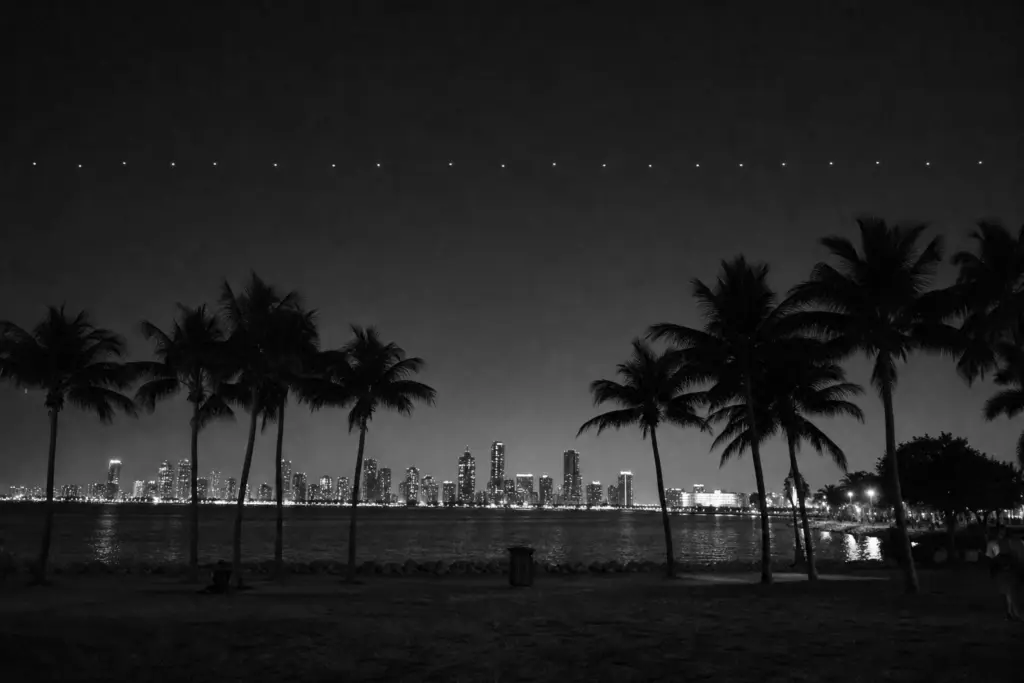
Reports tied to the Miami UFO sighting January 2 2020 describe an arresting scene: 19 lights, apparently low in the sky, moving in a line across the Miami area. That description is the starting point, not a settled identification. “Low altitude” may reflect a witness’s impression from a ground-level view, while “19” may be a count made from a particular clip or retelling rather than a measurement independently established by original media.
This review separates those layers. It follows the surviving posts and footage back as far as the available record permits, distinguishes a date or location asserted in a caption from one embedded in an original file, and examines what the images actually reveal about spacing, motion, brightness, and formation. A line of lights can look coordinated while still arising from objects separated by substantial distance along the viewer’s line of sight.
From there, the reported characteristics will be tested against ordinary possibilities, including aircraft moving on a shared approach or departure corridor, aerial lanterns, drones, satellites, and other light sources. An unidentified observation means only that the available record does not establish its cause; it is not evidence for any particular extraordinary cause. The key question is whether the evidence can support more than the report itself, and where it cannot, this account will say so plainly.
What Was Reported Over Miami on January 2, 2020?
The event is best described, at this stage, as a reported observation with four linked attributes: a date of January 2, 2020; a Miami-area location; a line or near-line of lights; and a total of 19 lights that appeared low and moved across the sky. Circulating descriptions present those attributes together, but they do not carry equal evidentiary weight.
The number “19” should be read as a reported count unless an original, continuous recording permits each visible light to be counted without ambiguity. Likewise, “low-altitude” describes appearance from the observer’s viewpoint, not a measured height. A line formation can mean lights genuinely travelling in sequence, but it can also be a perspective effect: separated objects may align visually when viewed along a common direction. Motion, too, requires more than a caption; it depends on whether stable landmarks, duration, and the camera’s own movement are visible.
No authenticated original file, embedded time record, or independently established geolocation is identified in the material considered here. The January 2 date and Miami attribution therefore remain parts of the reported case record rather than established measurements. This account treats the 19 lights over Miami on January 2, 2020 as a claim to examine, without presuming that the lights were aircraft, satellites, drones, or something anomalous.
What the Surviving Posts and Video Can, and Cannot, Establish
A defensible source timeline cannot yet begin with a verified first-hand post. No original file, named earliest uploader, platform archive record, or contemporaneous witness report has been preserved in the material available for this review. That absence does not disprove the Miami sky lights January 2020 report; it means the chain from an observer’s device to later circulation cannot be reconstructed.
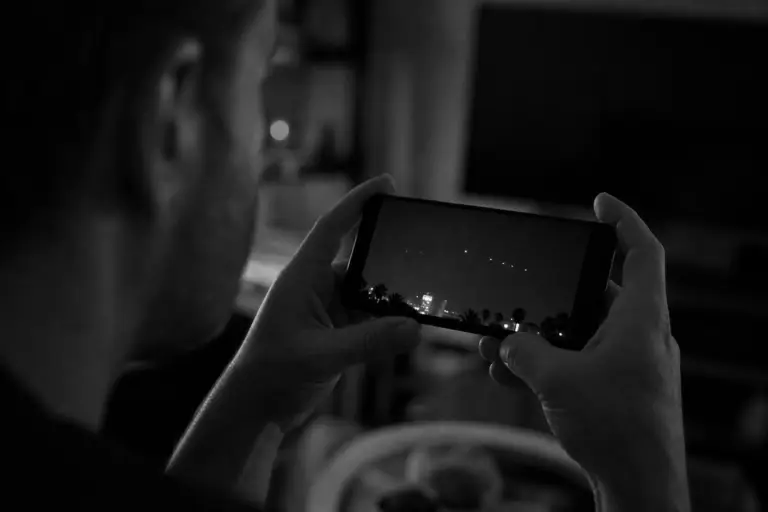
In that chain, an original recording is the strongest item: it may retain creation time, file details, untrimmed duration, ambient sound, and visual context. A first upload is weaker but can still establish when that account placed a clip online. Reposts, compilation videos, screenshots, and narrated segments are weaker again. They can preserve a claim that footage circulated, but not necessarily its date, place, sequence, or untouched content.
An upload date records publication, not observation. A person may post hours, days, or years after filming, and a reused clip can acquire a new Miami caption without showing any Miami landmark. Narration and on-screen labels may accurately relay a witness report, but they are later interpretation unless linked to the original speaker and recording.
Even authentic-looking footage has limits. Compression can merge nearby points of light; cropping removes landmarks and horizon cues; stabilization changes apparent camera motion; cuts can erase pauses or changes in direction; and replacement audio can sever a clip from its setting. Without a continuous, geolocated original and independent sensor-track evidence, the video cannot reliably measure altitude, distance, speed, physical size, or a precise total of 19 lights. It establishes only what is visibly present in that version of the clip.
Reconstructing the Line of Lights: Formation, Motion, and Apparent Altitude
The reported geometry is more useful than the label attached to it. A single-file formation means that separate lights appeared arranged along one visual path; it does not establish that they occupied one straight physical line or shared an altitude. Perspective can place objects separated by large distances on the same line of sight, while a moving camera can make a loose grouping look orderly. Here, the line of lights in the sky and the count of 19 remain report-level details rather than measurements recoverable from an authenticated recording.
Several observations would be directly testable in a continuous original video: how many distinct points are visible in each frame, whether gaps remain stable, whether lights overtake or merge with one another, and whether their brightness pulses independently or changes together. Those distinctions matter. Stable relative spacing can fit objects following a common route or moving together; shifting gaps can indicate differing speeds, wind drift, changing perspective, or camera movement. Zoom, autofocus, digital stabilization, and automatic exposure can also enlarge halos, suppress dim lights, or make a steady point appear to brighten and fade.
“Low altitude” is the least secure part of the description. In a phone video, apparent altitude means only where a light sits above the visible horizon or skyline. Measurable altitude requires a known filming position, compass direction, horizon reference, time, and either distance information or a second viewing point. A light near the horizon may be nearby and low, but it may also be distant and high; a cropped frame without buildings, coastline, or other fixed markers cannot resolve that difference. The reported travel direction likewise remains unknown without knowing where the camera faced. The available case record therefore supports a claimed near-single-file formation, not a reconstructed three-dimensional path.
Which Conventional Explanations Best Fit the Report?
Each candidate rises or falls on the full pattern, not merely on its ability to produce multiple lights. Aircraft using the same arrival or departure corridor can appear as a single line when viewed nearly end-on. That model can accommodate roughly 19 separate lights over a sustained period, with uneven apparent gaps and steady progress in one general direction. It is strongest if individual lights brighten as aircraft turn toward the viewer or display independent navigation-light flashes; it is weaker if all points hold perfectly fixed spacing and change brightness together. Engine noise may be absent at a distance or masked by the setting, so silence alone would not decide the issue.
Coordinated drones would more readily produce deliberately regular spacing, matched speed, synchronized color or brightness changes, and a comparatively compact display. They can also look low, particularly against a dark skyline. Their fit declines if the reported line traversed a large part of the sky for many minutes without formation changes, or if the lights behaved as independently spaced points rather than a managed group. A count near 19 is plainly possible for a drone display, but the available record does not establish launch location, flight duration, control pattern, or sound.
Sky lanterns would tend to show warmer, flickering lights whose spacing and direction respond to wind rather than precise control. A release could yield many lights, including a reported total near 19, but a clean, evenly paced line would be less persuasive unless wind and release timing happened to align. Lanterns generally drift rather than follow a sharply purposeful route; their height, speed, and sound cannot be inferred from the surviving description.
A satellite pass, including a Starlink train, can create a long sequence of similarly moving points with broadly consistent direction and no audible sound. Starlink was operational by early 2020, but visual resemblance is not a match: the decisive test would require an archived pass prediction for the claimed Miami location and time. A satellite train is less compatible with a genuinely low-altitude appearance, though a low viewing angle can create that impression. Without a verified observation time, camera direction, duration, or original media, the unidentified lights cannot be discriminated reliably among these explanations.
Was the Miami Lights Event Officially Investigated or Independently Corroborated?
An official response would be a separate evidentiary channel, not merely a more authoritative retelling. A police incident number, FAA occurrence record, airport operations notice, military statement, or weather-service observation tied to a specific time and viewing area could test the account against independently recorded activity. No such authenticated record is included in the surviving case material reviewed here. That is an absence of located records, not evidence that nobody called police, notified an airport, or made a report at the time.
Flight-tracking data would be useful only if it could be matched to a defensible observation window, filming location, and viewing direction. A screen capture showing routine Miami-area traffic without those anchors would not identify the lights; equally, the lack of a matching public track would not exclude aircraft, because the reported time and location have not been independently fixed. The same limitation prevents airport, military, and weather records from being meaningfully compared with the sighting.
Independent corroboration requires more than several posts repeating “19 lights over Miami.” Strong corroboration would consist of non-overlapping witnesses who separately provide compatible times, locations, directions, duration, and distinctive behavior, ideally with original media or identifiable landmarks. Reposts, narration channels, and copied captions may show that a claim circulated, but they do not establish multiple observations. On the available record, this remains one reported event without documented official investigation or independently traceable witness convergence sufficient to classify it as a corroborated UAP sighting.
What Can Be Concluded From the Available Evidence?
The most supportable finding is modest: the case record preserves a claim that lights were seen over the Miami area on January 2, 2020, not an authenticated observation whose date, place, count, altitude, or source can be independently established.
- Reported: a line or near-line of 19 lights moving across the sky and appearing low.
- Not established: a continuous original video, a first-hand uploader, embedded creation metadata, a precise viewing location and direction, or separate witness accounts anchored to the same event.
- Plausible but unproven: ordinary aerial sources, particularly aircraft viewed along a shared route, as well as drones, lanterns, or satellites under the right conditions.
- Unsupported: a conclusion that the lights were exotic technology, non-human intelligence, or a government operation.
Neither the apparent low altitude nor the visual line supplies that missing identification. A light can look low because it is near the horizon, while perspective can align separate aircraft or other distant objects into a single-file pattern. Those features make an event worth examining; they do not reveal distance, speed, propulsion, control, or operator.
No explanation can be ranked confidently because the decisive comparison points are absent. Aircraft remain a reasonable category to test because a traffic corridor can produce sequential lights, but the record cannot tie the observation to a time, direction, or flight track. The Miami UFO lights sighting therefore remains insufficiently documented for classification rather than evidence for an extraordinary cause.
What Would Make a Similar Sighting Easier to Identify?
A future observer can turn a fleeting impression into a testable record by treating the first minutes as evidence collection. Save the original, unedited video file before sharing it; record the exact time, location, viewing direction, duration, weather impression, and whether the lights changed spacing, brightness, or course.
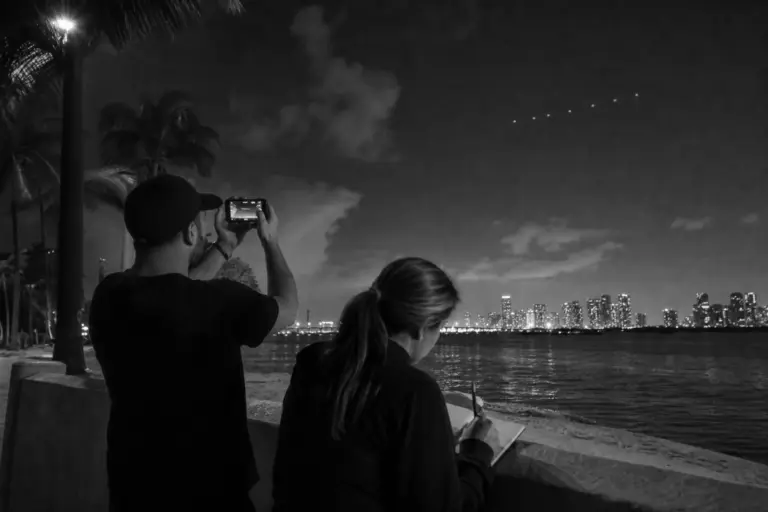
- Keep fixed landmarks, the horizon, and as much sky as possible in frame. A skyline, road, or shoreline gives later reviewers a reference that a tightly cropped sky clip lacks.
- Avoid digital zoom where possible: it enlarges pixels rather than adding detail and can make motion, spacing, and shape harder to assess. Film wide first, then take a steadier closer clip if conditions allow.
- Ask other observers to preserve their own files and notes separately, including their location and viewing direction, rather than circulating one shared account.
- Afterward, compare the recorded time and place with flight tracks and satellite-pass information. Those checks can test a specific match; they cannot repair a missing observation window.
Those steps cannot supply the missing record for the January 2, 2020 Miami report, but they show why that record could not be resolved further. Readers seeking wider context can follow our UAP disclosure coverage; it does not alter the evidentiary limits of this local case.
The Miami Lights Remain a Limited-Evidence Case
The lasting lesson from this case is evidentiary rather than exotic: an unusual visual pattern can be genuinely striking without supplying enough information to identify its cause. The reported total of 19, the Miami location, the January 2, 2020 date, and the impression of low altitude remain linked claims, not independently measured properties of an authenticated recording.
Several ordinary categories remain viable only as conditional fits. Sequential aircraft could produce separated lights on a shared visual path; drones would better fit deliberately uniform spacing or coordinated changes; lanterns would fit drifting, warmer points; and satellites could fit a longer procession moving in one direction. Unlike other widely discussed lights-in-formation cases, none can be selected responsibly here because the surviving material does not establish the observation time, viewing direction, distance, light behavior, or independent corroboration needed to distinguish them.
The absence of a located official record or verified witness chain does not make the event anomalous; it leaves the reported line of lights unclassified. Future sightings become far more useful when original files, timestamps, locations, landmarks, and separate witness accounts are preserved before reposting obscures their provenance.
Frequently Asked Questions
What were the 19 lights reported over Miami on January 2, 2020?
The report described 19 lights moving in a line or near-line across the Miami-area sky and appearing low to observers. The date, location, count, and apparent altitude remain reported details rather than independently verified measurements.
Was the Miami lights sighting backed by original video or official records?
No authenticated original video file, embedded timestamp, verified filming location, or named first-hand uploader has been identified. No authenticated police, FAA, airport, military, or weather-service record tied to the sighting is included in the available case material.
Could the line of lights over Miami have been Starlink satellites?
A Starlink train can appear as a long sequence of similarly moving lights with no audible sound, and Starlink was operational by early 2020. Confirming that explanation would require a verified observation time, Miami viewing location, camera direction, and archived satellite-pass predictions.
How can aircraft, drones, lanterns, and satellites be distinguished in a line-of-lights sighting?
Aircraft may show uneven spacing, steady travel along a corridor, and independent navigation-light flashes; drones more often show regular spacing and synchronized brightness or color changes. Lanterns tend to be warm, flickering, and wind-driven, while satellites typically move in a consistent direction without sound.
What should you record to identify a future line of lights in the sky?
Save the original unedited video and record the exact time, location, viewing direction, duration, weather, and changes in spacing, brightness, or course. Keep landmarks and the horizon in frame, avoid digital zoom, and preserve separate recordings and notes from other witnesses.