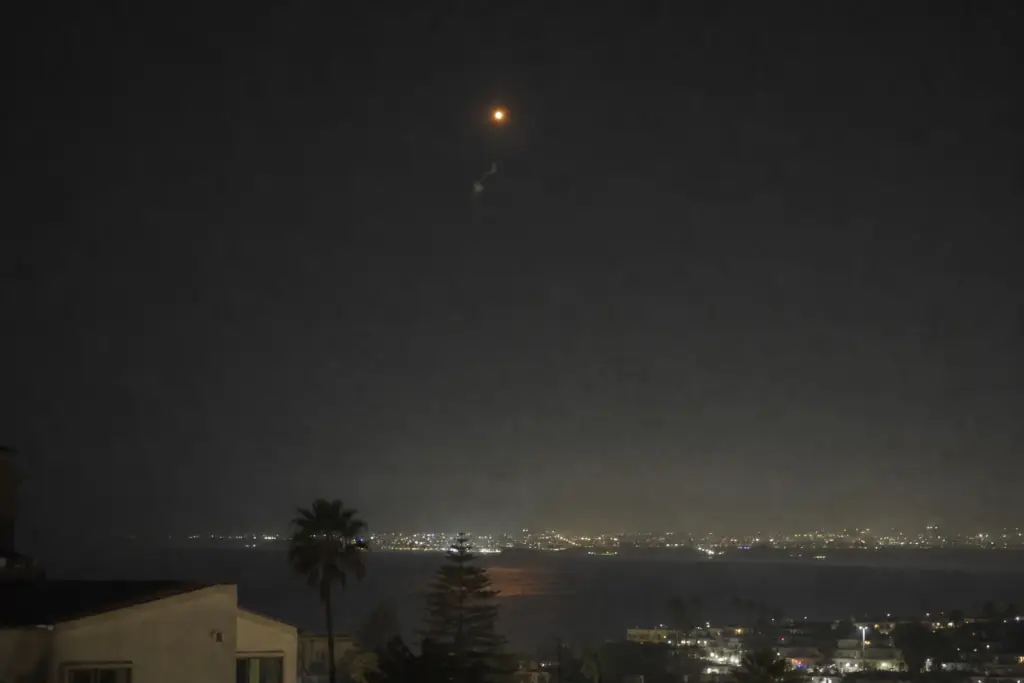
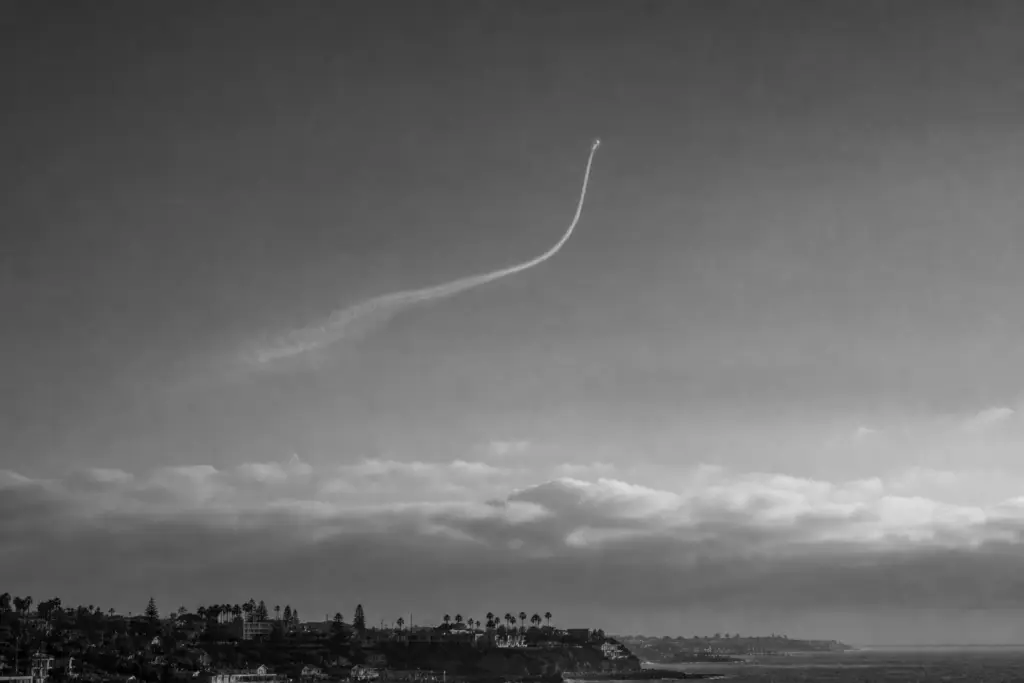
A report associated with the 2020 San Diego UFO sighting describes a compelling image: a small object that appears to rise straight up while drawing a white, snail-like line across the sky. That description records an observer’s visual impression, not yet a measured flight path. A video can show pixels moving against a background; by itself, it does not establish the object’s distance, altitude, speed, direction of travel, or identity.
This examination starts with that distinction. The apparent vertical climb could reflect a genuinely steep ascent, but it can also be shaped by viewing angle, camera tracking, zoom, exposure, and the changing position of a distant plume. The white trail likewise may be exhaust, condensed water vapor, a contrail distorted by winds at different altitudes, or another atmospheric effect. Its curled or “snail” appearance is a visual feature to test, not a classification.
The central questions are therefore practical: where did the earliest available footage or account originate, does it retain a date, time, location, or original metadata, and can contemporaneous flight, launch, airspace, or weather information be matched to a defensible viewing window? Until those links are established, the event remains a reported sighting with unresolved evidentiary limits, not evidence of an extraordinary craft.
What Is Claimed in the 2020 San Diego Sighting?
The case file begins with a narrow allegation, not a verified incident record: someone described an object seen in or near San Diego in 2020 as seeming to shoot upward while producing a white trail likened to a snail’s path. “Straight up” describes the apparent direction from the observer’s position; “white” and “snail-like” describe the trail’s visible color and curved or coiling form.
No attributable earliest upload, named witness statement, precise viewing location, reliable timestamp, or preserved original-file metadata has been supplied for this account. That absence matters because a reposted clip or retold observation can preserve the striking appearance while losing the details needed to compare it with a particular launch, aircraft route, atmospheric condition, or camera setting.
Later labels such as “UFO” or “UAP” are interpretations of an object not identified by the person sharing the material. They do not establish a non-human craft, unusual propulsion, or even a literal vertical ascent. The claim that can responsibly be carried forward is smaller: a reported San Diego-area observation appeared to show a rising object and a pale, curling trail.
The next steps are to separate the available recording or account from commentary attached to it, then test whether ordinary viewing geometry, image capture, plume behavior, and contemporaneous aerospace activity fit the reported scene. If the underlying time, place, and provenance cannot be recovered, the sighting may remain unresolved, but only because the evidence is too limited to identify it, not because it demonstrates an extraordinary vehicle.
Footage and Witness Record: What Can Be Verified?
The evidentiary starting point is not a clip’s dramatic appearance but its preservation history. For this report, no original camera file or attributable first upload is available in the material at hand. That leaves no basis to distinguish an unedited recording from a repost, a screen capture, a compilation excerpt, or a secondhand description attached to a video. The source provenance is therefore incomplete, a central issue in UAP video authentication.
An original file can retain metadata such as creation time, device model, frame rate, duration, and sometimes location data. Those fields do not identify an object by themselves, but they can establish whether the claimed 2020 date is plausible and whether the footage has a usable time window for comparison. A platform upload date is weaker: it dates publication, not necessarily observation. Re-encoding during upload may also strip metadata, alter frame cadence, and introduce compression artifacts that make a small bright object or thin trail harder to interpret.
Visual context matters as much as the moving feature. A useful San Diego UFO video would show a stable horizon or recognizable landmark, enough uninterrupted duration to track changes in the trail, and a known camera direction. Audio can preserve the filmer’s contemporaneous reaction, wind noise, aircraft sound, or clues about editing, though silence proves little. Screenshots and short commentary clips preserve only selected frames; they cannot show whether the camera panned, zoomed, lost focus, or began recording after the most informative part of the event.
Independent accounts would be strongest if they were separately recorded and agreed on a narrow time, viewing area, direction, and sequence without merely repeating a circulating post. At present, those corroborating details are not independently verified. The available record can preserve a reported visual impression, but it cannot establish a precise location, literal vertical flight path, speed, altitude, or a particular aerospace explanation. These limits contrast with a formally authenticated government video release and should govern every later attempt at identification.
Why an Object Can Appear to Shoot Straight Up on Video
A rising line on a phone screen is an image-plane movement: it shows where the feature traveled across the frame, not its measured route through the sky. A viewing angle close to the observer’s line of sight can make an object moving away, toward the camera, or along an oblique climb appear to move almost vertically. An aircraft or launch vehicle traveling on a slanted path may therefore occupy a near-straight upward track in the image without ascending directly above the observer.
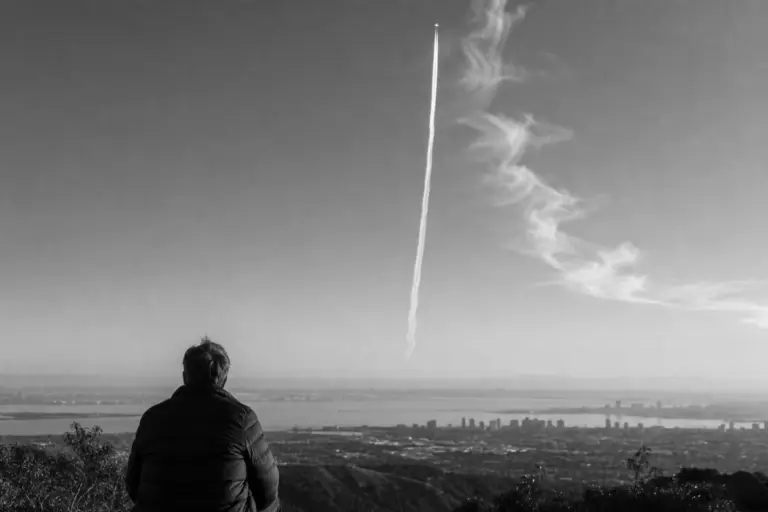
Perspective compression compounds that ambiguity. At long range, substantial changes in distance can produce only small changes in apparent size, while a small sideways component can be visually lost against an open sky. A receding object can seem to gain altitude even when much of its motion is away from the camera. Conversely, a genuinely climbing object may look slow because its angular position changes little. Without range data, stronger analytical methods than visual impressions alone are needed to determine speed, acceleration, altitude, or distance.
Camera movement is another variable. Tilting a handheld camera upward to keep a target centered can create the impression that the target is climbing faster than it is; panning can conceal its lateral travel. A fixed horizon, rooftop, mountain ridge, or other stationary reference permits an analyst to separate movement of the camera from movement of the feature. A blank-sky clip does not. Zooming also narrows the field of view and magnifies shake, making a small correction by the filmer look like abrupt motion by the object.
Establishing a three-dimensional flight path requires more than the apparent path of the object shot straight up over San Diego. Useful reconstruction would need a calibrated filming position and camera orientation, a defensible time, stable reference points, and ideally synchronized observations from separate locations. Two viewpoints can constrain direction through triangulation; one uncalibrated viewpoint generally cannot. The reported upward motion is therefore a valid description of the visual impression, but it remains unresolved as a literal vertical trajectory on the available record.
What Could Produce a White, Snail-Like Trail?
The trail’s shape is more informative than its color, but only when its development can be observed. A compact, bright line that lengthens behind a moving point is visually consistent with fresh exhaust from a rocket or missile plume. A trail that remains after the point fades, broadens into a diffuse band, or develops separate wisps is also consistent with a persistent vapor trail shaped after emission rather than a solid object leaving a fixed “tail.” Neither pattern, on its own, identifies the vehicle.
A rocket launch contrail can appear especially dramatic when exhaust reaches a high, sunlit layer of sky while the observer is closer to twilight or shadow. Under that geometry, the plume may look sharply white against a darker background and seem detached from the vehicle producing it. A concentrated origin, an expanding fan or bulb farther along the trail, and a visible change in brightness are features worth comparing with a launch hypothesis. The absence of a reliable time, direction, duration, and viewing location prevents that comparison from tying this report to any particular launch.
Aircraft contrails offer a different visual possibility. They commonly present as a relatively narrow line along the apparent direction of travel, while a persistent trail can widen, fragment, or drift after the aircraft has passed. Wind shear, winds moving at different speeds or directions across nearby layers, can pull one portion sideways while leaving another comparatively straight, producing bends, hooks, curls, or a snail-like curve. A visible aircraft-like point leading a long, level-to-oblique line would strengthen that interpretation; a rapidly expanding plume with no comparable linear segment would weaken it without excluding other exhaust-producing activity.
Viewing geometry can further distort both alternatives. A trail aligned partly toward or away from the camera may appear foreshortened, so a long slanting plume resembles a short vertical stroke. Camera exposure can wash a bright white plume into a thicker, smoother feature and obscure a dim leading object. The reported trail is therefore compatible with several ordinary aerospace and atmospheric mechanisms, including a missile plume, but the white color and curled outline are not unique signatures. On the available record, they cannot determine the object’s type, altitude, propulsion, or origin.
How Launch, Airspace, and Weather Records Should Be Checked
Begin by fixing the narrowest defensible viewing window rather than searching all of 2020. Preserve the claimed date separately from any date attached by a repost, convert any stated time to local time with its time-zone basis, and record the alleged viewing area, compass direction, duration, and whether the scene was near dawn or dusk. A match is meaningful only when its timing and apparent direction fit those details; a launch found somewhere in the same month is not an identification.
- Search FAA records for NOTAMs and temporary airspace restrictions overlapping that window. These notices can flag planned activity or restricted airspace, but they are context rather than proof that a visible plume came from a particular operation.
- Build a dated launch list from provider mission announcements and public Vandenberg-area activity, then compare launch time, trajectory direction, and the expected visibility from San Diego. Public military releases may add useful timing or mission context when available, but an absent release does not establish either a secret launch or an extraordinary object.
- Review flight-tracking records for aircraft near the reported line of sight. ADS-B-based tools can support an aircraft hypothesis when a track, timing, and direction agree; they are weaker when coverage is incomplete or the alleged object was distant, high, or not broadcasting a track available to the service.
- Test satellite-reentry reports separately. A reentry ordinarily produces a longer-lived, fragmenting path rather than a single compact climbing point, but only a time-and-direction comparison can make that distinction useful in this case.
- Retrieve archived surface observations, cloud reports, and upper-air wind data for the same window. The relevant comparison is whether winds at different altitudes could have carried a trail sideways or curled it after formation, not merely whether the day was clear at ground level.
Each search result should be saved with its archive link, retrieval date, stated time standard, and the assumptions used to compare it with the report. For the 2020 San Diego UFO sighting, the missing original timestamp and location prevent that disciplined cross-check from being completed. Public-record gaps leave the event unresolved on the available evidence; they do not, by themselves, demonstrate concealment or identify a non-ordinary craft.
What This Sighting Can, and Cannot, Tell Us About UAP Disclosure
The appropriate classification is unresolved because the record is insufficiently verifiable, not identified. The reported appearance is consistent with ordinary possibilities such as a distant aircraft contrail or an illuminated exhaust plume altered by viewing angle and wind, but no reliable time, location, original file, or matching operational record permits a specific attribution. “Unidentified” here means the available material cannot support a confident identification; it does not mean extraordinary.
That distinction matters in discussions of UFO disclosure and UAP disclosure. A local report with missing provenance cannot establish non-human intelligence, an alien craft, a government cover-up, or a broader disclosure claim. Those propositions require independently testable evidence: a preserved source record, corroborated observations, and data that rule out ordinary explanations rather than merely leaving them untested.
For future UAP sightings, the strongest first response is to preserve evidence before interpretation:
- Keep the original photo or video file, not only a repost or edited clip.
- Write down the exact local time, viewing location, duration, weather, and direction of travel; a compass bearing is more useful than “over there.”
- Include stable landmarks and avoid zooming or panning unnecessarily, since they help reconstruct camera orientation.
- Seek independent witnesses whose accounts were made separately.
- Compare the narrow time-and-direction window against reliable flight, launch, satellite, and weather records.
That method turns a striking image into a testable report. Without those anchors, this 2020 San Diego UFO sighting remains a vivid but evidentially limited observation.
The Evidence Supports a Careful, Testable Verdict
A firm identification requires a chain of evidence, not simply a striking visual pattern. Here, the available material supports only the report that a light or object appeared to climb steeply and leave a pale, curved trail. It does not establish a measured trajectory, altitude, speed, propulsion system, or origin.
That limit has practical force. A nearly vertical screen path can result from an oblique route viewed end-on, camera reframing, or the lack of fixed reference points. Likewise, a white “snail trail” can be consistent with exhaust or condensation spreading and curling in winds, with illumination and exposure changing its apparent thickness and brightness. Those possibilities are plausible mechanisms, not a retroactive identification of this particular event.
The most valuable path to a stronger conclusion is narrow and testable: recover the original media file and its metadata; establish the filming position, local time, and viewing direction; then compare that window with date-specific launch, aviation, and weather records. A matching record must fit the observed timing and geometry, while a match based only on the same city or year is weak.
The careful verdict is therefore unresolved on the available evidence. The video or account may document an unusual-looking sky event, but it does not by itself demonstrate an extraordinary craft.
Frequently Asked Questions
What was the 2020 San Diego object that appeared to shoot straight up?
It was a reported San Diego-area sighting of a small object that appeared to rise steeply while leaving a white, curled trail. No original file, reliable timestamp, precise location, named witness statement, or preserved metadata is available to identify it.
Why can a distant object appear to travel straight upward in a video?
A screen path shows image-plane motion, not a measured three-dimensional flight path. An object moving away or along an oblique route can look nearly vertical because of viewing angle, perspective compression, camera panning, tilting, or zoom.
Can a rocket or missile leave a white spiral or snail-like trail?
Yes. A rocket or missile exhaust plume can look bright white when it reaches a sunlit high-altitude layer, and winds at different altitudes can bend, hook, curl, or spread the trail into a snail-like shape.
Was the 2020 San Diego UFO sighting ever officially identified?
No official identification is supported by the available record. The case remains unresolved because it lacks a verifiable original video, date and time, viewing location, camera direction, and a matching launch, flight, or weather record.
What should viewers look for when verifying a reported UAP video?
Preserve the original file and record the exact local time, location, duration, compass direction, weather, and stable landmarks. Then compare that narrow time-and-direction window with FAA notices, launch schedules, ADS-B flight tracks, satellite reports, and upper-air wind data.