The Phoenix Lights 1997 remain memorable not because the record describes one uniform object, but because a single name came to carry an entire evening of startling reports, images, explanations, and recollections. That cultural shorthand has made the case seem simpler, and more decisive, than its underlying chronology permits.
On March 13, witnesses described an earlier sequence of lights moving along a broad route, while a later sequence appeared stationary over the Phoenix area. These are not interchangeable observations: motion, timing, viewing location, and available corroboration change what an explanation can account for. The later lights are the episode most directly aligned with documented military flare activity; that alignment does not, by itself, identify every earlier moving formation reported that night.
This reconstruction therefore separates three kinds of material. Contemporaneous reports preserve what people said near the event, though not necessarily an object’s measured distance, size, or altitude. Military records can establish activities capable of producing particular lights. Retrospective interviews show how witnesses and public memory interpreted the night later on. Read together, they explain not only what may have been seen, but how two reported sequences on one date became one enduring UFO narrative.
The Phoenix Lights Were Not One Single Evidentiary Event
The crucial unit of analysis is not the name but the observation. “Phoenix Lights” commonly functions as an umbrella label for an earlier, moving sequence reported across a wide corridor and a later cluster of lights that appeared stationary to viewers in the Phoenix area. A common date and regional nickname do not establish a common object, flight path, altitude, or cause.
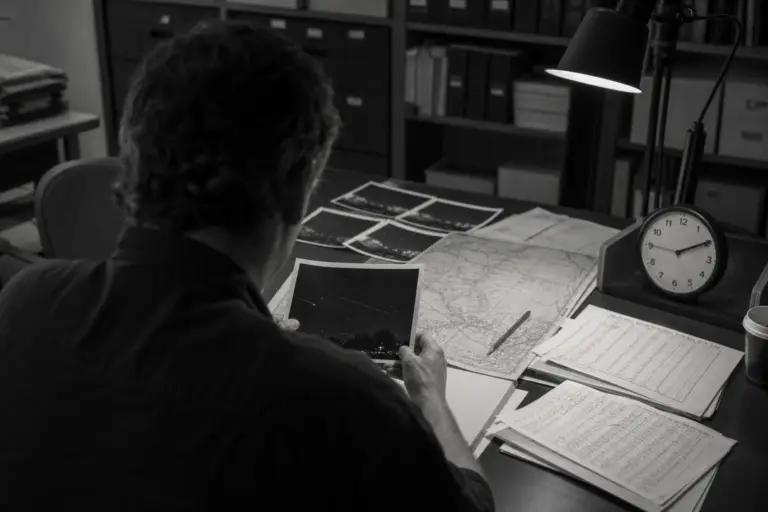
The chronology must therefore run on two tracks. One track follows reports of lights in motion earlier in the evening, including accounts that described a formation or a large outline. The other follows the later, visually memorable lights over the southern horizon: the sequence for which military illumination flares provide a specific, testable explanation. Explaining the second track does not automatically explain the first; treating both as one event makes that distinction disappear.
It also separates an observation from an identification. “Several lights appeared fixed in a row” is a report of appearance from a particular vantage point. “A single immense craft passed overhead” is an interpretation that requires additional evidence about distance, geometry, and motion. Those claims may arise from the same night without carrying the same evidentiary weight.
Later news coverage, photographs, documentaries, and recollections often placed both sequences beneath the Phoenix Lights incident label. The next timeline restores their order, locations, and differing behavior before asking what any proposed explanation can, and cannot, account for.
March 13, 1997: A Timeline of Two Reported Sequences
Chronology is the first safeguard against turning an evening of reports into a single flight path. Times from witnesses, calls, broadcasts, and later reconstructions do not always align to the minute, but they consistently divide the night into an earlier moving sequence and a later, more localized display.
| Approximate time | Reported area and behavior | What the timing can support |
|---|---|---|
| About 8:00–9:00 p.m. | Reports emerged along a broad corridor from Nevada into Arizona, including accounts from the Prescott area and communities north and west of Phoenix. Witnesses variously described several lights moving together, a V-like arrangement, or lights associated with a dark apparent form. | These are reports of motion from separated vantage points. The geographic spread shows that many people reported unusual lights; it does not, by itself, measure their distance or establish that every observer watched one continuous craft. |
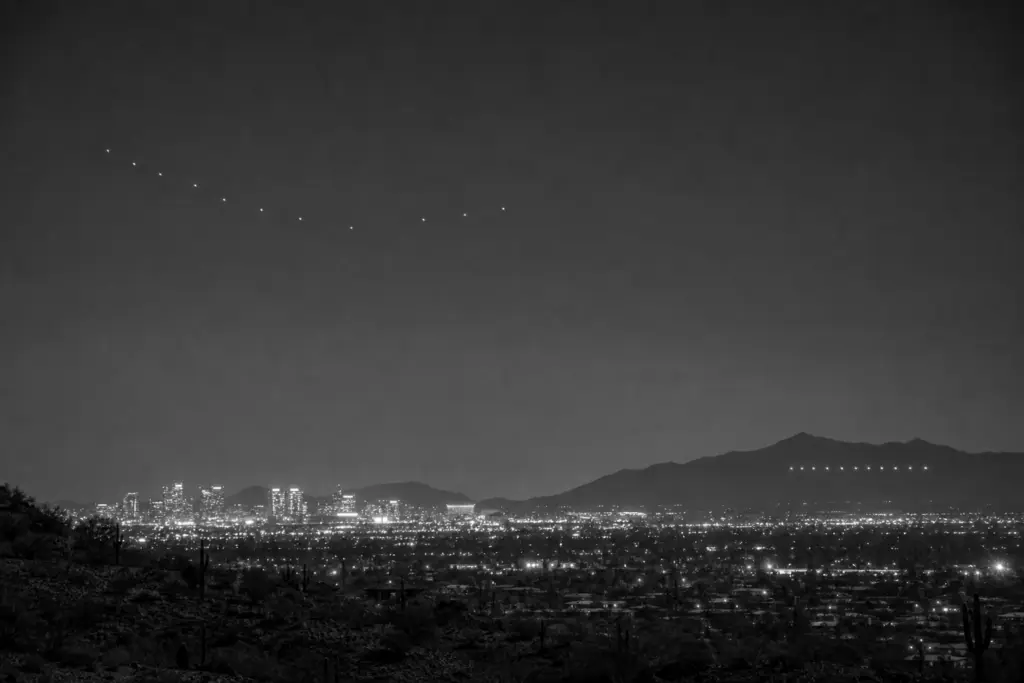
| About 10:00 p.m. | A separate set of lights appeared low over the southern Phoenix horizon and seemed stationary or nearly so. This later sequence supplied the photographs and video most often replayed in accounts of the Phoenix Lights timeline. | Its fixed-looking geometry, Phoenix-area viewing direction, and visual record make it a distinct episode for analysis rather than a final frame of the earlier moving reports. |
The gap matters more than a neat narrative allows. A witness may have seen lights earlier, another may have filmed lights later, and both may reasonably have used the same local name for what they saw. But matching date and region are weak continuity signals; a continuous identification would require reconciled times, directions, positions, and motion.
The later lights are the sequence directly addressed by the military-illumination-flare account developed later in this article. That account can explain why lights over the Phoenix area could seem suspended and then disappear one by one. It does not conclusively identify every earlier moving formation reported during the Arizona UFO sightings of 1997.
The Earlier Moving Formation: What Witnesses Reported, and What the Record Cannot Prove
Descriptions of the earlier moving reports share a recognizable core without yielding one uniform object description. Phoenix Lights witnesses recalled multiple lights traveling together, often in a broad triangular formation or a shallow V. Some emphasized apparently silent motion; others later described a large dark expanse between or behind the lights, sometimes said to block out stars.
Those statements are important evidence of perception: observers experienced lights as coordinated, directional, and unusual against the night sky. They can also preserve reported changes in bearing or apparent movement. They do not, on their own, supply the range data needed to calculate altitude, speed, or physical span. A row of separated lights at a substantial distance can subtend a similar angle to closer lights attached to one structure; darkness removes many of the ordinary visual cues that distinguish those possibilities.
The distinction between a light pattern and a solid craft matters most for claims about the reported dark shape. A visible absence of stars may reflect an intervening body, but it may also be shaped by low contrast, glare, cloud, terrain, viewing angle, and the eye’s tendency to join bright points into a single outline. Testimony can establish that a witness perceived a silhouette; it cannot establish the silhouette’s material structure, dimensions, or origin.
Contemporaneous witness accounts deserve particular weight for preserving the initial language of surprise, direction, and timing. Later interviews and documentaries often contain richer details, specific edges, immense size estimates, or a more definite craft-like form, but recollection can accumulate interpretation as people compare experiences and encounter widely circulated imagery. Richer testimony is not automatically false; it is simply a different evidentiary category from an account recorded close to the observation.
No securely identified photograph or video independently fixes the earlier moving sequence’s distance, altitude, or structure. The earlier reports therefore remain an unresolved set of observations with several possible explanations, not measured evidence of a single constructed vehicle or of non-human intelligence.
The Later Stationary Lights: Why Military Flares Fit This Sequence
The later display has a different visual logic: a compact line of bright points held in roughly the same part of the western sky, rather than a formation reported traveling across a long route. That behavior is the key reason the military-flare account fits this sequence more closely than it fits the earlier reports.
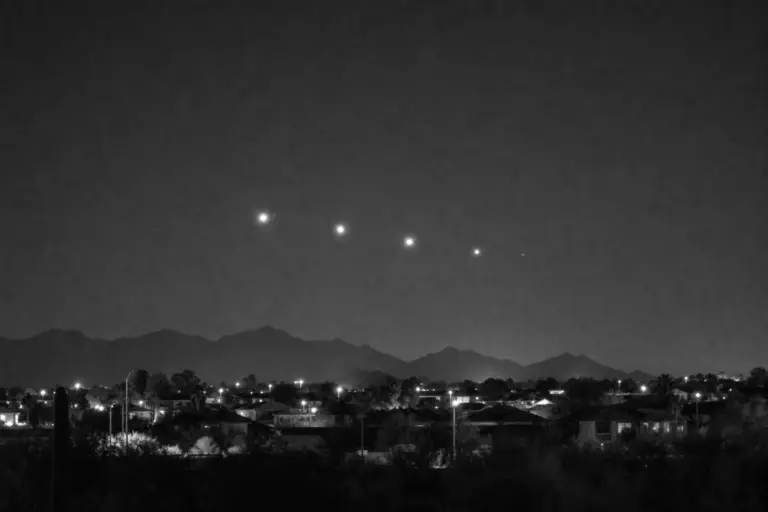
The account places A-10 aircraft on a training mission releasing LUU-2 illumination flares over the Barry Goldwater Range, southwest of Phoenix and beyond the Estrella Mountains from many Phoenix viewing locations. An illumination flare is designed to burn intensely while descending beneath a parachute. At a long, uncertain distance, its downward motion can be too slight to register against a dark sky; the light can therefore seem to hover.
Several flares released in succession can also produce the memorable geometry seen in the later images: a row or arc of lights, each bright point separated from the next but occupying a similar region of sky. Their apparent stillness is not evidence that they were fixed in place. It is the expected perspective effect when slow vertical descent is viewed at range, with no nearby object or horizon detail available to reveal motion.
The Estrella Mountains supply a second useful checkpoint. As individual descending lights pass behind the ridge line, they can vanish in sequence or appear to extinguish at nearly the same visual boundary. That combination, steady-looking points, a dramatic aligned pattern, and disappearance behind terrain, is consistent with the Phoenix Lights flares recorded and described later in the evening.
This is a bounded conclusion, not a universal one. The military explanation strongly addresses the later stationary-light sequence over the Phoenix area because its timing, location, and visual behavior align with flare deployment on the range. It does not establish that the earlier, moving reports across the broader corridor were the same flares, nor does it supply measurements that identify every light reported that night.
How Two Sequences Became One Enduring UFO Story
By the next day, March 13 had become the organizing fact: reports from a broad Arizona route and the later Phoenix-area display shared one date, one state, and the convenient label “Phoenix Lights.” That label could cover both a moving V or triangular formation and a separate row of lights beyond the Estrella Mountains without preserving the interval between them.
The visual record accelerated the merger. The best-known photographs and video show separated bright points in a stable-looking line or arc, the later sequence consistent with flares released over the Barry Goldwater Range, not a measured image of the earlier reports moving across Arizona. Yet those striking images were readily used to illustrate the whole story, including claims about a dark, enormous craft that the images do not depict.
Media framing made the mismatch easy to miss. A single headline could place an account of lights traveling southward beside footage of points seeming to hover west of Phoenix, treating different times, directions, and behaviors as consecutive views of one object. Later books, documentaries, and online summaries often inherited that compact narrative because it is more memorable than a two-track timeline.
Retrospective testimony, including descriptions of a giant craft, should not be discarded merely because it was recorded years later. It can preserve a witness’s sincere and important experience. Its evidentiary role changes, however, when the account is matched to a reported time, viewing location, direction of travel, and whether the lights moved or remained in one sector of sky. Those checkpoints prevent dramatic later imagery from silently supplying the shape, size, or identity of an earlier observation.
Fife Symington, Official Statements, and an Evidence Hierarchy
Fife Symington’s place in the story requires separating two roles that later retellings often blend. His 1997 press-conference response was an act of public communication, not an identification of what witnesses had seen. His later statement that he, too, had observed something unusual is relevant personal testimony, but it does not supply a measured distance, altitude, structure, or connection between every report made that night.
That distinction matters because official status can add context without converting an observation into physical identification. A former governor may be a credible witness to his own experience; he is not, by title alone, a sensor record, a flight log, or a provenance-established image. Official ambiguity or dismissive messaging may explain public frustration, but it is not by itself evidence of concealment.
A practical hierarchy keeps the case proportional:
- Contemporaneous reporting and traceable imagery: time-stamped calls, broadcasts, records, and video whose date, location, and direction can be established. These best test whether a proposed explanation fits a particular sequence.
- Corroborated witness accounts: independent observers whose reports align on time, place, motion, and appearance. They strongly establish that people saw an unusual display, while leaving distance and object identity less certain.
- Retrospective recollections and broad institutional claims: valuable context, but weakest when detached from primary records. Their weight rises only when they can be tied back to the night’s separate timelines.
What the Phoenix Lights Case Actually Supports
The defensible conclusion is narrower, and more useful, than the legend. The later stationary lights are strongly consistent with illumination flares released during military training: their location, persistence, alignment, and sequential disappearance fit that mechanism. That finding applies to that later display, not automatically to every observation made on March 13.
The earlier moving-formation reports remain a distinct evidentiary category. Witnesses described something unusual and apparently coordinated, but the surviving record does not conclusively establish one object’s structure, distance, altitude, or identity. Unresolved observations are not, by themselves, evidence of non-human intelligence.
For readers following UFO disclosure or UAP disclosure, the practical standard is claim-by-claim evaluation: match each image, account, and official record to a time, place, and behavior before combining them. Phoenix Lights 1997 supports a two-part finding, later lights well explained by flares, earlier reports less conclusively identified, not one seamless event or a conclusion beyond the evidence.
The Real Lesson of the Phoenix Lights
A useful checkpoint is whether a light pattern can be tied to a particular time, direction, and physical mechanism. The later lights meet that test more closely: their fixed-looking arrangement and fade pattern can be compared with a specific A-10 flare deployment. The earlier reports require a different conclusion: they preserve accounts of moving, coordinated lights, but not measurements sufficient to establish a single craft or a definitive identity.
That difference is not a choice between dismissing witnesses and accepting every later interpretation. It distinguishes evidence that can be matched to a known activity from evidence that remains incomplete. A photograph of the later lights, for example, is useful for analyzing their pattern; it does not automatically depict the earlier reported formation merely because both are remembered under the same name.
Media repetition, a shared place name, approximate recollections of time, and dramatic imagery made the separate sequences easy to join into one story. The real lesson is therefore neither a wholly solved mystery nor a wholly unsolved one. It is an example of how separate observations can become a single powerful public narrative, and why separating them again is essential to understanding what the record actually supports in the Phoenix Lights case.
Sources
- Phoenix Arizona Republic newspaper archive search
- Library of Congress catalog record for the Arizona Republic
- Axios Phoenix retrospective separating the reported events and later explanations
Frequently Asked Questions
Were the Phoenix Lights two separate events?
Yes. Reports from about 8:00 to 9:00 p.m. described moving lights across a broad corridor from Nevada into Arizona, while a separate group of lights appeared stationary over the southern Phoenix horizon around 10:00 p.m.
What happened during the Phoenix Lights on March 13, 1997?
Earlier in the evening, witnesses reported several lights moving together in a V-like or triangular arrangement. Later, viewers in Phoenix saw a compact row or arc of bright lights that appeared nearly stationary before disappearing one by one.
Were the later Phoenix Lights military flares?
The later stationary lights are strongly consistent with LUU-2 illumination flares released by A-10 aircraft during training over the Barry Goldwater Range southwest of Phoenix. The flares could appear to hover while descending by parachute and vanish sequentially behind the Estrella Mountains.
Did Fife Symington see the Phoenix Lights?
Fife Symington later said that he had observed something unusual on the night of March 13, 1997. His 1997 press conference was a public response to the reports, while his later account remains personal testimony rather than measured evidence identifying an object.
What evidence should you look for when evaluating Phoenix Lights claims?
Match each claim to a specific time, viewing location, direction, and reported motion before treating it as part of the same event. Time-stamped calls, broadcasts, military records, and traceable photos or video are stronger evidence than retrospective descriptions detached from the night’s timeline.