UAP Sightings 2025–2026: A Verification Workflow for Viral Clips, Radar Claims, and ‘Expert’ Takes
Verify UAP sightings 2025 with a practical workflow for viral videos, radar claims, expert takes, official records, and calibrated conclusions.
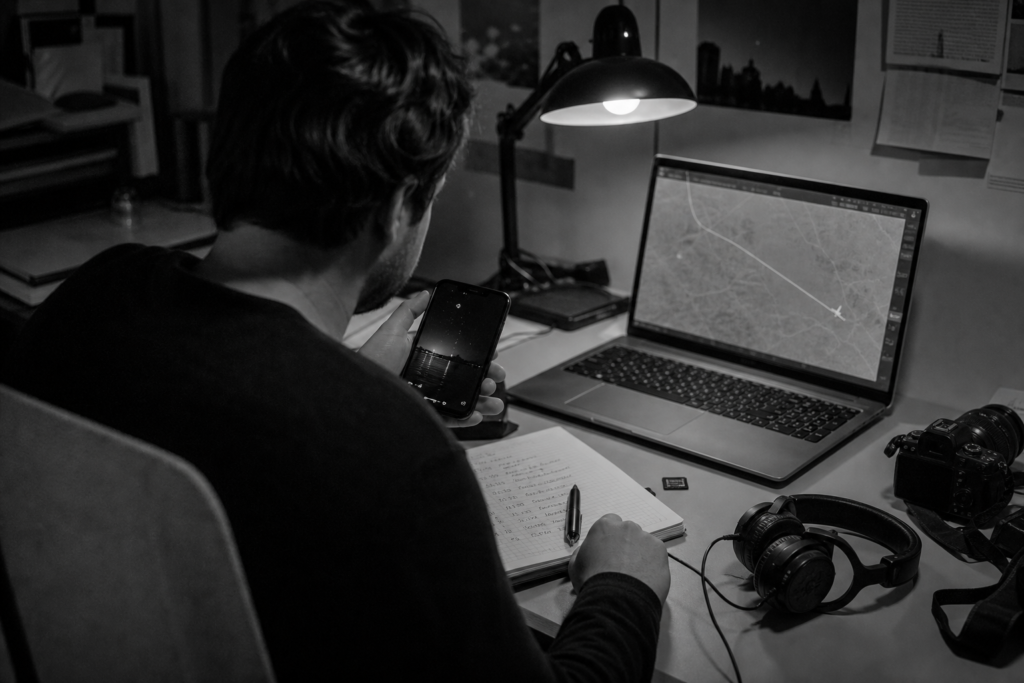
UAP sightings 2025 can become global narratives before anyone has established where a clip was recorded, whether a radar image is authentic, or what an “expert” actually reviewed. A repost may discard the original upload date, crop out landmarks, and add a confident caption; a screen recording of a tracking display can look like a primary radar return even when it is not. When those materials circulate together, apparent corroboration may be repetition rather than independent evidence.
That does not make every report trivial. It means “unidentified” is a description of the information presently available: an observation has not yet been reliably matched to an explanation. It is not a finding that the object was alien technology, non-human intelligence, or evidence of a cover-up. The distinction matters because a genuine extraordinary conclusion needs more than an intriguing image or an authoritative voice.
This guide uses an evidence-first workflow: preserve the earliest available claim, establish its source and time-place context, separate public tracking data from documented sensor records, and weigh commentary by the evidence behind it. An original video file with a known location and independently matching conditions is a stronger starting point than a captioned repost. A time-stamped record with system and operator context is stronger than a cropped radar screenshot. The aim is neither credulity nor ridicule, but a verdict calibrated to what the evidence can actually support.
Start With the Claim, Not the Conclusion
Begin by writing one sentence that can be disproved: “A witness recorded a bright object from this location at this time,” or “this display depicts a track at this time.” That is an observation claim. “The object could not be identified from the available material” is a narrower classification: it describes an unidentified object, not its origin or purpose.
An unresolved case goes one step further: the available evidence has not supported a reliable identification after reasonable testing. Missing provenance, incomplete sensor context, or an uncertain location can leave a case unresolved; each is an evidentiary gap, not positive evidence of non-human intelligence. Claims of alien disclosure, deliberate intent, recovered technology, or a government cover-up are extraordinary conclusions. They require direct, independently testable support beyond the clip, image, testimony, or credentials that prompted the inquiry.
Keep the layers separate. A pilot’s account may establish what that person reported seeing; it does not by itself establish identification. A radar screenshot may justify seeking a full record; it does not establish the system’s settings, source data, or what produced the apparent return. An analyst’s expertise can clarify possibilities, but authority does not replace underlying evidence.
For this article, “2025–2026” means a claim whose stated date, approximate time, location, and surviving record can be independently examined. It does not include predictions, undated reposts, or future-oriented UFO news presented as if it were an event record.
The Five-Step Workflow for a New UAP Claim
Use the same sequence every time, and do not let a dramatic detail move a case ahead of its evidence.
- Preserve the claim. Save the earliest post, full caption, upload link, screenshots, and any original file before edits or deletions change the record. A reposted, cropped video is useful for finding a lead, but it is weaker than the creator’s intact file.
- Build a chain of custody. Record who created, received, edited, and published each version. This separates a witness’s footage from an aggregator’s compilation and separates a purported radar image from an operator-provided record.
- Test time and place. Match the claimed date, clock time, direction of view, and location against visible landmarks and contextual records. A precise location can make a claim testable; “somewhere near the coast last night” usually cannot.
- Seek genuinely independent corroboration. Look for records or witnesses that were not derived from the same upload: separate footage from another position, weather and astronomical context, or a documented sensor record with its system and timing described. Several accounts repeating one clip are not multiple sources.
- Assign a provisional result. Use unsupported when the core claim lacks recoverable evidence; insufficient data when essential context is missing; plausibly explained when a mundane account fits the available material; unresolved when reliable identification is not possible; and supported by multiple independent sources when separate evidence converges on the same limited conclusion.
To verify UAP sightings, treat the last label as revisable. “Unresolved” identifies a limit in the available record; it does not demonstrate non-human technology, intent, or concealment.
Viral Video: Verify the File, Time, Place, and Camera Effects
A phone clip becomes substantially more useful when its pixels can be tied to a particular device, position, and moment. Find the earliest available upload, ask the recorder for the unedited original file, and retain the post alongside it. A file sent through a social platform may have been recompressed, stripped of metadata, cropped, stabilized, or slowed; it can still be a lead, but it is not equivalent to the camera’s original recording.
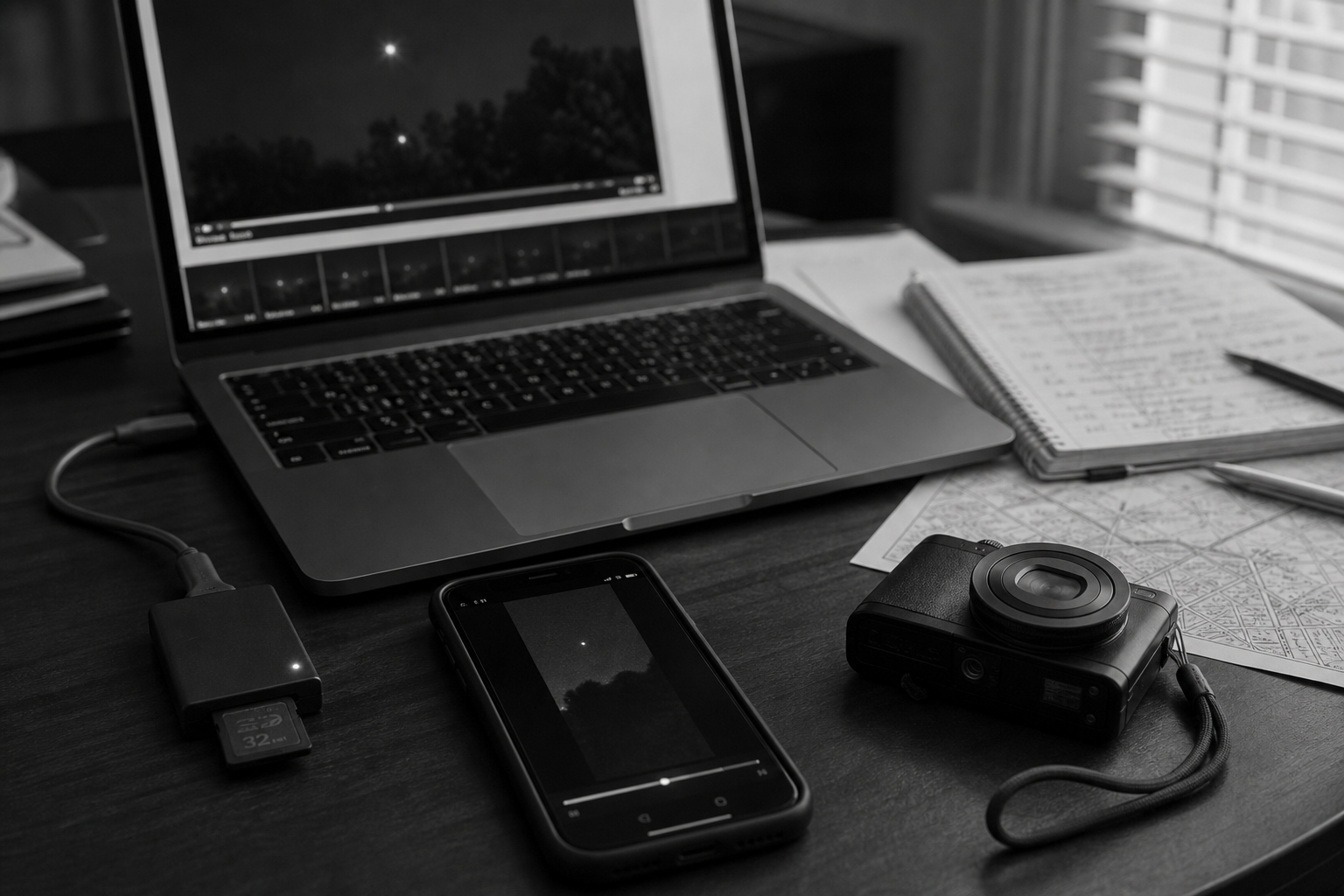
- Read the available file context. Creation time, device details, frame rate, resolution, and edit history may help establish a timeline, but metadata can be absent or altered. Treat it as supporting context, not proof by itself.
- Geolocate the view. Match skylines, ridgelines, roads, shorelines, signs, building geometry, and the camera’s apparent direction. A clip tied to one intersection and compass bearing is testable; a claimed city with no identifiable foreground is not.
- Chronolocate the event. Compare the stated time with the Sun’s elevation, cloud pattern, moon or bright planets, and visible stars. Then test candidate explanations against flight-tracking records, relevant NOTAMs, weather observations, satellite passes, and astronomical-object positions. These comparisons can narrow possibilities; they do not recreate every object outside the frame.
Camera behavior must be part of UAP video verification. Digital zoom enlarges pixels rather than resolving distant detail. Autofocus hunting can make a point of light pulse or change shape. Parallax makes a nearby object appear to race across a distant background when the camera moves; rolling shutter can skew fast-moving subjects; compression can create blocks, halos, and false edges. Infrared footage adds another limit: bright and dark areas represent a sensor’s response, not a direct color or temperature label.
A sharp original file, defensible location and time, and a match or mismatch with independent context are strong signals. When the original file, reliable time, or precise location cannot be recovered, the proper result for even a striking UFO sightings 2025 clip is insufficient data, not a conclusion that every ordinary explanation has failed.
Radar Claims: A Screenshot Is a Lead, Not a Track Record
A moving symbol on a map can be compelling while revealing almost nothing about the sensor that produced it. Public flight-tracking services primarily display cooperative position reports such as ADS-B, sometimes supplemented by multilateration estimates; they are not the same thing as a primary radar return, which detects reflected energy, or as military sensor data. A fused display may combine several feeds into one track, but its clean path does not show which inputs supported each point.
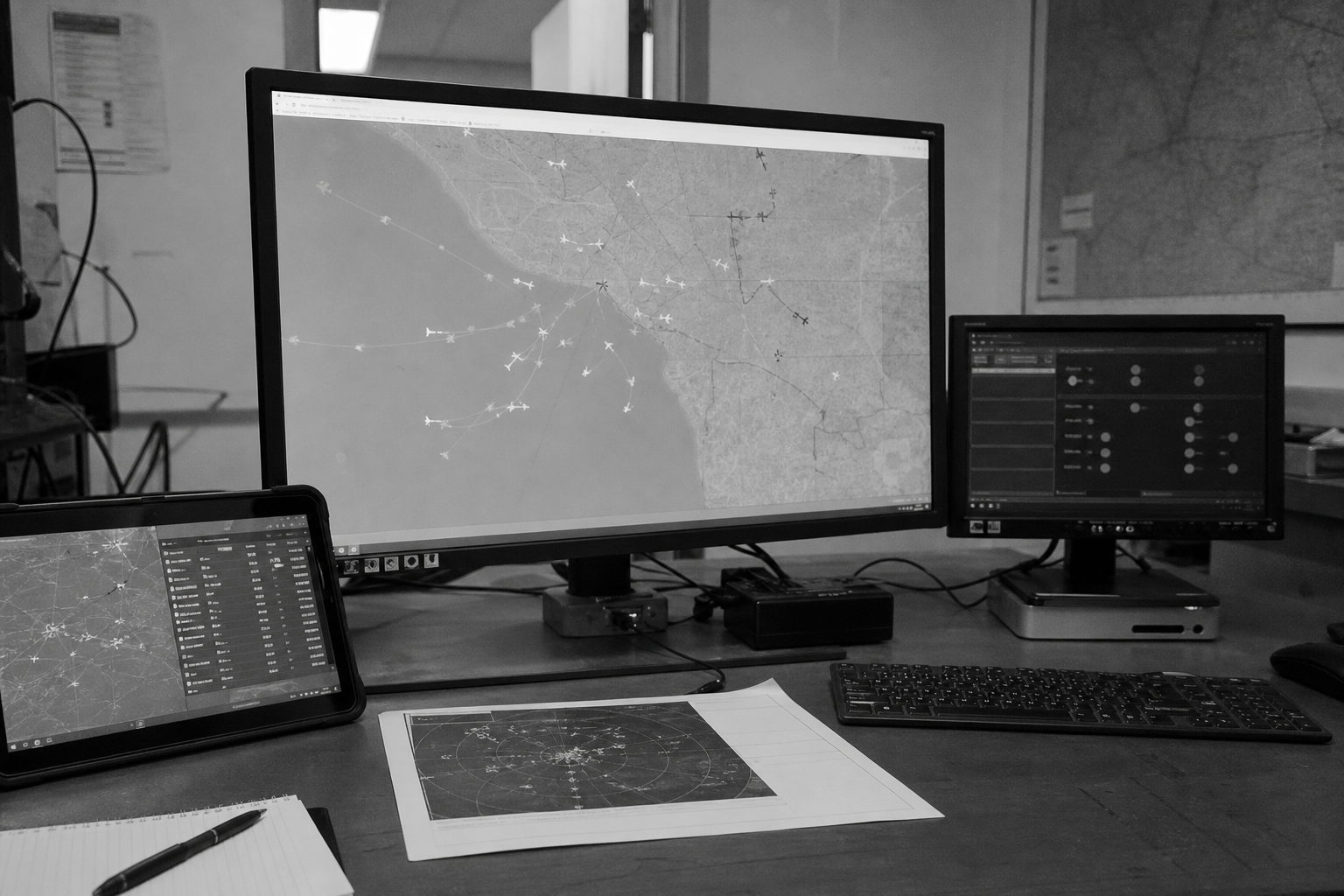
Start by classifying the image. A cropped air-traffic replay may show a missing or erratic aircraft position rather than an object with extraordinary movement. A primary-radar record can establish that a system detected something in a volume of air, but not necessarily its identity. ADS-B identifies a transponder-equipped participant when its message is received; it does not account for every aircraft or object. Weather clutter, data gaps, receiver coverage, filtering rules, multilateration geometry, spoofed signals, and a misread altitude or speed field can all create misleading apparent tracks.
- Preserve the underlying record. Request an exportable track or original recording, not only a screenshot. Retain the platform name, account, capture time, and any replay settings.
- Establish sensor context. Record the system type, sensor or receiver location, timestamp and time zone, coordinate reference, and whether the display is raw, processed, or fused.
- Read the whole track. Examine duration, point-to-point continuity, altitude, velocity, heading, confidence indicators, and gaps. A single dot or a few seconds of animation is weak; a time-stamped history that exposes its uncertainties is stronger.
- Seek independence. Operator notes, a second sensor using a different method, or a witness tied to the same place and time can corroborate a track. Multiple reposts of the same display cannot.
For UAP sightings 2026 search language, “radar-confirmed” should therefore mean more than a visualization. If provenance and context remain unavailable, describe the image as an unverified tracking claim, not proof of an anomalous craft or an extraordinary explanation.
“Expert” Takes: Separate Credentials, Access, and Evidence
A polished verdict can travel farther than the material on which it rests. Treat a pilot, former official, journalist, analyst, researcher, or high-profile commentator as a source with a particular vantage point, not as a conclusion.
- Match the credential to the claim. Flight experience may sharpen observations about aircraft behavior; image-analysis experience may reveal compression or perspective effects; investigative reporting may establish provenance. None of those credentials alone establishes what an object was.
- Separate firsthand knowledge from access. Ask what the person personally saw, heard, or recorded. Then ask whether they reviewed the original file, full sensor record, operator notes, or merely a repost, briefing summary, or anonymous account. Access to a claim is not access to its underlying evidence.
- Require a visible method. A useful analysis identifies the time, place, assumptions, measurements, comparison data, and uncertainty. “It moved impossibly” is weak if the analyst cannot show how distance, frame rate, camera motion, or sensor limitations were handled.
- Look for independent tests. Stronger interpretations can be challenged against material outside the commentator’s control: the original footage, a complete record, a second sensor, or a witness whose account was not shaped by the same viral post.
- Mark the leap. An expert may reasonably offer hypotheses for an ambiguous clip. Moving from ambiguity to alien disclosure or non-human intelligence requires evidence that distinguishes those claims from ordinary, mistaken, or still-unknown explanations.
In the common expert-led viral interpretation, confidence can help viewers notice a feature worth testing, such as apparent acceleration or an unusual light pattern. It does not turn that feature into proof. Give expert testimony the weight earned by the records it exposes, the limits it admits, and the corroboration it survives.
Use Official UAP Records, With the Right Expectations
Institutional records are most valuable when they let you inspect the underlying scope rather than borrow an institution’s authority. AARO UAP publications, including case-resolution material, can show the office’s stated assessment, the evidence it considered, and any limits it identifies; they cannot fill gaps in a viral clip’s missing file, timing, or sensor record.
- Pentagon public releases establish that the Department of Defense chose to publish a particular image, video, statement, or case update. They do not by themselves establish an object’s origin, capabilities, or complete sensor history.
- Congressional hearing transcripts and written testimony preserve what witnesses and officials said, the questions asked, and the evidence placed into the public record. Testimony may identify leads or disputes, but a hearing is not independent confirmation of every assertion made there.
- Agency FOIA reading rooms can provide released correspondence, reports, and records with useful provenance. A redaction or an absent record may reflect privacy, security, or retention limits; neither is proof of concealment.
- Aviation safety reporting is relevant when a claim concerns a flight crew or airspace event, but it records an observation or operational concern, not necessarily an identification. The UAP Records Collection at the National Archives adds archival context and provenance, not automatic resolution.
For every item, log the exact title, publication date, agency, stable link, and any classification, redaction, or missing-attachment limit. An official acknowledgment that a report exists, or remains unresolved, still describes the available record, not a confirmed cover-up or non-human intelligence.
Publish a Calibrated Verdict and Keep the Case Open to Revision
Finish each case with a short, timestamped evidence ledger rather than a dramatic label. A useful verdict separates five items:
- Known: the earliest recoverable post, stated time and place, file condition, and any independently matched context.
- Claimed but unverified: assertions such as “radar confirmed it,” extraordinary speed, or an analyst’s conclusion when the underlying record is unavailable.
- Alternatives tested: aircraft, satellites, astronomical objects, balloons, drones, camera artifacts, or display behavior, and the limits of each test.
- Missing: the original file, a defensible timestamp, sensor logs, operator context, or an independent witness or instrument record.
- What would change the assessment: for example, a preserved original plus location match, or a time-aligned primary record with enough context to evaluate the track.
Write the conclusion in proportion to that ledger: “unresolved on the surviving evidence” is a valid result; it is not evidence of non-human intelligence. Missing data, redactions, and an unresolved status do not independently establish a government UFO cover-up.
For UAP sightings 2025 and later reports, save original links and captures before reposts shed their context, and revise the entry when stronger records appear. Broader debates about access to records belong in related coverage of the UAP Disclosure Act and congressional UAP-records policy, not in assumptions about any single case.
A Better Standard for Assessing UAP Claims
The discipline is simple: let the conclusion be no stronger than the record. A striking clip with no original file, a radar assertion without sensor context, or a confident interpretation without exposed evidence may merit attention, but each remains a weak basis for identifying an object.
Use four verdicts precisely. Insufficient evidence means essential material, such as provenance, timing, or sensor detail, is absent. Likely explained means the available facts fit an ordinary cause better than competing accounts. Unresolved means reasonable testing has not produced a reliable identification. Supported requires converging, independently assessable evidence for a specific account; repetition of the same post, screenshot, or commentator does not qualify.
That standard avoids two symmetrical errors: treating every gap as extraordinary proof, or dismissing a report merely because it is unusual. Preserve what was first published, test mundane possibilities against the time and place, and give added weight only to evidence that is genuinely independent. If an original file, operator record, or corroborating observation later appears, update the assessment plainly, including what changed and why. Curiosity starts the inquiry; transparent revision is what makes the result credible.
Sources
Frequently Asked Questions
-
What does an unresolved UAP case mean?
An unresolved UAP case means reasonable testing has not produced a reliable identification from the available evidence. It does not prove alien technology, non-human intelligence, deliberate intent, or a government cover-up.
-
How can I verify a viral UAP or UFO video?
Find and preserve the earliest upload and unedited original file, then document who created, edited, and published each version. Verify the claimed time, location, direction, landmarks, weather, astronomical conditions, flight records, satellite passes, and possible camera effects such as digital zoom, autofocus hunting, parallax, rolling shutter, and compression.
-
Does a radar screenshot prove a UAP sighting?
No. A radar screenshot is a lead, not a complete track record, because it may show ADS-B data, multilateration estimates, a processed or fused display, weather clutter, receiver gaps, filtering, spoofed signals, or misread altitude and speed fields. Stronger evidence includes an exportable track, system type, sensor location, timestamp and time zone, processing context, full track history, and independent corroboration.
-
How do I tell whether a UFO expert is credible?
Match the person’s expertise to the specific claim, then determine whether they reviewed original footage, full sensor records, operator notes, or only reposts and summaries. A credible analysis shows its time, place, assumptions, measurements, comparison data, uncertainty, and tests that others can independently check.
-
What evidence should make me classify a UAP claim as supported instead of unresolved?
Classify a claim as supported only when independently assessable evidence converges on a specific, limited explanation or conclusion. Strong evidence can include an original file with confirmed location and time, documented sensor records with system and operator context, and separate witnesses or sensors that were not derived from the same viral post.