The Best Evidence for UAP: Videos, Radar, and Testimony
Explore the best evidence for UAP, from authenticated videos and radar to testimony. Learn what each source proves, and its limits.
A striking clip can establish less than it appears to establish. It may show that a camera recorded an object or signal under particular conditions; by itself, it rarely supplies reliable size, distance, speed, intent, or origin. An observation can therefore remain genuinely unidentified without becoming evidence of nonhuman technology.
This article treats the best evidence for UAP as an evidentiary-ranking question, not a test of belief. The strongest public cases have traceable provenance, meaning a clear account of who collected a record, when, and from which system, plus sensor context, independent corroboration, and meaningful access to the underlying material. A released video with known origin is more useful than an anonymous upload, but radar data or other sensor records can add measurements a video lacks; firsthand testimony can explain the setting and procedures, yet cannot replace records that others can inspect.
That standard will guide the comparison of authenticated UAP videos, radar and multisensor reporting, witness accounts, and official assessments. It will also frame the 2004 Nimitz encounter, a prominent case precisely because public discussion involves more than one kind of evidence, while leaving important underlying data unavailable for independent public review. The question is not whether any case feels extraordinary, but what its available evidence can actually support.
What Counts as the Best Public Evidence for UAP?
The key distinction is between an event, an explanation, and an origin claim. A record may establish that somebody or some instrument registered an unusual observation. It begins to narrow explanations only when it preserves information that can test ordinary possibilities: location, time, viewing geometry, weather, platform status, and the behavior measured by more than one system. An extraordinary origin claim requires still more, evidence that survives those alternatives and is sufficiently transparent for independent scrutiny.
Provenance answers where a file or account came from; chain of custody tracks how it was handled from collection to release. Together, they distinguish an original, attributable record from a copied clip whose date, edits, and source cannot be established. Sensor context supplies the settings and reference data needed to interpret an image or track. Contemporaneous logs, recordings, and reports matter because they reduce the risk that later recollection has filled gaps.
Observer training is relevant, not decisive: a pilot or operator may describe procedures, instruments, and conditions more precisely than a casual witness, but perception remains fallible. Independent corroboration is stronger when separate witnesses or systems converge without relying on the same mistaken input. The strongest UAP evidence therefore is not the most dramatic individual account; it is a traceable package of records that makes mundane explanations testable, even if the remaining observation is unresolved rather than proof of non-human intelligence.
Authenticated UAP Videos: Valuable Records, Not Self-Explaining Proof
Authentication changes the status of a clip, not the nature of what appears in it. A government-released military recording can be tied to a stated platform, sensor, and release pathway, making it a far better starting point than an untraceable social-media upload. It establishes that an instrument captured a particular display or signal sequence worth examining. It does not, on its own, establish the object’s distance, dimensions, true velocity, physical shape, intent, or origin.
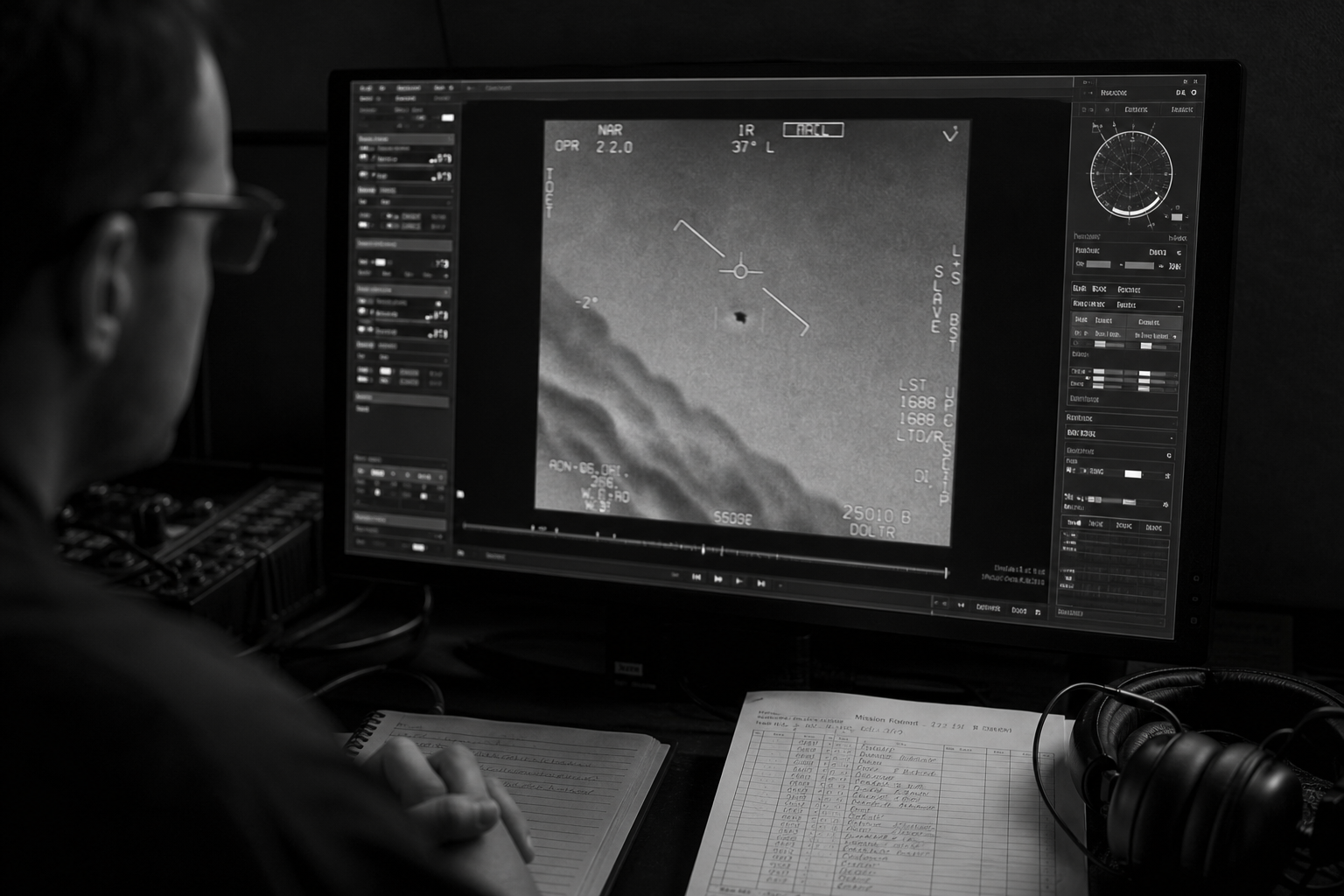
The Pentagon-confirmed Navy clips commonly discussed alongside the Nimitz UAP footage demonstrate the distinction. FLIR is forward-looking infrared: it renders differences in heat or infrared radiation rather than an ordinary-color view. Electro-optical imagery can provide visible-light detail, but both forms of imaging depend on range, atmospheric conditions, focus, exposure, field of view, and the camera’s motion. A narrow field of view or digital zoom enlarges pixels as well as a target; compression can further remove detail. An apparently crisp silhouette may therefore be a sensor-rendered contrast pattern rather than a reliable outline of a craft.
Motion is especially easy to overread. Tracking systems may slew, stabilize, or change zoom while an aircraft and its target move relative to one another. Without independently known range and geometry, parallax, the apparent shift caused by a changing viewing position, can make a distant object seem to race across the background, or make its motion difficult to judge. The Go Fast video UAP is a useful reminder that striking apparent movement on a display is not itself a speed measurement.
Video earns its greatest weight when the original file preserves timestamps, sensor settings, platform position, and a record that can be compared with other observations. On its own, even authenticated imagery is evidence of an observation, not self-explaining proof of extraordinary technology or non-human intelligence.
Radar and Multisensor Data: Stronger Context, Still Open to Error
A radar track is a time-linked series of detections assigned to one presumed object. Unlike a camera image, it can place returns in a measured geometry: range and bearing, sometimes altitude, followed across timestamps to derive a course and velocity estimate. That extra context can distinguish a stationary visual ambiguity from a track that appears to persist and move through monitored airspace.
Not all radar information means the same thing. Primary radar detects reflected energy and can register an object that does not cooperate; secondary radar depends on a responding transponder and is therefore useful for identifying participating aircraft. Shipborne and airborne radars differ in viewing angle, coverage, and operating conditions. A fused sensor display combines inputs, potentially radar, an electro-optical sensor, navigation data, and identification databases, into one operational picture. Fusing independent inputs can strengthen a case, but a display is still an interpretation layer, not necessarily the underlying measurements.
Multisensor data earns greater weight when timestamps, platform positions, settings, and the separate source records allow reviewers to test whether detections truly correspond. A radar track that matches an independently recorded image or observation can support the reality, location, and reported motion of an unknown track more strongly than either record alone.
Its limitations matter just as much. Calibration drift, ground or sea clutter, unusual propagation, signal interference, and errors in correlating separate detections can create or distort tracks. Public accounts may describe radar-related reporting while the raw returns, processing history, or collection methods remain unavailable or classified. In that situation, the public can assess the reported observation only at summary level. Radar can make an event more concrete; it cannot, by itself, establish exotic performance or non-human technology.
Testimony: Essential Context, but Not a Substitute for Records
People who were present can supply the operational detail that a display or recording leaves out: what they were tasked to do, where they were positioned, how the object appeared to behave, which procedures they followed, and whether the sighting disrupted normal operations. Pilot observations are especially useful for reconstructing an encounter’s timeline and viewing conditions. They are strongest when made close to the event and when dates, locations, radio traffic, logs, or recordings can test particular details.

Training does not make perception infallible. Distance, scale, closure rate, glare, weather, stress, expectation, and the limits of an aircraft canopy or sensor display can affect what a witness reasonably perceives. A direct account, “I saw this from this aircraft at this time”, is therefore evidence of that witness’s observation, not automatic proof of an object’s size, speed, or origin. The practical distinction is clear: a specific recollection that aligns with contemporaneous records carries more weight than an account whose central measurements cannot be independently reconstructed.
Secondhand allegations belong in a different evidentiary category. In his July 2023 sworn congressional testimony, former intelligence officer David Grusch said he had received information about alleged crash-retrieval and reverse-engineering programs. The David Grusch UFO testimony was consequential because it put those allegations before Congress under oath; it was not itself publicly verifiable physical evidence that such programs or recovered non-human craft exist. Treating a David Grusch whistleblower claim as equivalent to a firsthand pilot account would erase the difference between reporting what one was told and reporting what one personally observed.
The Nimitz Encounter: Why Corroborated Cases Matter Most
The 2004 USS Nimitz encounter is valuable less for any one dramatic claim than for the way several records and accounts can be compared. The public case centers on naval aviators’ visual observations, radar-related reporting described by personnel, operational communications and later interviews, plus the infrared clip widely known as FLIR1. Each element answers a different question: witnesses describe the scene and response; sensor reporting supplies a claimed instrumental context; and video preserves a limited record of one observation.
The Nimitz UAP footage is not a complete reconstruction of the encounter. It is an infrared display recording associated with the event, rather than a wide-angle, independently measurable image of an object at known range. Its official acknowledgment gives the clip a stronger provenance than a viral upload, but the public version does not by itself settle distance, size, acceleration, or the identity of what was tracked.
What raises the case above an isolated clip is convergence. Pilots including David Fravor’s firsthand account of the 2004 Nimitz encounter and Alex Dietrich later described an unusual visual encounter during a military training operation, while other participants described radar-related observations and command-and-control activity around the same broader episode. Those accounts make it more plausible that personnel confronted a real operationally significant observation, rather than a video artifact considered in isolation. They do not turn every later recollection into a precise measurement, nor do they demonstrate that all reported detections concerned one object.
The decisive limitation is public access. Raw radar returns, full sensor metadata, communications logs, and the complete sequence needed to test competing reconstructions are not available for independent public analysis. That gap leaves uncertainty about timing, correlation, geometry, and reported performance. The Nimitz case therefore belongs among the best evidence for UAP as a well-documented unresolved public event: its intersecting testimony, imagery, and sensor-related context are stronger than any single category alone, while the available material does not establish an extraordinary origin or exact capabilities.
What Official Assessments Do, and Do Not, Conclude
Official review changes the question from “what does this look like?” to “what explanation can the available record sustain?” The UAP Task Force (UAPTF), followed by ODNI reporting, organized military reports for analysis rather than treating every unresolved entry as a single phenomenon. An unresolved label means the material lacks enough quality, context, or comparable data for a confident attribution; it is not a finding of exotic manufacture, extreme performance, or non-human origin.
AARO UAP, the Pentagon UFO office formally known as the All-domain Anomaly Resolution Office, performs that attribution function across military domains. Its public case resolutions show the useful distinction: some reports can be matched to balloons, drones, aircraft, clutter, or sensor effects once additional information is available; others remain open because decisive information is missing. AARO has also said it has found no verifiable evidence that any UAP case represents extraterrestrial technology.
That conclusion does not make the public record complete. Operational sensor data may be classified, retained only briefly, unavailable to outside analysts, or released without the metadata needed to reconstruct an event. Those gaps limit what the public can independently assess, but they do not convert absence of access into evidence of a government cover-up. A transparent record identifies the underlying material, its provenance, and its limits; a cover-up claim needs comparably testable support rather than inference from withheld or unresolved data.
A Practical Standard for Weighing New UAP Claims
Apply a fixed ladder to each new report. The highest tier is a traceable primary record: for example, the Department of Defense’s released FLIR1 footage can be tied to a military release, while a complete case file would also preserve its timestamp, sensor settings, platform position, and related logs. The 2004 Nimitz case ranks above a lone clip because it combines FLIR1 with named aviator accounts and radar-related reporting, even though the raw public sensor record remains incomplete.
Next weigh genuinely independent corroboration: a visual observation, a radar track, and imagery matter more when their times and locations can be compared rather than merely repeated in later interviews. A named firsthand witness can clarify an event’s conditions; July 2023 sworn testimony by David Grusch, based on information he said he received from others, illustrates why allegation is not the same as publicly reviewable proof.
Cropped clips, screenshots without original files, and anonymous assertions are preliminary leads, not conclusions. The best evidence for UAP can support the limited finding that an event remains unidentified; public video, radar reporting, and testimony do not establish non-human intelligence. UFO disclosure or UAP disclosure coverage is most useful when it releases underlying records, provenance, and meaningful opportunities for independent scrutiny.
The Strongest UAP Evidence Is Corroborated, Not Conclusive
The difference between a compelling case and a compelling story lies in whether its parts can be compared. In the Nimitz example, witness accounts, reported sensor activity, and released imagery provide more investigative value together than any one element could provide alone. Their convergence can support a finding that personnel encountered something not readily explained by the public record; it cannot establish that every reported detail shares a single cause, or that the cause was extraordinary.
For future claims, look for records that preserve the event’s timeline, collection path, and technical context. A full file with metadata is stronger than a cropped excerpt; independently recorded observations that align in time and place are stronger than several retellings based on one original report. Treat missing raw data as a limit on the conclusion, not as evidence that an unavailable record would confirm a preferred theory.
The strongest public evidence therefore justifies disciplined uncertainty. Authenticated video can show what a sensor recorded, radar or other multisensor data can add measurable context, and firsthand testimony can explain operational circumstances. When those sources are traceable and mutually testable, they make unresolved UAP cases worth serious analysis. They still do not, without further independently reviewable evidence, prove a particular craft, capability, or non-human origin.
Sources
Frequently Asked Questions
-
What is the strongest public evidence for UAP?
The strongest public UAP evidence is a traceable package of records with clear provenance, sensor context, contemporaneous documentation, and independent corroboration. It can support that an observation remains unidentified, but it does not by itself prove non-human technology.
-
Why are UAP videos alone usually inconclusive?
Even authenticated video establishes that a sensor recorded a display or signal sequence, not an object’s true size, distance, speed, intent, or origin. Range, viewing geometry, zoom, atmospheric conditions, camera motion, compression, and parallax can all distort apparent shape or movement.
-
What can radar data measure in a UAP case?
A radar track can provide time-linked range and bearing measurements, sometimes altitude, to estimate an object’s course and velocity. Radar tracks can still be affected by calibration drift, clutter, unusual propagation, signal interference, and errors correlating detections.
-
Does the Nimitz UAP footage prove aliens exist?
No. The 2004 Nimitz case combines the FLIR1 infrared video, named aviator accounts, and radar-related reporting, making it stronger than an isolated clip, but publicly available material does not establish distance, size, acceleration, exact identity, or non-human origin.
-
What should you look for when evaluating a new UAP claim?
Look for original files with timestamps, sensor settings, platform position, chain of custody, and records that can be independently compared with other observations. Give more weight to visual, radar, and imagery records that align in time and location than to cropped clips, screenshots, anonymous claims, or secondhand allegations.