DoD Releases Declassified 2020 Navy UAP Videos FLIR, GIMBAL, GOFAST Confirmed Authentic
Learn what the DoD released Navy UAP videos reveal about FLIR, GIMBAL and GOFAST, the 2020 timeline, and what remains unidentified.
April 27, 2020 is the key checkpoint: the Department of Defense formally published three unclassified U.S. Navy recordings already authorized for release. The clips are titled FLIR, GIMBAL, and GOFAST; FLIR is associated with the 2004 USS Nimitz incident, while GIMBAL and GOFAST came from 2015 East Coast Navy training operations. The release did not identify the observed objects as extraterrestrial craft, or identify them at all.
The wording matters. “Declassified” is common shorthand, but DoD described the clips as unclassified and previously authorized for release. In September 2019, the Navy had separately confirmed that versions circulating publicly were authentic Navy footage. Authentication establishes provenance: the recordings came from Navy systems. It does not establish an object’s identity, origin, speed, or capabilities.
That distinction frames the record that follows: a timeline separating the Navy’s 2019 confirmation from DoD’s 2020 publication, concise context for each clip, and the boundary between an authentic military recording and an explanation for what it depicts.
What the DoD Released in April 2020
DoD’s stated rationale was the immediate April 27, 2020 checkpoint: publishing the recordings would not reveal sensitive capabilities or interfere with ongoing investigations of military airspace incursions. The Department posted official versions of three unclassified Navy videos that had already circulated publicly, labeled FLIR, GIMBAL, and GOFAST.
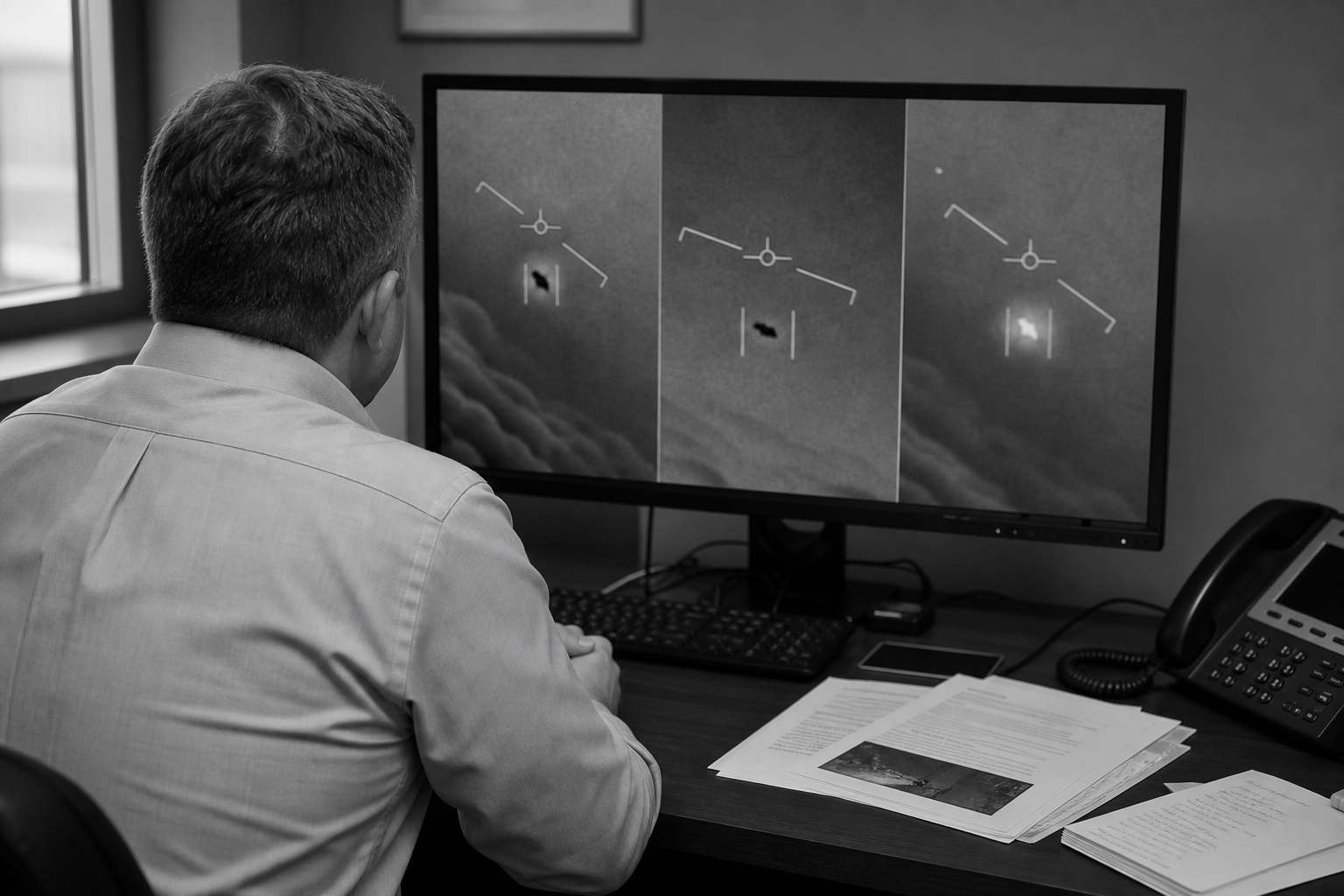
DoD described the footage as previously released and the phenomena depicted as previously acknowledged as unidentified. That wording has a defined limit. “Unidentified” records the unresolved status of an observation; it does not determine what the object was, who operated it, or where it originated. The announcement also did not call the videos “declassified.” Its operative terms were unclassified and previously authorized for release.
Three separate actions are often compressed into one event, although they answer different questions. Public circulation meant viewers could watch copies of the clips. Navy authentication addressed provenance, whether the recordings were genuine Navy material. The April 2020 release made official versions available and explained why DoD could publish them. None of those actions identified what appeared in the recordings. Official availability strengthened the public record; it did not turn an unresolved observation into a settled explanation.
Authentication vs. Official Release: The Crucial Timeline
The first checkpoint is the Navy spokesperson’s September 2019 confirmation that the recordings were authentic Navy videos. That authentication concerned provenance: the imagery had been recorded by Navy systems rather than fabricated or misrepresented as military material. The spokesperson also described the objects as “unidentified aerial phenomena.”
Authentication did not supply an explanation for what appears in the imagery. A genuine military recording can still leave an object’s identity, range, speed, size, altitude, origin, and apparent behavior unresolved. Sensor displays, audio, and compressed video are evidence, but they do not alone amount to a final identification. The phrase “authentic Navy UFO videos” is therefore accurate only when “authentic” means military origin of the recordings, not an extraordinary conclusion about the observed objects.
The clips had reached the public before either milestone. To The Stars Academy distributed versions of the footage, and major news reporting broadened their audience; public circulation, however, was not an official release. On April 27, 2020, the Office of the Secretary of Defense separately published authorized, unclassified copies under DoD authority. Its announcement did not identify the objects or establish their capabilities or origin. The practical timeline is simple: September 2019 addressed whether the material was genuine Navy footage; April 2020 made official copies available.
FLIR, GIMBAL, and GOFAST: What Each Video Shows
The three titles identify separate recordings, not three views of one incident. Each clip combines military aircraft operations with targeting-pod imagery and cockpit audio, but the dates and operational settings differ.
FLIR
The FLIR video UAP clip is associated with the 2004 USS Nimitz encounter. Its name refers to forward-looking infrared imagery: a sensor view that renders heat contrast rather than an ordinary color-camera scene. The recording shows a distant object through an aircraft’s targeting system while aircrew voices are heard. It belongs to the broader Nimitz-related episode, but the short public clip is not a complete record of every observation reported during that event.
GIMBAL
The GIMBAL video UAP clip is associated with Navy encounters off the U.S. East Coast during 2014–2015. It shows an infrared sensor tracking an object, accompanied by cockpit discussion among aircrew. “GIMBAL” is the video’s official label, not an official identification of the object or a conclusion about why its image appears to rotate. The setting, personnel, and timeframe distinguish it from the 2004 Nimitz footage.
GOFAST
The GOFAST video UAP clip is likewise associated with 2014–2015 East Coast Navy operations. Its targeting-pod display, aircraft audio, and tracking symbology give viewers operational context, but they do not turn the clip into a standalone measurement of an object’s speed, altitude, size, or identity. The title describes the released video, not a settled finding that the observed object was moving at an exceptional speed.
Reading the clips together can show why Navy aircrews treated the observations as worth reporting. Treating them as interchangeable evidence cannot: FLIR, GIMBAL, and GOFAST preserve different moments, sensors, crews, and encounter contexts.
What Official Authentication Did, and Did Not, Establish
The key analytical checkpoint is that provenance and identification answer different questions. Authentication established that the recordings were Navy material, while official publication established that DoD could release the unclassified versions publicly. In that release context, the phenomena shown remained unidentified. “Unidentified” describes an unresolved classification, not a conclusion about origin.
That evidentiary boundary excludes several claims often attached to UAP disclosure. Neither authentication nor publication established:
- an alien origin or non-human intelligence;
- a foreign-adversary platform;
- exceptional speed, acceleration, or maneuverability; or
- the correctness of any particular online reconstruction of what the imagery shows.
The distinction is practical. A targeting-pod clip records a sensor’s view from a moving aircraft, not a complete, independently readable account of an encounter. Apparent movement on screen can be affected by sensor geometry, the relative positions and motion of aircraft, camera, and object, viewing angle, tracking behavior, uncertain range, atmospheric conditions, and the display’s limited public context. Apparent rotation, for example, is not by itself proof that an object physically rotated; interpreting it requires information about sensor and aircraft orientation.
Pilot remarks preserved in cockpit audio are valuable contemporaneous observations, but they are not equivalent to a final technical identification. External analyses can offer hypotheses, yet short public clips do not supply every measurement needed to settle them. The durable conclusion is narrower: authentic military footage documented observations not publicly identified at the time, while the videos alone did not establish the identity, origin, or capabilities of what was observed.
Why the 2020 Release Was Significant Without Being a Final Answer
Public questions about whether the circulating footage was genuine Navy material gave the April 27, 2020 publication unusual institutional weight in UAP news. DoD said the unclassified videos could be released without revealing sensitive capabilities or affecting ongoing reviews.
That rationale connected the recordings to aviation safety and national-security reporting and the broader formal DoD UAP reporting and review structures emerging in 2020. FLIR arose from the 2004 USS Nimitz events, while GIMBAL and GOFAST came from separate 2015 East Coast Navy operations involving aircrews near training airspace. In that setting, UAP gave official discussion a restrained term for an observation requiring assessment, rather than an automatic claim of a particular UFO explanation.
The transparency mattered because it created a shared public record of three Navy recordings and of DoD’s determination that unclassified versions could be published. It did not supply the complete sensor data, intelligence context, or investigative findings needed to determine what each observed phenomenon was.
For the same reason, the 2020 release did not substantiate allegations of a government UFO cover-up, recovered craft, reverse-engineering programs, or non-human biologics. Those are distinct claims requiring distinct evidence; they do not follow from the public availability of authentic Navy footage whose depicted phenomena remained unidentified.
Later AARO Context: What Remains Unresolved
AARO’s later work reinforces a practical evidentiary checkpoint: imagery is only one part of an identification record. A short clip can preserve a real observation while still lacking range, sensor calibration, aircraft position, environmental data, and corroborating records needed to identify what was observed with confidence. That is why the Navy recordings are best assessed alongside the broader information available to investigators, rather than from the imagery alone.
An unresolved case means the available information does not support a reliable identification. It is not affirmative evidence for an extraordinary origin, advanced technology, or any particular explanation. The distinction is consequential: a strong conclusion requires converging data that can test competing explanations; an indeterminate clip does neither.
Later official assessments and analytical debates may sharpen questions about individual UAP sightings, data quality, and possible interpretations. They do not revise the historical record of 2020: DoD publicly released unclassified versions of the three Navy videos, and that action did not identify the phenomena shown.
The Bottom Line on the 2020 Navy UAP Video Release
The title’s “declassified” shorthand needs one final correction: the April 27, 2020 announcement concerned authorized public release of unclassified videos, not a newly announced declassification. The Navy had authenticated the footage as genuine Navy material in September 2019; DoD subsequently released the three recordings under their official titles.
Those actions established military provenance and placed official copies in the public record. They did not identify the objects or phenomena depicted, establish extraordinary capabilities, or confirm alien craft or non-human intelligence. The footage remains consequential because it records encounters the military had not publicly resolved in that context, not because it supplies a final explanation.
What the DoD’s 2020 Release Actually Confirmed
DoD’s April 27, 2020 posting answered a narrow but important public-record question: whether the Department had formally authorized public versions of the circulated footage. In September 2019, a Navy spokesperson had separately confirmed that the clips were genuine military material, establishing their provenance rather than identifying the observed phenomena.
DoD said it published the videos to clear up misconceptions about whether the footage was real and whether it had been officially released. The posting covered the clips labeled FLIR, GIMBAL, and GOFAST. It provided authoritative public versions, but did not make the material newly declassified evidence of any particular technology, origin, or capability.
The historical record therefore rests on two distinct dates and actions: Navy authentication in September 2019, followed by DoD publication on April 27, 2020. AARO’s later work supplies the appropriate interpretive limit: an unresolved UAP case reflects information insufficient for a reliable identification, not evidence for an extraordinary explanation.
The takeaway is clear: when DoD released Navy UAP videos, it made a consequential institutional confirmation of provenance and publication status. Those facts remain historically significant, but neither establishes what the UAP were or settles the questions the imagery leaves open.
Frequently Asked Questions
-
When did the DoD officially release the FLIR, GIMBAL, and GOFAST Navy UAP videos?
The Department of Defense officially published unclassified versions of FLIR, GIMBAL, and GOFAST on April 27, 2020. The videos had circulated publicly before then, but this release provided authorized DoD copies.
-
Did the Pentagon confirm the FLIR, GIMBAL, and GOFAST videos are authentic?
Yes. A Navy spokesperson confirmed in September 2019 that the recordings were authentic Navy footage. This confirmed the videos’ military provenance, not the identity or origin of the objects shown.
-
Were the Navy UAP videos declassified in 2020?
No. Although they are often called declassified, DoD described the three videos as unclassified and previously authorized for release. The April 27, 2020 action was an official publication of authorized public versions.
-
What is the difference between the FLIR, GIMBAL, and GOFAST UAP videos?
FLIR is associated with the 2004 USS Nimitz encounter and uses forward-looking infrared imagery. GIMBAL and GOFAST are separate recordings from 2014 to 2015 Navy operations off the U.S. East Coast, involving different contexts, crews, and sensor views.
-
Are the FLIR, GIMBAL, and GOFAST videos proof of alien spacecraft or extraordinary capabilities?
No. DoD and Navy authentication established that the recordings came from Navy systems, while the phenomena remained unidentified. The public clips alone do not establish an object’s origin, size, altitude, speed, acceleration, maneuverability, or physical rotation.