UAP Disclosure Actions and Deadlines: A Corrected 2017-2026 Timeline
Track the UAP disclosure timeline from 2017 to 2026, including promises, legal deadlines, reports, hearings, records releases, and results.
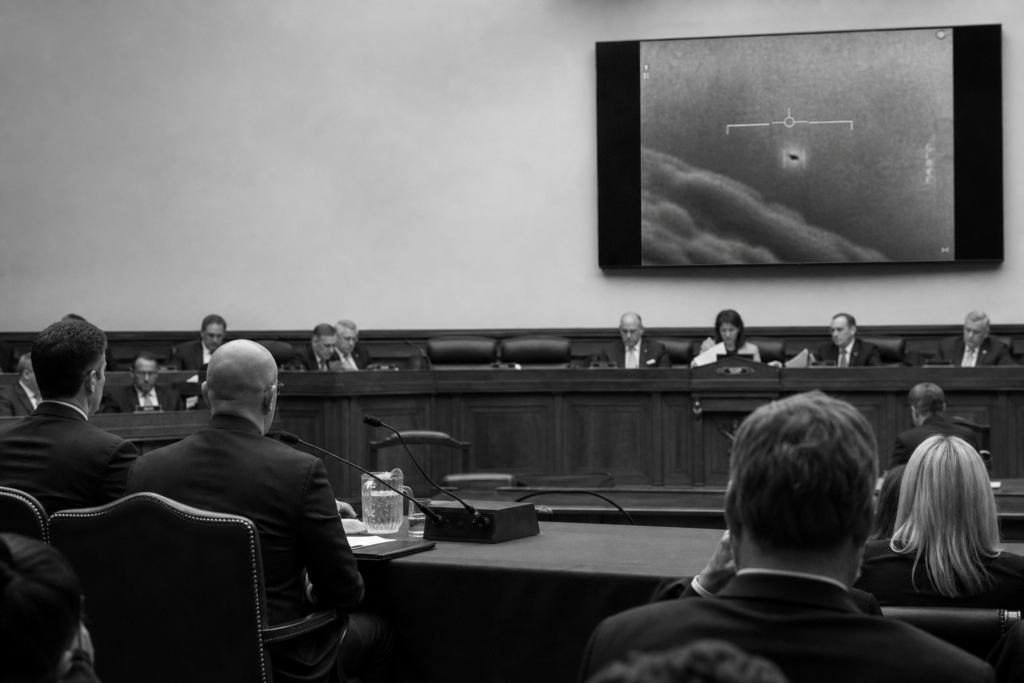
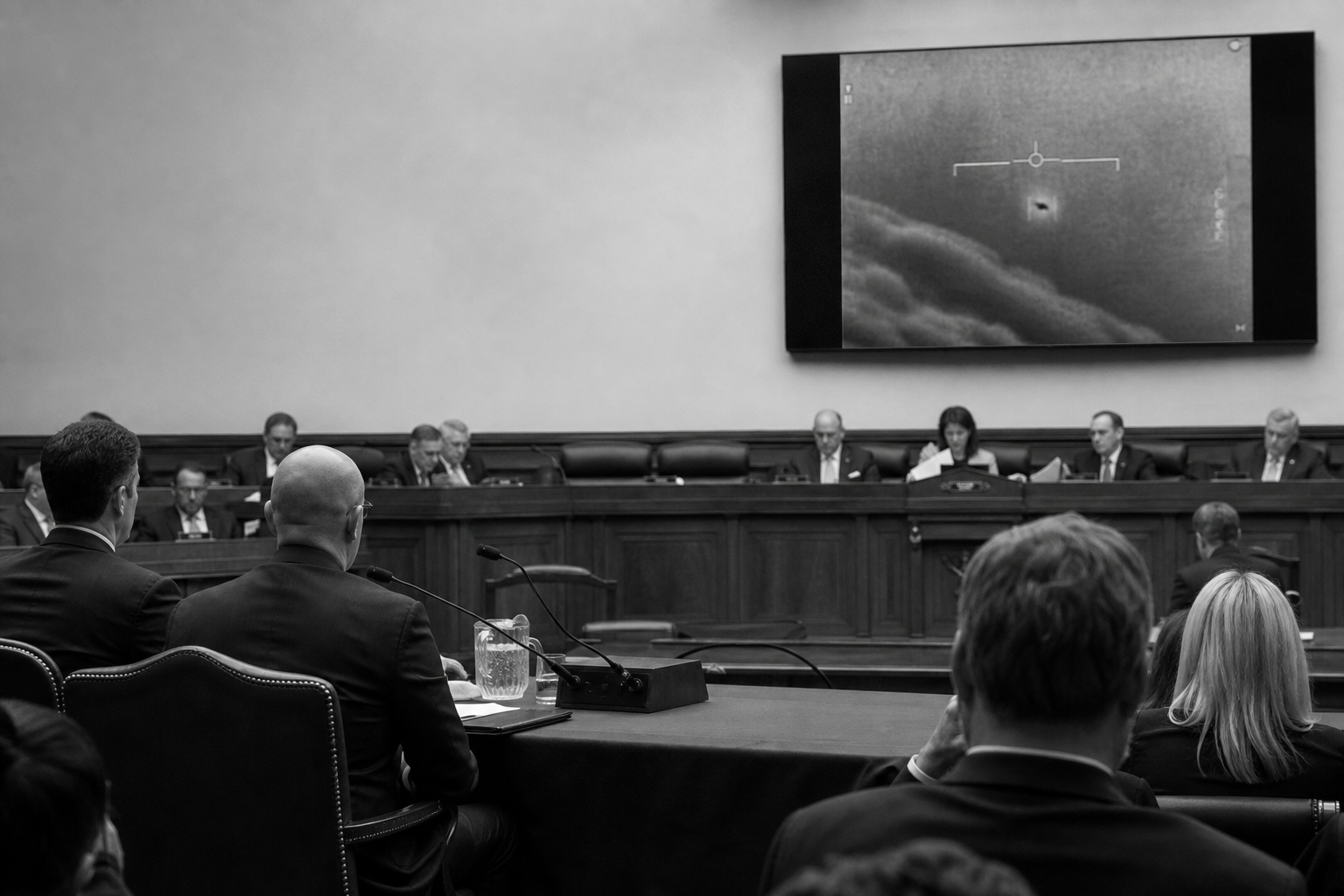
A required report can improve UAP transparency without resolving what an object was; likewise, a sworn allegation can raise expectations without establishing the allegation’s underlying claim. For some audiences, “UAP disclosure” means the publication of reports, records, and video. For others, it means public confirmation that the United States possesses hidden nonhuman technology. Those are not interchangeable outcomes.
This timeline tracks the modern U.S. disclosure cycle from 2017 through the reporting cutoff of August 5, 2026. It includes only nationally consequential milestones that created a concrete public expectation: statutory reporting duties, proposed or enacted records measures, official commitments, congressional hearings, and high-impact public allegations. Each entry identifies the actor and date, the promised action or expected result, any deadline, the documented outcome, and an accountability verdict: delivered, partial, delayed, narrowed, blocked, or unverified.
The distinction matters. Enacted law is not the same as a proposal; a scheduled hearing is not a completed investigation; and released UAP records are not, by themselves, evidence of nonhuman intelligence. The result is a reader-friendly account of what institutions actually did, and where the expectations attached to UFO disclosure outran the measurable record.
What Counts as a UAP ‘Disclosure’ Promise, and How This Timeline Scores It
The accountability test is deliberately narrower than public fascination. UAP transparency means making information about government handling, reporting, or analysis visible; declassification changes the status of material previously restricted; records release makes particular documents available; and congressional oversight tests executive-branch conduct through hearings, requests, and legislation. None automatically supplies the evidentiary conclusion commonly associated with alien disclosure.
A milestone qualifies as major only when a nationally consequential official, Congress, statute, formal proceeding, or prominent whistleblower/media intervention created a specific expectation that the public could later measure: a report, hearing, archive process, investigation, release, or claimed finding. Routine commentary, ambiguous hints, and recycled sighting claims do not qualify on their own.
- Fulfilled: the promised action occurred substantially as described.
- Partial result: an action occurred, but delivered only part of the expected access, evidence, or oversight.
- Delayed: a defined action missed its expected timetable.
- Diluted: a proposal or commitment survived in a materially weaker form.
- Unresolved: the available public record cannot establish the claim’s outcome.
- Letdown: rhetoric or expectation pointed to a consequential result that did not materialize.
Allegations remain allegations, including sworn testimony, unless independently substantiated. This timeline records their institutional impact without treating them as proof of non-human intelligence or of a government UFO cover-up.
2017–2020: Mainstream UAP Coverage Returns, but No Formal Disclosure Deadline Exists Yet
December 2017 supplied the modern era’s public ignition point. The New York Times reported on December 16 that the Pentagon had funded the Advanced Aerospace Threat Identification Program, while videos associated with Navy encounters, later widely known as FLIR1, GIMBAL, and GOFAST, rapidly became central to UFO news. The immediate, supportable takeaway was narrower than many headlines implied: military personnel had recorded and discussed aerial incidents that remained unidentified in the material made public. It was not an official finding that the objects were non-human technology.
- December 16, 2017, AATIP reporting and video release. The reporting established that a Defense Department program had examined aerial-threat reports and brought unusual Navy footage into mainstream view. Expectation: greater official attention and eventual clarification, but no announced government disclosure deadline. Verdict: a major catalyst, not a formal promise.
- April 27, 2020, Pentagon formally releases three Navy videos. The Department of Defense authorized release of the three clips, saying they had been previously released without authorization and did not reveal sensitive capabilities. That action authenticated the videos as Defense Department material; it did not authenticate a proposed explanation for what appeared in them. Verdict: fulfilled release, limited evidentiary conclusion.
- August 4, 2020, UAP Task Force announced. The Pentagon said the task force would detect, analyze, and catalog UAP that could pose a threat to U.S. national security. This changed the practical expectation from episodic UAP sightings to a more systematic federal assessment. No initial public reporting deadline accompanied the announcement. Verdict: fulfilled institutional commitment, with its public-accountability test deferred.
The Navy’s 2019 effort to standardize how aviators and other personnel could report unexplained aerial encounters also mattered because it treated reporting as an operational and safety issue rather than a declaration about origin. By the end of 2020, the UAP disclosure narrative had grown substantially, but the government’s concrete undertaking was to investigate and report, not to confirm an extraordinary explanation.
2021–2022: Congress Mandates UAP Reporting and Builds a Permanent Office
Congress turned a general expectation of answers into a dated federal obligation. The Intelligence Authorization Act for fiscal year 2021 required the Director of National Intelligence and Secretary of Defense to submit an unclassified UAP assessment within 180 days of enactment, June 25, 2021.
- June 25, 2021, ODNI preliminary assessment. The Office of the Director of National Intelligence met the deadline with a nine-page public assessment covering 144 military reports from 2004 to 2021. It identified one report as a large, deflating balloon and left 143 unexplained, while stressing that most cases lacked the data needed for firm analysis. Verdict: delivered on time, but only a preliminary, data-limited accounting rather than a resolution of the cases.
- December 27, 2021, FY2022 National Defense Authorization Act. Congress required a more durable UAP program: an office to synchronize collection and analysis across Defense and intelligence agencies, standardized reporting, rapid notification of certain incidents, and recurring classified and unclassified reports. The statute moved the issue beyond an ad hoc task force by making oversight and public reporting continuing duties. Verdict: substantial institutional expansion.
- May 17, 2022, House Intelligence subcommittee hearing. Ronald Moultrie and Scott Bray testified publicly before the Counterterrorism, Counterintelligence, and Counterproliferation Subcommittee, the first open congressional UAP hearing in more than 50 years. The session exposed the reporting system and analytical approach to public questioning, but officials did not offer a definitive explanation for the incidents. Verdict: fulfilled oversight milestone, limited explanatory result.
In July 2022, the Defense Department established the All-domain Anomaly Resolution Office, superseding the short-lived Airborne Object Identification and Management Synchronization Group and widening the mission from airborne reports to anomalies across air, sea, space, and other domains. That evolution mattered because it created a named office with an ongoing mandate rather than another one-time review.
For UAP disclosure, 2021–2022 was therefore a real gain in transparency machinery: deadlines, public reporting, a hearing, and a permanent investigative structure. It was not the decisive evidentiary outcome many readers attached to “UFO disclosure”; the initial assessment chiefly documented how much remained unresolved and why.
2023: Grusch’s Allegations Raise Expectations as the Schumer-Rounds Disclosure Proposal Sets a Deadline
Two events in 2023 dramatically widened public expectations, but they carried very different evidentiary weight: one was sworn whistleblower testimony; the other was an ambitious, but still proposed, statutory disclosure system.
- June 5 and July 26, 2023, David Grusch’s public allegations and House testimony. Former intelligence officer David Grusch alleged in a June interview that the United States had retrieved craft of “non-human” origin. Under oath before the House Oversight Committee’s national-security subcommittee on July 26, he further alleged that officials had informed him of a crash-retrieval and reverse-engineering program, and that “biologics” had been recovered. Grusch said his knowledge came from interviews and information supplied by others; he declined to provide classified details in open session and did not present public physical evidence. The hearing put the whistleblower allegations into the congressional record, but did not itself establish the recovered-craft or biological-material claims. Verdict: consequential testimony and a major catalyst for UFO disclosure expectations; extraordinary claims remained unverified publicly.
- July 2023, Schumer-Rounds UAP Disclosure Act proposal. Senators Chuck Schumer and Mike Rounds introduced a bipartisan amendment to the FY2024 National Defense Authorization Act modeled in part on the JFK Records Act. It would have created a presidentially appointed UAP Records Review Board, required agencies to identify and send relevant records to a National Archives collection within 300 days of enactment, and set a presumption of disclosure unless the board found a defined reason to postpone release. The proposal also contemplated a controlled-disclosure campaign and asserted federal eminent-domain authority over recovered UAP, technologies of unknown origin, and biological evidence of non-human intelligence.
The timetable mattered because it converted a broad demand for transparency into measurable checkpoints: board appointments within 90 days, records transfer within 300 days, and review decisions generally within 180 days after transfer. Its practical tradeoff was explicit: broad collection and eventual public access, but with a mechanism for temporary postponement where officials could meet the proposal’s withholding standard.
The public expectation was therefore unusually high: a dedicated independent board could have compelled a systematic accounting of historically dispersed records. But this was an introduced Senate proposal, not an enacted archive regime. Congress ultimately passed a substantially narrower UAP-records provision in the FY2024 NDAA. Verdict: powerful proposed deadline and framework, later diluted before becoming law.
2024: A Weaker Records Law Arrives, While AARO Publishes Its Historical Review
December 22, 2023–2024, the FY2024 NDAA’s UAP-records compromise. The enacted law created a UAP Records Collection at the National Archives, requiring federal agencies to locate and transfer relevant records for centralized preservation and eventual public access. That was a real public-records release mechanism, but it was substantially less forceful than the Schumer-Rounds proposal that generated the expectation.

- The original proposal would have installed an independent, presidentially appointed UAP Records Review Board to decide disclosure and postponement questions. The final law created no such board, leaving implementation within existing executive-branch and archival structures.
- The proposal paired a presumption of disclosure with an outside review process and defined grounds for delaying material. The enacted framework retained the collection and a disclosure-oriented objective, but lacked the same independent adjudicator and enforcement architecture.
- The original bill gave the president a defined role in reviewing board recommendations on postponed records. Without a board in the final statute, presidential authority remained central to continued withholding without the proposal’s intervening independent-review layer.
- Its explicit federal eminent-domain provision for recovered UAP, technologies of unknown origin, and alleged non-human biological evidence was removed entirely.
The practical result was an archive pathway, not the autonomous disclosure commission many supporters expected. Records entered the National Archives’ UAP collection and catalog process, but collection does not itself compel immediate publication of every classified record. Verdict: enacted but narrowed, a meaningful archival requirement and a clear dilution of the proposed UAP Disclosure Act’s enforcement design.
March 8, 2024, AARO’s historical record report. In Volume I of its historical review, the All-domain Anomaly Resolution Office reported that it had found no verifiable evidence that the U.S. government or private industry possessed extraterrestrial technology, or that the government had confirmed non-human intelligence. The report described its conclusion as the result of reviewing available historical records and interviewing relevant personnel; it did not purport to settle every allegation made outside the material it could verify.
Some lawmakers, witnesses, and disclosure advocates disputed AARO’s treatment of particular allegations and argued that its access or investigative approach was incomplete. That disagreement matters in a UFO disclosure timeline, but it does not convert the allegations into publicly established facts. Verdict: an official negative finding, contested by critics, with no public corroboration of the extraordinary claims by the report’s release date.
2025–2026: What Actually Happened by the Latest Reporting, Archive, and Hearing Deadlines
The relevant reporting clock did not stop at the archive law: October 31, 2025 was the annual UAP-reporting checkpoint, while October 31, 2026 falls after this article’s August 5, 2026 cutoff. A statutory report is a defined submission to Congress; an AARO case-resolution release is a public explanation of a particular file; and a National Archives catalog entry shows that a record is held, not necessarily that every underlying record is public.

Verified through August 5, 2026: the research record supplied for this section contains no ODNI or Defense Department report dated 2025–2026, no AARO case-resolution release, and no dated National Archives accession or catalog update. It likewise contains no official 2025 UAP hearing notice, witness list, transcript, video record, or resulting committee commitment. Those outcomes are therefore unverified here, not evidence that no event occurred.
| Promised action | Due date | Outcome by Aug. 5, 2026 | Verdict |
|---|---|---|---|
| Annual ODNI/Defense UAP report | Oct. 31, 2025 | No primary report supplied | Unverified |
| AARO public case materials | Ongoing | No release supplied | Unverified |
| 2026 annual report | Oct. 31, 2026 | Not yet due | Pending |
| 2025 congressional hearing | No statutory date | No official record supplied | Unverified |
Reports of UFO sightings in 2025 or 2026 would not substitute for these institutional checkpoints.
Bottom Line: More UAP Transparency, but Not the Definitive Disclosure Many People Expected
The record is best scored as institutional progress rather than definitive disclosure. Recurring federal reporting, AARO’s investigative mandate, public congressional hearings, and the National Archives records-collection mechanism are concrete gains in UAP transparency.
The larger expectations were only partly met. Many cases remain publicly unresolved; the enacted records law lacked the proposed independent review board and stronger disclosure powers; classified evidence remains inaccessible to the public; and no U.S. institution has officially confirmed possession of non-human technology.
For future UFO disclosure claims, apply four checkpoints: identify the speaker and the authority behind the promise; locate the precise deadline; read the primary record, a statute, report, hearing transcript, or archive entry; then compare its actual result with the original claim. A scheduled release is not a release, an allegation is not a finding, and increased transparency is not equivalent to verified alien disclosure.
The Disclosure Record: Real Transparency Gains, No Final Reveal
The enduring value of this chronology is not a single verdict on unexplained incidents; it is a way to measure institutional claims against their actual outputs. A reporting requirement creates a due date and a public record. An investigative office creates an accountable point of contact. A records collection can preserve and organize material for future access. Each is meaningful, but none establishes what an unresolved case represents.
The same discipline applies when legislation changes shape. A proposed independent review mechanism, with authority to press agencies toward disclosure, promises a different result from an enacted records-preservation framework. The latter can improve access while leaving key decisions within the existing executive-branch system. That is a dilution of the original transparency ambition, not evidence that the underlying extraordinary allegation is either true or false.
Future UAP disclosure claims should therefore be scored in three lanes: a completed government action, an attributed allegation, or an inference drawn from incomplete information. The strongest signal is a dated primary document that does what its sponsor or agency promised. Predictions, teaser language, and unresolved cases may justify attention, but they do not substitute for a deadline met, a record released, or a finding supported by public evidence.
Frequently Asked Questions
-
What is the difference between UAP transparency and UFO disclosure?
UAP transparency means public access to government reports, records, videos, and oversight information. UFO disclosure, as commonly used, means verified confirmation that the United States possesses non-human technology, which no U.S. institution has officially provided.
-
What did David Grusch claim in his 2023 congressional testimony?
David Grusch alleged that officials told him the United States had recovered craft of non-human origin, operated crash-retrieval and reverse-engineering programs, and recovered “biologics.” His public testimony did not include physical evidence, and the claims remained publicly unverified.
-
Has AARO found evidence of extraterrestrial or non-human technology?
No. In its March 8, 2024 historical report, AARO said it found no verifiable evidence that the U.S. government or private industry possessed extraterrestrial technology or had confirmed non-human intelligence.
-
What happened to the Schumer-Rounds UAP Disclosure Act?
The original proposal was substantially narrowed in the enacted FY2024 NDAA. The final law created a UAP Records Collection at the National Archives, but removed the independent UAP Records Review Board, stronger review structure, and eminent-domain provision for alleged recovered materials.
-
What should you look for when evaluating a new UAP disclosure claim?
Identify who made the promise and their authority, check for a precise deadline, and verify the result in a primary source such as a statute, official report, hearing transcript, or National Archives entry. A scheduled release, a sworn allegation, or an unresolved case is not the same as a completed release or publicly supported finding.