UAP Disclosure Act 2023: Schumer-Rounds Bill Seeks JFK-Style Declassification
Learn how the UAP Disclosure Act 2023 modeled JFK-style declassification, and why Congress enacted only a narrower records framework.


The UAP Disclosure Act was not a law requiring the government to reveal proof of extraterrestrial life. It was 2023 bipartisan amendment language advanced by Senate Majority Leader Chuck Schumer and Senator Mike Rounds during work on the fiscal year 2024 National Defense Authorization Act, a proposal to organize and release government-held UAP records through a defined statutory process.
Its most consequential design borrowed from the JFK Records Act: create a centralized records collection at the National Archives, presume disclosure, and use an independent review body to assess agency requests to delay release. That structure matters because it would have shifted the question from whether each agency chose to publish material to whether it could satisfy a formal standard for withholding it.
Congress ultimately enacted narrower UAP-records provisions in the FY2024 NDAA, not the proposal’s full review-board-and-disclosure architecture. The difference is the heart of the story. This article separates the introduced Schumer-Rounds framework from the enacted text, explains the concrete parallels and limits of the JFK model, and distinguishes records policy from unverified allegations involving non-human intelligence, crash retrievals, or reverse engineering.
What the Schumer-Rounds UAP Disclosure Act of 2023 Proposed
Its operative checkpoint was a new government-wide disclosure process: amendment language offered during Senate consideration of the FY2024 National Defense Authorization Act. Formally titled the Schumer-Rounds UAP Disclosure Act of 2023, it would have required federal UAP-related records to be found, preserved, reviewed, and released through a defined system, rather than treating any particular incident as proof of non-human intelligence.
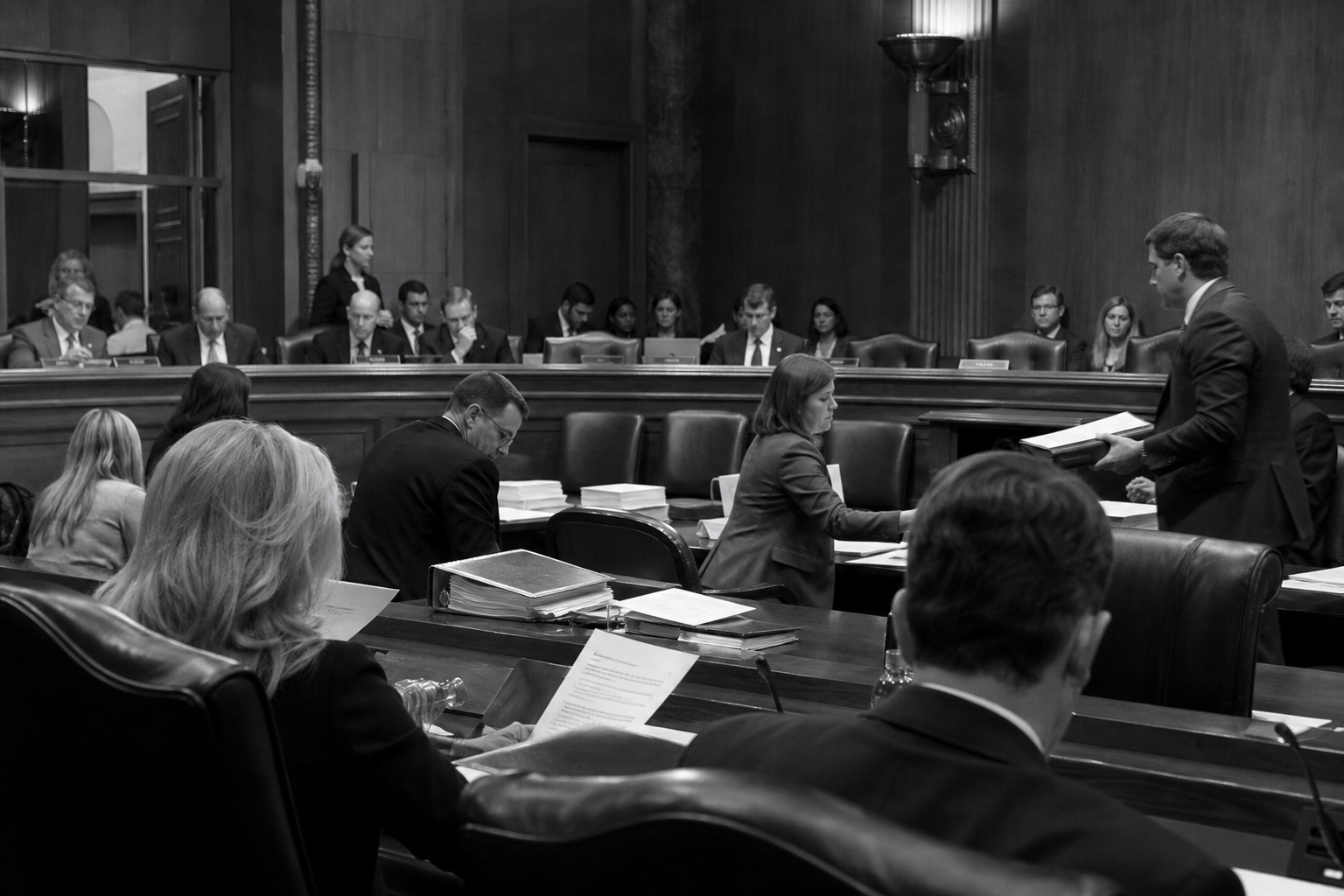
The proposal arrived after David Grusch, a former intelligence officer, publicly alleged that the United States had long-running programs involving recovered craft and biological material. Those assertions were allegations, not findings made by the amendment. Its practical focus was records accountability: relevant material, if held by federal bodies, would move from dispersed offices and classifications into a common disclosure framework.
Schumer described the proposal as modeled on Congress’s process for Kennedy-assassination records, while Rounds emphasized the public interest in greater transparency. The comparison concerned the machinery of disclosure, collection, review, and release, not an official endorsement of claims that had sharpened public interest in UAPs.
Why It Was Compared With the JFK Records Act
The comparison rests on administrative design. The JFK Assassination Records Collection Act created a single archival collection so that records from many federal holders could be identified, gathered, and assessed within one public-disclosure system. The proposed UAP records disclosure act used the same basic architecture: dispersed material would be treated as a collection problem, not merely as a series of isolated classification decisions made by individual agencies.
Its other parallel was a structured presumption in favor of release. That presumption would place the burden on an agency seeking delay: it would need to identify a defined harm that justified postponement, rather than rely on a general preference for secrecy. Postponement is not permanent withholding; it is a time-limited exception under specified standards. Agency review obligations mattered for the same reason. They would require offices to search for responsive material, account for it, and submit it to a common process, an important contrast with a system in which records can remain fragmented, obscurely described, or reviewed only when someone requests them.
The proposed independent review board was the strongest JFK-style feature. Rather than leaving every disputed withholding decision solely with the originating agency, a board would have provided an external statutory forum to evaluate requests for delayed disclosure and weigh the claimed harm against the public interest in disclosure. That design could create consistency and accountability, but it was not an automatic-release rule. Even under the model, properly supported postponements could protect information whose disclosure met the law’s stated threshold for harm. Nor did an institutional resemblance establish that any particular UAP claim was true; it defined how government records, if covered, would be found and judged for release.
The Proposed UAP Records Collection: What Agencies Would Have Had to Identify
At the center of the proposal was a practical mandate: turn scattered holdings into a searchable UAP Records Collection at the National Archives and Records Administration. The collection would have covered records relating to unidentified anomalous phenomena, technologies of unknown origin, and biological evidence connected to non-human intelligence, whether classified or unclassified. “Government office” was defined broadly enough to reach executive-branch departments, agencies, and other components that might hold relevant material.

Each covered office would have had to locate responsive material, organize and review it, and transmit it to the Archivist for inclusion in the centralized collection. That matters because a record can be significant even when its title does not use familiar UAP language: a technical assessment, contract file, intelligence memorandum, photograph, or correspondence could be responsive if its subject fell within the statutory definition. The proposal was designed to require an affirmative search and accounting, rather than leaving discovery dependent on a requester knowing which office to ask.
Public access depended on more than depositing files. The framework also contemplated record-identification aids: descriptions that would help the public see what had been located and how it was being handled, including material whose release was postponed. A collection rule, however, is not a truth-finding rule. Inclusion would mean that a record met the proposal’s coverage standard; it would not establish that an allegation within it was accurate, that a claimed technology existed, or that every page was immediately releasable. Those disclosure decisions would have been governed by the separate review and postponement process.
The Core Declassification Mechanisms: Review Board, Presumption, and Postponement Tests
Disclosure would have begun from a presumption, not from an agency’s ordinary discretion to retain classified material. Under the proposed framework, a UAP record was to be publicly disclosed in full unless an agency could satisfy a defined ground for postponement. That distinction matters: classification alone would not have been the endpoint. The agency would have needed to make a case for a particular delay.
The proposed UAP Records Review Board was meant to supply the independent checkpoint. The President would appoint nine citizens, subject to Senate confirmation, from nominations associated with congressional leaders and the Archivist. Its members were intended to bring expertise in areas such as history, archives, law, national security, intelligence, and foreign policy. The board could review agency postponement requests, obtain records and information needed for that review, hold hearings, and issue decisions or recommendations on disclosure.
An agency seeking to withhold all or part of a record would have needed to provide a written justification. The operative test was demanding: identifiable harm to interests such as military defense, intelligence operations, law enforcement, foreign relations, privacy, or a confidential relationship had to outweigh the public interest in disclosure. A vague assertion that a document was sensitive would not meet that model; the claimed harm had to be specific enough for review.
Postponement was therefore a delay mechanism, not a permanent exemption. The proposal paired written determinations with review dates, reporting, and eventual-release expectations, while preserving a presidential role in exceptional disputes. That structure resembles the JFK-records process: sensitive details could be protected temporarily, but the government had to explain why and return to the question rather than simply closing the file indefinitely.
The practical result would have been a controlled disclosure campaign rather than immediate blanket declassification. Records could enter the public collection in full, in redacted form, or with release postponed under a recorded rationale; the review board’s function was to make those paths subject to a common standard instead of leaving each agency as the final judge of its own withholding.
Non-Human Intelligence Language and the Proposed Eminent-Domain Provision
The proposal’s definitions reached beyond sightings or flight data. It defined “non-human intelligence” as a sentient, intelligent non-human life form, regardless of its nature or ultimate origin, that may be presumed responsible for unidentified anomalous phenomena or of which the federal government had become aware. “Biologics” meant organic tissue, bodily material, or other biological material from such intelligence. Those terms identified categories of potentially responsive records and alleged material for the disclosure system; they were not congressional findings that any particular material existed or had been authenticated.
Its most unusual clause addressed possession rather than classification. The UAP Disclosure Act proposed that the federal government “shall exercise eminent domain” over recovered technologies of unknown origin and biological evidence of non-human intelligence controlled by private people or entities, “in the interests of the public good.” Eminent domain is the government’s power to take private property for a public use with constitutionally required compensation. Here, it would have created a route to bring alleged privately held material into federal custody, where it could be assessed, preserved, and addressed within the proposed records regime rather than remaining beyond it.
That provision helps explain why the measure drew attention in alien disclosure debates, but its legal function was conditional and procedural. Congress can legislate for a claimed category of property without thereby proving that the category is real, privately held, or connected to non-human intelligence. The clause was designed to prevent a possible gap in an investigation and disclosure process, not to resolve the underlying factual claims.
What Happened in the Final FY2024 NDAA
The decisive change appeared in the conference text: Congress retained an archival disclosure requirement but dropped the institutional machinery that would have made the system closely resemble the JFK process. Federal offices still had to identify, organize, and provide qualifying UAP records for centralized preservation and public handling.
| Introduced Schumer-Rounds framework | Final FY2024 NDAA result |
|---|---|
| A centralized records program backed by detailed disclosure rules and an outside review structure. | A UAP records collection, with agency duties to locate and provide covered records for archival inclusion. |
| An independent UAP Records Review Board to evaluate disputed postponements of release. | No independent review board. The enacted statute did not create the proposed external body. |
| Provisions addressing technologies of unknown origin, biological material, and federal acquisition through eminent domain. | No enacted eminent-domain authority for alleged recovered technology or biological material. |
| A JFK-style process for testing agency decisions to withhold or delay records. | A narrower archival framework, without an equivalent independent adjudicator. |
The practical difference is substantial. A collection requirement can bring dispersed records into a common system and make their existence easier to trace. A review board would have done something different: moved contested release decisions beyond the originating agencies and supplied a dedicated statutory checkpoint. Congress preserved the first function while omitting the second.
The NDAA UAP provisions therefore were not the full UAP Disclosure Act 2023. They created a statutory route for assembling and disclosing UAP-related government records, but did not enact the proposal’s strongest tools for independently testing secrecy claims or obtaining alleged privately controlled material. The final text also made no factual finding that non-human intelligence, recovered craft, or biological evidence exists.
The Bottom Line: A JFK-Style Proposal That Was Only Partially Realized
For readers weighing a UAP disclosure claim, the key checkpoint is the text being discussed: the 2023 Schumer-Rounds amendment, the enacted FY2024 NDAA provisions, or a later Schumer-Rounds UAP disclosure bill. The first proposed an independent review-and-postponement system akin to the JFK model; the second established the collection without that outside decision-maker. Neither official records policy nor its terminology authenticates claims about non-human intelligence or recovered material.
What the UAP Disclosure Act Actually Changed
The most reliable test is whether a claim distinguishes archival collection from independent adjudication. The enacted FY2024 NDAA required the National Archives to assemble UAP-related federal records and imposed identification, review, transmission, and disclosure duties on covered offices. Those are meaningful transparency measures: they create a common destination for records that might otherwise remain dispersed and make the existence and handling of material more visible.
But the statute did not create the proposed UAP Records Review Board, an outside body that could have assessed agency requests to postpone release under a dedicated public-interest framework. Nor did Congress enact the proposed presumption-and-postponement architecture in its full form, or the extraordinary eminent-domain provision aimed at alleged privately controlled material. The surviving law therefore relies more heavily on executive-branch implementation and existing withholding authorities.
That is why “comprehensive disclosure” is too strong a description of what changed in 2023. The UAP Disclosure Act offered a far more forceful JFK-inspired model: centralized records, a release-oriented rule, independent review, and potential reach beyond ordinary federal custody. The NDAA preserved the first element and related reporting structure, not the full enforcement system. It also did not establish that any claim concerning non-human intelligence, crash retrieval, or reverse engineering is true; a records regime governs how government material is managed and released, not what the material ultimately proves.
Frequently Asked Questions
-
What was the UAP Disclosure Act of 2023?
The Schumer-Rounds UAP Disclosure Act of 2023 was bipartisan amendment language proposed during Senate work on the FY2024 National Defense Authorization Act. It sought to create a centralized National Archives collection and a formal process for finding, reviewing, and releasing federal UAP-related records.
-
Did the Schumer-Rounds UAP Disclosure Act pass into law?
No. Congress enacted narrower UAP records provisions in the FY2024 NDAA, but did not enact the full Schumer-Rounds framework. The final law retained a centralized records collection while omitting the proposed independent review board and eminent-domain authority.
-
Why was the UAP Disclosure Act compared to the JFK Records Act?
The proposal borrowed the JFK Records Act model of a single National Archives collection, a presumption favoring disclosure, and independent review of agency requests to delay release. It would have required agencies to justify specific harms that outweighed the public interest before postponing disclosure.
-
What records would the proposed UAP Records Collection have included?
The collection would have covered classified and unclassified federal records concerning unidentified anomalous phenomena, technologies of unknown origin, and biological evidence connected to non-human intelligence. Covered offices would have had to locate, organize, review, and transmit responsive records to the Archivist.
-
How can you tell whether a UAP disclosure claim describes the law accurately?
Check whether the claim distinguishes the enacted archival collection from the proposed independent review system. The FY2024 NDAA created record identification, review, transmission, and disclosure duties, but it did not create the nine-member UAP Records Review Board or prove claims about non-human intelligence or recovered craft.