UAP Classification and Declassification: How Records Are Restricted, Reviewed, Redacted, and Released
Learn how UAP declassification works, why released UFO files can mislead, and how to assess records, redactions, and official claims.
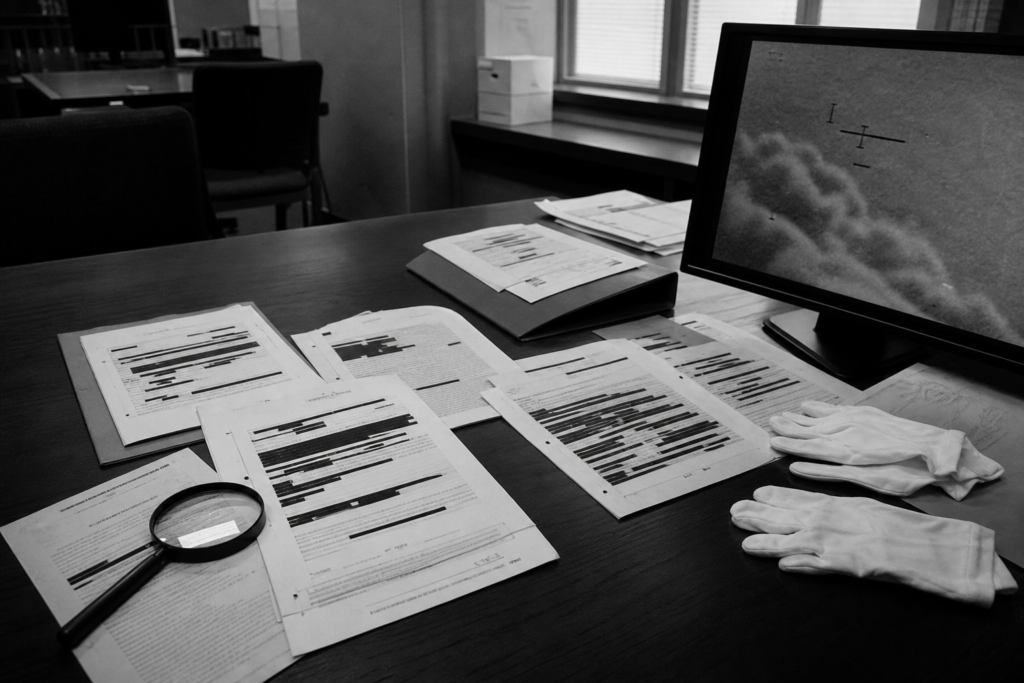
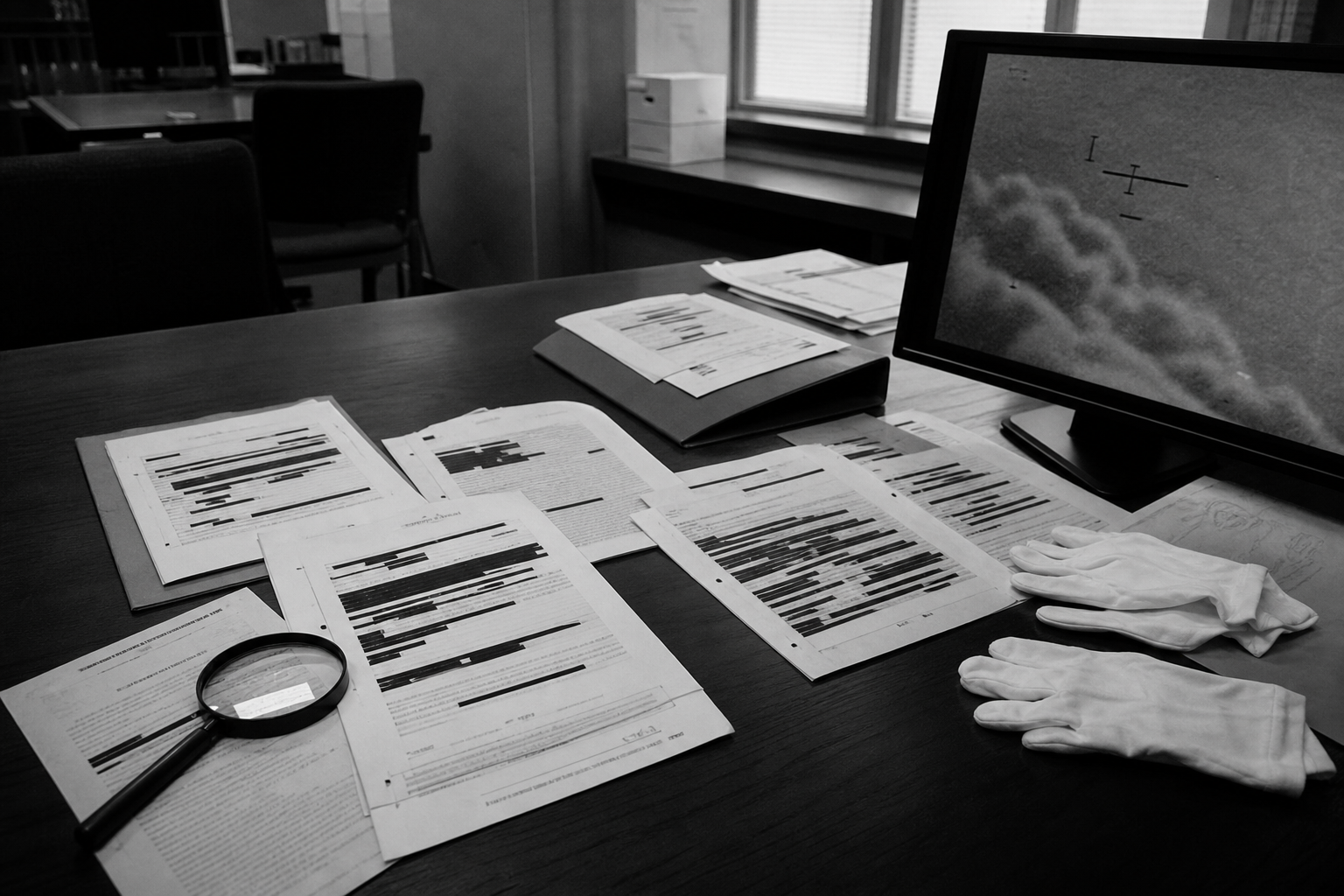
“Declassified UFO” is a powerful headline, but it compresses several different questions into one misleading word. A video may be officially released, a memo may be obtained through FOIA, and a page may be declassified with passages still blacked out. Each development can establish something important about the record’s provenance or the government’s willingness to disclose it. None, by itself, proves that every claim in the material is accurate, complete, newly discovered, or evidence of non-human intelligence.
That distinction matters in UFO disclosure. An authentic government record can preserve a pilot’s observation, an analyst’s preliminary judgment, an unresolved sensor event, or an allegation made to investigators. Authentication answers whether the item is genuinely what it purports to be; it does not answer what the object was. Likewise, redactions can protect sensitive details without making the visible text false, or making the missing text support a preferred theory.
This guide separates classification from public release, and release status from evidentiary weight. It will explain the U.S. rules that govern secrets, the routes by which UAP material reaches the public, and a practical method for reading documents, images, videos, and official statements with appropriate rigor: neither dismissing evidence because it is inconclusive nor converting ambiguity into proof.
“Declassified” Is a Status Label, Not a Truth Verdict
Begin with two separate inquiries: May this record be made public? and Does the record accurately establish what it describes? The first concerns handling status; the second concerns evidence. They can produce very different answers.
A government file may faithfully record a pilot’s account, a staff member’s allegation, an early analytic judgment, an intelligence lead, or an observation that remains unidentified. Its release establishes that the government created, retained, or officially acknowledged that record in the form released. It does not turn the account within it into an agency finding, identify an observed object, or supply context absent from the record.
That is why wording matters. “Observed” means someone or something detected an event; “reported” preserves what a person said; “assessed” signals an analytic conclusion; “unresolved” means the available material did not support a determination. Those labels are evidentiary signals, not interchangeable forms of confirmation.
This article uses UAP, unidentified anomalous phenomena, the current U.S. governmental term where appropriate, while recognizing that many readers encounter the same material through UFO disclosure claims. Its focus is U.S. national-security classification and release practices, not a universal rule for every country or proof of any extraordinary explanation.
Classification 101: What the U.S. Government Actually Classifies
Classification attaches to specific information because of the harm its unauthorized disclosure could reasonably cause to national security; it is not a label for topics that seem unusual. Under Executive Order 13526, the level reflects the expected scale of damage: Confidential for damage, Secret for serious damage, and Top Secret for exceptionally grave damage.
An original classification authority makes the initial decision that information requires protection and identifies its level, basis, and duration. Derivative classification is different: an authorized official incorporates, repeats, paraphrases, or extracts already-classified information into a new record while carrying forward the original protection markings. In practical terms, a briefing slide can be classified even when its individual sentences look ordinary, because their combination reproduces protected facts.
Executive Order 13526 identifies categories such as military plans and operations, foreign-government information, intelligence activities, sources and methods, and vulnerabilities or capabilities of national-security systems. “UAP” is not a blanket classification category. A report about an unidentified object may be unclassified; a seemingly mundane frame from the same event may be classified if it reveals where a sensor was positioned, what it can detect, its resolution, collection timing, processing techniques, or an operational pattern.
That distinction changes how a reader should interpret withheld UAP material. A classification marking can indicate protection of the means of observation rather than confidence that the observed thing was extraordinary. Conversely, removing a marking through UAP declassification does not reveal every fact that may have been withheld under another authority or establish an explanation for what the sensor recorded.
Six Different Ways UAP Information Can Become Public
A public-facing UAP item can arrive through several routes, and the route determines what the government has actually done, not what the item ultimately proves.
| Label | What changed | What it does not establish |
|---|---|---|
| Public release | An agency deliberately posts or furnishes material, such as a video or report. | That every frame, claim, or implied explanation is complete or correct. |
| Declassification | Previously classified information is formally cleared for public release, in whole or in part. | That other withholding rules no longer apply; redactions may remain. |
| Unclassification | Material is determined not to be classified, or no longer carries a classification restriction. | That it was ever secret, newly discovered, or evidentially conclusive. |
| FOIA disclosure | An agency processes a Freedom of Information Act request and releases responsive records. | That all responsive records were released. FOIA exemptions can protect classified material and other information. |
| Mandatory declassification review | A requester seeks review of specific classified material for possible release. | An automatic right to the full document or a favorable outcome. |
| Official acknowledgment | An authorized agency statement confirms that an item, event, program, or record exists. | That an allegation within the acknowledged material has been validated. |
| Authentication | An agency confirms provenance, for example, that a document, image, or video originated with it. | That the content accurately identifies an object, supports an interpretation, or demonstrates non-human intelligence. |
Automatic declassification is also a review process, not a guarantee that every old UAP-era file will appear online. Age can trigger review, but exemptions and continuing protections can preserve sensitive portions or an entire record. A released page with black bars therefore may be genuinely declassified in part while still withholding operational details.
The practical checkpoint is to identify the precise action: “released under FOIA,” “declassified,” and “authenticated” answer different questions. Treat UFO declassification headlines as a prompt to locate the agency’s release language, then separate provenance, handling status, and the underlying evidentiary claim.
How to Read a “Declassified” UAP Record Without Overclaiming
Read the record from the inside out: its creator, date, audience, and purpose set the limits of what it can show. A contemporaneous incident report records what an observer reported at the time; it is not the same thing as a later assessment of whether that report was accurate. An intelligence summary condenses reporting for decision-makers and may preserve uncertainty. A briefing slide highlights selected points. A final finding is the strongest of these forms because it represents a stated conclusion, but even it may be limited by the evidence available.
- Establish provenance. Identify the originating office, date, file number, distribution markings, and release location. Provenance asks where the item came from and how it reached the public. Authentication can establish that an agency created a video, memo, or image; it does not establish that the object in the material has been correctly identified.
- Classify the claim inside the record. Words such as reported, alleged, assessed, unresolved, unable to determine, and insufficient data are not filler. They distinguish an account, an analytic judgment, and a conclusion the agency declines to make.
- Test the record’s completeness. Determine whether the item is a full file, a single page, an excerpt, a transcript, or a third-party reproduction. Missing attachments, omitted imagery, redactions, and absent chain-of-custody details can narrow what a reader can responsibly infer.
- Look for corroboration separately. Ask whether independent sensor data, additional witnesses, contemporaneous logs, or a documented analysis support the central claim. Repetition of one original allegation in multiple declassified UFO documents is not independent confirmation.
The disciplined conclusion should match the document’s level, particularly when evaluating public UAP crash-retrieval allegations. A government record can be strong evidence that a pilot, official, or source reported an unusual event, while offering little basis to conclude that the event occurred exactly as described or that it involved non-human intelligence. Preserve that distinction when summarizing a record: state who reported what, identify what the agency assessed, and leave unresolved what the record itself leaves unresolved.
Why Released UAP Records Can Still Be Redacted, Incomplete, or Unresolved
Black bars and missing annexes often reveal more about the limits of public release than about the event under discussion. A UAP file may omit details that could expose an intelligence source, reveal how a sensor performs, identify an active operation, invade a person’s privacy, disclose information supplied by a foreign government, interfere with a law-enforcement matter, or reveal predecisional internal debate.

Those grounds do different jobs. Protecting sources, methods, and sensor capability can remove the location, timing, collection settings, or analytic cues needed to understand an encounter fully. Privacy protections can remove names and identifying details. Deliberative material can withhold draft recommendations or internal disagreement rather than the final agency position. A file may also be withheld in full when separating releasable text from protected material would not leave a meaningful public record.
A redaction is therefore a narrow signal: the releasing office determined that particular material could not be disclosed under the authority it invoked. It does not reveal the words behind the black box, establish that they concern a crash retrieval or non-human intelligence, or show that the withheld material would support any favored theory.
The same restraint applies to unresolved UAP sightings. “Unresolved” can mean the available reporting lacks sufficient detail, imagery, sensor context, or corroboration for a confident identification. It is a statement about the remaining uncertainty, not an affirmative finding that the object was extraordinary. Treat the visible record, the stated withholding rationale, and the unanswered questions as three separate parts of the evidence.
Applying the Rules: Videos, AARO Findings, Archives, and Proposed UAP Legislation
Concrete releases show the difference. On April 27, 2020, the Department of Defense formally released three Navy videos commonly known as FLIR1, Gimbal, and GoFast, stating that the footage had previously circulated and that it did not reveal sensitive capabilities. That agency release establishes DoD’s publication and description of the clips; it does not identify every object shown or establish an extraterrestrial or non-human intelligence explanation.

An agency assessment and congressional testimony have different institutional weight. AARO’s March 2024 historical report was an official analytic assessment and reported that it found no verifiable evidence that the U.S. government or private industry had access to extraterrestrial technology. David Grusch’s July 26, 2023 House hearing appearance, by contrast, placed his allegations about concealed crash-retrieval and reverse-engineering programs into the congressional record. The hearing record establishes that he gave that testimony, not that Congress or an agency verified each allegation.
The National Archives’ UAP Records Collection is an access and preservation mechanism created under the Fiscal Year 2024 National Defense Authorization Act. It brings identified UAP records into a centralized collection, but a collection entry can still be withheld, postponed, or redacted under applicable authorities; archival placement neither authenticates every assertion nor guarantees a complete public file.
Legislative labels need equal care. The broader 2023 UAP Disclosure Act proposal was not enacted in its original form. Readers may accurately describe the FY2024 collection provisions as enacted, but not treat every proposed disclosure-review, records-board, or public-release feature as current law. A collection mandate changes where records are reviewed and located; it does not itself create unrestricted access to every attachment or protected detail.
A Fast Checklist for Evaluating the Next “Declassified UFO” Headline
Before sharing the next dramatic claim, run this short test:
- Find the original agency, archive, hearing record, or FOIA release, not a screenshot or summary.
- Identify the pathway: formal release, declassification, FOIA disclosure, archive posting, or authentication each establishes something different.
- Read the agency’s exact language, then note the record’s date, missing attachments, and redactions.
- Separate an observer’s report or testimony from an official analytic finding, and seek independent corroboration.
- Treat “unresolved” as insufficient identification, not a conclusion of non-human origin.
UFO disclosure can strengthen the public record, but a record’s classification status cannot by itself determine what a UAP was or prove a broader claim.
Read the Release, Not the Headline
The strongest takeaway is methodological: let the primary record set the ceiling on the claim. An officially published video can establish provenance; a FOIA response can establish that an agency disclosed particular pages; a declassified memo can establish that information was cleared for public release. None of those events, standing alone, identifies the object described within the material.
That limit does not make UAP records unimportant. A dated report, sensor record, witness statement, or official assessment may preserve valuable evidence of what personnel observed, reported, and investigated. It may also show where the evidentiary trail stops: withheld technical detail, an absent attachment, competing explanations, or an assessment that remains unresolved. “Unidentified” is a bounded conclusion about identification, not a shortcut to an extraordinary one.
Apply a proportional standard to future UFO disclosure claims. Trace the item to its issuing office or archive; read the release notice and metadata; distinguish the disclosure route from authentication and analysis; and record both the stated finding and the unanswered questions. A strong conclusion says no more, and no less, than the available record supports.
Headlines reward certainty. Sound interpretation rewards provenance, context, and calibrated language. Read the release itself, preserve the distinction between an allegation and a finding, and allow the evidence, not the label declassified, to determine what the record means.
Sources
Frequently Asked Questions
-
What does declassified mean in UAP disclosure?
Declassified means previously classified information was formally cleared for public release, in whole or in part. It confirms a handling-status decision, not that every claim in the record is accurate or that an object was identified.
-
Does a declassified UFO document prove the event happened?
No. A declassified document can prove that an agency created, retained, or released a record, but it may only preserve a witness report, allegation, preliminary assessment, or unresolved observation.
-
What is the difference between a FOIA release and declassification?
A FOIA release occurs when an agency processes a Freedom of Information Act request and discloses responsive records. Declassification is a formal decision to clear previously classified information for public release, while FOIA exemptions can still withhold classified or other protected material.
-
Why are declassified UAP records still redacted?
Records can remain redacted to protect intelligence sources and methods, sensor capabilities, operational details, privacy, foreign-government information, law-enforcement matters, or internal deliberations. A blacked-out passage does not reveal what was withheld or prove it supports a non-human intelligence claim.
-
What should I look for before trusting a declassified UFO headline?
Find the original agency release, archive entry, hearing record, or FOIA response, then identify whether the item was released, declassified, authenticated, or assessed. Check the creator, date, missing attachments, redactions, and whether independent sensors, witnesses, logs, or analysis corroborate the central claim.