Operation Mainbrace and the 1952 RAF Topcliffe UFO Report
On 19 September 1952, five RAF aircrew at Topcliffe reported a silver circular object descending, rotating and accelerating away. The surviving British archival record makes this a significant military-witness case—but not a documented radar intercept or proof of extraterrestrial technology.
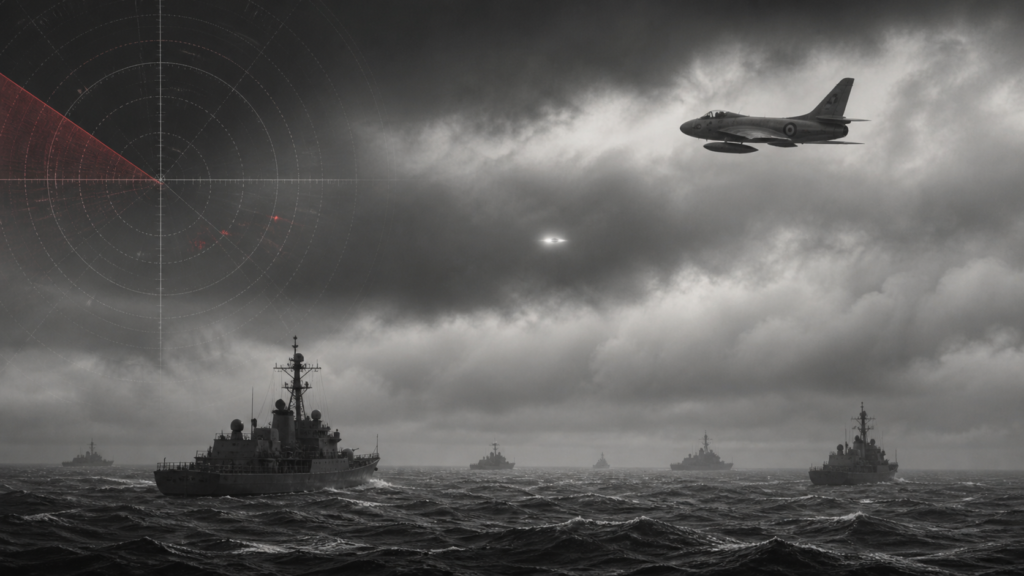
On the afternoon of 19 September 1952, a group of Royal Air Force personnel at RAF Topcliffe in North Yorkshire watched a Meteor jet descend toward the area. One of them then noticed something else: a pale object behind and above the aircraft. In the written report that followed, the object was described as silver, circular and capable of a startling change in motion.
The sighting occurred while NATO forces were conducting Exercise Mainbrace, one of the alliance’s major early Cold War exercises. That coincidence has made Topcliffe a durable part of UFO history. It has also encouraged later accounts to treat every unusual report associated with the exercise as one coordinated event. The surviving archival evidence supports a more careful story. It documents a short visual observation by trained military personnel and an official reporting path. It does not, by itself, establish that the object interacted with NATO forces, appeared on radar, or represented extraterrestrial technology.
The source at the center of the case
The key record is held by the UK National Archives under reference AIR 16/1199, described in the catalogue as occurrence reports by service personnel at Topcliffe station, Thirsk, and members of the local public in September 1952. The file is not simply an anecdote added decades later. The National Archives reproduces the substance of the report in its official history of British UFO files and identifies the witness who submitted it as Flight Lieutenant John Kilburn of 269 Squadron.
According to that archival account, Kilburn was on the airfield with four other Shackleton aircrew. The group was watching a Meteor fighter at about 5,000 feet approach from the east. Flight Lieutenant Paris noticed a white object estimated to be between 10,000 and 20,000 feet, roughly five miles behind the Meteor.
Kilburn described the object as silver and circular. It initially seemed to travel more slowly than the Meteor on a similar course. It then descended with a swinging motion that reminded the observers of a falling sycamore leaf. Their first ideas were conventional: perhaps a parachute or a piece of engine cowling.
The report became unusual when the perceived behavior changed. As the Meteor turned toward Dishforth, the descending object appeared to follow. Kilburn said it stopped descending, ceased its pendular motion and began rotating. It then accelerated away, first westward and then toward the southeast, disappearing after a total observation of about 15 to 20 seconds. His report emphasized that the motion and apparent acceleration were unlike anything he had previously seen in the air.
What military experience adds—and what it cannot add
Five aircrew observing from an RAF station are not casual witnesses. Their familiarity with aircraft, parachutes and operations is relevant, especially because they considered two familiar possibilities before concluding that the motion did not fit their experience. The immediate written report also carries more evidential weight than a story reconstructed for the first time decades later.
Training, however, does not eliminate the geometry problem in a brief visual sighting. The estimated height, distance and speed of an unknown object depend on assumptions about its actual size and range. With no documented image, measured angle, recovered material or synchronized instrument track in the Topcliffe record summarized by the National Archives, the extraordinary acceleration remains a witness estimate rather than a measured performance figure.
This does not mean the witnesses imagined the event. It means the record preserves what they perceived and reported, while the physical parameters remain uncertain. That distinction is also essential in the site’s analysis of the 1956 Lakenheath-Bentwaters case, where visual and radar claims must be traced separately rather than blended.
What Operation Mainbrace establishes
Mainbrace was a real, large multinational exercise, not a later invention attached to the UFO story. Imperial War Museums records preserve official photographs and NATO-sponsored film from the September 1952 operation. One photograph of the 27 September critique aboard HMS Eagle states that 200 senior officers from eight participating nations attended. NATO’s archive also catalogues its 1952 exercise record.
The Topcliffe observation occurred during that exercise period, and the National Archives explicitly places it in that context. Military aircraft and observers were therefore unusually active. That increases the significance of a report made by serving aircrew, but it also creates a busy visual environment containing friendly aircraft, operational equipment and changing flight activity.
The evidence does not allow a stronger causal statement. AIR 16/1199 does not demonstrate that the unknown object was monitoring Mainbrace, maneuvering against the Meteor, or controlled by an adversary. Nor does the exercise context convert a visual report into a radar case. The honest formulation is temporal: the Topcliffe sighting occurred during Mainbrace.
Do not merge Topcliffe with every 1952 RAF report
The National Archives’ history discusses additional British military sightings later in 1952, including an October incident involving a Meteor from Little Rissington and reported radar information. Those cases are important, but their evidentiary details cannot be imported backward into Topcliffe.
Topcliffe’s core surviving account is the visual report by Kilburn and the other aircrew. Claims that ‘radar confirmed the Topcliffe UFO’ require a separate contemporary record tying a specific radar plot to the 19 September observation. The official summary cited here does not provide that link. Combining independent reports because they occurred in the same season creates a stronger story than the documentation supports.
The same discipline applies to the heavily discussed 1952 Washington, D.C., radar and interceptor events. Each sensor, witness and time must be evaluated on its own chain of evidence.
How the report affected British attention
The institutional aftermath may be as historically important as the object’s identity. The National Archives says that, after the 1952 military reports, the Air Ministry moved toward permanent monitoring. Responsibility was assigned to a technical intelligence branch, and later orders required RAF stations to route reports of aerial phenomena for examination.
An official National Archives briefing guide says Captain Edward Ruppelt of the U.S. Air Force’s Project Blue Book later wrote that the Topcliffe sighting caused the RAF to recognize the UFO issue officially. That is Ruppelt’s retrospective characterization, not a scientific identification of the object. It nevertheless fits a documented policy change: British authorities maintained a reporting and evaluation function after the 1952 wave.
For comparison, the American program’s history is summarized in Project Blue Book’s beginning and the site’s account of the 1952 Pentagon press conference. Both show how unexplained reports could influence procedure even when officials did not endorse an extraordinary explanation.
Possible explanations and missing evidence
The witnesses’ initial parachute or cowling ideas should remain in the record because they show an attempt at ordinary identification. The later change in apparent motion is why those ideas did not satisfy Kilburn. Other hypotheses—balloon material, reflective debris, an astronomical object seen through moving cloud, or a perceptual error—can be proposed, but the cited official record does not conclusively select one.
Likewise, ‘unidentified’ is not an identification. It describes the limit of the available information. The report contains no material evidence of nonhuman manufacture, no measured propulsion signature and no verified communication or hostile action. A case can remain unresolved without becoming proof of a preferred theory.
The evidence-calibrated verdict
Topcliffe deserves to be treated as a genuine historical RAF report. The National Archives identifies the file, date, unit, named reporter, other aircrew present and the observation’s main sequence. The account was made in a military setting and appears to have contributed to official interest in systematic UFO reporting.
The case is strongest when kept within those boundaries. Five aircrew reported a silver circular object that appeared to descend, rotate and depart with exceptional acceleration during the Mainbrace period. The surviving account available here does not give Topcliffe an independent radar confirmation or a measured speed. It does not establish a link to the exercise beyond timing, and it does not identify an extraterrestrial vehicle.
That is not a dismissal. It is the difference between preserving a compelling report and turning it into folklore. The site’s sources and methodology guide explains why those boundaries matter: a credible historical timeline must keep the original report, later interpretation and missing evidence visibly separate.
Sources
- https://cdn.nationalarchives.gov.uk/documents/the-ufo-files-extract.pdf
- https://cdn.nationalarchives.gov.uk/documents/briefing-guide-12-07-12.pdf
- https://discovery.nationalarchives.gov.uk/details/r/C507596
- https://www.nationalarchives.gov.uk/help-with-your-research/research-guides/ufos/
- https://www.iwm.org.uk/collections/item/object/205163179
- https://archives.nato.int/nato-exercises-1952-3