Non-Human Intelligence in UAP Policy: Where the Term Appears and What It Does Not Prove
Learn what non-human intelligence means, why NHI is used in UAP debates, and what evidence supports a defensible source claim.


As the phrase appears more often in news coverage, policy debate, and online discussion, non-human intelligence can sound more conclusive than it is. It is best understood as a category of possible explanation: intelligence not attributable to known human actors. That label does not establish that an event has an intelligent source, identify where a source came from, or demonstrate that any particular report involves one.
Precision matters because neighboring terms answer different questions. A UAP or UFO describes an observation that has not yet been identified; extraterrestrial life specifies an off-Earth origin; alleged non-human biologics and recovered technology refer to claimed physical evidence. None follows automatically from another. A striking witness account, an ambiguous video, an official assertion, or a case that remains unresolved may warrant investigation, but it does not by itself establish a source.
This article explains why broader language is useful when origin and mechanism remain uncertain, then applies an evidence-first standard. A defensible conclusion would require more than mystery: authenticated data and metadata, understood sensor limits, independent corroboration, serious testing of ordinary alternatives, and, where material is claimed, traceable provenance and repeatable laboratory results. Uncertainty is not a failure of reasoning; it is the appropriate result when the available evidence cannot yet support a stronger claim.
Unidentified Does Not Mean Non-Human
An observation can be unusual for many reasons: incomplete data, a sensor artifact, unfamiliar equipment, atmospheric conditions, a misperceived ordinary object, or an explanation that has not yet been established. “Unidentified” records the present state of analysis; it does not identify the thing observed. An unresolved report is therefore a question, not a positive finding about its origin.

This distinction keeps the discussion out of the trap of treating every collection of UAP sightings as a running tally of non-human cases. A UAP label can apply to a visual, radar, infrared, or other observation whose identity remains undetermined. It does not establish a craft, intention, technological capability, or biological presence. Likewise, an alleged recovered object is a claim about material, while alleged biologics are claims about biological material; each requires its own evidence before it can support any broader inference.
Non-human intelligence belongs at the hypothesis stage: it is a possible source category to evaluate only after more ordinary explanations have been tested. A compelling account, a single unclear video, an authoritative assertion, or an open case may justify further inquiry, but none settles source. The relevant standard is converging, independently testable evidence, not the mere persistence of mystery.
What “Non-Human Intelligence” Means, and What It Does Not Mean
The decisive word is intelligence: an NHI claim proposes agency, purposeful information processing, communication, adaptation, or technology, not merely an object that looks strange or moves unexpectedly. In plain language, the term refers to intelligence that cannot be attributed to known human beings or human institutions. It is a source category under consideration, not a finding that identifies a species, place, or method of arrival.
| Term | What it asserts, and what it leaves open |
|---|---|
| UAP/UFO | An observation remains unidentified; it makes no claim about intelligence or origin. |
| Alien or extraterrestrial | Specifies an origin beyond Earth. NHI does not. |
| Interdimensional | Proposes a particular mechanism or realm; NHI supplies neither. |
| Advanced technology | Suggests an engineered object, which could still be human-made, misidentified, or inadequately measured. |
| Non-human biologics | Describes an allegation about biological material, not proof of intelligence or provenance. |
The label therefore does not rule out natural phenomena, instrument error, perception effects, classified or commercial human technology, or an unknown but ordinary terrestrial explanation. Nor does apparently sophisticated behavior automatically establish an intelligent actor: a sensor can generate a misleading track, and an automated human system can appear autonomous.
A defensible NHI conclusion has two separate burdens. First, evidence must show intelligence rather than anomaly alone: authenticated recordings and metadata, understood sensor performance, and independent observations should support the inference of deliberate behavior or engineered capability. Second, it must establish non-human provenance: credible terrestrial and human explanations must be tested, while any physical material needs a secure chain of custody, qualified laboratory analysis, and independent replication. A persuasive witness, ambiguous video, or unresolved report may motivate investigation; none supplies both parts of that conclusion.
Why Officials, Researchers, and Commentators Use NHI
Word choice matters most when the available record is incomplete. “Alien” commits the speaker to an extraterrestrial origin; “non-human intelligence” leaves origin, form, and mechanism unresolved. That makes it useful to officials describing an allegation or an analytic possibility, researchers separating a hypothesis from a result, and commentators who want to discuss claims without assuming that a reported object came from another planet.
The broader label also accommodates several distinct questions that public debate often blends together. Is there a real object or event? Does it display evidence of agency or design? If so, is it attributable to a human actor or institution? Only after those questions are answered would extraterrestrial origin become a justified possibility rather than an added assumption. In this sense, the NHI UFO term can describe the outer boundary of an investigation, not its destination.
That caution has a rhetorical downside. Readers may hear a technical-sounding phrase as an official confirmation, particularly when UAP disclosure or alien disclosure debates pair it with dramatic testimony or claims about alleged recovered technology and non-human biologics. An agency can receive, assess, or investigate such a claim without validating it. Likewise, an official’s use of neutral language can reflect uncertainty, classification limits, or a desire not to prejudge the evidence, not knowledge of a non-human source. The practical rule is simple: treat the label as a description of what is being considered, then ask what underlying data actually support it.
The Evidence Ladder: From a Sighting to a Defensible Source Claim
A useful way to evaluate a claim is to ask where it sits on an evidence ladder, and what the next rung would add.
- Witness report. A person’s account can establish that they experienced or observed something, and trained observers may provide valuable details about timing, setting, and behavior. But memory, viewing conditions, expectation, and distance can affect interpretation. Testimony is a lead for investigation, not a source determination.
- Documented instrumented observation. A video, radar track, infrared recording, or other sensor record adds information that can be measured. Its value depends on preserved raw files and metadata: time, location, sensor mode, settings, and processing history. Calibration information matters because it shows the instrument’s expected accuracy and known failure modes.
- Multisensor corroboration. Stronger cases have separate measurements that converge, for example, visual imagery and radar that agree on time and position. Two outputs from the same system are less persuasive than independently operated sensors with different error patterns. Witness accounts should be compared with these records, not used in place of them.
- Authentication and alternative testing. Investigators must establish that files have not been altered, identify gaps in collection, and test credible explanations: ordinary aircraft, balloons, drones, astronomical or atmospheric effects, sensor artifacts, perception errors, and human technology. “Unresolved” usually means this work cannot reach a reliable answer because the record is incomplete; it does not elevate the most extraordinary explanation.
- Physical material with provenance. A specimen can be tested only if its chain of custody is documented: who recovered it, where and when, how it was stored, and who handled it. Without that history, even unusual laboratory results cannot securely connect a material to the reported event.
- Independent replication. Qualified laboratories using transparent methods must be able to reproduce meaningful findings from authenticated samples or data. Replication separates a one-off anomaly from a durable result.
The practical standard is convergence. A striking clip in UFO news, an official assertion, or a collection of UAP sightings may justify attention, but a defensible non-human intelligence claim would require multiple reliable lines of evidence that survive independent scrutiny and leave credible conventional explanations behind.
What Would Actually Justify a Non-Human Intelligence Conclusion?
The relevant unit of proof is not a dramatic artifact or report but a case record that other investigators can audit from first observation to final inference. For a detected object, signal, or event, that record should preserve the original data, time and location information, instrument settings, processing steps, and the known limits of each sensor. Analysts in the relevant disciplines, such as engineering, physics, atmospheric science, astronomy, materials science, and signal analysis, must be able to test whether the apparent behavior follows from measurement error, environmental conditions, or familiar technology before treating it as anomalous.
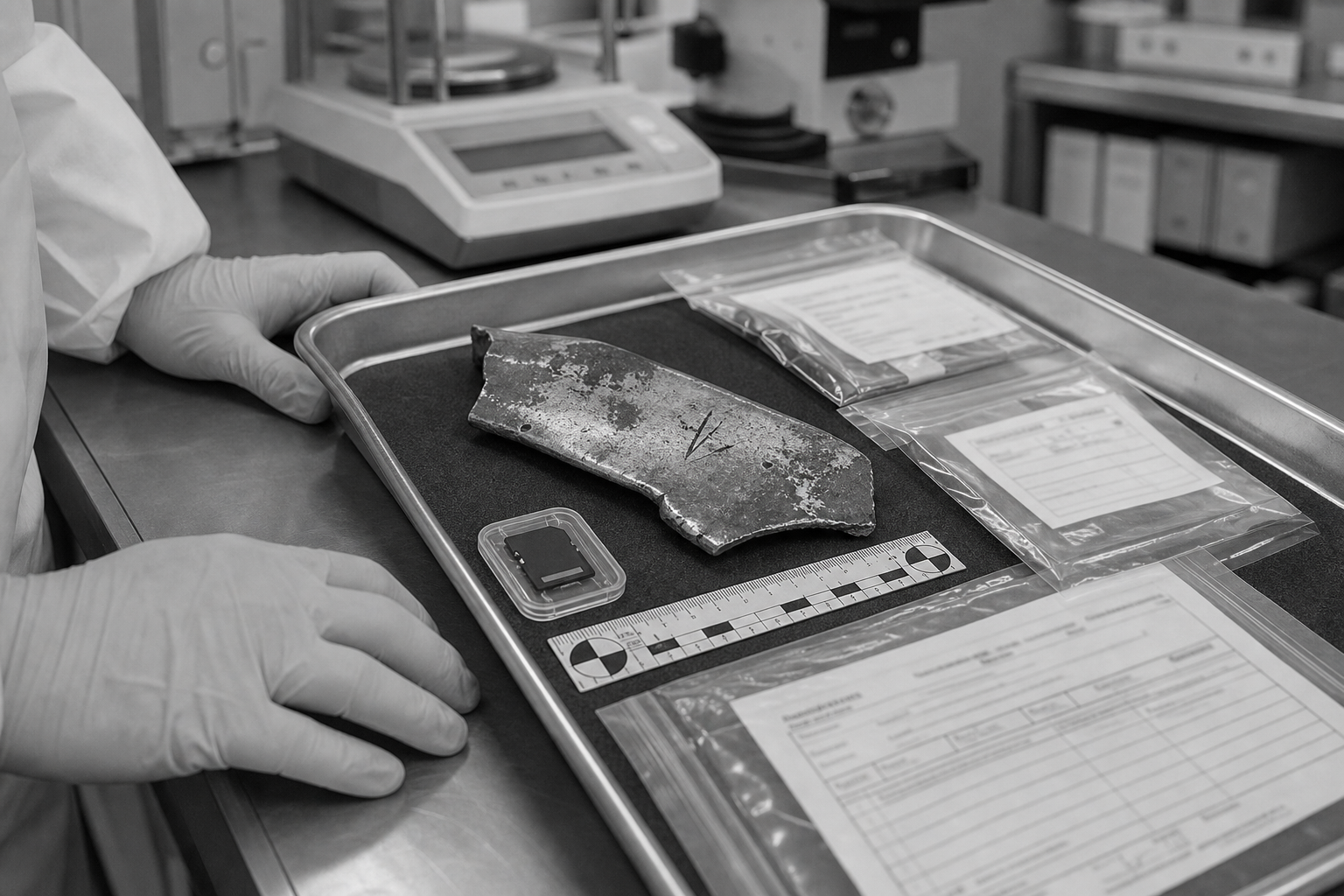
Physical evidence raises an additional requirement: provenance. This is the documented history that connects a specimen to a particular recovery and prevents a later sample from being substituted, contaminated, mislabeled, or stripped of context. A secure chain of custody records who recovered it, when and where it was collected, every transfer, storage conditions, sample preparation, and the portions supplied to each laboratory. Laboratory work should use validated methods, comparison samples and blanks that expose contamination, and reporting detailed enough for another team to repeat the analysis. An unusual composition by itself would not establish origin; it must be reliably measured and meaningfully connected to the reported event.
A non-human intelligence conclusion also requires a positive basis for inferring intelligence, rather than merely an inability to explain something. Repeated, well-characterized observations might show a structured signal, engineered features, or behavior that remains inconsistent with credible terrestrial, natural, instrumental, and perception-based explanations. Separate investigators using independent data or independently authenticated portions of a sample would then need to reach compatible results. Independence matters because repeating the same flawed assumption, sensor pipeline, or contaminated test does not strengthen a finding.
That is why a single video, radar trace, personal testimony, leaked document, or allegation involving non-human biologics or a UAP crash retrieval cannot meet the full standard alone. Each may warrant preservation and investigation; none supplies authentication, context, alternative testing, provenance, expert scrutiny, and replication all at once. The conclusion becomes defensible only when those safeguards converge on the same explanation and provide independently verifiable evidence.
What Does Not Prove NHI, and Why
Testimony can establish that a person made a report and, when firsthand, describe what that person believes they observed. It does not by itself establish the underlying event. A UFO whistleblower repeating information received from colleagues is offering hearsay: potentially useful for identifying records, witnesses, or material to seek, but not a substitute for those underlying sources. An authority figure’s confidence changes neither the availability nor the quality of independently testable evidence.
An unattributed leak has a related limitation. Without a known origin, complete version history, and authentication, readers cannot tell whether it is genuine, altered, incomplete, or misinterpreted. Footage detached from its original file is similarly weakened: missing timestamps, location, camera settings, compression history, and surrounding frames can make apparent size, speed, distance, or motion impossible to assess. An anonymous source may merit protection, but anonymity prevents outside readers from evaluating access, incentives, and firsthand knowledge.
An unresolved case means the available record did not support a confident identification; it does not select non-human intelligence as the remaining answer. Claims of a government UFO cover-up, secrecy, or classification may justify requests for records and careful investigation, yet classification can concern military capabilities, intelligence methods, privacy, or ordinary administrative limits. Secrecy is evidence of restricted information, not independent evidence of what that information proves.
A Practical Checklist for Reading NHI and Disclosure Claims
Use the same questions for every claim:
- What was directly observed, and what is inference?
- Are original data, metadata, and sensor limits available?
- Who authenticated and independently verified the record?
- For material, is its chain of custody documented?
- Which natural, terrestrial, instrumental, and perceptual alternatives were tested?
- Has a qualified independent team replicated the result?
UFO disclosure and UAP records releases can expand access and scrutiny; they do not establish origin. Non-human intelligence is useful only as a hypothesis label proportionate to the evidence.
The Standard Is Evidence, Not Mystery
Mystery is a status of knowledge, not a positive explanation. A report may remain unresolved because key measurements were never captured, records cannot be authenticated, or competing explanations cannot be separated, not because the remaining answer is non-human intelligence. The appropriate conclusion in that situation is limited: more inquiry may be warranted, but the source has not been established.
Moving beyond that limit requires a convergent record that outsiders can examine: preserved raw data and metadata; measured sensor performance and error analysis; observations corroborated by independent instruments or witnesses; and, for any physical material, an unbroken account of where it came from and who handled it. Qualified teams must also be able to reproduce laboratory results and show why terrestrial technology, natural effects, instrument faults, and perceptual errors do not account for the finding.
Give greater weight to evidence that remains persuasive when separated from the claimant, the institution, and the original interpretation. A compelling story or unusual image can prompt investigation; it cannot carry the conclusion. When future disclosures make extraordinary claims, return to the checklist: ask what data exist, who can independently test them, what alternatives were eliminated, and whether the chain of verification supports the inference. Novelty earns attention; reliable evidence earns belief.
Sources
Frequently Asked Questions
-
What does non-human intelligence mean in UFO discussions?
Non-human intelligence, or NHI, is a possible source category for intelligence that cannot be attributed to known human people or institutions. It does not establish that an event involved intelligence, identify a species or origin, or prove an extraterrestrial source.
-
Is NHI the same thing as aliens or extraterrestrials?
No. Alien or extraterrestrial specifies an origin beyond Earth, while NHI leaves the origin, form, and mechanism unknown. NHI also does not rule out natural phenomena, sensor errors, perception effects, or unidentified human technology.
-
Why do UAP officials use the term non-human intelligence?
Officials may use NHI because it describes an allegation or analytic possibility without assuming an extraterrestrial origin. The term separates key questions: whether an event occurred, whether it shows agency or design, and whether it can be attributed to a human actor.
-
What evidence would prove a UAP is non-human?
A defensible conclusion requires preserved raw data and metadata, documented sensor settings and limits, independent multisensor corroboration, and serious testing of conventional explanations. Any physical material also needs a documented chain of custody, qualified laboratory analysis, and independently replicated results.
-
What should I look for when evaluating claims about non-human biologics or recovered UAP materials?
Look for provenance: who recovered the material, where and when it was collected, every transfer, storage conditions, and laboratory sample handling. An unusual composition alone does not establish NHI; the sample must be authenticated, connected to the reported event, tested with validated methods and controls, and independently replicated.