Mexico’s Congress 2023: Maussan Presents Alleged Non-Human Bodies to Lawmakers
Mexico Congress alien bodies 2023: examine Maussan's claims, Nazca provenance, testing limits, and why the hearing was not official disclosure.
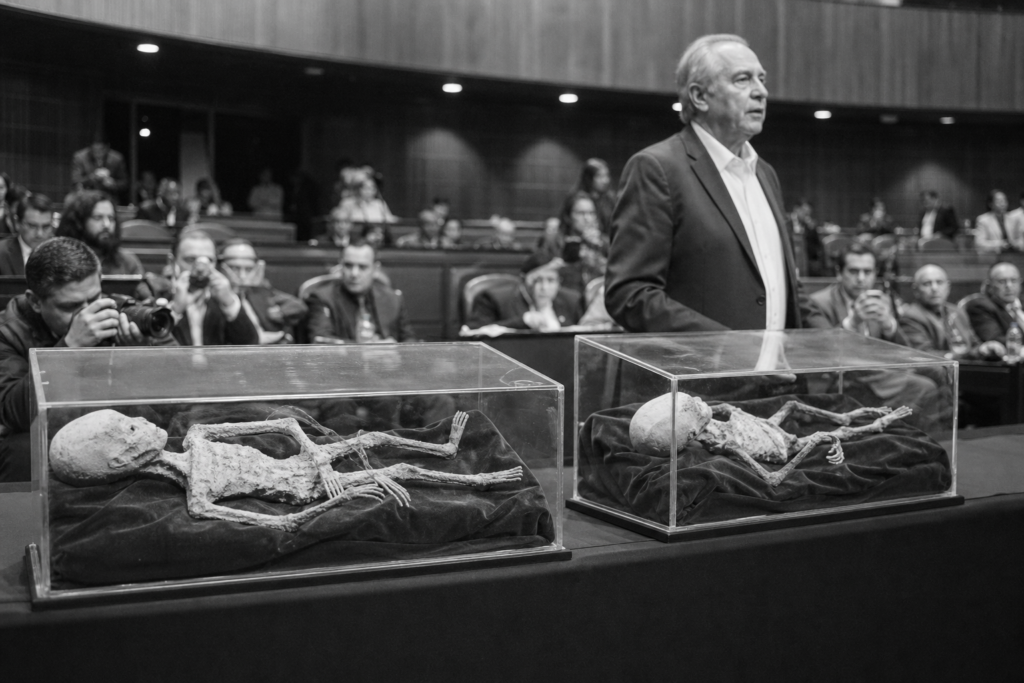
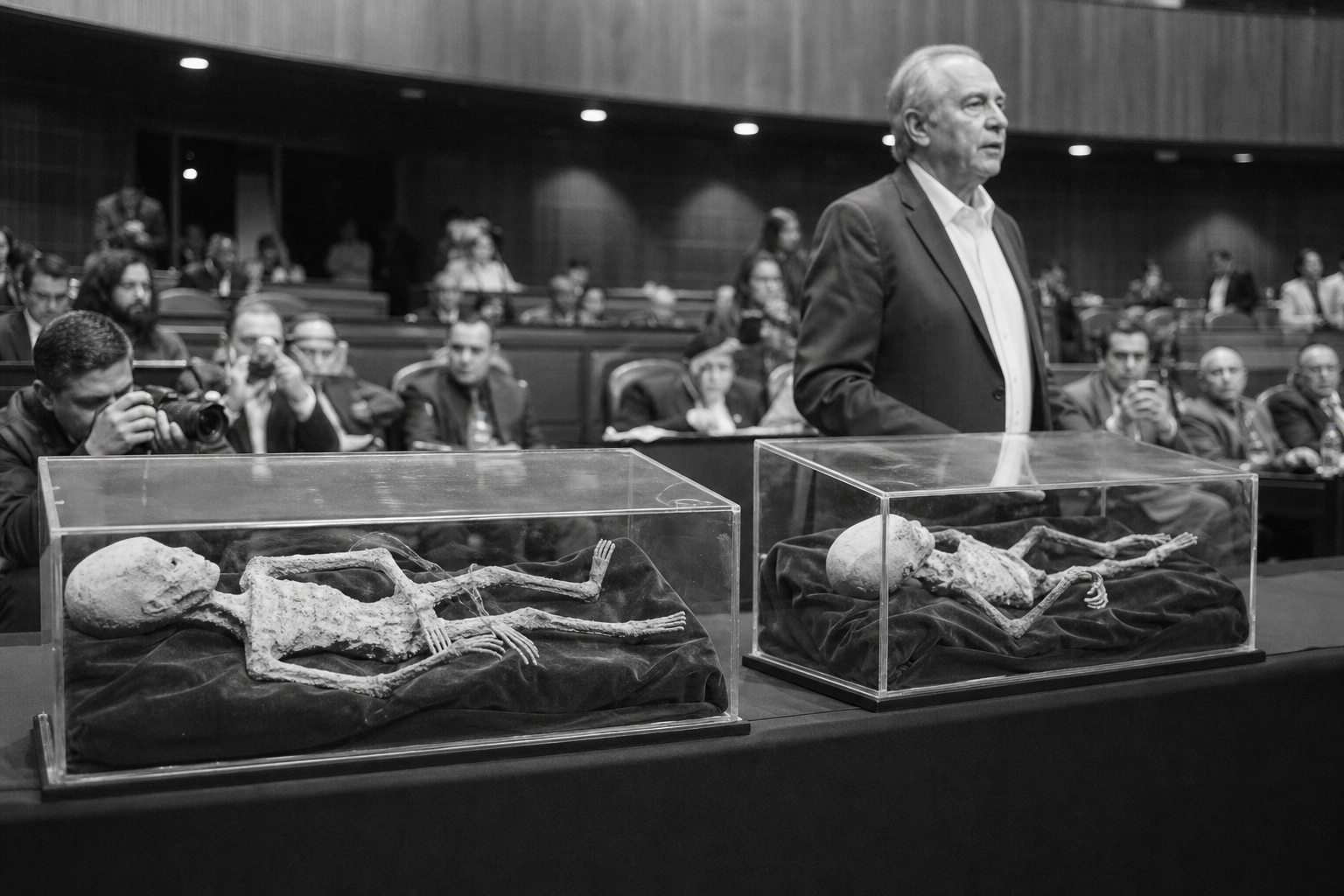
On September 12, 2023, television journalist Jaime Maussan placed two small, mummified specimens in display cases before a public hearing on unidentified anomalous phenomena at Mexico’s Chamber of Deputies in San Lázaro. The images traveled worldwide under the shorthand “Mexico Congress alien bodies 2023,” prompting claims that Mexico had revealed evidence of non-human life.
That interpretation goes further than the event itself. A legislator-hosted public hearing gave presenters a prominent platform to offer testimony and exhibits; it was not a scientific determination, an act of Congress, or a Mexican government confirmation that the specimens were extraterrestrial. Maussan and other participants described the bodies as non-human, but describing an object at a hearing is fundamentally different from establishing its origin through independently reproducible research.
The distinction turns on evidence that can be examined beyond the room: a documented chain of custody, lawful and traceable provenance, access to the physical specimens for independent testing, transparent imaging and DNA methods, and peer-reviewed interpretation of results. This article separates what lawmakers were shown from what presenters claimed, then examines the specimens’ connection to the Nazca mummies controversy, the limits of the cited tests, and the relevant responses from Mexican and Peruvian institutions.
What Happened at Mexico’s Congress in 2023?
The key procedural point is that the September 12, 2023 event placed physical exhibits before legislators without producing an institutional finding. During the public UAP hearing, Jaime Maussan displayed preserved, humanoid-looking remains in cases at Mexico’s Chamber of Deputies. Legislators could view the objects and hear accompanying testimony, but neither action authenticated an extraterrestrial origin.
That distinction matters. A public, legislator-hosted hearing is a forum in which witnesses can offer claims and materials; an official finding would require an authorized Mexican institution to evaluate evidence and issue a conclusion in its own name. The Mexico UFO hearing 2023 was the former: a widely viewed congressional setting for allegations, not a Mexican declaration that non-human bodies had been discovered.
The event’s immediate significance was therefore evidentiary and media-related, not dispositive. It created a record of what presenters chose to display and assert before lawmakers. Whether the remains were biological, how they were obtained, and what the cited tests could establish remained separate questions that the venue and testimony alone could not resolve.
Where It Took Place, Who Organized It, and Who Spoke
San Lázaro is the parliamentary complex that houses Mexico’s Chamber of Deputies, and it gave the event an unmistakably official-looking backdrop. The September 12 session was a public forum on unidentified anomalous phenomena hosted by Deputy Sergio Gutiérrez Luna, rather than a vote, committee investigation with findings, or formal act of the Mexican Congress. Jaime Maussan was the principal civilian presenter behind the specimen claims.
The program mixed two distinct kinds of testimony. Maussan and Mexican naval forensic physician José de Jesús Zalce Benítez addressed the displayed specimens and the tests said to have been performed on them. Zalce Benítez discussed imaging and anatomical interpretations; those statements represented his testimony, not a Chamber of Deputies determination. Other participants addressed UAP reports rather than the mummified bodies themselves.
Former U.S. Navy pilot Ryan Graves’s UAP testimony and military reporting appeared remotely to discuss military aviators’ UAP encounters and the need for more systematic reporting. His participation lent the forum international visibility, but it did not amount to an endorsement of Maussan’s specimens or their proposed origin. That distinction is important: a witness can describe unexplained aerial observations, while a separate presenter can advance a biological claim. The presence of legislators, foreign guests, cameras, and expert credentials did not merge those subjects into a Mexican legislative conclusion.
What Maussan Presented to Lawmakers
At the center of the room were two compact, desiccated figures displayed horizontally in transparent cases. Their visible features included elongated heads, small torsos, three-fingered hands, and a pale, mummified surface. The display established only that lawmakers and cameras were shown physical objects with a humanoid appearance; appearance is not, by itself, a biological identification.
Maussan presented the figures as alleged non-human bodies rather than props or conventional archaeological remains. He associated them with material said to have been recovered in Peru and characterized them as ancient specimens. José de Jesús Zalce Benítez and other allied presenters supplemented that framing with slides, radiographic images, and anatomical descriptions intended to show internal structures, including purported skeletal features and implants or dense objects visible in imaging.
The testimony also advanced claims about age and genetics. Presenters referred to radiocarbon dating results as placing the remains roughly a millennium old and discussed DNA analyses said to contain sequences not readily identified in available comparison databases. An unmatched or incomplete DNA result, however, is not equivalent to evidence of a new species or extraterrestrial ancestry: it can also reflect degraded material, limited reference data, contamination, sampling choices, or analytical limits.
Similarly, X-rays and CT-style images can show the arrangement and density of material inside an object, but they do not alone establish how it was assembled, where it originated, or whether its anatomy represents one organism. The Mexico Congress alleged alien bodies presentation therefore supplied a striking visual exhibit and a set of extraordinary interpretations, not an independently authenticated identity for the specimens or proof of non-human biologics.
The Nazca Connection and the Specimens’ Contested Provenance
The asserted Peruvian origin places the displays within the much older controversy over the so-called Nazca mummies: unusual mummified remains and related materials promoted as having come from the Nazca region. Presenters linked the Mexican exhibits to that body of claims, but an asserted geographic connection is not the same as a demonstrated archaeological origin.
Specimen provenance means the recorded history of an object from recovery through every transfer, examination, storage location, and sampling event. A strong provenance record identifies an excavation site, the people and institutions responsible for recovery, contemporaneous photographs and field records, and an unbroken inventory trail. A weak record begins only after a specimen has entered private hands or media circulation, leaving its original context and possible alteration unknown.
That distinction changes how later laboratory results should be read. A radiocarbon date can date the material actually sampled; it cannot establish where the material was excavated, whether every visible component belonged together when recovered, or whether the tested portion represents the whole object. Likewise, DNA and imaging findings become harder to interpret if outside researchers cannot trace which specimen was sampled, when it was opened, and how contamination was controlled.
Questions also remain about the relationship between the alleged non-human bodies displayed in Mexico and specimens previously publicized in connection with Nazca. Establishing that link requires more than similar appearance or shared promotional history: it requires specimen-level identifiers, custody records, and matching sampling documentation. Whether the materials were recovered and handled lawfully is consequential for the same reason. Legal archaeological custody helps preserve the site context and institutional record needed to evaluate an extraordinary biological claim, rather than merely its later presentation.
What the Imaging, DNA Claims, and Forensic Testimony Can, and Cannot, Show
Imaging is best understood as a map of what lies within an object, not a verdict on what the object is. CT scans produce cross-sectional views from which observers can assess internal density, cavities, fractures, and the apparent placement of bones or other materials; X-rays provide a flatter projection that can reveal overlapping structures. Either can document that internal features exist, but neither technique alone identifies a species, dates tissue, establishes that all parts were originally associated, or demonstrates an extraterrestrial origin.
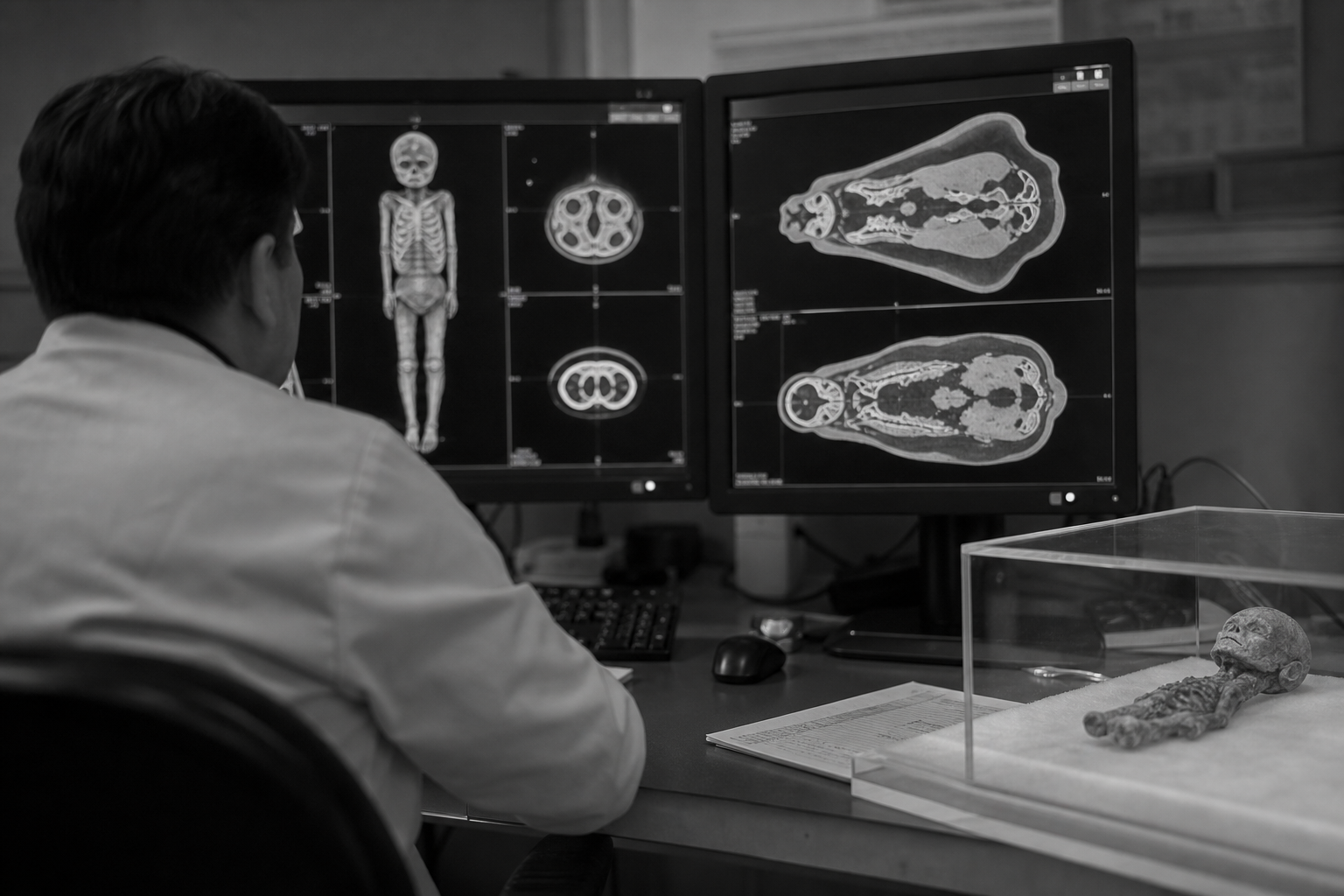
That is why forensic analysis must link images to a precisely identified specimen and ask narrower questions first: do the visible structures form anatomically coherent joints, are materials continuous across apparent boundaries, and do multiple qualified readers reach the same interpretation? A strong signal would be blinded review of the complete image sets by radiologists and comparative anatomists who have no role in promoting the conclusion. Selected scans, presentation slides, or impressions offered during testimony are weaker than access to the underlying files and a replicable reading process for the two displayed specimens.
DNA testing has similar limits. A sequence result depends on whether the sampled material is traceable to the displayed specimen, how it was extracted and prepared, what contamination controls were used, and which reference databases were used for comparison. “Unidentified” sequence fragments may reflect degraded material, incomplete databases, laboratory contamination, or analytical choices; they do not by themselves identify a new organism.
An extraordinary biological conclusion would require released laboratory methods, raw sequencing data, complete sample records, and independent replication from researchers without a stake in the claims. Independent peer review does not guarantee that a result is correct, but it exposes the sampling decisions, statistical assumptions, and alternative explanations needed for others to test it. Without that level of transparent, reproducible work, imaging and genetic assertions remain evidence to investigate rather than confirmation of non-human bodies.
What Peruvian Authorities and Government Institutions Said
One concrete Peruvian intervention concerned objects seized at Lima’s Jorge Chávez International Airport in October 2023 while being sent to Mexico. At a January 2024 presentation, specialists associated with Peru’s Ministry of Culture and the Institute of Legal Medicine and Forensic Sciences described the two small seized figures as recently assembled artifacts, citing animal bones, paper, adhesive and other manufactured components. That assessment applies to those airport-seized objects, not automatically to the two specimens Jaime Maussan displayed at San Lázaro in September 2023.
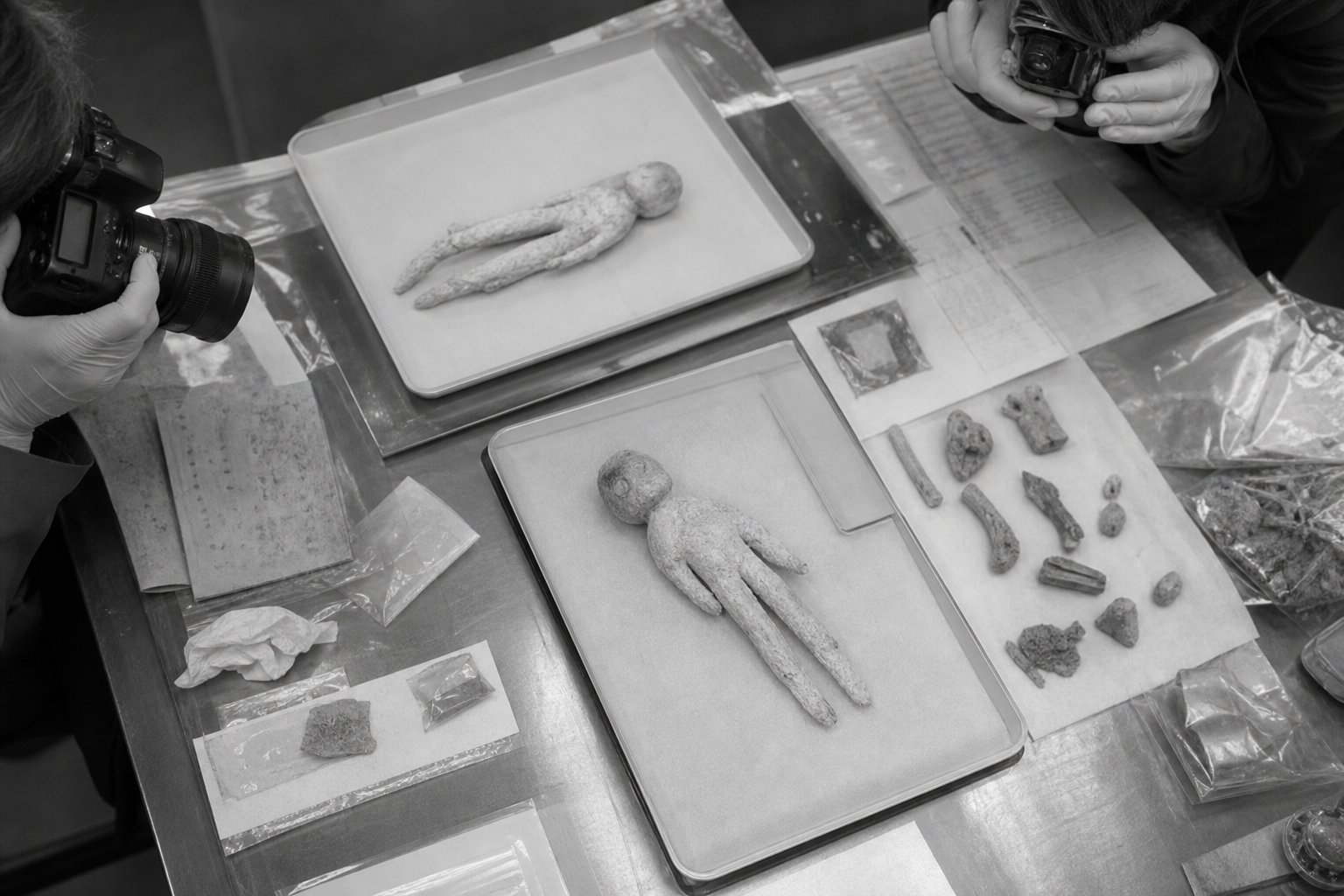
The distinction is material because “Nazca mummies” is a promotional label applied to more than one object and set of remains. Peru’s Ministry of Culture has treated the possible removal, possession and export of Nazca-area cultural material as a heritage-protection issue, while forensic conclusions depend on the exact specimen examined. A strong connection between an official examination and a Mexican exhibit would require matching inventory information, photographs, custody records and sampling identifiers; a shared claimed origin or similar appearance is not that connection.
Mexico’s government likewise did not issue an executive determination, congressional resolution, or scientific finding that the displayed figures were extraterrestrial, non-human, or authentic evidence of alien disclosure. The September 12 forum was hosted by Deputy Sergio Gutiérrez Luna at the Chamber of Deputies and allowed Maussan’s claims to be aired publicly. Its setting does not support either a government UFO cover-up narrative or a claim of official confirmation.
Bottom Line: A High-Profile Hearing, Not Confirmed UFO Disclosure
The lasting significance of the episode is its visibility, not a settled biological conclusion. Mexico’s 2023 congressional setting gave Jaime Maussan and other participants a prominent platform for extraordinary assertions, but a platform is not an adjudicative process. Displaying specimens and presenting testimony does not itself establish what the specimens are, where they came from, or whether they represent a previously unknown form of life.
For readers following UFO news, the careful conclusion is straightforward: this was not confirmed UFO disclosure. It was a legislator-sponsored public forum in which alleged non-human bodies were shown and debated, without a Mexican governmental finding that they were alien or non-human. The unresolved issues remain the ones that matter most to the claim: traceable provenance, controlled access to the exact objects, transparent testing, and independent scientific evaluation.
It should also be kept separate from U.S. UAP disclosure debates and the 2023 congressional hearing. U.S. congressional hearings have principally examined reports, military encounters, reporting systems, and government records concerning unidentified phenomena; they have not authenticated the Mexican specimens. Treating those distinct subjects as one evidentiary story obscures what each proceeding can actually show.
What Mexico’s 2023 Hearing Did, and Did Not, Prove
The evidentiary threshold for identifying a non-human organism is far higher than a compelling display or confident testimony. The 2023 forum at Mexico’s Chamber of Deputies established that Jaime Maussan presented unusual mummified specimens to lawmakers and associated them with extraordinary biological claims. It did not produce an official Mexican finding, a congressional authentication, or a reproducible scientific conclusion that the objects were extraterrestrial.
The difference lies in what can be independently tested. Imaging can reveal internal arrangements, and laboratory results can raise questions worth investigating, but neither settles identity without an unbroken specimen history, clearly recorded sampling, released methods and data, and access for unaffiliated specialists to repeat the work. Testimony describes an interpretation; scientific verification tests whether that interpretation survives independent scrutiny.
The Nazca-related history remains consequential because disputed recovery and custody can compromise the meaning of later analyses. Peruvian institutional responses regarding materials linked to that controversy also supply contrary context to the non-human biologics narrative, while not automatically resolving the identity of every separately displayed object.
In short, the Mexico Congress alien bodies 2023 episode was a public presentation of claims, not authenticated disclosure. Its unresolved status follows from the gap between what was shown and what has been transparently, independently established.
Frequently Asked Questions
-
What happened when Jaime Maussan presented alleged alien bodies to Mexico’s Congress?
On September 12, 2023, Jaime Maussan displayed two small mummified, humanoid-looking specimens in cases during a public UAP hearing at Mexico’s Chamber of Deputies in San Lázaro. The event was hosted by Deputy Sergio Gutiérrez Luna and allowed testimony, but it was not a congressional finding or vote.
-
Did Mexico’s Congress confirm that the bodies were non-human or extraterrestrial?
No. Mexico’s Chamber of Deputies did not issue a finding that the specimens were non-human, extraterrestrial, or authentic evidence of alien life. The hearing gave presenters a public platform, but testimony and exhibits did not constitute Mexican government confirmation.
-
Were the alleged bodies shown to Mexican lawmakers actually from Nazca, Peru?
Presenters associated the displayed specimens with materials said to have come from Peru’s Nazca region, but their archaeological origin was not independently established. Confirming a Nazca connection would require specimen-level identifiers, excavation records, custody documentation, and matching sampling records.
-
What can CT scans, X-rays, radiocarbon dating, and DNA tests prove about the alleged bodies?
CT scans and X-rays can show internal density, cavities, fractures, and the placement of materials, while radiocarbon dating dates only the sampled material. DNA fragments that do not match a database can result from degradation, contamination, incomplete reference data, or analytical limits, and do not prove a new species or extraterrestrial origin.
-
What should you look for before accepting claims that the Mexico Congress bodies were alien?
Look for an unbroken chain of custody, lawful and traceable provenance, documented sample records, full imaging files, released DNA methods and raw data, and independent replication by unaffiliated researchers. Peru’s specialists described two separate figures seized at Lima airport in October 2023 as recently assembled artifacts made with animal bones, paper, adhesive, and other components, but that assessment does not automatically apply to Maussan’s two September 2023 exhibits.