Diamond-shaped UFO Reported Hovering Over Prince Albert, Canada for Two Hours on January 28, 2000
Examine the Prince Albert diamond-shaped UFO January 28 2000 report, its evidence, source trail, possible explanations, and unanswered questions.
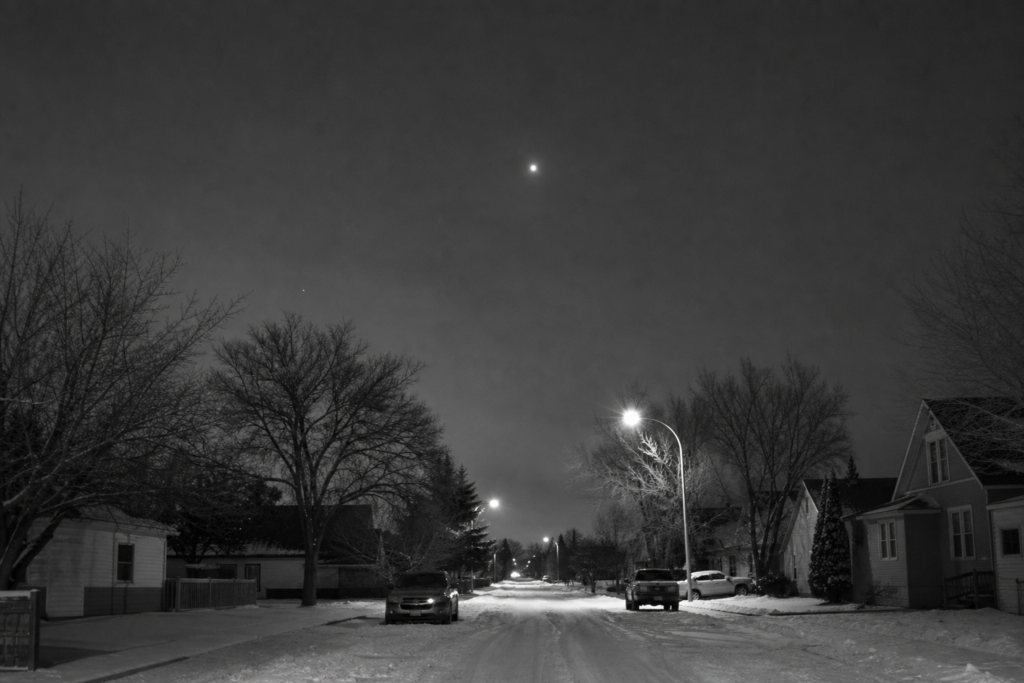
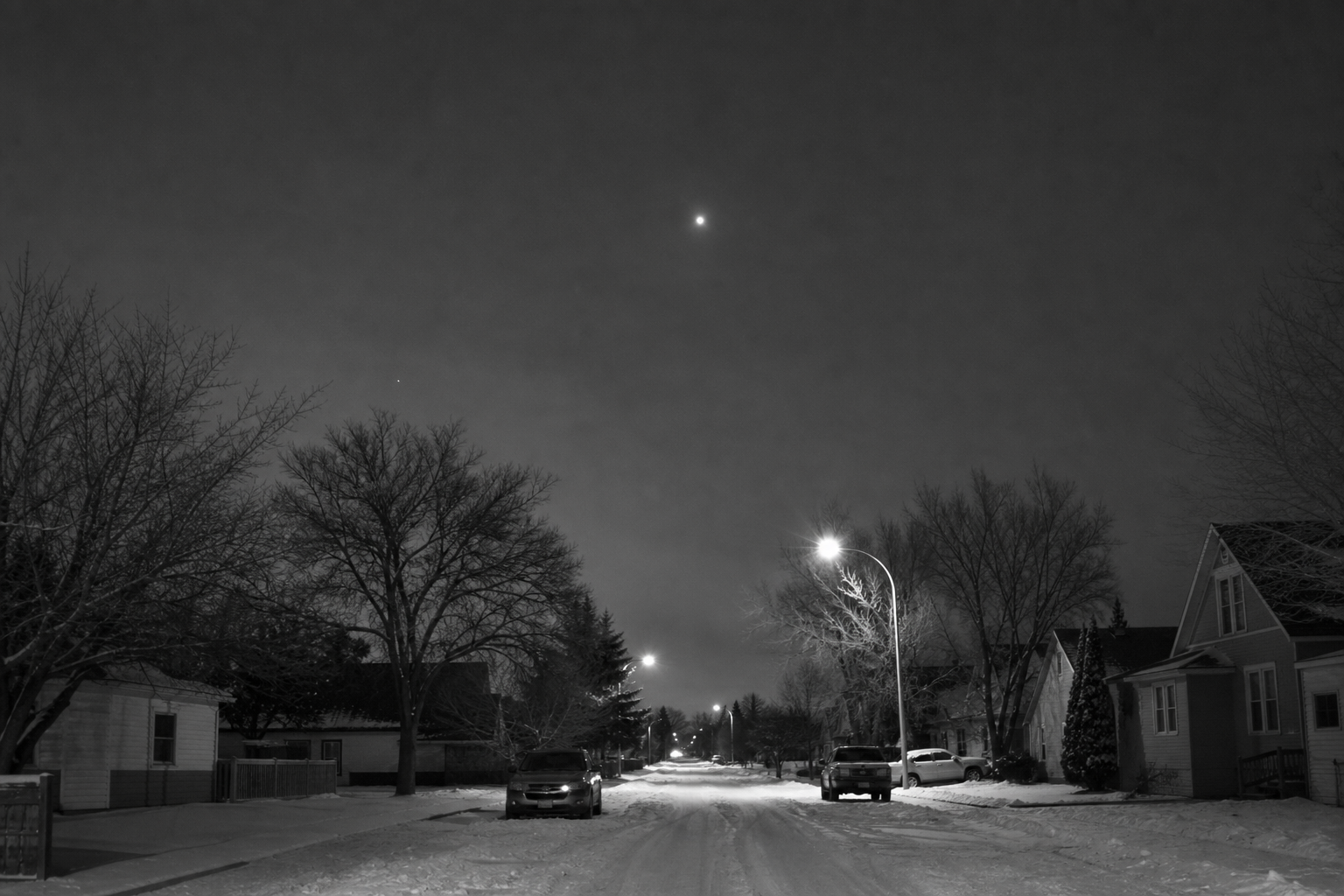
The Prince Albert diamond-shaped UFO report for January 28, 2000 centers on an arresting claim: an object described as diamond-shaped reportedly hovered over Prince Albert, Saskatchewan, for roughly two hours. Those details are allegations within a sighting narrative, not a verified identification of an object, aircraft, astronomical body, or other phenomenon. “UFO” is used here in its narrow descriptive sense, an object reported as unidentified, not as a conclusion about its origin.
This review begins by separating the core story from the evidence needed to support it. It traces where the date, location, shape, hovering behavior, and reported duration appear; distinguishes any contemporaneous material from later database entries or retellings; and looks for independent corroboration such as witness accounts, local reporting, official records, weather conditions, or aviation context. Ordinary explanations matter only if they fit the reported appearance and unusually long apparent duration. If the surviving record cannot establish those details beyond repetition of the same claim, the appropriate conclusion is an unverified reported incident, not proof of an extraordinary event.
What Was Reported Over Prince Albert on January 28, 2000?
The earliest located version of the claim is not an original witness statement, a dated local-news report, or an official incident record. Instead, the available account survives as a later sighting entry and retelling. It places the event in Prince Albert, Saskatchewan, the city in central Saskatchewan, Canada, rather than another community bearing the Prince Albert name, and assigns it the date January 28, 2000.
In that retold account, an observer or observers reportedly saw an unidentified object described as diamond-shaped. Later versions add that it appeared to hover and remained in view for about two hours. No exact start or end time is presently established, and the surviving wording does not supply the observational basics needed to reconstruct the scene reliably: a precise viewing location, direction of view, elevation, changing weather, number of witnesses, or a contemporaneous description in the witness’s own words.
That distinction matters. A database-style entry can preserve a lead worth examining, but it is not equivalent to a report made at the time of the alleged event. For the Prince Albert UFO sighting in 2000, the date, place, diamond description, hovering claim, and two-hour duration should therefore be treated as linked elements of a later narrative, not independently verified facts. The sections that follow test how far the available record can support each element, and where it cannot.
The Diamond Shape, Hovering Claim, and Reported Two-Hour Duration
“Diamond-shaped” is an appearance description, not evidence of an object’s physical geometry. A distant light, silhouette, reflection, or group of lights can look diamond-like from one viewing angle, while a genuine diamond outline would require details such as distinct edges, orientation, size changes, and a stable view. The surviving account does not preserve those details in an original witness statement, recording, questionnaire, or interview.
Nor does the available retelling establish brightness, colour, altitude, compass direction, sound, or changes in appearance. Those omissions matter because they are the observations that help separate a stationary celestial light, an aircraft seen head-on, a nearby illuminated object, and a moving object whose motion is difficult to perceive at night. “Hovering” may describe genuine lack of apparent motion, but it can also mean that a distant object held roughly the same bearing from the observer’s position.
The reported two-hour duration is potentially important because a long observation could allow a witness to notice movement, changing light, weather effects, or a departure. Yet duration is also especially vulnerable to estimation error when no beginning or ending time was recorded. For this diamond-shaped UFO over Prince Albert, no presently available time-stamped call, photograph, dispatch entry, independently collected witness testimony, or contemporaneous account anchors the claimed span.
That leaves the descriptive package intact only as a later narrative: an apparently diamond-shaped object, said to hover for about two hours on January 28, 2000. It does not establish whether one person or several people made the observation, whether accounts were independent, or whether the reported features remained consistent before the story was retold.
Tracing the Record Trail: What Is Documented and What Is Retold
A reliable record trail would begin with material created close to the observation: a dated Prince Albert or Saskatchewan news report quoting a witness, a police or emergency-dispatch log with a time and location, or an original written, recorded, or photographed witness submission. Such material fixes when the report entered the record and permits comparison between the first account and later versions.

None of those primary or contemporaneous materials is presently available for this case. No located newspaper item from late January or early February 2000, police or RCMP occurrence record, emergency-call entry, aviation occurrence report, or original witness interview independently establishes the Prince Albert location, January 28 date, diamond shape, apparent hovering, or roughly two-hour span. This absence does not prove that nobody reported an unusual sight; it means the available narrative cannot presently be tied to a contemporaneous record.
Official reporting channels would carry different weight for different reasons. A police or dispatch entry could document that someone called; it would not by itself identify what was seen. An aviation or air-traffic record could establish relevant aircraft activity or a pilot report, while a Canadian UFO report collection could preserve a submitted civilian account. None is interchangeable with the others, and none located here supplies independent corroboration.
The surviving material belongs at the lowest tier of the audit: later UFO databases, websites, and online summaries. A sighting database can be valuable as an index, preserving a date, place, and description that might otherwise be lost, but an entry does not independently verify that the report was made, that its details were recorded accurately, or that multiple witnesses agreed. Repetition across sites may simply reflect copying from one original entry.
For that reason, the Prince Albert diamond-shaped UFO January 28 2000 account should be treated as an unverified reported incident whose defining details are retained in later retelling. The next evidentiary question is not whether the wording is striking, but whether the limited description can be tested against ordinary sky, weather, and aviation possibilities.
Could Known Sky, Weather, or Aviation Factors Fit the Account?
A meaningful comparison requires a viewing time, compass direction, elevation above the horizon, and description of changing light, none of which survives in the later account. Without those anchors, astronomical objects cannot be reconstructed for the alleged observation period. A bright planet or star can appear fixed for hours, which is consistent with apparent hovering, but it would not ordinarily present a resolved diamond outline. Atmospheric shimmer, glare, an out-of-focus view, or an intervening object could alter a point of light’s apparent form, yet the report preserves no detail that would distinguish those effects.
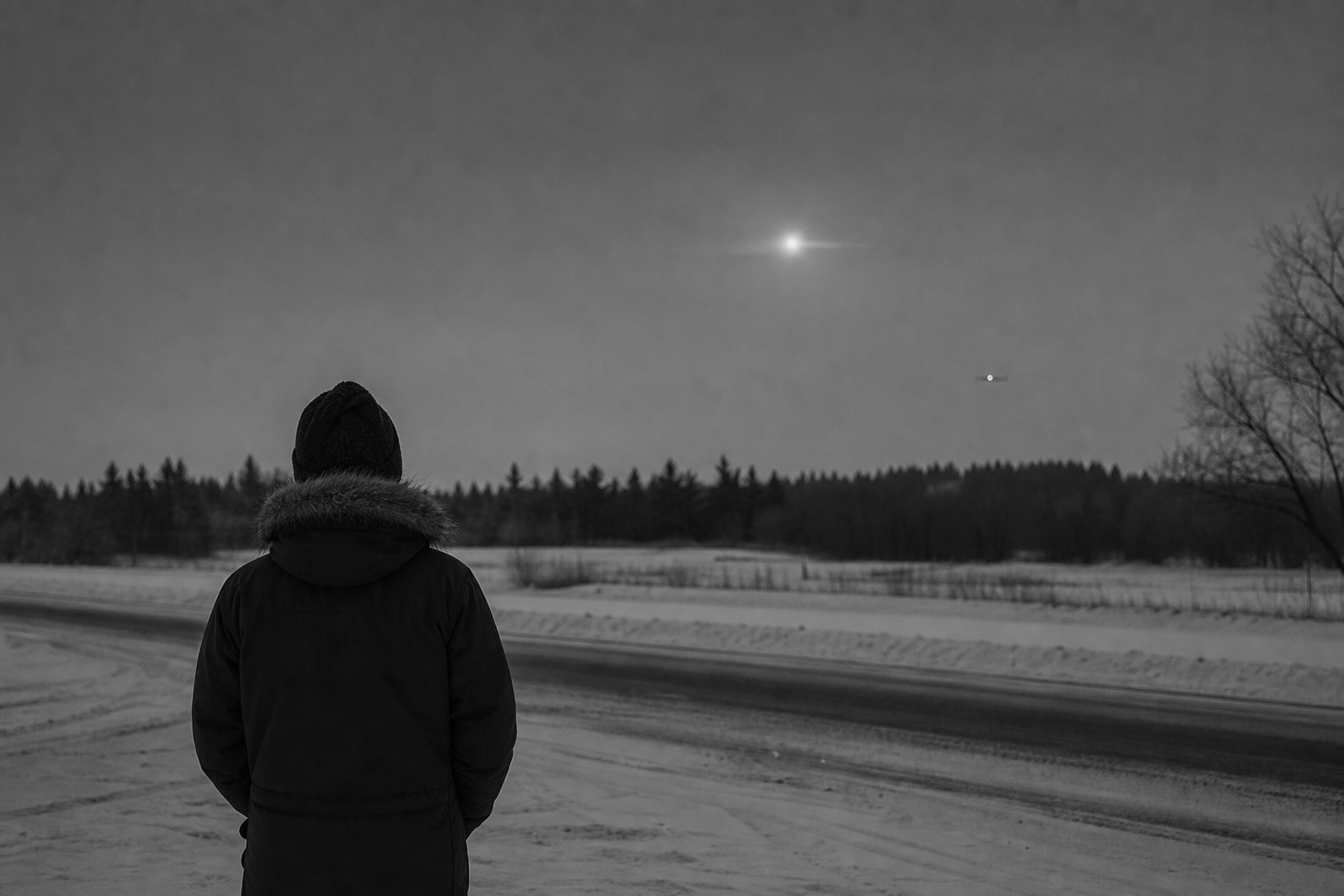
Aircraft are similarly possible in principle but cannot be matched to this report. An aircraft approaching nearly head-on can seem nearly motionless because its bearing changes slowly; its navigation lights may also make one distant target look structured rather than point-like. That explanation becomes stronger if an account includes a direction of travel, flashing or coloured lights, engine sound, later motion, and an approximate time that can be compared with aircraft and aviation records. None of those comparison points is available here, and an apparent two-hour stationary display would require more detail before an aircraft could be preferred.
Weather and viewing conditions matter because clouds, ice crystals, haze, and low-angle lights can change apparent brightness, contrast, and shape. Historical observations for the relevant Prince Albert viewing interval would be needed to assess whether clear skies, cloud layers, wind, or optical effects were present; the surviving narrative supplies neither an observation time nor local conditions. A weather balloon might remain visible for an extended period, but wind normally determines its drift, while a reflection generally depends on a nearby window or vehicle surface and shifts as the observer moves. Neither possibility can be tested from the retained wording.
The practical result is asymmetric: several ordinary categories can accommodate one element of the January 28 2000 UFO sighting Canada narrative, especially an apparently fixed light, but none can be responsibly fitted to the whole package of diamond shape, hovering, location, and roughly two-hour duration. The missing observational particulars prevent both a conventional identification and a claim that conventional causes were excluded.
How Strong Is the Corroboration for This Sighting?
Corroboration depends on independence, not on how many times the same account is reproduced. Two people who separately report a bright, diamond-like object from different parts of Prince Albert, while agreeing on the time window, direction, apparent position, and later movement, provide a meaningful cross-check. A database entry copied into several UFO-sightings Canada lists does not: it may represent only one original, untraceable narrative.
No located material establishes multiple independent witnesses to the January 28, 2000 event. Nor is there a contemporaneous account from separate nearby locations, a dated photograph or video with a known original file and custody history, or an accessible police, aviation, or radar record tied to the claimed observation. Those absences do not determine what any observer saw; they limit what can be independently tested decades later.
Time and direction are especially important corroboration points. If independent witnesses place an object in the same sector of sky at overlapping times, investigators can compare that information with astronomical positions, flight paths, weather, and ground-based light sources. The retained Prince Albert narrative supplies the location, date, diamond description, hovering claim, and roughly two-hour duration, but not those shared observational anchors.
The report therefore has narrative continuity rather than demonstrated corroboration. It remains a lead within Saskatchewan UFO sightings: a reported observation whose memorable details have been preserved, but whose witness count, independence, and supporting records cannot presently be established. That is a judgment about evidentiary strength, not witness sincerity.
Was the Prince Albert Object Ever Identified?
An identification requires a proposed cause that can be tied to the observation by particulars such as time, direction, position, appearance, movement, and independent records. No authoritative identification, by an aviation body, scientific institution, police investigation, or documented contemporary inquiry, has been located for the reported Prince Albert event.
That does not place the case in the stronger category of an unresolved but adequately documented unidentified aerial phenomenon. Such a classification would rest on a preserved original report, identifiable witness testimony, a usable time-and-location record, and enough observational detail to test plausible explanations even if none prevailed. Here, the known account does not retain those foundations.
The more accurate status is an insufficiently documented report with no reliable determination available. The January 28, 2000 date, Prince Albert location, diamond-shaped appearance, apparent hovering, and roughly two-hour duration survive through later retelling, rather than through a located contemporaneous record. They establish what the narrative claims, not what an investigator can independently reconstruct.
Ordinary possibilities have not been ruled in or out: a fixed celestial light, an aircraft, an atmospheric effect, or a ground-based light could be assessed only if the missing viewing details emerged. Conversely, no surviving material supports an extraordinary explanation. In short, the Prince Albert account remains unidentified only in the limited sense that its reported object was never reliably determined, not because the evidence demonstrates an anomalous object.
What This Report Can, and Cannot, Tell Us
The lasting value of this case is methodological rather than evidentiary. The available later retelling preserves a specific claim: on January 28, 2000, a diamond-shaped object reportedly hovered over Prince Albert for about two hours. It does not preserve the contemporaneous report, identifiable and independent witness accounts, or time-specific observational data needed to establish that claim as a reconstructed event.
For historical UAP reports, the strongest signal is convergence: independently made accounts that agree on a narrow time window, viewing direction, position, movement, and appearance, supported where possible by records created at the time. A weak signal is a memorable description repeated across databases without a traceable original. That distinction changes the conclusion: repetition can preserve a story, but it cannot supply missing corroboration.
The appropriate finding here is therefore limited and clear: this is an unverified Prince Albert sighting report, not evidence of alien activity, non-human intelligence, or a government UFO cover-up. Neither the absence of an identification nor the absence of records demonstrates any of those propositions. Broader claims about UFO or UAP disclosure require their own documentary evidence, independent of this account.
Frequently Asked Questions
-
What was reported over Prince Albert, Saskatchewan, on January 28, 2000?
A later UFO sighting narrative reported a diamond-shaped unidentified object over Prince Albert, Saskatchewan. It was said to appear to hover, but no original witness statement or contemporaneous official record has been located.
-
How long did the diamond-shaped UFO reportedly hover over Prince Albert?
The object was reportedly visible for about two hours. No exact start time, end time, time-stamped call, photograph, or dispatch record confirms that duration.
-
Are there contemporaneous records of the Prince Albert UFO sighting?
No contemporaneous newspaper report, police or RCMP occurrence record, emergency-call entry, aviation report, or original witness interview has been located. The date, location, diamond shape, hovering claim, and two-hour duration survive through later database entries and retellings.
-
Was the Prince Albert diamond-shaped UFO ever identified?
No authoritative identification has been found from aviation authorities, police, scientific institutions, or a documented contemporary investigation. The case remains insufficiently documented rather than a well-supported unresolved aerial phenomenon.
-
What should you look for to determine whether a UFO sighting is credible?
Look for independent witness accounts that agree on the time, direction, position, movement, and appearance of the object. Time-stamped photos or video, police or aviation records, weather data, and a traceable original report provide stronger evidence than repeated database listings.