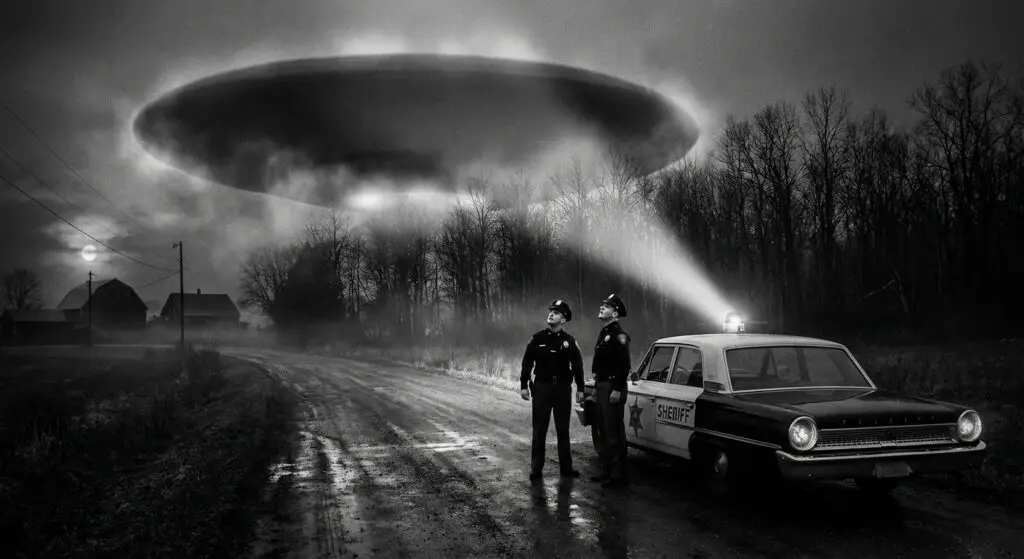
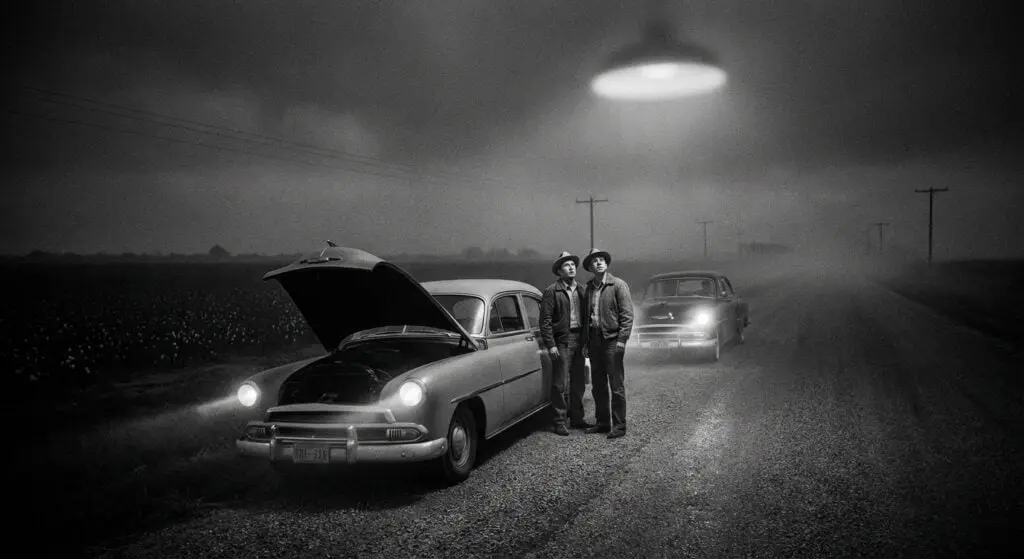
Fifteen separate reports in roughly two hours is not a “single sighting” story. It is a burst of calls clustered along the highways outside Levelland, Texas, on the night of November 2 to 3, 1957, as recorded in contemporary press coverage and captured in Air Force/Project Blue Book files now archived online (Project Blue Book case file “1957-11-6781581-Levelland-Texas”; Levelland Daily Sun News, Nov. 1957; NICAP re-evaluation (secondary)).
The recurring detail that made drivers stop talking and start dialing was mechanical: cars that had been running normally lost power, lights went out, and engines stalled in the same narrow window of time and geography, a pattern reported in contemporary newspapers and summarized in later compendia (Levelland Daily Sun News, Nov. 1957; LevellandNews.net retrospective; NICAP re-evaluation (secondary)).
Those calls did not land in a vacuum. By 1957, the U.S. Air Force maintained an investigative program for reported unidentified flying objects that logged cases, recorded summaries, and sought dispositions; guidance and typical case forms for that program and its procedures are preserved in official archives (NARA: Air Force UFO records and Project Blue Book; Project Blue Book case documentation and procedures (sample)).
Levelland still will not settle because its core pattern is simple and stubborn: a tight reporting cluster on the night of November 2, 1957, storm conditions in the area, and multiple motorists insisting their vehicles failed in the same moment they encountered a luminous presence on the road. The best available approach is to keep primary records and contemporaneous press separate from later retellings and to focus analysis on verifiable elements in the preserved documents (AF/Blue Book archive item; NICAP re-evaluation (secondary)).
Timeline, Roads, and Witness Clusters
Levelland reads like an unfolding incident because multiple reports cluster along specific approaches to town within a tight window. Sources differ on minute-level timestamps, and surviving documentation mixes contemporaneous press, law-enforcement reporting, and later summaries. The following timeline entries are drawn from the best-available contemporaneous and archival sources; where primary-case-level names or precise minutes are not preserved in the surviving public scans, that limitation is stated explicitly.
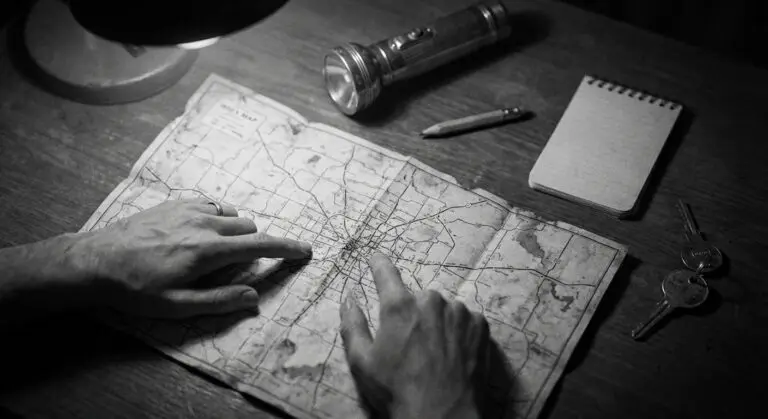
- Nov. 2, 1957, about 11:00 P.M. — Route 116, approximately 4 miles east of Levelland — witness: Jim Wheeler (named in contemporary reporting and summaries) — reported seeing a very large, egg-shaped, brightly lit object; this account is cited in press and case summaries (summary citing Lubbock Avalanche-Journal, Nov. 4, 1957; local retrospective).
- Nov. 2, 1957, late evening (commonly summarized as roughly 8:30–10:30 P.M. or “around 11:00 P.M.”) — multiple approaches into Levelland, including Farm-to-Market roads such as FM 300 and other rural connectors — witness names: many contemporary summaries list motorists but individual names are variably reported in the public scans and some are absent from surviving primary-image scans (see note below) — reported vehicle effects: headlights and radios going out, engines stalling, then restarting after the object moved away (AF/Blue Book archive item; Levelland Daily Sun News, Nov. 1957; NICAP re-evaluation (secondary)).
- Nov. 2–3, 1957, late evening — town reports and multiple road segments — witness: Levelland Police Chief Don Licht is reported in later interviews and secondary sources as observing phenomena during the episode, though not every primary-case scan names him in the public images — reported effects included sighting one or more objects and multiple motorists reporting stalled cars (NICAP re-evaluation (secondary); contemporary press excerpts/compilation).
Note on witness names and primary-source limits: the public scan of an Air Force/Project Blue Book entry for Levelland is archived at archive.org, and contemporaneous newspapers (for example the Levelland Daily Sun News and The Odessa American, Nov. 1957) name several motorists, but many later summaries and compiled chronologies (NICAP, CUFOS) aggregate multiple calls without always reproducing a full roster of individual motorists that can be verified directly from the surviving scanned pages. Where a specific witness name is cited above, it is tied to the sources named in the same list.
Levelland sits on a simple but consequential road geometry: a small town anchored by major highways and surrounded by Texas rural connectors where nighttime traffic concentrates on a few usable routes rather than dispersing across an urban grid. Those connectors include Farm-to-Market roads, and one relevant example is Farm to Market Road 300 (FM 300), a route inventoryed by TxDOT (FARM TO MARKET ROAD NO. 300 — TxDOT inventory), which illustrates the kind of corridor where multiple motorists can encounter a similar event within a short span of time.
Responding or involved agencies are commonly listed in contemporary and later summaries as Levelland Police, the Hockley County Sheriff’s Office, the Texas Department of Public Safety, the Lubbock Police Department, and the Lubbock County Sheriff’s Office (AF/Blue Book archive item; NICAP re-evaluation (secondary)).
Documentation context for 1957 records: small-town and county law-enforcement agencies in the 1950s commonly maintained radio/dispatch logs, blotters, and incident reports; state agencies such as the Texas Department of Public Safety preserved photographic negatives and other records that can survive in state archives (TSLA finding aids and historical records; TSLA: DPS photographic holdings). Project Blue Book case files typically included a case report, investigator notes, and a disposition summary; sample documentation and guidance for how cases were recorded are illustrated in archived Blue Book forms and procedure notes (sample Blue Book case documentation and procedures). Specific Levelland-related documents that survive in public archives include the AF/Blue Book item archived at archive.org and the series of contemporary newspaper clippings and later compiled chronologies preserved by NICAP and CUFOS (NICAP re-evaluation (secondary); CUFOS compiled documents (secondary); NARA guidance on UAP/Blue Book holdings).
What Witnesses Said Happened
Witness value here is in repeating motifs across separate drivers. Storm-night perception, incomplete records, and secondhand retellings can sharpen the core pattern while blurring details that would let you test it. The summary below clearly distinguishes primary reporting from later compilations.
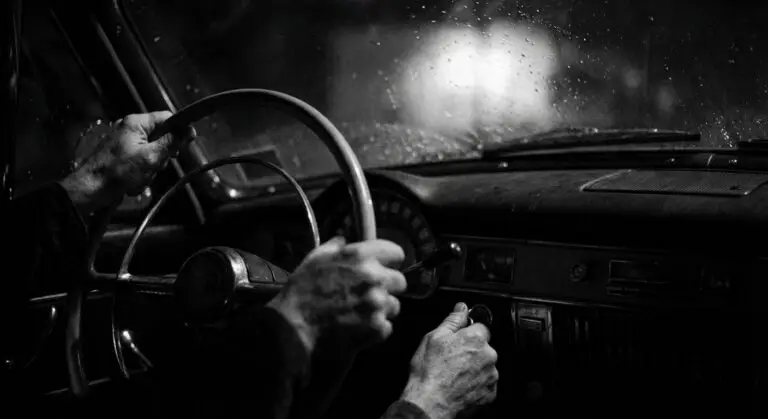
Primary contemporaneous press and the archived AF item consistently emphasize an intensely bright light near the roadway; finer points such as exact shape, altitude, and color vary across accounts and are more fully cataloged in secondary compilations than in the public scans of the primary file (Levelland Daily Sun News, Nov. 1957; AF/Blue Book archive item; NICAP re-evaluation (secondary)).
Non-visual categories such as sound, heat, and smell are discussed in some secondary summaries, but the surviving public primary scans do not consistently record these details in a way that lets us definitively score their presence for each witness. Where contemporary newspapers reported a motorist’s claim of an engine dying or lights going out, those press accounts provide the basis for vehicle-effect summaries in both Blue Book and later compendia (Levelland Daily Sun News, Nov. 1957; LevellandNews.net retrospective).
Mechanical context: 1950s-era cars used ignition and electrical systems that could fail in a range of ways that might be described by motorists as “everything died.” That technical point is background engineering context, not an explanation for a specific report absent vehicle inspection records or contemporaneous diagnostic logs.
Summary of limits: primary Blue Book scans, contemporaneous press clippings, and later compiled chronologies together establish the repeating pattern of bright light plus reported vehicle electrical disruption and recovery. But many narrative details—precise distances, exact times to the minute, and comprehensive lists of named witnesses tied to specific vehicle effects—remain variably preserved across those sources.
Investigations and Official Explanations
Levelland became more than localized rumor because law enforcement logged multiple calls and the incident reached the attention of regional authorities and the Air Force. Contemporary reporting and archived summaries document a multi-agency response, which put the event into official workflows of calls, notes, and follow-ups (AF/Blue Book archive item; NICAP re-evaluation (secondary)).
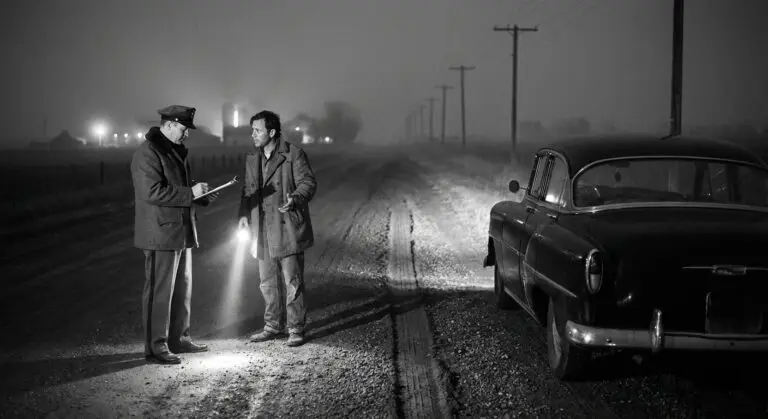
How Project Blue Book recorded and dispositioned cases is documented in surviving procedure notes and sample forms: cases were logged, investigators collected statements and any supporting material, and a disposition (for example, “identified” or “insufficient information”) was recorded per program guidance (Project Blue Book case documentation and procedures; NARA: Project Blue Book overview and holdings). Citing these procedural references clarifies that an official disposition is a record of investigative judgment made according to program methods, not an incontrovertible factual verdict that removes the need for further review.
Weather and electrical phenomena were among the explanations offered in Blue Book-era summaries and by some later commentators. The presence of storms on the night of Nov. 2, 1957 appears in contemporaneous reporting and is one factor investigators noted in assessments (Levelland Daily Sun News, Nov. 1957; AF/Blue Book archive item). Where institutional summaries favored weather- or electricity-related explanations, those dispositions reflect analysts applying standard causal categories available at the time; they should be read as interpretable conclusions subject to the archival evidence that supports them.
In short, official dispositions in Project Blue Book should be read against the documented procedures and surviving case material: they are useful records of how investigators interpreted the evidence under program rules, and they provide a starting point for re-evaluation when new or previously unreleased primary data become available.
Levelland in the Disclosure Era
Levelland matters today because it is often used as a test case for expectations about record quality. Modern demands for “instrumentable” evidence—time-stamped telemetry, synchronized calls, vehicle maintenance logs—do not map neatly onto 1957-era recordkeeping. Nevertheless, archived Blue Book files and newspaper clippings are the archival trail researchers follow when reassessing older incidents (NARA: Air Force UFO records; AF/Blue Book archive item; NICAP re-evaluation (secondary)).
Recent legislative attention to UAP records has prompted archival guidance and proposed statutory actions to centralize and accelerate review of UAP-related records. A circulated amendment text proposing an “Unidentified Anomalous Phenomena Records Collection” at the National Archives is publicly available (uap_amendment.pdf), and NARA has published guidance on UAP records handling (NARA UAP guidance).
Use Levelland as a discipline check: original records trump later summaries, provenance matters, and any re-evaluation should make explicit which materials are primary and which are secondary compilations.
What We Know and What We Don’t
The strongest ground is structural: contemporaneous newspapers, the archived AF/Blue Book case item, and later compendia together document a narrow reporting window, clustered locations, and repeated claims of vehicle electrical disruption followed by recovery. Sources documenting those elements include the AF/Blue Book archive item (archive.org), contemporaneous press (for example Levelland Daily Sun News, Nov. 1957 and The Odessa American, early Nov. 1957), and secondary re-evaluations (NICAP; CUFOS).
What blocks closure is documentation density and mechanism specificity: missing or incomplete contemporaneous logs for some responding units, limited vehicle diagnostic records, and later narrative overlays. Good archival practice for legacy cases requires releasable originals, clear provenance, and a methodology that distinguishes contemporaneous notes from retrospective summaries.
Counts and categorical summaries shift when archives are re-examined: for example, later re-reviews and compilations change how many Blue Book cases were classed as “unexplained” or “identified.” For one widely cited secondary source on historical case classification, see J. Allen Hynek’s The Hynek UFO Report, which discusses Blue Book assessments and program context (The Hynek UFO Report — CUFOS PDF).
Frequently Asked Questions
What happened in the 1957 Levelland UFO sightings?
The article describes about 15 separate reports in roughly two hours on November 2-3, 1957 near Levelland, Texas. Multiple motorists reported seeing a bright, low light near the roadway followed by their cars losing power, lights going out, engines stalling, and then normal operation returning after the light moved away.
How many Levelland UFO reports were made and over what time period?
The article states there were fifteen separate reports clustered into roughly two hours. The commonly summarized reporting window is around 8:30 to 10:30 p.m., with minor timestamp variation across different logs and later summaries.
Did the Levelland 1957 incident involve cars stalling and electrical failures?
Yes-secondary summaries repeatedly describe a pattern of engine cut-outs, headlights going dark, and radios dying. The article emphasizes the sequence as “failure, a short interval, then restoration,” often perceived to occur after the light/object moved away.
What were the weather conditions during the Levelland UFO reports?
Contemporary accounts in the article describe “freak weather,” including rain, thunderstorms, and lightning. The storm context is presented as a key factor because it can create glare, reflections off low clouds, and intense flashes that complicate perception.
Which roads and locations were tied to the Levelland sightings, and what is the spec for FM 300?
The reports are described as clustering along highways and rural connector routes (including Farm-to-Market roads) on approaches outside Levelland rather than a single point in town. The article gives FM 300 as an example corridor and specifies it runs 14.6 miles (23.5 km) through Hockley and Cochran counties.
What agencies responded to or were involved in the Levelland 1957 calls?
The article lists Levelland Police, the Hockley County Sheriff’s Office, the Texas Department of Public Safety, the Lubbock Police Department, and the Lubbock County Sheriff’s Office. It frames the response as multi-agency because the reports came from multiple road segments across overlapping jurisdictions.
What should you look for when evaluating Levelland-style UAP disclosure claims today?
The article says to prioritize original records over later summaries, with traceable provenance and timestamps that can be audited. It also emphasizes focusing on repeatable core elements-like the tight two-hour cluster and the vehicle-failure-then-recovery motif-while separating contemporaneous statements from later retellings.