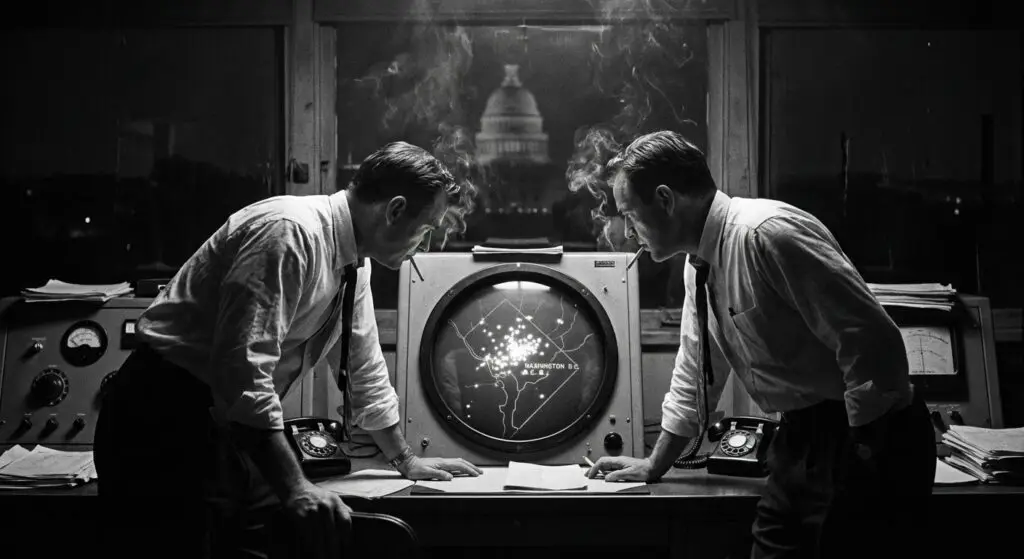
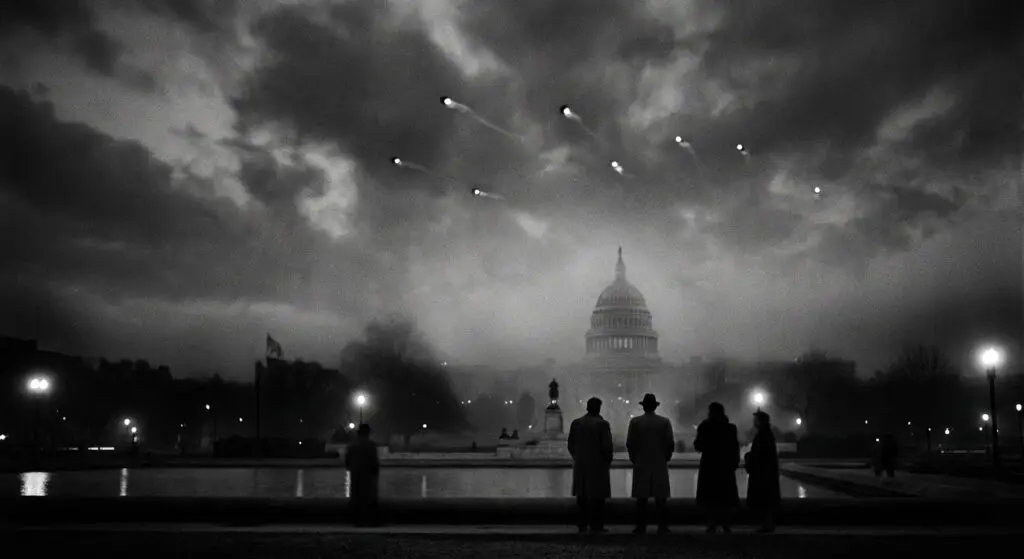
You can’t scroll far in 2025 without running into UAP clips, “UFO disclosure” countdowns, and confident claims that the government already knows what’s in the sky. If you want one historically grounded case that calibrates what “unknown” actually means, the 1952 Washington, D.C. incident is the benchmark: radar returns over the nation’s capital, jets scrambled, and public pressure strong enough that officials had to answer on the record.
The stakes were cinematic, but the evidence is stubbornly adult. The same raw inputs that trigger an operational response can still fail to identify a cause. A blip can demand action because it is in controlled airspace, near sensitive sites, or behaving unexpectedly. That urgency is real. The identity question is separate, and it is where stories inflate, timelines blur, and later retellings quietly replace what was actually documented at the time.
This piece locks to the two documented incident windows: July 19-20, 1952 and July 26-27, 1952, commonly referred to as the “Washington Flap.” The reports center on Washington National Airport and are often labeled the “Washington National Airport Sightings.” The scope stays inside those two weekends, with a hard line between contemporaneous records and everything that got layered on afterward.
You also get verifiable source paths, not vibes. Primary material can be cross-checked through the Project Blue Book report and case files (see the Project Blue Book report collection BBA-PBSR10-300 (Project Blue Book) and the National Archives research guide on Air Force UFO records at National Archives – Air Force UFO Records). For modern context on aggregate reporting and review, see the All-domain Anomaly Resolution Office historical record report (AARO Historical Record Report, Volume 1 (2024)).
You’ll leave with disciplined standards you can apply to the next surge of UFO news and “alien disclosure” claims, and you’ll know exactly what the evidence can prove, what it cannot, and why this incident keeps resurfacing anyway.
Cold War Skies and Radar Anxiety
The July 1952 reports landed in the worst possible place and time: a capital-region air-defense posture built for surprise attack, paired with sensors that could warn without explaining. Washington’s military and political value made any unexplained track near the city a command decision, not a curiosity, and the Cold War’s escalation logic pushed operators to treat uncertainty as risk.
By 1950, President Truman had directed continued thermonuclear research and development efforts, reinforcing a strategic environment where air defense assumed high stakes and short timelines (see primary material on Truman-era nuclear policy in presidential papers and official records at the Truman Library and the Department of State historical series at Truman Library and FRUS 1950, document D85).
In that climate, controllers filed what the era called a UFO, an Unidentified Flying Object, because the report category captured the operational problem: something appeared to be flying, and its identity was unknown at the moment it mattered.
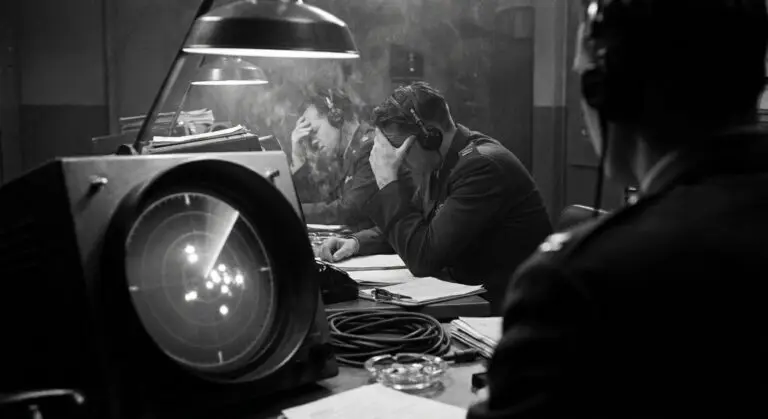
1952-era scopes could put a target on the screen without the target “agreeing” to be seen, because primary radar detects reflected energy rather than relying on a cooperative transponder. Mid-20th-century radar systems could detect low-altitude targets, but exact minimum detectable altitude varied by radar model, installation, and site environment; detection floors depend on antenna height, beam geometry, and local clutter conditions rather than a single universal figure (see technical summaries of airport and surveillance radar performance in historical radar evaluations and technical reports at NASA technical report and PB2001107556). The friction point was classification, not detection: separating true airborne targets from ground clutter, the smear of unwanted echoes from terrain, buildings, and other near-surface reflectors, was a significant technical challenge. Controllers worked a stream of radar returns, each “return” implying only that energy came back to the antenna, not that the operator had a verified aircraft with altitude, intent, or identity. That ambiguity was structurally baked in, especially near an urban landscape where reflections and interference could crowd the picture.
Those limits set the stage for the first push of attention: early reports place the first weekend’s initial radar concern around 11:40 p.m. on July 19, 1952, when multiple returns prompted scrutiny.
In the Project Blue Book era, “UFO” anchored the discussion to an object in flight, which naturally encouraged the public to expect a single, identifiable craft behind each report. Modern official usage often prefers UAP, Unidentified Aerial Phenomenon, a broader frame that includes events and effects that might not resolve cleanly to a discrete object. That label shift matters to today’s “UAP disclosure” narratives: a radar-driven case can credibly support that operators saw unknown returns and responded under pressure, while still failing to support claims about what the returns were.
The timeline that follows stays inside that boundary: what was observed, how it was interpreted, and what actions it triggered.
First Weekend of Tracks and Scrambles
The first weekend produced enough anomalous tracking to trigger operational responses, and the record’s opening anchor is specific: the initial radar detections are reported to begin at about 11:40 p.m. on July 19, 1952.
Those first reports are tied to Washington National Airport personnel, who are repeatedly identified as the earliest named operators in the chain, because the anomaly begins as an air-traffic-control radar problem, not as a public sighting story.
One contemporaneous account describes seven blips appearing on a radar screen at about 11:40 p.m. on July 19; that “seven” count is a single-account detail and should not be treated as a number every log or later summary independently confirms.
Evidence Check: The “about 11:40 p.m.” start time and the “seven blips” count belong to the contemporaneous reporting stream, with the count explicitly traceable as a single-account detail. When later summaries repeat a number without showing the original context, treat the repetition as a retelling, not new documentation.
The stable point in this opening phase is the evidence type: radar-only. At 11:40 p.m. on July 19, the surviving phrasing is about returns on a Washington National scope, not a synchronized set of ground witnesses and pilots giving the same description at the same time.
The friction is operational and immediate: a radar return is trackable in real time, but it does not automatically produce a visual correlate. The practical rule that keeps the timeline honest is simple: keep “Washington National radar returns at about 11:40 p.m.” separate from anything later described as lights, shapes, hovering, or acceleration.
The clearest contemporaneous escalation detail is not a dramatic maneuver claim but a coordination fact: accounts state Washington National tracked the blips on July 19 and that the returns were corroborated by Andrews and Bolling Air Force facilities.
That corroboration line tells you what Washington National personnel were doing as the central node on the July 19 to July 20 overnight: maintaining tracks and pushing the problem outward for confirmation, because corroboration by Andrews and Bolling only exists after somebody loops those sites into the same operating picture.
The non-obvious tradeoff is that “multiple radars saw returns” is both stronger and narrower than it sounds. Stronger, because it is not a single-scope oddity at one facility; narrower, because it still does not identify what produced the returns at Washington National, Andrews, and Bolling.
Evidence Check: “Corroborated by Andrews and Bolling” is the contemporaneous coordination claim supported here. Any added specifics, such as exact radio phrasing, exact track coordinates over named landmarks, or detailed timing beyond “July 19” and “about 11:40 p.m.”, only belongs in the narrative if it is tied to a primary log or official summary.
The actionable takeaway for reconstructing July 19 to 20 is to treat Washington National’s role as procedural, not mythic: track on the scope, report it, and seek confirmation. That keeps the weekend’s first hours grounded in what the documented facilities actually did, instead of what later summaries compress into a single cinematic sequence.
The contemporaneous coordination claim is specific in its named facilities: Washington National Airport, Andrews, and Bolling all appear in the same corroboration description for the July 19 incident, which is a checkable facility-level fact even when finer-grain timestamps are not preserved in the summaries.
What complicates reconstruction is that later retellings often graft performance language onto that corroboration frame: sudden speed shifts, hovering-like returns, and vanishing and reappearing. Without a primary record attached, those behaviors have to be labeled by evidence type before they are treated as event facts: radar-only language for target “returns” changing, visual observation language for what someone says they saw, and later retelling language for stitched narratives that combine both.
Use the facilities as your sorting key. If a claim is framed as “returns on a radar scope,” treat it as radar-only; if it is framed as “lights over Washington,” treat it as visual-only; if it is framed as “what happened” without naming whether Washington National, Andrews, or Bolling logged it, treat it as later synthesis until proven otherwise.
Evidence Check: The named-facility corroboration (Washington National, Andrews, Bolling) is contemporaneous in this evidence set. “Speed,” “hover,” and “vanish” claims are common in later summaries, but they only become usable here when tied to a specific evidence type and a specific record.
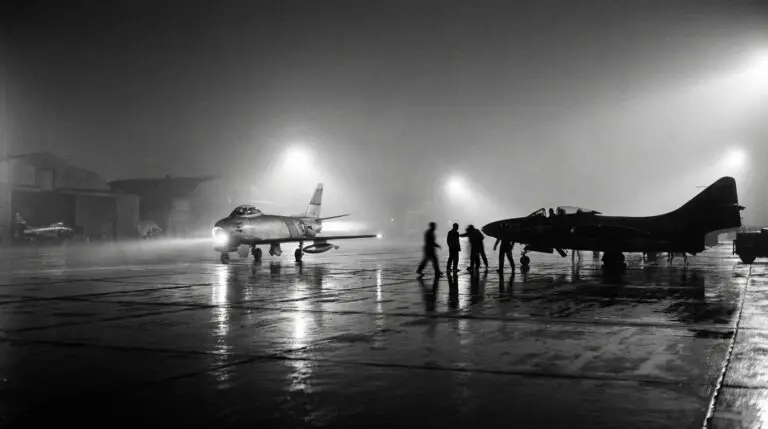
Discussions of an interceptor response during the July 19 to July 20 weekend often center on the Lockheed F-94 Starfire, and the stable, attributable aircraft detail is straightforward: the F-94 is a first-generation, jet-powered all-weather day/night interceptor built by Lockheed.
Reference summaries also describe the F-94 as the first American all-weather jet interceptor, which explains why it appears in the same conversations as a night radar-driven event, even when an individual retelling does not supply a matching sortie log.
The catch is that “an interceptor type exists” is not the same claim as “a specific interceptor launched at a specific time from a specific unit and engaged a specific target.” For July 19 to 20, keep those layers distinct: aircraft description is a stable platform fact; claims about scrambles, pursuit, and engagement belong to whatever primary or official summary they cite, not to the platform spec itself.
Evidence Check: The F-94 platform description is attributable and stable. Any cockpit-level anecdotes, weapons-lock stories, or step-by-step pursuit timelines are later narrative unless they are anchored to a primary log or an official contemporaneous summary.
A disciplined read of July 19 to 20 starts with three checkable facts supported here: the anomalies begin around 11:40 p.m. on July 19; Washington National Airport personnel are the early named operators in the reporting chain; and contemporaneous accounts describe corroboration by Andrews and Bolling Air Force facilities.
The method that prevents meaning from outrunning documentation is repeatable: for every claim you encounter, label it by evidence type first (radar-only, visual observation, or later retelling), then decide whether it belongs in the timeline at all. The first weekend matters because it produced enough anomalous tracking to force real coordination, but the only way to interpret it responsibly is to sort the claims before you explain them.
Second Weekend of Tracks and Reports (July 26-27, 1952)
Contemporaneous records and press reports record a renewed and widely noticed set of detections on the weekend of July 26-27, 1952. The documented sequence for that weekend includes initial tower and pilot reports, multiple radar returns, and military attention. For a general summary of the two-weekend sequence and later reporting, see the consolidated case overviews at Wikipedia – 1952 Washington, D.C. UFO incident and a readable media summary at History.com – Washington, D.C. UFO reports.
Contemporaneous records and immediate reports: Washington National tower personnel and air traffic controllers reported radar returns and visual reports during the late-night hours of July 26 and into July 27. Some controllers reported unexplained blips that appeared and disappeared and that, according to contemporaneous press and tower logs summarized in secondary sources, included returns that plotted over sensitive locations in the capital area. Pilots departing or arriving that night also reported seeing lights; one ground crew or pilot account commonly cited in summaries describes a bright light skimming the horizon before disappearing. These contemporaneous controller and pilot mentions are documented in press reporting and post-event Air Force summaries cited in case overviews (Wikipedia, History.com).
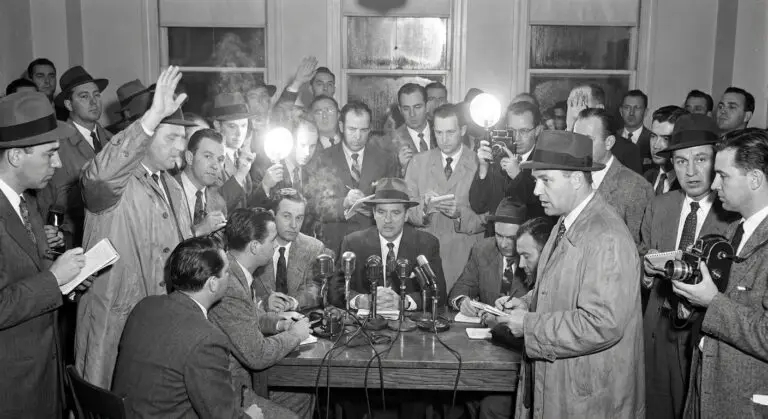
Who reported them and what actions followed: Air traffic controllers at Washington National, a Capital Airlines pilot, and military radar operators at Andrews AFB and other nearby installations were among the initial reporters. The unusual radar returns prompted inquiries between the tower and en route control, calls to airborne aircraft to check visually, and an Air Force scramble of interceptors on at least one of the nights as summarized in official case overviews. Contemporary newspaper coverage also reported that military jets searched over the White House and other locations during the period (Wikipedia, contemporary press coverage compiled in retrospective pieces such as History.com).
What is and is not contemporaneously logged: The contemporaneous, checkable parts are the tower and radar returns, pilot visual reports, and emergency coordination between facilities. What is less consistently preserved in primary logs are fully timestamped, coordinate-rich radar plots tied to named controller transcripts that would allow a precise track reconstruction over the Capitol or White House. Press accounts and later summaries sometimes present clearer track-over-landmark narratives than survive in the declassified case files and public Blue Book summaries. For primary documentary context that researchers use to verify these facility-level claims, see the Project Blue Book file collection and National Archives guidance on Air Force UFO records (Project Blue Book report, National Archives – Air Force UFO Records).
Later retellings: Many dramatic details commonly repeated in books and later articles, such as precise radar tracks plotted directly over the Capitol dome or extended close-range visual-jet engagements, are taken from retrospective accounts, oral histories, and later Project Blue Book retellings rather than from a single contemporaneous, unambiguous radar plot. Where later authors reconstruct position-over-landmark narratives, label those details as post-event reconstructions or later retellings unless they point to a specific primary log or plot. For guidance on later narrative sources versus contemporaneous documentation see archival summaries and retrospectives such as the National Archives Prologue blog and Project Blue Book overviews (NARA Prologue – Saucers over Washington, case overviews at Wikipedia).
Official Explanations and the Inversion Debate
The public line from officials was designed to turn a high-stakes unknown over the capital into a bounded technical problem: radar and weather, not intruders. Operationally, that framing lowered the implied requirement for drastic defensive action; rhetorically, it shifted the burden of proof from “identify the craft” to “explain the tracks.”
In practice, the official hypothesis leaned on a specific meteorological claim: that a temperature inversion, meaning a layer where air temperature increases with altitude instead of decreasing, was present over Washington, D.C. on both nights when unknown radar targets were recorded. Officials and later summaries used that asserted inversion as the key that could reconcile “busy scopes” with the absence of a confirmed hostile platform, but that assertion only stands up if it matches contemporaneous weather observations and the timing of the returns.
The core mechanism officials pointed to is straightforward in plain language: radar does not travel through “the air” in the abstract; it travels through a specific atmosphere along a specific path. Radio-wave propagation behavior depends on meteorological and path conditions, so when those conditions change, the radar energy can bend, spread, or concentrate in ways the operator does not expect under standard assumptions. That makes anomalous propagation a plausible mechanism category: it is the umbrella for propagation that departs from normal line-of-sight behavior because the atmosphere’s refractive properties vary with height and distance.
Under inversion-like conditions, radar energy can be refracted enough to create three operational problems that look like “objects” without requiring an object behaving like a craft. First, ground or water returns can be carried into the radar’s detection geometry and interpreted as discrete targets. Second, real aircraft can appear displaced from their true positions, making tracks look like they jump, split, or accelerate. Third, intermittent ducting can make returns appear and disappear in bursts, producing the exact kind of “cluster” pattern that reads as structured activity when it is actually structured meteorology.
The atmospheric story is plausible as a class of explanation, but it strains at the points where the reported pattern seems repeatable, multi-sourced, and time-bound. Two weekends of intense returns matters, because “anomalous propagation happened” is not a complete explanation unless the record shows the required conditions were present at the relevant altitudes, over the relevant radar paths, during the relevant windows, on both nights.
The strongest objections stay narrow and testable. If multiple radar sites produced correlated tracks with consistent geometry, the “local clutter painted as targets” account weakens unless the same refractive conditions plausibly affected each path in a compatible way. If the returns included stable headings and speeds over meaningful durations, the “intermittent ducting bursts” account has to explain why the artifacts formed coherent trajectories instead of noise. And if officials asserted an inversion over Washington on both nights, the obvious question is documentary: do the surface observations, upper-air soundings, and station logs actually show it, at the strength and structure needed to distort those specific radars?
A “government UFO cover-up” claim requires more than an unsatisfying explanation; it requires evidence of suppression, fabrication, or internal contradiction strong enough to outweigh the mundane incentives of crisis messaging. In this case, the documented posture is consistent with reputational and security management: contain public alarm, protect confidence in air defenses, and offer a technical narrative that does not imply penetrated airspace over the seat of government.
That is not proof the official account is complete. It is proof of intent to manage perception. The record supports that officials used atmospheric and radar explanations to defuse the implication of intruders; it does not, by itself, establish a coordinated deception about a non-human presence.
For context, Project Blue Book, the U.S. Air Force program established in 1952 that became the longest-running U.S. government inquiry into UFO sightings, institutionalized both investigation and public messaging after high-profile waves. Its official conclusions included that no UFO it investigated indicated a national-security threat. That conclusion frames how officials preferred to classify ambiguous cases: as misidentifications, insufficient data, or non-threatening unknowns rather than adversary platforms or extraordinary technology. For primary Project Blue Book materials and case files, consult the digitized report collection linked above and National Archives research guidance (Project Blue Book report, National Archives – Air Force UFO Records).
The practical standard is simple: the official explanation strengthens dramatically if it is supported by contemporaneous weather data (surface and upper-air), primary radar logs and plots, and cross-site correlation showing how propagation artifacts would align across different geometries. In modern UAP news, look for that same class of documentation; without it, you are evaluating a narrative, not a settled technical account.
Why 1952 Matters in Today’s Disclosure Era
1952 matters in today’s disclosure era because it demonstrates how uncertainty survives headlines and official briefings. The Washington, D.C. weekend remains a live reference point not because it “proves” anything about non-human technology, but because it functions as an evidence stress-test: multiple sensors, fast-moving interpretation, public pressure, and an official message that lands before the record is fully settled. That is exactly why it keeps getting invoked as a rhetorical anchor: if something this visible can stay contested, readers naturally ask what else never becomes a clean case file.
What changes in the modern “UFO disclosure” and “UAP disclosure” environment is scale, and scale forces triage. The All-domain Anomaly Resolution Office reported receiving 757 new UAP reports between May 1, 2023 and June 1, 2024 and identified a smaller subset for further analysis; see the AARO historical record report for the 757 and case-resolution figures (AARO Historical Record Report, Volume 1 (2024)). Those numbers do not validate 1952; they explain today’s workflow reality. “Reviewed” becomes a processing category, not a truth stamp, and attention concentrates on the small subset that still resists quick resolution.
What does not change is the gap between claims and records. The discourse is carried by personalities as much as documentation, which is why names like David Grusch, Lue Elizondo, Christopher Mellon, and George Knapp dominate search traffic. Grusch publicly testifies as a whistleblower, states he interviews government personnel, and alleges retaliation. That kind of claim creates heat fast, while primary-source cooling measures stay slow.
Some modern media summaries omit historical precedent such as the 1952 Washington incident even while presenting recent events as unprecedented; that omission is important to note when assessing claims about how novel current disclosures are.
- Separate “reviewed” from “unexplained”; both describe process stages, not conclusions.
- Demand primary documentation (raw sensor logs, contemporaneous transcripts, chain-of-custody) before accepting “non-human intelligence” as anything more than assertion.
- Weight explanations by data quality; a one-line callback to inversion or anomalous propagation never substitutes for the underlying records.
Transparency Laws, Hearings, and What Comes Next
Modern UAP oversight is built to standardize reporting and control ambiguity, not to promise sensational disclosure. “Transparency” in practice means forcing consistent intake (what got reported, by whom, in what format), preserving records so they do not disappear into stovepipes, and creating repeatable review methods that can survive leadership changes and news cycles.
The complication is structural: the government’s most relevant data often sits inside classified systems, and the unclassified story the public sees is downstream of what can be sanitized, sourced, and released without exposing capabilities. Process can improve the signal, but it cannot conjure public evidence on demand.
Congress uses a familiar toolchain: reporting mandates, historical reviews, records collection concepts, and hearings. The research summary is explicit that the law requires AARO to conduct a major historical UAP review to uncover information relating to UAP. Separately, the UAP Disclosure Act of 2023 was described as aiming to accelerate disclosure of U.S. government records associated with UAP reports, chiefly by driving centralized records collection and a structured review pathway.
Hearings, including ongoing House Oversight interest (and the search-driven churn around “UAP congressional hearing 2025,” sometimes tied to named members), are a visibility tool. They pressure agencies to comply with process, but they do not, by themselves, produce declassified files.
Whistleblower channels are oversight mechanisms, not publication pipelines. Under the Whistleblower Protection Act (5 U.S.C. § 2302(b)(8)), certain protected disclosures are covered, but disclosures that include classified information are generally not protected in the same way. Practically, that means a person can brief an inspector general or Congress in secure settings, and the public still gets nothing until an authorized declassification decision occurs.
The antidote to 1952-style ambiguity is disciplined recordkeeping plus disciplined release: standardized data fields, durable archiving, and declassification pathways that yield durable public sets, the way some historical JCS volumes were declassified and distributed unclassified and the FRUS series serves as an official record framework.
What to watch for: published methodologies, formal data standards, and declassified record sets you can audit, not headlines that do not come with documents, especially as “UFO sightings 2025” and “UFO sightings 2026” keep public pressure high.
A Case Study in Uncertainty and Accountability
The 1952 Washington, D.C. incident remains the cleanest reminder that “unknown” describes the state of the record, not the identity of a craft. The documented core does not require speculation: two weekends of reports with radar and air-traffic control at the center of the story, followed by an official response aimed at explaining what operators and the public were hearing about. What never closes, and still drives debate, is the gap between radar “unknowns” and a verified identity that can be independently checked.
Three pressures kept the case from settling. First, Cold War sensing created a terms problem: radar returns, controller calls, and pilot impressions are not the same category of evidence, yet they were forced into a single narrative. Second, the two-weekend recurrence intensified scrutiny because repetition feels like pattern, even when the underlying data quality varies. Third, the official explanation reduced immediate alarm but left friction points unresolved in the public mind, because it addressed interpretation while the record still lacked a durable chain from track to object to identification.
The institutional response shows why standards matter: the CIA-created Robertson Panel met in January 1953 to review Air Force UFO records going back to 1947, and from 1952 to 1969 the U.S. Air Force investigated UFO sightings. The next wave gets clearer when the record is built to audit, not to reassure.
- Separate radar returns, visual reports, and radio transcripts instead of blending them into one claim.
- Demand source logs (raw radar, ATC recordings, weather data) with timestamps and custody notes.
- Track what oversight bodies actually publish: mandated reports, hearing transcripts, inspector general findings, and declassification releases.
Use primary-source repositories first, then treat summaries as pointers back to documents. If a story cannot show its documentation trail, it cannot graduate from “unknown” to “identified,” no matter how confident the headline sounds.
Frequently Asked Questions
What happened during the 1952 Washington, D.C. UFO incident?
The incident involved unknown radar returns near Washington, D.C. during two documented windows: July 19-20, 1952 and July 26-27, 1952, often called the “Washington Flap.” The reports centered on Washington National Airport radar, with corroboration described from Andrews and Bolling Air Force facilities.
When did the first radar detections start in the 1952 Washington, D.C. case?
Contemporaneous reporting places the initial radar concern at about 11:40 p.m. on July 19, 1952. One account describes seven blips appearing at that time, but the article notes that “seven” is a single-account detail and not universally confirmed across records.
Which sites reportedly corroborated the Washington National Airport radar returns in 1952?
The article states that Washington National Airport tracked the returns and that the blips were corroborated by Andrews and Bolling Air Force facilities. This is presented as a facility-level coordination claim rather than a fully timestamped, track-by-track reconstruction.
What’s the difference between “UFO” and “UAP” in the context of the Washington, D.C. 1952 radar case?
In the Project Blue Book era, “UFO” framed the problem as an unidentified flying object, encouraging people to assume a discrete craft behind each report. The modern term “UAP” (Unidentified Aerial Phenomenon) is broader and fits radar-driven events where operators can have unknown returns without identifying what produced them.
What was the official explanation for the 1952 Washington, D.C. radar tracks?
Officials pointed to a temperature inversion and related anomalous radar propagation as the key explanation for the radar targets. The article explains this can create apparent “objects” by bending radar energy, pulling ground or water returns into the display, or making real aircraft appear displaced and intermittent.
What interceptor jet is commonly mentioned for the 1952 Washington, D.C. UFO weekend, and what is it?
The Lockheed F-94 Starfire is frequently referenced in accounts of the July 19-20 weekend. The article describes it as a first-generation, jet-powered all-weather day/night interceptor built by Lockheed, sometimes summarized as the first American all-weather jet interceptor.
What documents should you look for to evaluate UAP/UFO claims like the 1952 Washington, D.C. incident?
The article says the strongest evaluation comes from primary documentation such as raw radar logs/plots, contemporaneous weather data (surface and upper-air), and chain-of-custody records. It specifically advises separating “reviewed” from “unexplained” and demanding auditable record sets rather than relying on headline summaries.