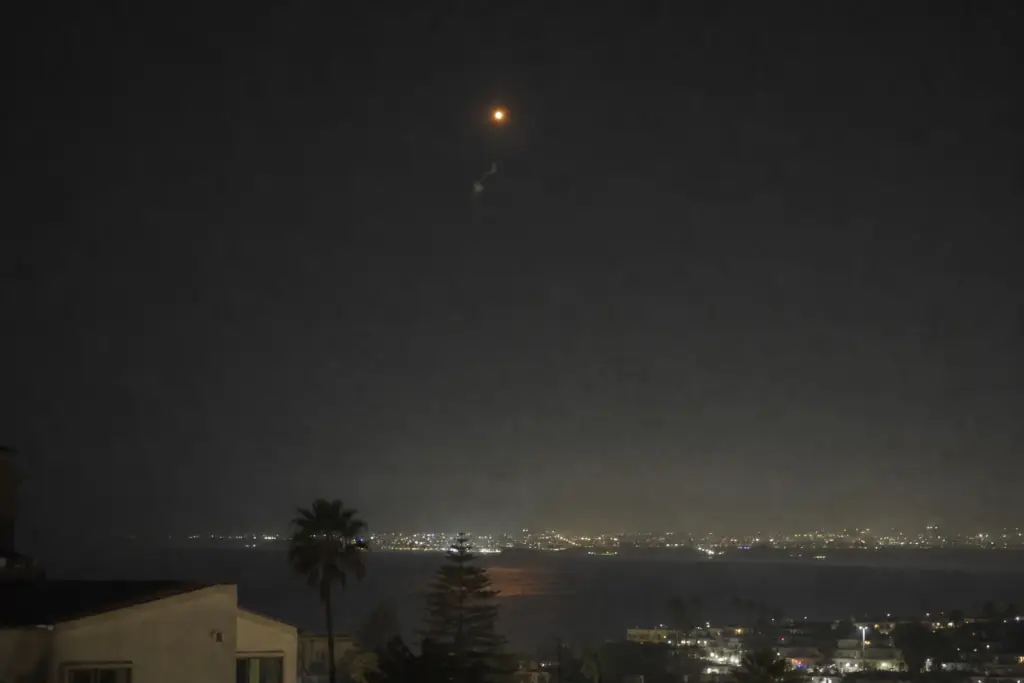
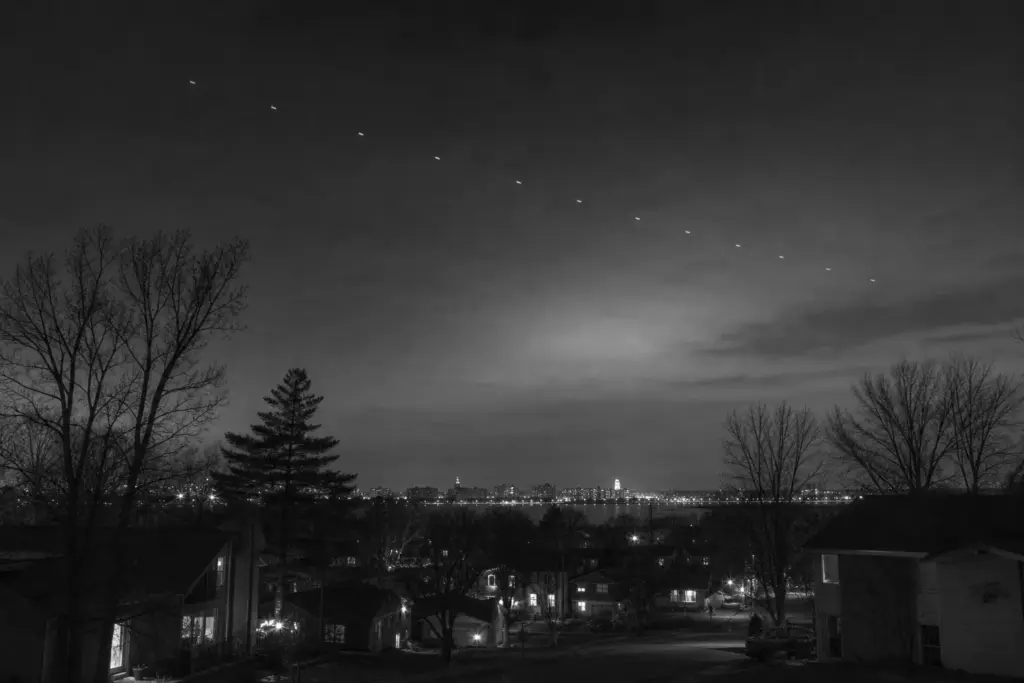
The Madison WI UAP sighting March 6 2020 begins with a narrow claim: someone reported dim lights moving quickly over Madison, Wisconsin. “UAP” is a label for an observation not yet identified; it does not establish what the objects were, how high they flew, or whether they were unusual.
This examination therefore separates the report from an identification. A possible Starlink-satellite explanation is worth testing because newly deployed satellites can sometimes appear as several faint, steady points following a shared path. That differs from a single satellite, which is ordinarily seen as one moving light, and from an aircraft, whose navigation or anti-collision lights may blink, vary in color, or change apparent brightness as it turns.
The decisive details are the observation time, direction of travel, apparent spacing and number of lights, and sky conditions. Those details allow the reported motion to be compared with satellite geometry and historically appropriate March 2020 orbital activity, rather than with modern visibility patterns. They also provide a basis for considering ordinary alternatives, including aircraft activity and astronomical objects. Where the surviving report lacks those checkpoints, the proper outcome is an unresolved gap, not a more dramatic conclusion.
What Was Reportedly Seen Over Madison on March 6, 2020
The surviving account fixes the reported event only to Madison, Wisconsin, and March 6, 2020. It describes dimly lit objects that appeared to move quickly overhead, but that wording records an observer’s impression rather than a measured track, altitude, or velocity. No independently preserved observation is available here to establish what the lights were.
Several details needed for identification remain absent: an exact local time; the number of lights; how long they remained visible; their direction of travel; their position above the horizon; whether their brightness was steady, blinking, or changing; and whether they held a line, spacing, or other formation. It is also unclear whether more than one witness made an independent report. A cluster of separate accounts with matching time and direction would be stronger evidence than repeated retellings of one initial observation.
“Fast-moving” is especially limited without those measurements. It describes apparent angular motion, the rate at which a light seemed to cross the observer’s field of view, not physical speed. A nearby aircraft, a distant satellite, and a light whose brightness changes near the horizon can produce very different impressions of motion. Thus, the reported dim lights moving over Madison WI provide a starting description, but not yet a track that can be matched responsibly to a particular object or group of objects.
Why Time, Direction, and Apparent Motion Matter
A usable comparison begins by turning a memory of lights into a sky position and a clock reading. A time stamp is the local date and time of the observation, recorded with its time zone and converted to Coordinated Universal Time (UTC), the common reference used by many orbital, aviation, and weather archives. An orbital pass is the interval in which a satellite’s predicted path is above the observer’s horizon; it can be tested only against a particular place and time.

Viewing direction should be expressed as azimuth and elevation. Azimuth is the compass bearing along the horizon, north, east, south, west, or a degree value, while elevation is the angle above the horizon, from 0 degrees at the skyline to 90 degrees directly overhead. Together they distinguish, for example, a light moving low in the western sky from one crossing high overhead. “Apparent angular motion” is the rate at which that light seems to sweep across the sky. It is not a measurement of its actual speed: a distant object can look quick when it crosses a large angle in a short time, while a nearer aircraft may appear slower on a more direct approach.
For night-sky identification, location within the Madison area is necessary but insufficient. The minimum observation record is a precise observing point; local time and UTC; starting and ending azimuth and elevation; duration; direction of travel; number and spacing of lights; brightness behavior; and cloud, haze, or precipitation conditions. That record permits separate comparisons with archived satellite passes, aircraft tracks, astronomical positions, and weather observations. Without it, a proposed match remains an inference rather than a demonstrated identification.
Could Starlink Satellites Have Been a Plausible Explanation in March 2020?
The relevant question is not simply whether Starlink existed by early March 2020, but whether a specific group could have crossed Madison’s sky during the unrecorded observing window. Launch chronology narrows the candidates: satellites recently released together begin with similar low-Earth orbital paths, then separate as orbit-raising and station-keeping maneuvers change their spacing. A historical match would therefore require an identified launch group and archived orbital data capable of producing a Madison pass at the reported time.
A newly deployed satellite train is a sequence of individual spacecraft seen from one observing location, rather than one object breaking apart or a formation under common control. If sunlit, its usual visual signature is several small, steady points following broadly the same route with roughly regular gaps. The lights can appear dim because the observer sees reflected sunlight at a great distance, yet still seem to move quickly across the sky because their apparent position changes continuously against the stars.
That pattern also has a built-in change in visibility. Individual members of a train may fade or disappear as they enter Earth’s shadow, while others remain illuminated briefly farther along the track. Uneven brightness does not by itself rule out satellites; nor does it establish them. A persuasive comparison needs the predicted pass time, direction, highest elevation, and expected brightness for Madison, then asks whether those details agree with the observation rather than merely whether multiple moving lights sound familiar.
For the reported lights over Madison, the necessary comparison cannot be completed from launch timing alone. The surviving account does not preserve the exact time, travel direction, number of objects, or spacing needed to associate it with a particular orbital group. Starlink satellites over Madison, Wisconsin, in March 2020 are consequently a plausible hypothesis to test, not a confirmed identification. A launch before March 6 supplies possible candidates; it does not show that any candidate was above the horizon, sunlit, or visible from the observer’s location when the lights were seen.
What Would Support, or Weaken, the Starlink Hypothesis?
The strongest test is agreement across several details, not a resemblance between any moving light and a satellite. A Starlink explanation would gain support if historical satellite tracking placed a relevant group above Madison during the reported interval and its projected travel direction, height in the sky, and duration broadly matched the account.
- Several dim lights moving on one shared track, without abrupt turns or changes in relative order, would be consistent with a train. Roughly even angular gaps between lights would strengthen that comparison; an irregular cluster whose members spread apart, converge, or travel in separate directions would weaken it.
- Steady illumination is a useful discriminator. Lights that remain continuously visible, perhaps with gradual differences in brightness, fit the satellite possibility better than repeated flashes, alternating colors, or distinct blinking patterns characteristic of aircraft lighting.
- Brightness changes need context. A group that gradually fades at the same part of its path, or disappears in sequence while maintaining formation, could be consistent with changing illumination. A sudden, isolated brightening is less diagnostic.
- Travel direction matters as much as apparent speed. A match requires the reported path, from its first sighting to its last, to align with a documented pass window. A formation reported well away from that path, or stationary against the stars, would not support the hypothesis.
A satellite flare is a different visual event: one satellite can briefly brighten when its reflective surfaces favor the observer’s viewing angle. That can account for a conspicuous single light, but it does not by itself explain multiple objects maintaining a line and spacing. Conversely, several lights do not automatically establish a train unless their number, formation, and movement can be compared with a dated prediction.
For this Madison report, those decisive observations were not preserved. No exact time, direction, count, spacing, duration, or description of blinking is available for comparison with historical satellite tracking. The Starlink interpretation therefore remains compatible with the limited description, but the missing geometry prevents it from becoming a demonstrated match; evidence-led testing of reported characteristics against ordinary explanations would weigh reported independent motion, sharp course changes, hovering, or aircraft-style flashes against it.
Other Explanations That Need to Be Checked
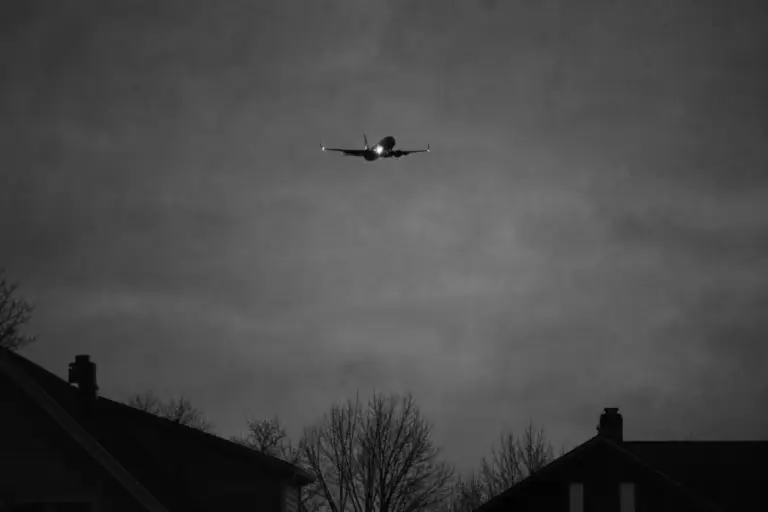
Aircraft deserve separate treatment because their apparent speed and brightness can change sharply with viewing angle. An approaching or departing aircraft may seem to hold nearly still before crossing the sky, while an aircraft traveling across the observer’s line of sight can appear much faster. Repeated flashes, alternating colors, or several lights whose spacing changes as the craft turns would favor aircraft traffic; a set of steady points keeping fixed spacing on one uninterrupted path would conflict with that explanation. A useful reconstruction would compare the reported direction with plausible approach and departure corridors, while recognizing that no flight track can be matched without a time window.
A single satellite, including the ISS, is a different candidate from a group. It would fit one continuously moving light that remains on a smooth course and gradually brightens or fades. It would not account for several lights retaining a line or sequence unless more than one object was actually present. Because the surviving Madison description preserves neither a count nor a time, it cannot distinguish an individual satellite pass from the ISS or from multiple objects.
A meteor is normally a short-lived streak or rapidly vanishing point of light, rather than an object that maintains visible formation or crosses the sky for an extended interval. A report of a single, sudden flash with a brief trail would make that alternative more relevant; multiple dim lights moving together would make it a poor fit.
Atmospheric and observational effects can further complicate perceived motion. Thin cloud, haze, glare, and an obstructed horizon can make a light appear to fade, reappear, or move faster as attention shifts between it and nearby landmarks. No archived weather observation is available in the preserved record here, so local cloud cover and visibility cannot be used to favor or eliminate any of these possibilities.
A Measured Conclusion: Plausible, Unconfirmed, or Still Unidentified
The appropriate finding is unconfirmed. A Starlink-related explanation is plausible only as a conditional identification: it would require a historical pass over Madison to align with a recovered local time, the reported direction and elevation, and a sequence of multiple steady lights with broadly consistent spacing. Those converging details would make the satellite interpretation stronger; a mismatch in time or path, or a report of blinking and changing formation, would weaken it.
That standard has not been met here. The generalized description of dim, apparently fast-moving objects does not preserve the particulars needed to test a particular launch group or to exclude aircraft, a single satellite, or viewing conditions. For the Madison WI UAP sighting March 6 2020, “plausible” does not mean “confirmed.” If the missing information cannot be recovered, the most accurate classification is insufficiently documented, or unidentified in the narrow sense that the observation lacks enough data for a responsible identification.
An unidentified observation is not evidence of alien disclosure, non-human intelligence, or a government cover-up. Responsible UAP news and UFO news reporting should preserve that distinction rather than turn an evidentiary gap into an extraordinary conclusion.
For any future report, preserve:
- local time, time zone, and observing location;
- travel direction, starting and ending elevation, and duration;
- number of lights, spacing, color, and blinking or brightness changes;
- original video with its unedited context; and
- independent witness accounts recorded separately.
Frequently Asked Questions
What does UAP mean in a report of lights over Madison?
UAP means an observation that has not yet been identified. It does not establish what the objects were, their altitude, speed, or whether they were unusual.
How do Starlink satellites look when they pass overhead at night?
A newly deployed Starlink train can appear as several faint, steady points following the same route with roughly regular spacing. Individual satellites may gradually fade or disappear as they enter Earth’s shadow.
Can satellites appear to move quickly across the sky?
Yes. A satellite can look fast because its apparent position changes continuously against the stars, even though apparent angular motion does not measure its actual physical speed.
What details are needed to confirm whether Starlink satellites were visible over Madison on March 6, 2020?
A reliable comparison needs the exact local time and UTC, observing location, travel direction, starting and ending azimuth and elevation, duration, number and spacing of lights, brightness behavior, and sky conditions. Historical satellite tracking must then show a relevant group above Madison on a matching path and time.
How can you tell a Starlink satellite train from aircraft or a meteor?
A Starlink train is more likely to show several steady lights on one uninterrupted track with consistent order and roughly even gaps. Aircraft commonly blink, show alternating colors, or change spacing while turning, while meteors are usually brief streaks or rapidly vanishing lights rather than a sustained formation.