Close Black Oval UFO Seen Over Trampoline in Reno, Nevada on January 1, 2020
Examine the Reno Nevada UFO sighting January 1 2020, including source evidence, visual limits, ordinary explanations, and official records.
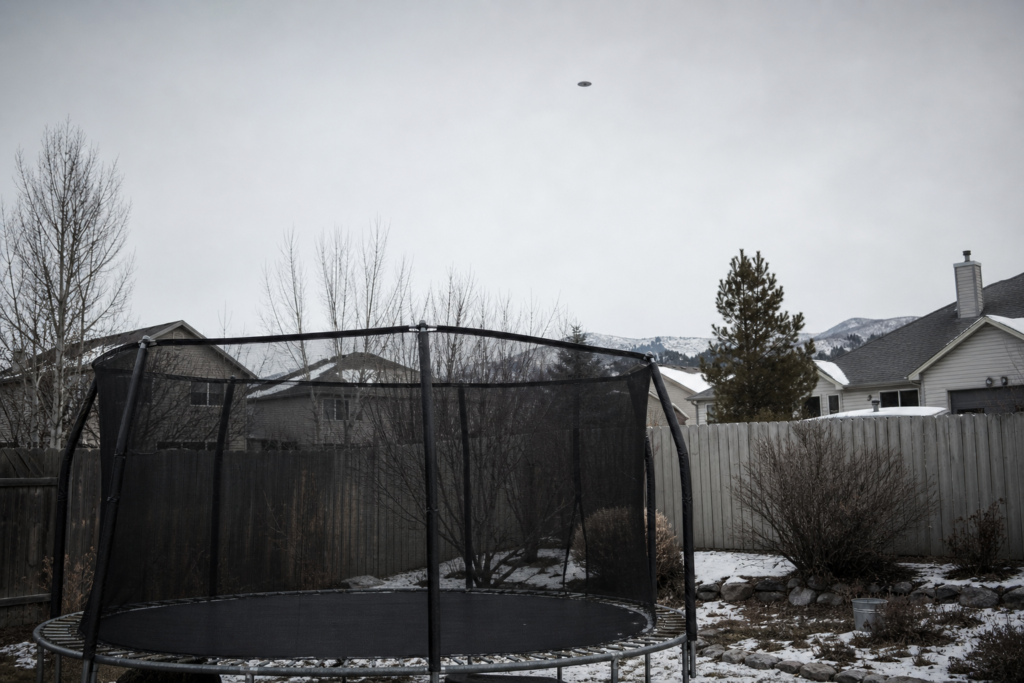
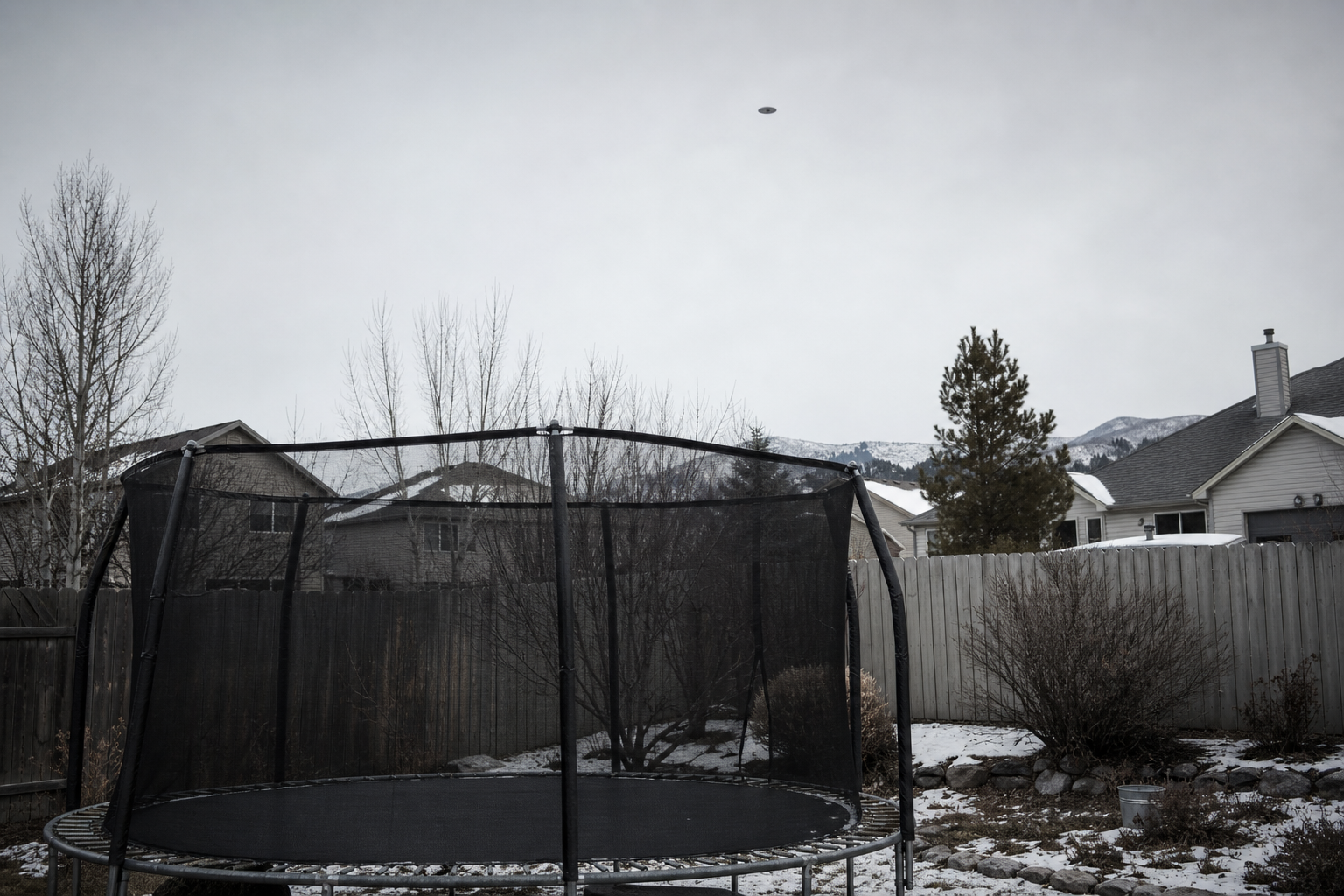
The Reno Nevada UFO sighting January 1 2020 centers on an unusual but narrow claim: a dark, oval-looking object was reportedly seen close to or above a backyard trampoline. That description is visually striking, yet it does not by itself establish the object’s size, distance, speed, physical form, or origin. “UFO” here describes an object not identified by the person reporting it; it is not evidence that the object was an extraordinary craft.
The available material for this report has not been established here as a reliable primary record with an original file, identifiable witness account, capture time, precise location evidence, or documented chain of reposting. That distinction matters. A firsthand photo or video with intact metadata offers a basis for testing when and where it was made, while an unattributed image or later retelling can preserve a claim without preserving the details needed to assess it.
This examination therefore treats the black oval UFO account as unverified and separates the reported appearance from what can be independently supported. It will assess provenance, visible limitations in any media, and ordinary possibilities such as a nearby object, lens effect, balloon, bird, or edited image. It will also look for any identifiable official report or investigation. An unresolved appearance may remain unidentified; it does not become proof of an extraordinary origin merely because a conclusive explanation is absent.
What Was Reported Over the Reno Trampoline
At its most literal, the report consists of four linked details: a black, oval-looking object; an apparent position close to or above a trampoline; Reno, Nevada; and the date January 1, 2020. The claim may describe a sighting, a recording, or both, but those are materially different records. A witness recollection preserves what someone believed they saw; an original photo or video can also preserve visual clues, though it still cannot automatically establish distance or identity.
“UFO over trampoline Reno” is therefore a shorthand label, not an established finding. “UFO” and “UAP” describe an object that has not been identified within the report. By contrast, descriptions such as alien craft or anomalous technology make claims about origin or mechanism that the basic observation does not contain. Calling a dark shape a UFO can be a neutral statement of uncertainty; calling it extraterrestrial adds a conclusion that requires separate evidence.
No earliest firsthand post, original upload, quoted witness wording, or intact media file has been established in the material available for this assessment. As a result, Reno, the trampoline setting, and the January 1 date must presently be treated as details repeated with the claim rather than independently demonstrated capture facts. The article examines that limited record and the way the description has been framed; it does not treat the headline as proof that a particular object was filmed in a particular Reno backyard on that day.
What the Available Record Documents, and What It Does Not
Provenance is the test that connects a piece of media to the event it is said to show. For a photograph, the strongest starting point would be the original camera file rather than a screenshot, crop, or repost: it may retain capture information, image dimensions, and signs of editing. For video, the useful equivalent is the complete original sequence, including the seconds before and after the object appears. That context can show camera movement, focus changes, foreground obstructions, and whether the object remains consistent from frame to frame.
An upload history supplies a separate, limited form of support. A platform timestamp can establish when that particular account posted a file; it does not establish when or where the file was recorded. A credible chain would lead from the earliest public upload back to the person who captured it, without unexplained copies or altered versions between them. Retellings that repeat “Reno,” “January 1,” or “over a trampoline” preserve the allegation, but repetition alone does not authenticate those details.
Location evidence would need to tie the scene to Reno through identifiable, independently matchable features or a witness who can be contacted and can explain the setting. Capture-date evidence could come from retained file data, a contemporaneous post by the recorder, or a consistent account supported by surrounding material. None of those routes has been established for the black oval UFO Reno Nevada claim considered here.
Corroboration also has a specific meaning. Two witnesses who independently describe the same time, direction, duration, and surroundings are more informative than several accounts copied from one online post. Likewise, separate recordings from different positions can test whether an apparent object was in the sky, near one camera, or introduced during editing. No identified witness pathway, independent account, original media file, or traceable posting sequence is available in this record.
That absence does not demonstrate fabrication, nor does it supply a hidden explanation. It limits what a UFO photo analysis or UFO video analysis could responsibly determine. The case is presently an unverified reported sighting with insufficiently documented media provenance, not a reconstructable event from which date, place, object behavior, or identity can be established.
Why a Close Black Oval Appearance Is Hard to Interpret
Apparent proximity is a perspective effect unless the object and a known reference occupy the same depth. A black oval object in sky can look as though it hangs immediately above a trampoline while actually being much nearer to the camera, much farther beyond the yard, or not in the sky plane at all. The trampoline supplies a recognizable foreground shape, but it becomes a usable scale only if the object’s position relative to it is independently known.
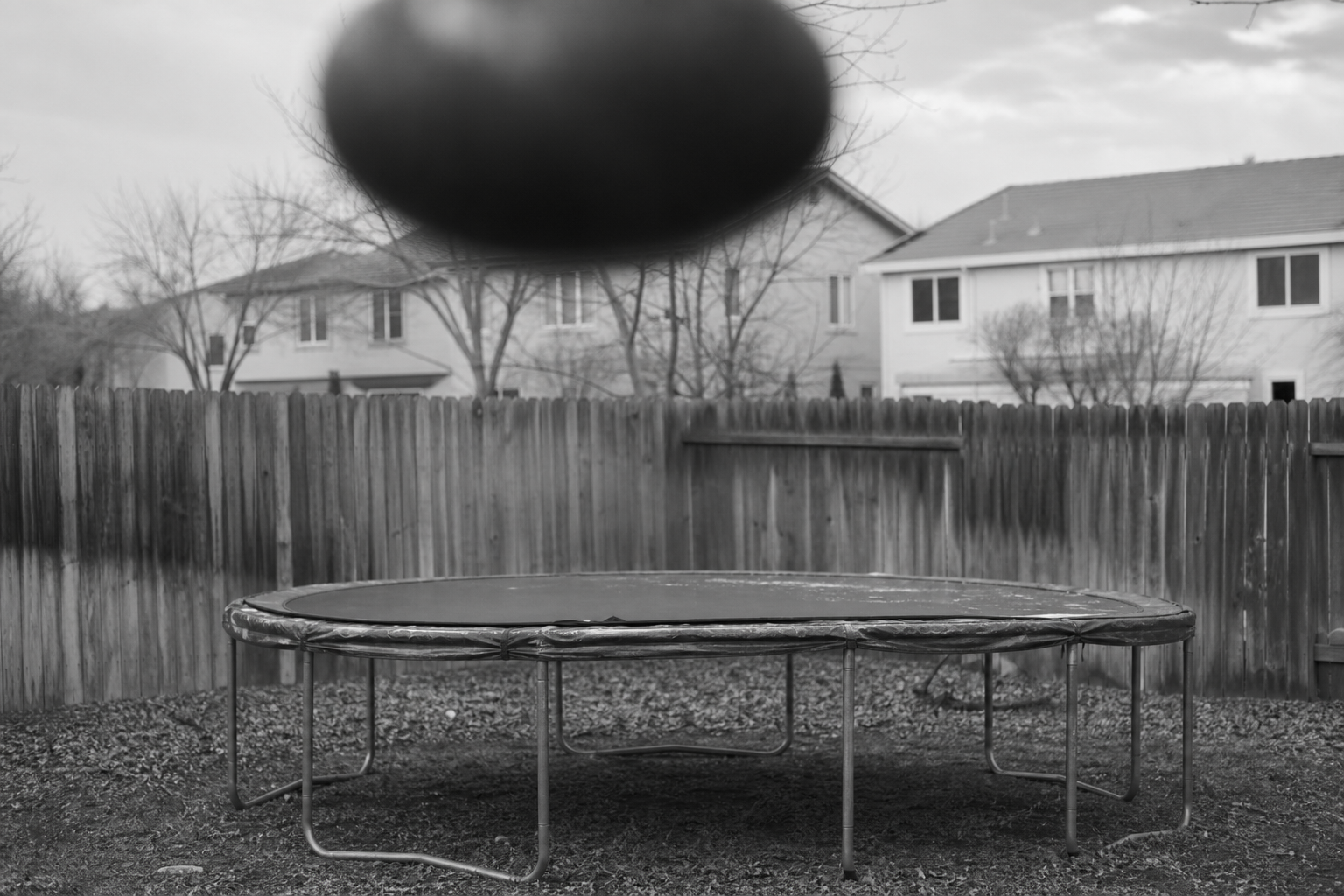
Shape is similarly conditional. A true oval should retain a broadly consistent outline across consecutive video frames despite modest changes in camera angle or focus. A soft, changing oval may instead reflect defocus, compression, motion, or an object crossing the frame at an angle. Edge sharpness matters: a clean, stable boundary against the background is stronger visual information than a dark blur whose boundary blends into the sky. Neither appearance, by itself, identifies material.
Contrast and lighting can alter the impression of solidity. A featureless black region may be an underexposed subject, a silhouette against a bright sky, or a camera exposure response rather than a surface that is literally black. Useful analysis would compare the object’s bright and dark sides with the direction of illumination visible on the trampoline, nearby structures, clouds, or vegetation. A shadow, highlight, or consistent rim can constrain interpretation; their absence leaves several possibilities open.
Motion also requires a stable frame of reference. Blur can come from camera shake, autofocus hunting, digital stabilization, or subject movement. Background features, rooflines, poles, branches, and distant terrain, would allow a frame-by-frame comparison of the object’s path and size. Without intact footage or such reference points, the reported Reno Nevada UAP cannot yield reliable conclusions about distance, maneuverability, or physical dimensions from its apparent oval form.
Plausible Non-Extraordinary Explanations to Test First
The useful question is not which familiar object best matches a single label, but which hypothesis predicts the visible behavior of the reported oval. Each candidate should account for its outline, movement, changes across frames, and relation to the camera and background.
- Balloon: A dark balloon could appear oval when side-lit or silhouetted, drift irregularly, rotate, and alter apparent shape as it turns. A visible string, a slow wind-like path, or a changing highlight would support that possibility. Sustained rapid travel on a straight, controlled course, or a consistently rigid outline at close range, would weaken it. Context from unidentified objects later considered balloon-related underscores the value of testing this explanation first.
- Drone: A small multirotor can hover, climb, and translate in ways a freely drifting object cannot. Evidence would include a stable position relative to distant features, abrupt controlled stops, visible arms or propellers, or navigation lights. An entirely featureless form whose path simply wanders would offer little affirmative support for a drone.
- Kite: A kite can present as a dark flattened oval when viewed edge-on or from below. A tether leading toward the ground, repeated pulling motions, or oscillation around a fixed point would be the strongest indicators. No line is not decisive in low-resolution media, but a path that does not resemble tethered movement weakens the fit.
- Bird: A bird can become an oval silhouette when wings are folded, blurred, or captured at an unfavorable angle. Wingbeat-driven shifts in width, brief banking, and a trajectory consistent with flight would support it. A long-lasting, perfectly unchanged oval would be less consistent with a nearby bird.
- Insect near the lens: A close insect can be badly out of focus while the distant yard remains sharp, producing a large dark blob with no recoverable detail. Sudden entry or exit, erratic movement unrelated to the background, and rapid focus changes are useful signs. A sharply resolved object that remains fixed in the distant scene would argue against this explanation.
- Reflection: Internal lens reflections can create dark or bright shapes that move as the camera tilts, often tracking the frame rather than the landscape. A shape that shifts predictably with camera angle supports an optical cause; one independently changes position against stable background landmarks does not.
- Image or video artifact: Compression, digital sharpening, stabilization, and motion blur can merge fine detail into a smooth oval. Blocky edges, changing outline from frame to frame, and appearance only during fast camera movement favor an artifact. A clean original sequence showing the same defined object across multiple steady frames would weaken that account.
Because no intact, attributable recording has been established for this Nevada UFO sighting in January 2020, these are testable possibilities rather than identifications. The missing frame sequence and original file prevent a responsible ranking based on drift, rotation, duration, focus, or fine visual detail.
Was the Reno Object Officially Investigated?
Official handling would leave a different kind of trail than online circulation. A social-media post, reposted image, or unattributed video records only that someone shared a claim; it does not show that a public agency received, assessed, or validated it.
A local police report would ordinarily document a call for service or an incident report, while an aviation report would identify a reporting channel, time, location, observer, and potential flight-safety concern. A civilian UFO-database entry is different again: it can preserve a witness submission or a later transcription, but it is not an agency finding and its value depends on whether it retains firsthand details and source history.
A formal government UAP review is the strongest category, because it would involve an identifiable office, case or report reference, and evidence subject to an official assessment process. No named police case, aviation report, agency statement, civilian-database record with established source provenance, or public government UAP review has been identified for the reported Reno object.
That means the report’s online circulation should not be treated as evidence of an official investigation. Wider discussions of UAP disclosure do not create a connection to this particular Nevada UFO report, and they do not supply the missing record of who reported it, when an agency may have received it, or what evidence an investigator examined.
Evidence-Based Verdict: Unidentified, Misidentified, or Too Poorly Documented?
The appropriate classification is too poorly documented to classify, rather than misidentified or genuinely unresolved. “Misidentified” would require enough attributable material to show that a particular ordinary object best fits the observation. “Unidentified” would require a credible record of an object whose identity remains open after meaningful examination. Here, the missing original media, traceable witness account, precise capture details, and independent corroboration prevent either conclusion.
An unidentified aerial phenomenon is a description of an identification gap, not a finding of non-human intelligence, advanced technology, or an anomalous craft. Uncertainty is not positive evidence for an extraordinary explanation. For the reported Reno Nevada UFO sighting January 1 2020, the black-oval description remains a claim associated with a stated place and date, but the available record does not establish the event or provide a basis for measuring the object’s physical characteristics.
A stronger assessment would begin with a compact, preservable record:
- Keep the original photo or full video file, not only a screenshot, crop, or repost; originals can retain sequence and capture information needed to assess focus, motion, and editing.
- Record the date, approximate time, exact viewing location, camera direction, and weather or lighting conditions while memory is fresh.
- Obtain a full firsthand account describing duration, apparent movement, sound, distance cues, and whether the observer saw the object directly or only in imagery.
- Seek independent observers, nearby recordings, and imagery from other angles; agreement on specific details is stronger than repeated online retellings.
- Compare the complete imagery against ordinary candidates before assigning a more consequential label.
Until that threshold is met, the responsible verdict is insufficient documentation, not confirmation of an anomalous object.
What Can, and Cannot, Be Concluded About the Reno Object
The record supports only a limited conclusion: a claim has circulated describing a black oval near a trampoline in Reno on January 1, 2020. It does not support a measurement of the object, a reliable flight path, a physical origin, or an inference that it was extraordinary. Calling the object “unidentified” is possible only as a description of the reported appearance, not as a conclusion drawn from examinable UFO evidence.
The key distinction is between an observation that lacks an identification and a case that lacks the material needed for evaluation. An original image or complete video could be tested for focus behavior, frame-to-frame movement, compression artifacts, and the object’s relationship to the yard. A repost, crop, or verbal retelling cannot provide those controls. Likewise, a named witness with a capture time and exact vantage point would make weather, lighting, and possible local activity testable; repeated descriptions alone do not.
Material capable of changing the assessment would include the unedited file, a traceable first upload, retained metadata, a detailed firsthand account, and independent footage or witnesses from a separate position. Those items would not guarantee an identification, but they would permit ordinary explanations to be compared against observable details before any more consequential interpretation is considered.
For the Reno Nevada UFO sighting January 1 2020, the evidence-based endpoint remains an unverified report with insufficient documentation. The absence of a settled explanation leaves a gap in the record, not verifiable evidence of extraterrestrial or non-human technology.
Frequently Asked Questions
-
What was the black oval UFO reported over a trampoline in Reno on January 1, 2020?
The claim describes a dark, oval-looking object reportedly seen close to or above a backyard trampoline in Reno, Nevada, on January 1, 2020. No original witness account, intact media file, or independently verified location and date evidence has been established.
-
Is there verified video or photographic evidence of the Reno Nevada UFO sighting?
No verified original photo or full video sequence has been identified for the reported sighting. There is also no documented chain of reposting, retained metadata, traceable first upload, or identifiable firsthand witness.
-
Could a black oval UFO in a photo be a balloon, bird, drone, or camera artifact?
Yes. Plausible explanations include a balloon, drone, kite, bird, insect near the lens, reflection, compression artifact, motion blur, or defocus. Without original footage, analysts cannot reliably compare drift, focus behavior, rotation, frame-to-frame shape, or movement against background landmarks.
-
What should you look for to verify a UFO sighting in Reno?
Keep the original image or complete video file and record the exact location, approximate time, camera direction, weather, lighting, duration, and observed movement. Stronger verification also requires a traceable first upload, retained metadata, a detailed firsthand witness account, and independent recordings or witnesses from separate positions.