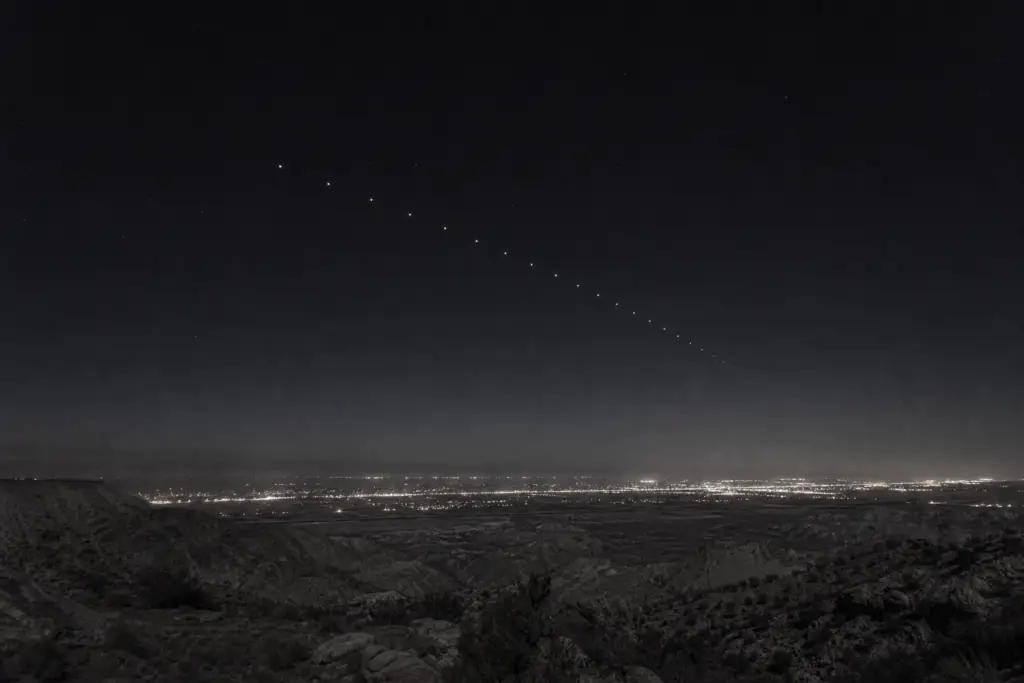
The key detail is a reported line of lights that seemed to fade from view into the night sky on January 4, 2020. “Vanish” describes the observed appearance, not a demonstrated physical disappearance or an established identity for the lights.
This examination treats the account as a localized night-sky report rather than proof of a UFO, UAP, aircraft, satellite train, or military activity. Its first task is to separate details that may be directly documented, an original image or video, timestamp, and location, from repeated descriptions and later interpretation. A strong reconstruction would establish viewing direction, number and spacing of lights, duration, apparent motion, and sky conditions; without them, a straight-line formation remains an incomplete observational record.
The sections that follow assess how a linear formation can appear to fade or “vanish,” including changing visibility, illumination, perspective, clouds or haze, and objects moving beyond an observer’s useful line of sight. They also consider what weather observations, flight information, satellite records, and local contemporaneous reporting can add. Where the available record does not support a firm match, the responsible conclusion is unresolved, not extraordinary by default.
What Was Reported Over Grand Junction on January 4, 2020
The case label supplies the basic setting: Grand Junction, Colorado, on January 4, 2020. The surviving description is of multiple lights arranged along a straight or nearly straight line, with the line seeming to recede, fade, or vanish into the dark sky. That is the reported visual pattern, not a measured track, confirmed object count, or demonstrated physical disappearance.
No authenticated original post, identifiable witness statement, unedited footage, or contemporaneous local report is available in the material reviewed here. As a result, the exact observing point within the Grand Junction area, time of night, viewing direction, duration, spacing, brightness, and motion of the lights cannot responsibly be treated as established facts.
This distinction matters because a caption such as “linear trail vanishes into night sky” is an interpretation of what a viewer saw. A firsthand account can preserve useful observations, where the observer stood, whether the lights moved together, and whether they faded one at a time, while reposts often preserve only the most dramatic wording. For this Grand Junction lights formation, the date, general place, linear appearance, and claimed fading define the report; the underlying event record remains too thin to identify the lights from that description alone.
Reconstructing the Formation and Its Reported Path
A defensible timeline therefore has only two fixed points: the report places the observation in the Grand Junction area on January 4, 2020, and it describes a line-like grouping that later became no longer visible. Everything between those points, how long the display lasted, whether its members crossed the sky, and the order in which they faded, remains unrecorded rather than merely uncertain.
The available wording does not establish a count. “Multiple lights” could describe a short row or a much longer sequence; it does not show whether the apparent gaps were even, whether all lights had similar intensity, or whether any was brighter than the others. Nor does it establish a rigid formation. Lights at different distances can appear evenly aligned from one observing position, while lights moving together would require a time-stamped sequence showing that their spacing and relative positions remained stable.
- Motion: no documented track identifies a direction of travel, rate of movement, change in elevation, or turn. A line that appears to recede may be moving away, crossing the observer’s view, or simply becoming less visible.
- Geometry: the reported straight or nearly straight appearance is an observed visual arrangement, not a measured bearing. An observer location and compass azimuth would be needed to map the line against the sky.
- Sound: there is no preserved witness account describing engine noise, silence, or a delay between sight and sound. Silence cannot be inferred from the absence of a recorded comment.
- Image or video evidence: no original file is available here to establish upload time, frame rate, phone orientation, zoom, exposure changes, trimming, or whether the lights remained aligned across successive frames.
That leaves the Grand Junction UAP sighting January 4 2020 as a report of appearance rather than a reconstructable flight path. The useful distinction is between a line seen from one viewpoint and a demonstrated group moving in formation: the former is preserved by the description; the latter would require independent observations or original time-sequenced imagery.
Why a Straight Line of Lights Can Seem to Vanish Into the Night Sky
Visibility can end before the lights themselves do. A thin cloud layer, ground haze, or a darker portion of the sky can reduce each light below the eye’s contrast threshold: the point at which it is no longer bright enough to stand apart from its background. If the group is traveling away from the observer or toward a dimmer part of the sky, the farthest or faintest members may drop out first, creating a sequential fade that makes a linear trail appear to dissolve.
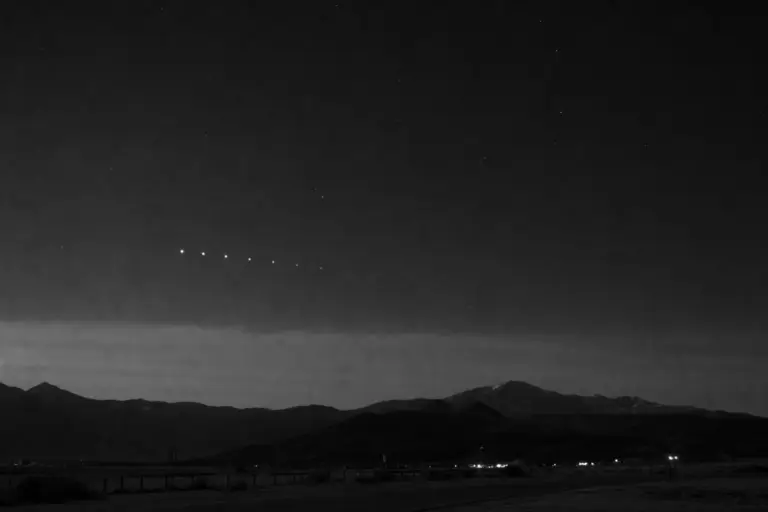
Illumination can produce a similar result. A reflective object may brighten only while its surface catches a favorable angle of sunlight; a small change in its orientation or the observer-object-sun geometry can make it fade without any sharp maneuver. Perspective also compresses separation along a line of sight. Lights that appear tightly aligned can seem to converge as their apparent spacing shrinks, then become difficult to distinguish individually. Terrain, buildings, trees, or a distant ridge can mask the lowest part of a path, while a cloud edge can obscure a line progressively rather than all at once.
Recorded imagery needs separate caution. A phone’s auto-exposure may dim the entire scene after a brighter light enters the frame; autofocus can soften pinpoints into faint blobs; digital zoom magnifies noise and hand movement. Frame-by-frame video can distinguish a light leaving the frame, being covered, or fading gradually, but no original recording is available here for that test. The reported apparent disappearance therefore does not, by itself, demonstrate unusual acceleration or a physical vanishing event; it describes the endpoint of a limited night-sky observation.
Conventional Explanations That Fit a Formation of Lights
Each candidate makes a different prediction about spacing, motion, brightness, and the way the display ends. A satellite train would be a sequence of sunlit satellites following nearly the same orbital path, usually with fairly even apparent spacing and steady, non-blinking points. It is a strong visual match for a line of lights that moves together and fades progressively; it is weaker if the lights changed direction independently, flashed in aviation patterns, or remained fixed over one place. The surviving account does not preserve the time, heading, duration, or original imagery needed to test that match.
Aircraft can also create an apparent formation. Several aircraft on similar routes, or aircraft turning within a holding pattern, may align from one viewing position even when they are widely separated. Aircraft navigation lights are more likely to show rhythmic flashes, changing red, green, or white colors, and changes in relative position as the aircraft turn. Distant aviation lights may seem stationary or converge toward one point, but a clean, evenly spaced line moving as a unit would be a less natural fit unless flight paths and viewing angle supported it.
A rocket launch plume generally predicts a broader, evolving luminous cloud or streak rather than discrete points in a stable line. It becomes more plausible only if the reported time and direction align with a launch trajectory and sunset illumination. Bright planets and stars can explain isolated stationary lights, but not a moving linear sequence; a meteor normally produces a brief streak rather than multiple persistent lights. Drones could form a deliberate low-altitude line, yet would more often show maneuvering, variable spacing, or nearby sound.
Atmospheric distortion and camera processing can alter the apparent shape or continuity of real lights, but neither independently supplies the lights themselves. In this Grand Junction report, those mechanisms remain possible modifiers rather than an identification. Without a dated recording or a precise observation record, no conventional explanation materially accounts for the entire pattern better than the others.
What Records Can Confirm, and What They Cannot
A useful case file separates evidence by what it can actually establish. Direct evidence would be an original photograph, video, or firsthand account tied to a specific time and viewpoint. Corroborated sensor and tracking evidence includes records that match those details: weather records can show whether cloud, haze, wind, or visibility conditions could have affected the apparent fade, but cannot identify a light on their own.
Flight-tracking records are most useful when a reported direction, minute-level time, and approximate elevation allow a comparison with known aircraft movements. A match can support an aircraft explanation; no visible match is weaker evidence because public tracking has coverage gaps and does not necessarily represent every aircraft or every usable position. The same standard applies to satellite catalogs: an orbital pass is meaningful only when it is calculated for the observer’s location and reported time, then compared with the observed direction and motion.
Geolocation narrows the sky being tested. A landmark, road, horizon, or compass bearing can turn a general Grand Junction claim into a usable viewing line. Video metadata may preserve capture time, device location, and editing history; an exported clip, repost, or screenshot may not. Local news archives and official local, state, or aviation reporting channels can establish whether a contemporaneous report exists, but silence in those records does not disprove an observation.
For this case, the missing original material prevents that level of cross-checking. “UFO” or “UAP” is therefore only a label for something unidentified within the available record. It does not establish an exotic craft, official investigation, or a physical disappearance; it marks the limit of what the evidence presently resolves.
The Most Defensible Conclusion From the Available Evidence
The evidentiary ranking is necessarily short. A satellite-train-like appearance is the best visual fit in the abstract because a sequence of similarly moving points can form a line and fade as illumination or contrast changes. Aircraft seen along a shared route are also plausible, particularly if perspective compressed their positions into a row. Neither explanation is a documented identification here: there is no retained time, viewing direction, duration, original imagery, or independently attributable witness account with which to test either prediction.
What can be retained is narrower: the report associates Grand Junction and January 4, 2020 with lights described as line-like and later no longer visible. The number of lights, exact geometry, altitude, speed, heading, spacing, and whether they faded sequentially are unverified. “Vanished into the night sky” describes the reported visual endpoint, not a demonstrated change in the objects themselves.
The responsible classification is therefore an unresolved report of lights, not a confirmed UAP case. “Unresolved” identifies a gap between the description and a specific conventional match; it does not add evidence for alien activity, non-human intelligence, a military program, or a government cover-up. Those claims would require independent, testable evidence beyond an unverified sighting label.
A firmer conclusion would require primary material tied to a precise location and minute-level time, plus a clear view direction and unedited file metadata. Those details could support a genuine comparison with satellite passes, aircraft tracks, and local sky conditions. Without them, restraint, not an extraordinary inference, is the most defensible result.
How to Document a Similar Colorado Night-Sky Event
The strongest future report begins before any identification is attempted: capture observations that let another person reconstruct the same sky view. Note whether each light was steady, blinking, or changing color; whether the group held its spacing; and whether it crossed the frame, faded, or passed behind an obstruction. A compass bearing gives horizontal direction, while elevation describes height above the horizon; “west, about 30 degrees up” is far more useful than “over town.”
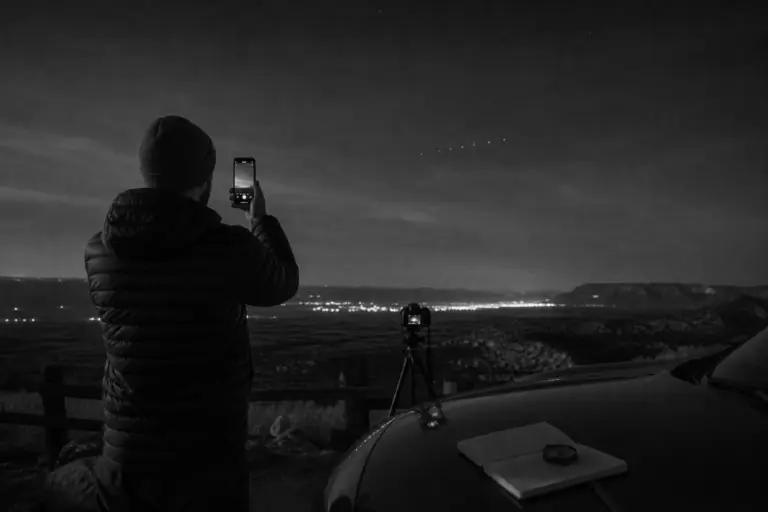
- Record the local date and time to the minute, precise observing location, compass direction, estimated elevation, duration, apparent movement, spacing, weather, and any sound.
- Film continuously when possible, including landmarks and a short sweep from horizon to sky; avoid filters, digital zoom, and edits.
- Keep the original photo or video file. Copies posted to social media may discard metadata such as capture time, device settings, and location.
- Write down observations separately from interpretation: “eight steady points moved east” is stronger evidence than an immediate label.
- Then compare the time and viewpoint with weather observations, satellite passes, aircraft activity, launch information, and astronomical objects.
That sequence turns a fleeting Colorado night-sky sighting into evidence that can be tested, rather than a description that must remain unresolved.
What the Grand Junction Lights Do, and Do Not, Establish
A decisive checkpoint is whether the account can be matched to a particular place, minute, and direction of view. It cannot: no authenticated original imagery, attributable firsthand account, or contemporaneous record supplies those details. The surviving material supports only the association of Grand Junction and January 4, 2020 with lights presented as a linear display that later was no longer visible; it cannot establish their number, altitude, speed, duration, spacing, or identity.
The apparent vanishing remains a visibility description rather than evidence of physical disappearance. Reduced contrast, changing illumination, haze or cloud, increasing distance, and movement beyond a useful viewing angle can each make lights fade from sight. A satellite-train-like sequence is the closest general visual fit, while aircraft following a shared route remain plausible; neither explanation can be matched to this report without a time and viewpoint.
“Unresolved” means the available information cannot distinguish among explanations. It does not turn an unidentified night-sky observation into evidence of an extraordinary craft, military activity, or an officially recognized UAP case. The Grand Junction UFO sighting January 4 2020 is best retained as an unverified report with a limited descriptive core.
Original files, continuous footage, minute-level timing, location, and compass bearing would make a future report substantially more testable against weather, satellite, and aircraft records.
Frequently Asked Questions
What were the lights seen over Grand Junction, Colorado, on January 4, 2020?
The surviving report describes multiple lights in a straight or nearly straight line that appeared to fade or vanish into the night sky. The exact number, time, location, direction, duration, and motion were not documented.
Could the line of lights over Grand Junction have been Starlink or other satellites?
A satellite train is the closest general visual match because sunlit satellites can appear as evenly spaced, steady points moving along the same path and fading as illumination changes. No minute-level observation time, viewing direction, or original footage exists to confirm a satellite pass.
Why can a straight line of lights appear to vanish at night?
Thin clouds, haze, reduced contrast, changing illumination, increasing distance, and perspective can make lights fade from view without physically disappearing. A phone camera can also alter the effect through auto-exposure, autofocus, digital zoom, and hand movement.
What details are needed to identify lights in the Colorado night sky?
Record the date and time to the minute, exact location, compass bearing, elevation above the horizon, duration, apparent movement, spacing, weather, colors, blinking pattern, and sound. Keep continuous unedited video with landmarks visible and preserve the original file metadata.
Was the Grand Junction lights formation officially identified as a UAP?
No official identification, authenticated original imagery, attributable witness statement, or corroborating tracking record is available. The case is best classified as an unresolved report of lights, not confirmed evidence of a UAP, military activity, or extraordinary craft.