COMETA Report 1999: French Analysis Arguing Some UFO Cases May Warrant an Extraterrestrial Hypothesis
Explore the COMETA Report 1999, its private French origins, key UFO cases, and why its extraterrestrial hypothesis remains unproven.


The COMETA Report 1999 remains controversial because it gave unusually direct voice to an idea most official investigations avoid endorsing: that a narrow residue of well-documented UFO cases may be difficult to reconcile with conventional explanations. That is not the same as France concluding that alien visitors were present, nor is it proof that any particular sighting involved non-human technology.
Produced by a private French study group whose participants included retired military, aerospace, and public-service figures, COMETA assembled case material it regarded as unusually strong, such as converging witness accounts, radar observations, aviation reports, and alleged physical effects. Its authors argued that, after other explanations had been considered, the extraterrestrial hypothesis deserved to remain on the table for a limited class of unresolved incidents.
The distinction matters. “Unexplained” describes the state of an investigation when the available record does not support a confident identification; it does not establish a specific cause. Strong evidence can narrow possibilities, but incomplete files, uncertain measurements, missing context, and inferential leaps can still prevent a definitive conclusion.
This article examines what COMETA was, who wrote it, how it selected and assessed cases, and why its conclusion still surfaces in today’s UAP disclosure debate. It also separates the report’s policy-oriented argument from the work of France’s official civilian reporting unit, GEIPAN, and from the much larger claim that extraterrestrial visitation has been demonstrated.
What the COMETA Report Was, and What It Did Not Establish
Published in 1999 as Les ovnis et la défense: à quoi doit-on se préparer? (“UFOs and Defense: What Should We Prepare For?”), the COMETA study framed unidentified aerospace reports as a question with potential implications for defense, aviation, and public policy. Its purpose was not to announce a French state finding, but to weigh whether a carefully filtered remainder of cases justified serious strategic attention.
COMETA’s conclusion was deliberately narrower than many later retellings suggest, much like the limited conclusions of the 1968 Condon Committee UFO report. The authors treated the extraterrestrial hypothesis as, in their view, a possible explanation for a limited residual category after conventional explanations had been examined. A hypothesis is a proposed account to be tested against the record; it is not a finding that visitors from another world were present. An incident may remain unidentified because observations are incomplete, records cannot be reconciled, or available explanations do not fit cleanly, not because one extraordinary explanation has thereby been established.
That boundary explains the report’s continued place in UFO disclosure debates. Public release of military reports, sensor data, or unresolved UAP cases can improve scrutiny and show that an event was not readily identified at the time. It does not, by itself, supply the chain of reliable measurements, provenance, and independently testable evidence needed to attribute an event to non-human intelligence. COMETA is consequential because it pressed for the first step, taking a demanding residual category seriously, while leaving the far larger claim unproven.
Who Produced COMETA? Private Authors, Retired Officials, and a Crucial Status Distinction
The names on the report’s masthead gave COMETA unusual visibility, but they did not change its institutional character. COMETA was a private study group, an association assembled around people with experience in defense, aviation, science, and public administration, not a French ministry, military command, intelligence service, or state investigative office.

Its leading figure was retired Air Force General Denis Letty. Other prominent participants included General Bernard Norlain, a former senior Air Force officer who had directed the Institut des hautes études de défense nationale (IHEDN); André Lebeau, a former president of France’s space agency, CNES; and Jean-Jacques Velasco, associated with CNES’s earlier UFO-study work through SEPRA. Aerospace engineer François Louange and astrophysicist Jean-Claude Ribes were also among the contributors. Those backgrounds mattered because they brought familiarity with aviation operations, radar questions, space science, and strategic analysis to the French COMETA UFO report.
They did not, however, make the group delegates of their former employers. Retired rank is not a government mandate, and a former CNES or military role does not convert an independently issued analysis into an official finding. The useful distinction is between expertise and authority: COMETA could draw on experienced individuals and still speak only for its authors.
Its connection to IHEDN requires the same care. IHEDN is a French defense-studies institution whose courses and networks have included civilian and military participants. COMETA emerged from circles linked to that milieu, but it was not an IHEDN report or an IHEDN-endorsed inquiry. Readers should therefore treat its professional roster as context for the seriousness of its policy argument, not as evidence that the French state adopted its conclusions.
How the Report Evaluated UFO Evidence
Its method was essentially one of evidentiary convergence. A lone observation could be sincere yet still leave major uncertainty about distance, size, speed, lighting, and ordinary objects seen under unusual conditions. COMETA gave greater weight when separate channels appeared to point in the same direction: several witnesses whose accounts could be compared, an aircrew report made in an operational setting, a radar return recorded near the time of a visual observation, or a reported ground trace subject to examination.
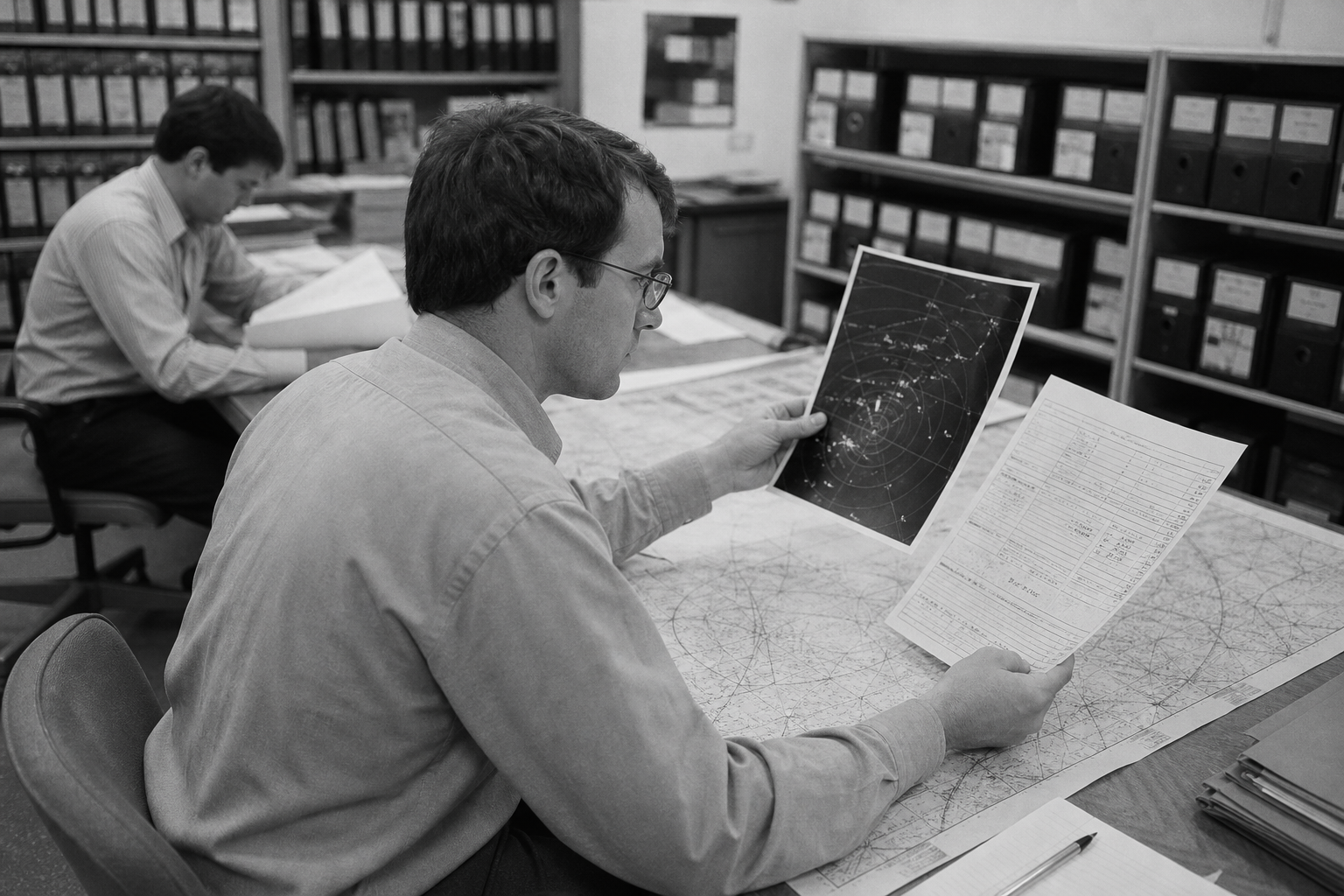
Those categories were not interchangeable. Witness credibility concerns whether an observer was positioned and trained to describe what happened reliably; it does not establish an object’s identity. Radar can supply information about a detected track, but a return may also reflect propagation effects, clutter, processing limits, or an uncertain correlation with the visual target. A physical trace can be more useful still if its collection, preservation, testing, and comparison samples are documented. The practical difference is that an independently measured result can be reassessed, whereas an unrecorded recollection usually cannot.
In this COMETA report analysis, pilot and military accounts mattered because they often came with timing, location, weather, communications, or aircraft data that could constrain an interpretation. The authors also favored systematic UFO case evaluation through attempts to eliminate familiar explanations, misidentification, astronomical phenomena, atmospheric effects, aircraft, balloons, and deception before treating a case as residual. Elimination narrowed the possibilities; it did not positively identify a non-human craft.
That caution is especially important for older aeronautical cases. Files may preserve a summary rather than original radar plots, full witness interviews, photographs, instrument settings, or laboratory records. Retrospective reconstructions can therefore make an episode seem either more decisive or less secure than the contemporaneous material warrants. The strongest unidentified aerial phenomena in COMETA’s framework were consequently not “proven extraordinary” events, but cases in which several imperfect lines of evidence remained difficult to reconcile.
The Cases COMETA Treated as Most Significant
COMETA’s case selection ranged across different evidentiary profiles rather than relying on one celebrated incident. Military aviation encounters were especially prominent because operational reports can fix an approximate time, route, altitude, radio exchanges, and the crew’s immediate reaction. The report discussed the 1976 Tehran incident, in which Iranian air-force personnel reported an aerial object and alleged equipment difficulties during interception attempts. COMETA treated the combination of pilot testimony, command reporting, and claimed instrument effects as more significant than a visual account alone. Public retellings, however, rely heavily on later summaries of military material; the condition and interpretation of the underlying records, including whether malfunctions had ordinary causes, remain contested.
It also emphasized radar-visual cases: episodes in which a visual observation was said to coincide with a radar detection. The 1957 RB-47 incident over the United States was useful to COMETA because aircrew observations, airborne electronic detections, and ground-radar reports were presented as mutually reinforcing. That is a stronger evidentiary structure than either a radar blip or a witness account in isolation. Yet the surviving public record does not permit a simple reconstruction of every signal, track correlation, or atmospheric condition. Multiple sensors can record a real event without establishing that each recorded anomaly arose from the same object.
For claimed physical effects, COMETA drew attention to French cases including Trans-en-Provence in 1981, where an official investigation recorded a witness account and examined reported marks and vegetation effects at the location. The value, in COMETA’s view, was the prospect of material examination rather than reliance solely on memory. But a trace indicates that something affected a site only if collection, comparison, timing, and alternative causes are tightly established; it does not identify what caused it. The case therefore illustrates both why some UFO sightings appeared worth preserving as evidence and why an unresolved file cannot bear an extraterrestrial conclusion by itself.
Why COMETA Considered an Extraterrestrial Hypothesis
The report’s decisive move was not to treat every unidentified observation as extraordinary, but to narrow attention to a remainder that its authors believed had survived ordinary explanations. They considered misperception, astronomical or meteorological phenomena, deliberate hoaxes, and classified human technology as possible explanations. In their view, those possibilities could account for many reports, but not for the selected cases that appeared to combine credible observers, multiple observations or sensors, and behaviour they regarded as difficult to reconcile with known aircraft or natural events.
COMETA then compared competing explanations for that residual set. A secret terrestrial program could in principle explain advanced performance, but the authors considered it an unsatisfying fit where reports spanned long periods, several countries, and characteristics allegedly beyond publicly known capabilities. They argued that the extraterrestrial hypothesis, the proposition that some phenomena could be of non-human origin, provided the most coherent overall explanation for the remaining pattern. This was a comparative judgment: COMETA considered that hypothesis more plausible than the alternatives it had reviewed, not a finding that any individual case had established alien visitation.
That distinction identifies the report’s central logical vulnerability. An unexplained case may reflect missing measurements, uncertain witness estimates, incomplete records, mistaken correlation between sensor and visual data, or an explanation not considered at the time. Rejecting familiar candidates therefore creates an anomaly category; it does not supply independent evidence for a specific extraordinary cause. Strong affirmative evidence would need to do more: reliably identify an object or material, establish provenance and chain of custody, and rule out ordinary or human-made origins through reproducible analysis. The COMETA extraterrestrial hypothesis was consequently an argument for taking a limited residue seriously, rather than proof of non-human intelligence.
COMETA, GEIPAN, and Today’s UAP Disclosure Debate
Institutional purpose is the clearest dividing line. GEIPAN is the civilian unit within CNES that receives, documents, and analyzes reports of unusual aerospace phenomena; its role is to classify and examine reports, including those that remain unidentified after available information is assessed. That reporting function creates a public record and can preserve dates, witness accounts, environmental context, and supporting material. It does not convert an unresolved file into an endorsement of any particular cause. COMETA, by contrast, was a private, policy-oriented analysis whose authors went beyond case classification to argue that an extraterrestrial hypothesis merited consideration for a selected residual category.
Modern UAP discussion makes that distinction more useful, not less. “UAP” is a broader official label intended to describe observations without building an explanation into the name; “unidentified” means the available evidence did not permit a reliable identification at that point. A stronger disclosure signal is therefore the release of underlying records, methods, uncertainty limits, and later revisions, not merely a statement that an event remains unresolved. The COMETA Report 1999 remains relevant because it pressed for serious treatment of difficult reports, but contemporary evidentiary standards place greater weight on traceable data, independent review, and analytical methods, with conclusions that remain proportionate to what the record can actually establish.
The Bottom Line: A Serious Argument for Scrutiny, Not a Finding of Alien Visitation
The lasting value of COMETA lies in its insistence that the hardest reports should not be dismissed simply because they are difficult. Its authors treated a limited residual set as worthy of sustained investigation and policy attention; their extraterrestrial hypothesis was an interpretation of incomplete material, not a French state finding or evidence that alien visitation occurred.
For future UFO news, distinguish a genuine evidentiary lead from an extraordinary conclusion. Ask what original data exist, who independently examined them, whether timing and sensor limits are known, which ordinary alternatives were tested, and whether the claim goes beyond those records. An event may remain unexplained without demonstrating an extraterrestrial cause.
Why the COMETA Report Still Deserves Careful Reading
A report’s institutional label should shape the weight given to its conclusions. The COMETA Report 1999 merits attention because experienced former officials assembled an argument from cases they judged unusually information-rich, but its private status means its assessment was not an official French finding.
Its most useful discipline is selective scrutiny: multi-witness accounts, radar-visual correlations, contemporaneous operational reports, and trace evidence can narrow uncertainty more effectively than an isolated story. Yet those categories are only as strong as the preserved underlying material. A radar claim without plots or calibration details, or a witness account reconstructed years later, is a weaker signal than a record whose timing, conditions, and independent observations can be tested.
The appropriate conclusion from unresolved cases is continued inquiry, not a leap to origin. For COMETA and for present-day UAP claims, readers should separate provenance from prestige, raw data from summary, and an eliminated explanation from every conceivable alternative. The extraterrestrial hypothesis can remain an option under discussion without becoming the result established by the evidence.
Frequently Asked Questions
-
What was the COMETA Report of 1999?
The COMETA Report was a 1999 private French study titled “UFOs and Defense: What Should We Prepare For?” It argued that a limited set of well-documented UFO cases deserved serious defense and policy attention after conventional explanations were considered.
-
Was the COMETA Report an official French government report?
No. COMETA was produced by a private study group led by retired Air Force General Denis Letty and including former military, aerospace, and public-service figures, not by a French ministry, military command, intelligence service, or CNES office.
-
Did the COMETA Report conclude that UFOs are extraterrestrial?
No. Its authors argued that the extraterrestrial hypothesis should remain a possible explanation for a narrow residual category of unresolved cases, but they did not establish alien visitation or identify any specific incident as non-human technology.
-
What UFO cases did the COMETA Report consider most significant?
COMETA emphasized cases with converging evidence, including the 1976 Tehran military interception report, the 1957 RB-47 radar and aircrew incident, and the 1981 Trans-en-Provence case involving reported ground marks and vegetation effects. The report valued combinations of witness testimony, radar or electronic detections, operational records, and examinable physical traces.
-
What should you look for when evaluating COMETA-style UAP evidence?
Prioritize original records, known timing and sensor limits, independent review, documented chain of custody, and reproducible analysis. Radar claims without plots or calibration details, and witness accounts reconstructed years later, are weaker than contemporaneous records that can be independently tested.