COMETA Report (1999): French Analysis Arguing Some UFO Cases Warrant the Extraterrestrial Hypothesis
Explore the COMETA Report, its French authors, key UFO cases and extraterrestrial hypothesis, plus why its conclusions remain contested.
Published in France in 1999, the COMETA Report is often invoked as if it were a French government declaration that UFOs were extraterrestrial. It was not. It was a privately produced analysis associated with an organization and contributors that included experienced former officials and technical specialists; its conclusion represented the authors’ judgment, not a finding adopted by the French state.
That distinction matters because the report made a narrower, and more interesting, argument. Its authors separated ordinary reports that might reflect misidentification, insufficient information, or conventional events from a residual group of cases they regarded as well documented and still difficult to explain. Corroborated witness accounts, radar-visual reports, and observations described as showing unusual performance carried more weight in that assessment than a lone anecdote. From that selected remainder, they argued that the extraterrestrial hypothesis deserved serious consideration and could be the most plausible explanation in some instances.
This article examines who assembled the French UFO report, how its case-selection and evidentiary logic worked, and what its conclusion did, and did not, claim. An unresolved observation is a problem for explanation, not proof of visitors from another world. Selection bias, incomplete records, uncertain historical reconstructions, and alternative explanations can remain even in a striking case. Those limits explain why COMETA remains influential in debates over UFO disclosure while its central inference remains contested.
What the COMETA Report Was, and What It Was Not
The report’s French title frames its subject more narrowly than many later retellings: Les OVNI et la Défense: à quoi doit-on se préparer?, usually translated as UFOs and Defense: What Should We Prepare For?. Issued in 1999 by the COMETA association, it approached unidentified aerial observations as a potential defense and public-policy problem: not every report merited attention, but a small set might require authorities to preserve records, assess risks, and avoid premature dismissal.
That framing matters. “Defense” did not mean that France had identified an extraterrestrial threat, nor did the English rendering make the document a ministry publication. The COMETA report was an analysis produced outside the French state’s formal decision-making structure. Its contributors’ professional experience gave the document historical visibility, but it did not turn its conclusions into French government policy, an official intelligence assessment, or a scientific finding.
The French UFO report of 1999 also did not claim to establish extraterrestrial visitation. Its argument was conditional: where an observation appeared to combine credible testimony with independent material, such as aviation reports, radar information, photographs, or physical effects, and conventional explanations remained unsatisfactory, the extraterrestrial hypothesis should not be excluded from analysis. A hypothesis is an explanatory possibility to be tested against alternatives; proof would require evidence capable of establishing that explanation rather than merely leaving a case unresolved.
COMETA’s lasting relevance therefore rests on the seriousness of its question, not on an official seal or a final answer. The crucial issue is how its authors defined the small residual category they thought deserved that level of attention.
Who Produced It? COMETA, Its Contributors, and the French UFO-Research Context
The names attached to the report help explain its prominence. The COMETA association, Comité d’Études Approfondies, brought together people whose careers had involved national defense, aviation, engineering, space science, and intelligence-related work. Its president, retired Air Force General Denis Letty, was joined by figures including retired General Bernard Norlain, former director of the Institut des hautes études de défense nationale; Admiral Marc Merlo; engineer and former CNES president André Lebeau; astrophysicist Jean-Claude Ribes; and aerospace analyst François Louange.
That mixture mattered because it encouraged a defense-oriented reading of reports: pilots could speak to aviation conditions, engineers to instrumentation and performance claims, and former senior officers to reporting and command structures. It did not, however, make every member a serving representative of a ministry, intelligence service, or the French space agency. Professional credentials describe the experience contributors brought to the Association COMETA; they do not convert the group’s collective judgment into an institutional finding.
COMETA also sat beside, rather than inside, France’s public UFO-research framework. CNES, the French government space agency, created GEPAN in 1977 to study unidentified aerospace phenomena. That program later became SEPRA, and CNES established GEIPAN in 2005 as its current public-facing unit for collecting, evaluating, and publishing reports of unidentified aerospace phenomena. These bodies had an administrative mandate and access to official reporting channels; COMETA was an independent association producing an external analysis.
The distinction is especially important because the report drew on material and case histories associated with French official study. Using such material can inform French UFO analysis, but it does not mean CNES, GEPAN, SEPRA, or GEIPAN adopted COMETA’s conclusions. The relevant checkpoint is authorship: institutional investigation and private expert interpretation may examine overlapping incidents while reaching different judgments, and carry very different public authority.
How COMETA Sorted Evidence: From Misidentifications to Residual Anomalies
The key distinction was not simply between “explained” and “unexplained.” COMETA treated an identification as stronger when an observation could be matched to an ordinary cause, such as an aircraft, astronomical object, atmospheric effect, or reporting error, on the available timing, location, and descriptive evidence. A report with too little information belonged in a different category: unresolved because the record was thin, not because it displayed extraordinary characteristics.
The authors reserved their attention for residual unexplained cases in which several lines of information appeared to converge. They weighed the circumstances of observation, the consistency and independence of witness accounts, and whether witnesses were in a position to describe what they saw reliably. Multiple credible witnesses can reduce the likelihood that a report is merely idiosyncratic, but agreement alone does not establish the nature, distance, speed, or physical reality of the object described.
COMETA gave particular weight to combinations of visual testimony with instrument returns, trace reports, or claimed effects. Radar information could potentially provide an independent time-and-location record; physical traces could offer something beyond recollection; and pilot or witness reports of interference, illumination, or unusual aircraft behavior could make an event relevant to flight safety. Each category has a different evidentiary role. Radar may include clutter, propagation anomalies, tracking ambiguity, or incomplete records. Traces may have multiple environmental causes. Retrospective testimony can change as accounts are repeated.
That is why the report’s residual unexplained cases were not presented as a single body of proof. They were cases the authors believed had survived ordinary explanations more successfully than weakly documented sightings, particularly where observation and measurement seemed to overlap. The practical implication of this sorting method was a demand for better-preserved records: precise chronology, original radar data where available, contemporaneous witness statements, weather and traffic context, and transparent treatment of competing explanations, an approach that invites comparison with the 1968 UFO-study report’s evaluation of evidence.
Its analytical leap came only after that filtering. For a limited remainder of unidentified aerospace phenomena, COMETA argued that the extraterrestrial hypothesis merited serious examination; it did not claim that ambiguity, a radar return, or an unusual witness account independently demonstrated an extraterrestrial craft.
The Cases COMETA Treated as Important, and Why They Remain Debated
Case studies mattered because they let COMETA test its hierarchy against records rather than against a generalized idea of “mysterious sightings.” The Trans-en-Provence case was especially useful to that purpose: the report treated the 1981 account of an apparent landing near the witness’s property as significant because investigators examined a reported ground trace and collected environmental samples, alongside taking testimony. That combination made it stronger, in COMETA’s view, than a distant light seen briefly in the sky. It did not, however, turn the trace into an identification of a vehicle or establish what produced it.
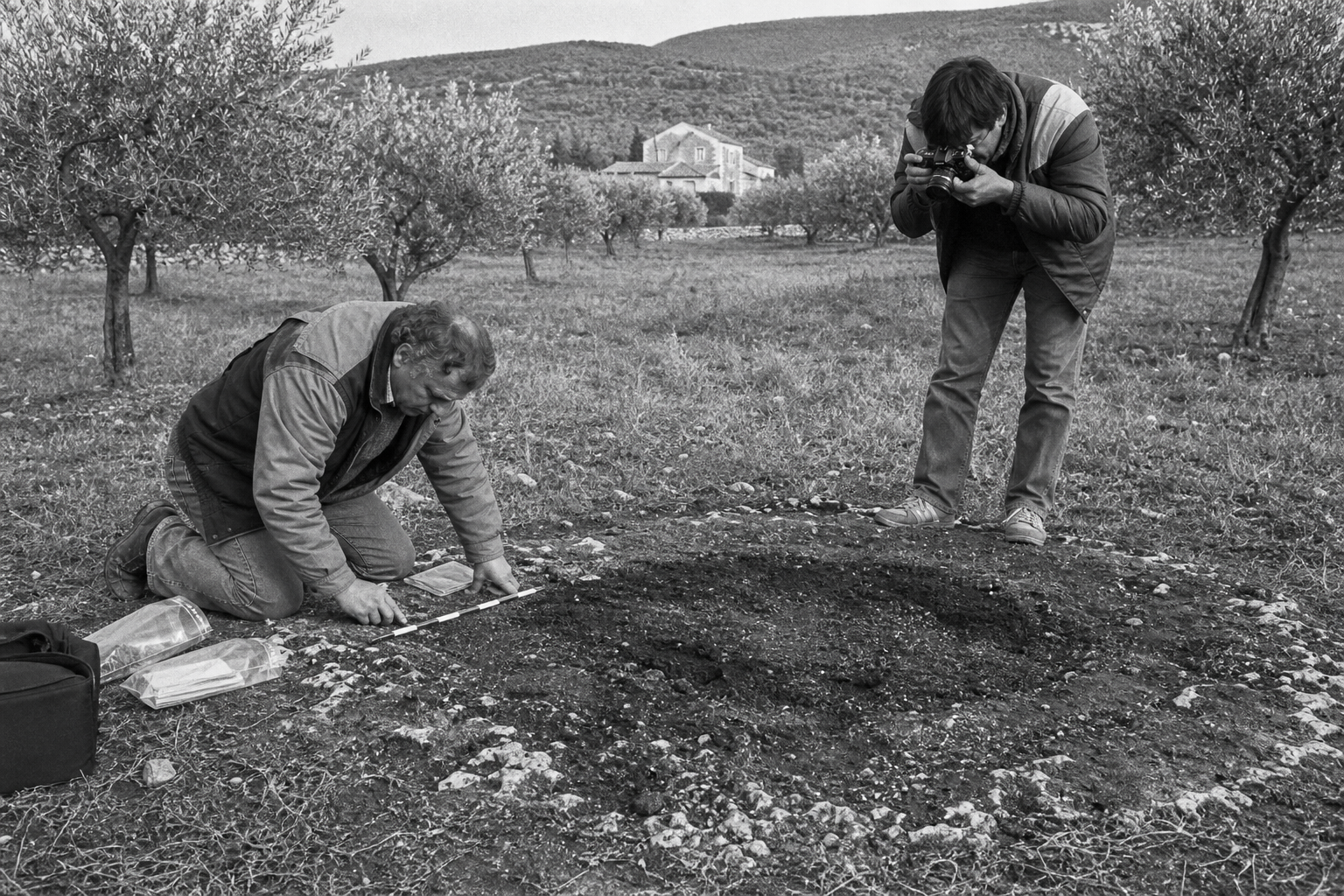
The distinction is consequential. A physical trace can show that investigators found an alteration at a specified place, while the proposed cause of that alteration remains a separate question. In the Trans-en-Provence case, interpretations of soil and vegetation findings have remained disputed, as have the weight that should be given to a single witness’s reconstruction of a short event. The file therefore illustrates both sides of COMETA’s reasoning: an inquiry may contain more than testimony alone without supplying a uniquely diagnostic result.
COMETA also referred to the SOPHIE case among the French material it regarded as worth examining in detail. Its relevance was not that a case name settled the matter, but that the authors saw a potentially meaningful fit between the reported observation and the available investigative record. For readers assessing such examples, the useful checkpoint is to separate the underlying observations, dates, original statements, instrument logs, trace analyses, and contextual data, from the explanatory conclusion later drawn from them.
That discipline also applies to the wider body of GEIPAN UFO cases. “Unexplained” is a status describing what the available record has not resolved; it is not positive evidence for one particular origin. Missing measurements, uncertain distances, incomplete radar retention, and non-exclusive interpretations of traces can leave a case open while still limiting what can responsibly be inferred from it. COMETA used its selected cases to argue for continued analysis, not to claim that any individual French investigation had proved an extraterrestrial event.
Why COMETA Considered the Extraterrestrial Hypothesis Worth Examining
COMETA’s decisive move was comparative rather than declarative. In its 1999 synthesis, the group asked which explanation could accommodate the residual cases it had selected after setting aside ordinary aircraft, astronomical objects, atmospheric phenomena, hoaxes, and reporting mistakes. The authors emphasized reports combining more than one channel of information, such as visual observations and radar data, or testimony and physical effects, and treated that convergence as more significant than an isolated light or anecdote.
The capabilities inferred from those reports shaped the comparison. COMETA highlighted accounts of objects said to accelerate rapidly, change direction abruptly, appear or depart at exceptional speed, operate without an evident propulsion system, or produce electromagnetic disturbances. Those are reported characteristics, not measured specifications: an observer’s estimate of distance or speed, a radar track with incomplete retained data, and a claimed vehicle effect each carry different uncertainties. But the authors argued that, if the strongest reports were substantially accurate, familiar civilian aircraft and known natural causes fit them poorly.
That led to the COMETA extraterrestrial hypothesis: technologically advanced visitors from beyond Earth could, in the authors’ view, provide a more coherent explanation for a limited remainder than the conventional alternatives they considered. Their conclusion was a ranking of hypotheses, often summarized as treating extraterrestrial origin as the most plausible explanation for certain cases, not an identification of a craft, its occupants, or its point of origin. Neither contact nor extraterrestrial technology had been demonstrated.
The weakness in that chain is equally concrete. Selecting striking historical files can magnify the apparent pattern while excluding the much larger population of mundane or poorly documented reports; moreover, an unresolved radar-visual case may remain unresolved because key records, calibration details, weather data, or independent observations are missing. “Difficult to explain” therefore increases the value of further inquiry, but it does not logically establish an extraterrestrial explanation. COMETA’s conclusion was the assessment of its private 1999 study group, not a finding adopted by the French state.
COMETA’s Legacy: Influential Historical Document, Not a Modern Disclosure Verdict
Its afterlife is driven less by any settled finding than by the unusual profile of the people who made the argument. In UFO disclosure and UAP disclosure discussions, the COMETA Report 1999 remains a conspicuous historical example of former French defense, aviation, scientific, and intelligence-linked specialists urging that a small residual class of reports be treated as an analytical problem rather than dismissed wholesale.
That is a narrower significance than many UFO news retellings imply. The document was published in 1999, well before the recent U.S. vocabulary, investigations, and public debate surrounding “UAP.” It was not a French government determination: COMETA was a private association, and the professional careers of its contributors did not convert its hypothesis-ranking judgment into a state conclusion.
The durable lesson is methodological. A strong anomaly claim requires more than a label of “unexplained”: it depends on the quality, convergence, and limits of the underlying testimony, instrument data, traces, and interpretation. COMETA’s authors thought some files justified keeping an extraterrestrial explanation in serious contention. They did not establish that explanation as fact, and the same evidentiary uncertainties that shaped their conclusion continue to define the limits of unresolved anomalous cases.
What the COMETA Report Still Means
Its most useful legacy is a standard of reasoning, not a conclusion to adopt. COMETA separated reports that had an ordinary, evidence-based identification from reports that were merely incomplete, then focused on the smaller residue in which witness accounts appeared to align with radar data, physical traces, or other observations. That sorting process changes the question from “Is every unidentified sighting extraordinary?” to “Which files remain anomalous after plausible conventional explanations have been tested?”
The answer remains provisional. Multiple indicators can make a case worth preserving and re-examining, but they do not eliminate uncertainty about sensor reliability, witness perception, chronology, or whether separate observations describe the same event. An extraterrestrial explanation may be a proposed fit for such a record; it is not established simply because alternative explanations are imperfect.
For later UAP policy debates, the report is therefore best read as a historical argument for disciplined case handling: retain usable data, distinguish an unresolved record from positive evidence, and state clearly where inference outruns observation. Its value lies in refusing both reflexive dismissal and unwarranted certainty.
Frequently Asked Questions
-
What was the COMETA Report of 1999?
The COMETA Report, titled Les OVNI et la Défense: à quoi doit-on se préparer?, was a 1999 French analysis of UFO reports and potential defense implications. It was published by the private COMETA association, not by the French government.
-
Was the COMETA Report an official French government report?
No. COMETA was an independent association whose contributors included retired military officers, aviation specialists, engineers, and scientists, but its conclusions were not adopted as French state policy, an intelligence assessment, or a CNES finding.
-
What did the COMETA Report conclude about extraterrestrial UFOs?
COMETA argued that the extraterrestrial hypothesis deserved serious consideration and could be the most plausible explanation for a limited group of well-documented unresolved cases. It did not claim to prove extraterrestrial visitation, identify a craft, or demonstrate extraterrestrial technology.
-
Which UFO cases did the COMETA Report consider important?
COMETA highlighted cases such as the 1981 Trans-en-Provence incident, which included a witness account, a reported ground trace, and environmental samples, and it also discussed the SOPHIE case. The report regarded these files as more significant than isolated sightings because they appeared to combine testimony with physical or investigative evidence.
-
What should researchers look for when assessing an unexplained UFO case?
Look for original radar data, precise chronology, contemporaneous witness statements, weather and air-traffic context, photographs or physical traces, and transparent testing of alternative explanations. An unexplained status alone is not evidence of extraterrestrial origin, especially when records, sensor calibration details, or independent observations are incomplete.