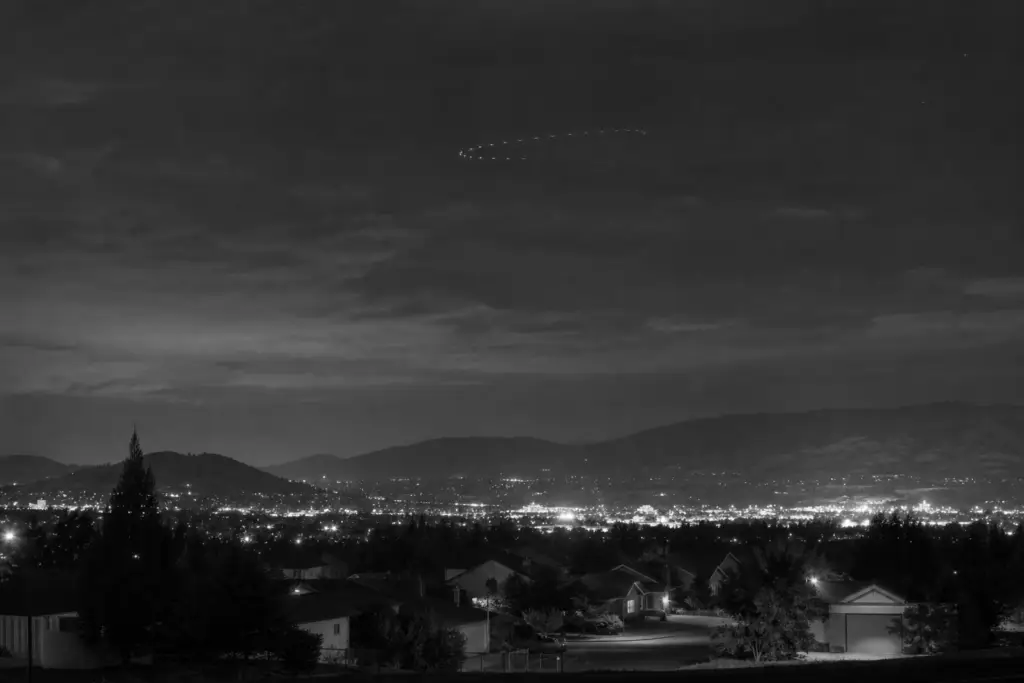
The Medford Oregon UFO sighting February 18 2020 is best treated first as a witness report: someone reportedly saw an oval-appearing object over Medford, Oregon, with lights that seemed to loop, and described it as hovering. Those are observations as perceived by the reporter, not independently established measurements of shape, distance, altitude, or motion.
“Oval,” “hovered,” and “looping lights” each describe appearance rather than identity. An object can look oval when its outline is indistinct, appear stationary when its distance is unknown, and seem to have circling or looping lights because of changing viewing angle, patterned lighting, camera effects, or the observer’s movement. None of those possibilities resolves this particular report; they show why the description cannot by itself identify what was seen.
This article therefore separates the underlying claim from later interpretation. The available record may support that an unusual aerial sighting was reported in Medford on the stated date. It does not, without independently verifiable details, establish an exotic craft, a conventional aircraft, or any other specific cause. The next step is to determine what the surviving Medford UFO report 2020 entry actually preserves, and what essential details are absent.
The Available Case Record: Source, Date, and Missing Details
The record trail is the first limitation of this case. The materials available for this article do not include a link, archive capture, case number, database publisher, or copy of an original Medford sighting submission. As a result, the February 18, 2020 date and the short description of an oval object with looping lights can be treated only as the reported case label and summary, not as metadata authenticated against a preserved primary entry.
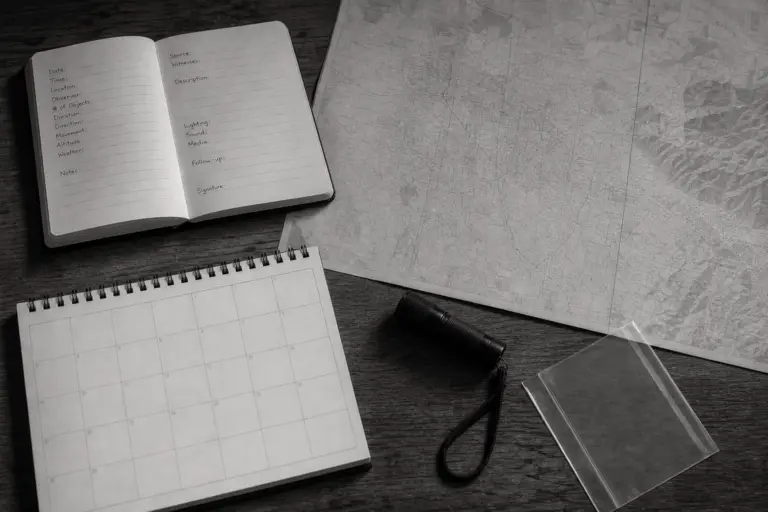
A sighting database can be useful when it retains the submitted narrative alongside fields such as the observation date, reporting date, clock time, town or coordinates, number of witnesses, duration, direction of view, and attached media. Those fields allow later researchers to compare an account with aircraft activity, astronomical objects, and weather at a defined place and time. A bare title or reposted synopsis does not offer that same analytical footing.
For this Medford Oregon UAP sighting February 18 2020, the following details are not available in the surviving material provided here:
- A precise time of observation, including time zone.
- A location more specific than Medford, Oregon, or a viewing direction.
- The witness count, whether the account was first-hand, and whether it was submitted anonymously or retrospectively.
- The full, unedited witness report, including duration, apparent size, altitude, sound, weather, and the sequence of the lights’ movement.
- Photographs, video, original files, radar data, air-traffic records, official reports, or a documented investigation.
These omissions do not establish that the event did not occur. They do mean that the account cannot yet be independently placed in time and space with enough precision to test competing explanations. Until an original sighting-database entry or comparable contemporaneous record is located, the case remains an unverified report rather than a documented identification.
What the Witness Reportedly Described
The surviving summary preserves three descriptive elements, but not the witness’s original phrasing or the order in which they were perceived. It characterizes the sighting as an oval object with looping lights over Medford, Oregon. “Oval” may describe a visible solid-looking body, a bright outline, or the overall arrangement of separate lights; the available material does not distinguish among those possibilities.
The report’s use of “hovered” likewise records an apparent lack of movement from the observer’s viewpoint. A hovering object can be genuinely stationary relative to the ground, but it can also appear fixed when it is distant, moving toward or away from the witness, or viewed without nearby reference points. Without a stated viewing direction, duration, and landmarks, the description cannot establish altitude, range, speed, or whether the object held a position over a particular part of Medford.
“Looping lights” is the most motion-specific feature, yet it remains unclear whether the lights themselves appeared to trace circles, switched on in a sequence that suggested rotation, or moved around an oval-shaped object. Those are materially different observations: lights circling a fixed point imply a different visual pattern from a stationary light array seen through changing haze or from a moving object whose orientation changes. No preserved account identifies brightness changes, colors, sound, direction of travel, or a beginning-and-end sequence for the reported movement.
The practical distinction is between what was perceived and what can be measured. An oval appearance does not supply dimensions; an apparent hover does not prove stationary flight; and looping lights do not, by themselves, identify a mechanism or craft type. The report supports retaining those features as the witness description of an unusual sighting, while leaving the object’s actual form, distance, and behavior undetermined.
Could Ordinary Sky or Aviation Sources Account for the Report?
A conventional explanation can be assessed only by matching its expected appearance and movement to the observation, rather than by treating any familiar object in the sky as an answer. That comparison cannot be completed here because the available case summary supplies no clock time, viewing direction, elevation, duration, weather conditions, or observer position beyond Medford.
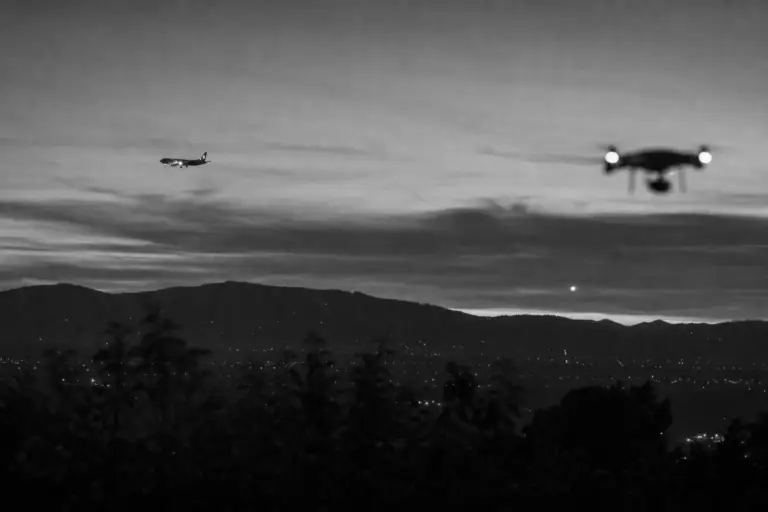
Aircraft lighting is one possibility worth separating into its components. Navigation, anti-collision, landing, and cabin or ground-reflected lights can produce changing patterns, while an aircraft approaching nearly head-on may show little obvious sideways movement. A match would require a flight at a compatible time and bearing, plus a light pattern that plausibly accounts for the reported oval appearance and apparent loops. Public flight tracks can be useful for that test, but they do not by themselves establish what a witness saw, and no track has been tied to this report.
A helicopter can appear to hold position and may display multiple lights, but its relevance would depend on a documented location, duration, sound description, and any local flight record. Drones present a different possibility: nearby small aircraft can hover and use programmed or moving light displays, yet range, scale, and the direction of travel are essential to distinguish one from a distant manned aircraft or a weather balloon seen at night. None of those discriminating details survives in the summary.
Astronomical night-sky identification also needs a time and direction. A bright planet, star, or other celestial object can remain apparently fixed, but it would not ordinarily account for genuinely looping lights without an additional visual effect. Haze, thin cloud, refraction, and an observer’s changing line of sight can alter the apparent shape, brightness, or steadiness of a light. If the “looping” occurred in video rather than solely by eye, autofocus, exposure changes, hand movement, and digital zoom would be separate possibilities to examine.
These categories remain testable alternatives, not case-specific conclusions. A meaningful identification would need the missing particulars to align: a source in the reported direction at the reported time, behavior consistent with the duration, and a credible account of the unusual light pattern. On the record presently available, ordinary aviation, astronomical, atmospheric, and perceptual explanations cannot be either matched or excluded.
Photos, Video, Radar, and Corroboration: What Would Strengthen the Case?
The evidentiary record currently available contains no original photograph, video file, image link, archival media reference, or stated chain of custody for visual material connected to the Medford report. That absence matters because photographic evidence can preserve details unavailable in recollection, such as the number and arrangement of lights, their changes over time, and a usable background for estimating direction, but only when the original file and its provenance can be examined. A reposted screenshot or compressed clip may show that an image circulated; it cannot reliably establish when, where, or how the image was made.
No multiple, independently recorded witness accounts have been identified in the material available for this article. Corroboration is more than several people repeating the same account after it has been published. Stronger corroboration would consist of separate reports from observers in the Medford area who give compatible times, viewing directions, durations, and light behavior without relying on one another’s wording. Independent accounts can narrow the object’s possible location; they still do not establish its identity without enough observational detail.
Likewise, no radar data, air-traffic record, law-enforcement record, airport report, or official investigative finding has been located and tied to the reported February 18, 2020 event. A relevant flight record could show that a tracked aircraft was in the appropriate part of the sky at a known time, while radar can sometimes provide position and movement information. Neither automatically resolves a sighting: many records do not capture every object, and a detected track must still be matched to the observer’s direction and timing.
For a single-witness public report, the most useful additions would be an unedited, time-stamped original account; original media with retained file metadata; and independently created reports from the same narrow time window. Until material of that kind is found, the case remains unverified: the description is preserved as a claim, but the record cannot test it strongly enough to identify what was seen.
Assessment: Unidentified Does Not Mean Identified as Non-Human
Identification requires particulars that can distinguish one explanation from another. Here, the available record supports only that a person reportedly described unusual lights and an oval-appearing object in the Medford area on February 18, 2020. “Oval,” “hovering,” and “looping” preserve the observer’s reported impression; they do not establish measured size, distance, altitude, speed, structure, or the independent movement of a physical craft.
An unexplained aerial sighting is a classification of information, not an identification of the object. It means the surviving details cannot reliably distinguish among potential explanations. In this instance, the missing time, viewing direction, duration, original narrative, and independently traceable supporting records prevent a meaningful match to, or exclusion of, ordinary aerial or astronomical sources.
No reliable material presently identifies the object as an aircraft, drone, astronomical phenomenon, secret technology, or anything else. That same absence provides no basis to infer an origin, advanced technology, government involvement, a government UFO cover-up, or non-human intelligence. Such conclusions require affirmative, independently testable evidence, not simply an unusual description that remains unresolved.
Thus the Medford report is unverified and unresolved because the information needed for identification is absent, not because extraordinary explanations have been demonstrated. The account should be retained as a reported observation, with its uncertainty stated plainly rather than converted into either a conventional solution or a non-human conclusion.
How to Evaluate Similar Local UFO Reports Responsibly
A useful report begins at the moment of observation: write down the exact time, location, viewing direction, duration, weather, sound, and changes in light pattern before memory is reshaped by discussion.
- Keep the original account and unedited photo or video files; copies shared through social media can lose metadata and context.
- Seek witnesses who reported independently, then compare where they stood and what each observed.
- Match the time and direction against visible astronomical objects and documented aviation activity; a candidate is meaningful only if its position and behavior fit.
- Follow a responsible UAP reporting protocol and separate a report that remains unexplained from a claim that it was extraordinary; the first reflects missing identification data, while the second needs affirmative evidence.
For comparable Oregon UFO sightings, the Medford account illustrates the consequence of missing fundamentals: a memorable description can be preserved, but without an original record, precise time and place, independent corroboration, or traceable media, it cannot carry a stronger conclusion.
The Medford Report Remains Unidentified, Not Explained as Extraordinary
The decisive issue is not whether the description sounds unusual, but whether it can be tested. In this case, the reported February 18, 2020 Medford observation retains an oval appearance, apparent hovering, and looping lights, yet lacks the particulars needed to compare those impressions against a specific aircraft, helicopter, drone, astronomical object, or optical effect.
No preserved original submission, precise observation time, viewing direction, duration, observer position, traceable image or video, independent witness account, radar return, flight record, or official finding is available in the material reviewed here. That leaves no basis for either a conventional identification or an extraordinary one. A possible ordinary explanation remains possible; it is not established merely because it is familiar.
The same standard applies in the other direction. “Unidentified” describes an evidentiary result: the available information does not permit a reliable identification. It does not supply affirmative evidence that the object was non-human, technologically exceptional, or physically a craft at all.
The lasting value of this Oregon UAP report is therefore limited but clear. It records a claimed observation that deserves to be described accurately and without embellishment. If new material emerges, its weight will depend on whether it preserves original files, fixes the time and location, and permits independent comparison with sky and aviation activity. Until then, the Medford report remains unverified and unresolved, not explained as extraordinary.
Frequently Asked Questions
What was reported over Medford, Oregon, on February 18, 2020?
A person reportedly saw an oval-appearing object over Medford with lights that seemed to loop and an apparent hovering motion. The available record does not establish the object’s shape, distance, altitude, speed, or identity.
Was the Medford oval object with looping lights ever identified?
No reliable material identifies the reported object as an aircraft, drone, astronomical object, secret technology, or non-human craft. The sighting remains unverified and unresolved because key evidence, including a precise time, viewing direction, and original report, is missing.
Are there photos, videos, or radar records of the Medford Oregon UFO sighting?
No original photographs, video files, image links, radar data, air-traffic records, official reports, or documented investigation have been tied to the February 18, 2020 report. No independently recorded witness accounts have been identified either.
Could aircraft, drones, stars, or atmospheric conditions explain looping lights?
Aircraft lights, helicopters, drones, bright celestial objects, haze, thin clouds, refraction, camera autofocus, and digital zoom are all possible categories to investigate. None can be confirmed or excluded because the report lacks a clock time, viewing direction, duration, weather conditions, and observer location.
What should you look for when evaluating a single-witness UAP report?
Look for an exact time, precise location, viewing direction, duration, weather, sound, light changes, original unedited media, and independent witness reports. Compare those details with astronomical positions and documented aviation activity, and treat an unexplained report as unidentified rather than evidence of an extraordinary craft.