Anna Paulina Luna’s UAP Task Force: What It Is, What Power It Has, and What to Watch Next
Learn what Anna Paulina Luna UAP task force can and cannot do, its oversight powers, disclosure limits, and signs of real progress.
Expectations around UAP disclosure often leap straight to hidden files and dramatic revelations. The consequential question is more procedural: what congressional mechanism exists, who can use it, and what can it compel, or merely encourage?
Representative Anna Paulina Luna’s UAP-focused work is widely called a “UAP task force,” a convenient label that can obscure the difference between a member-led congressional initiative, a standing House committee, and an executive-branch office. Those distinctions determine whether an announcement produces a binding demand, a request for information, a hearing record, or simply public pressure. They also explain why a task force cannot unilaterally declassify material held by the executive branch.
This article identifies Luna’s effort by its formal structure rather than its nickname, separates it from AARO, the former Pentagon UAP Task Force, House Oversight, and statutory records processes, and maps its real levers and limits. Then it turns to measurable next steps: published charters or membership, formal hearings and subpoenas, released records, agency actions, and legislation that advances beyond rhetoric. Those are signals of institutional movement; none alone proves the substance of any extraordinary claim.
Anna Paulina Luna’s UAP Effort: The Name Matters Before the Claims
A label becomes misleading when it substitutes for an institution. “Anna Paulina Luna UFO task force” is useful shorthand, but the relevant formal description is a House-led declassification initiative: its public identity depends on the announced charter, named chair and members, and the committee or House leadership arrangement through which it operates.
That structure is the key distinction. A congressional initiative can organize members around oversight, seek briefings and records, develop a public record, and press for declassification or legislation. It is not itself an intelligence body, a Pentagon investigative office, or an independent office empowered to release classified material. “UAP task force” should therefore describe its subject-matter focus, not imply direct control over executive-branch files or a guaranteed path to UFO disclosure.
The practical test is threefold: what formal vehicle exists; which congressional tools its participants can actually use; and whether those tools produce observable results. A published charter, identified membership, committee-backed hearing, formal records request, or enacted disclosure measure would show more than an announcement. Public appearances and broad promises may build pressure, but they do not by themselves establish investigative authority, compel agency production, or declassify a record.
Four Entities Often Confused in UAP News
Names in UAP news can describe entirely different centers of power. The comparison below keeps the institutional boundary visible.
| Entity | Where it sits and what it does | Records, reporting, and public role |
|---|---|---|
| Luna’s House-led initiative | A congressional, member-organizing effort focused on declassification and oversight. Its practical work can include coordinating members, seeking briefings, developing requests, and advocating hearings or legislation. | Its route to records and formal action depends on participating members’ committee assignments and support from the relevant House or committee leadership. Its public role is political oversight and agenda-setting, not executive investigation or unilateral release of classified files. |
| House Oversight Committee | A standing House committee, rather than a UAP-specific body. It has an established jurisdiction, procedures, and leadership structure for investigations and hearings. | Committee action can create a formal public record and, when authorized through its procedures, use oversight tools unavailable to an informal member group. Membership alone does not give any individual member unrestricted access to classified programs. |
| Unidentified Aerial Phenomena Task Force (UAPTF) | A former Pentagon-led task force that examined unidentified aerial phenomena for defense and intelligence purposes. | It operated inside the executive branch, using departmental channels rather than congressional oversight processes. It is a historical reference point, not Luna’s initiative and not the current executive-branch office. |
| All-domain Anomaly Resolution Office (AARO) | An executive-branch office created to address reports of unidentified anomalous phenomena across domains. Its job is operational and analytic: receiving, assessing, and reporting through the Defense Department structure. | AARO can draw on information available through authorized executive-branch processes and produces designated public-facing reports or materials. It does not function as a House task force, and a congressional initiative does not direct its internal work. |
The useful checkpoint is simple: a House effort can press for answers; a standing committee can turn that pressure into formal oversight; and an executive office can investigate within its assigned system. Treating any one of those roles as interchangeable obscures what a claimed UAP disclosure development can actually change.
What Power Does Luna’s Task Force Actually Have?
Influence begins well before compulsion. Luna’s members can ask agencies for briefings, seek voluntary production of records, coordinate questions for witnesses, and use public statements to focus attention on a defined issue. Those steps can expose conflicting accounts or identify which office controls a disputed record, but an invitation to brief or produce documents is not an enforceable order.
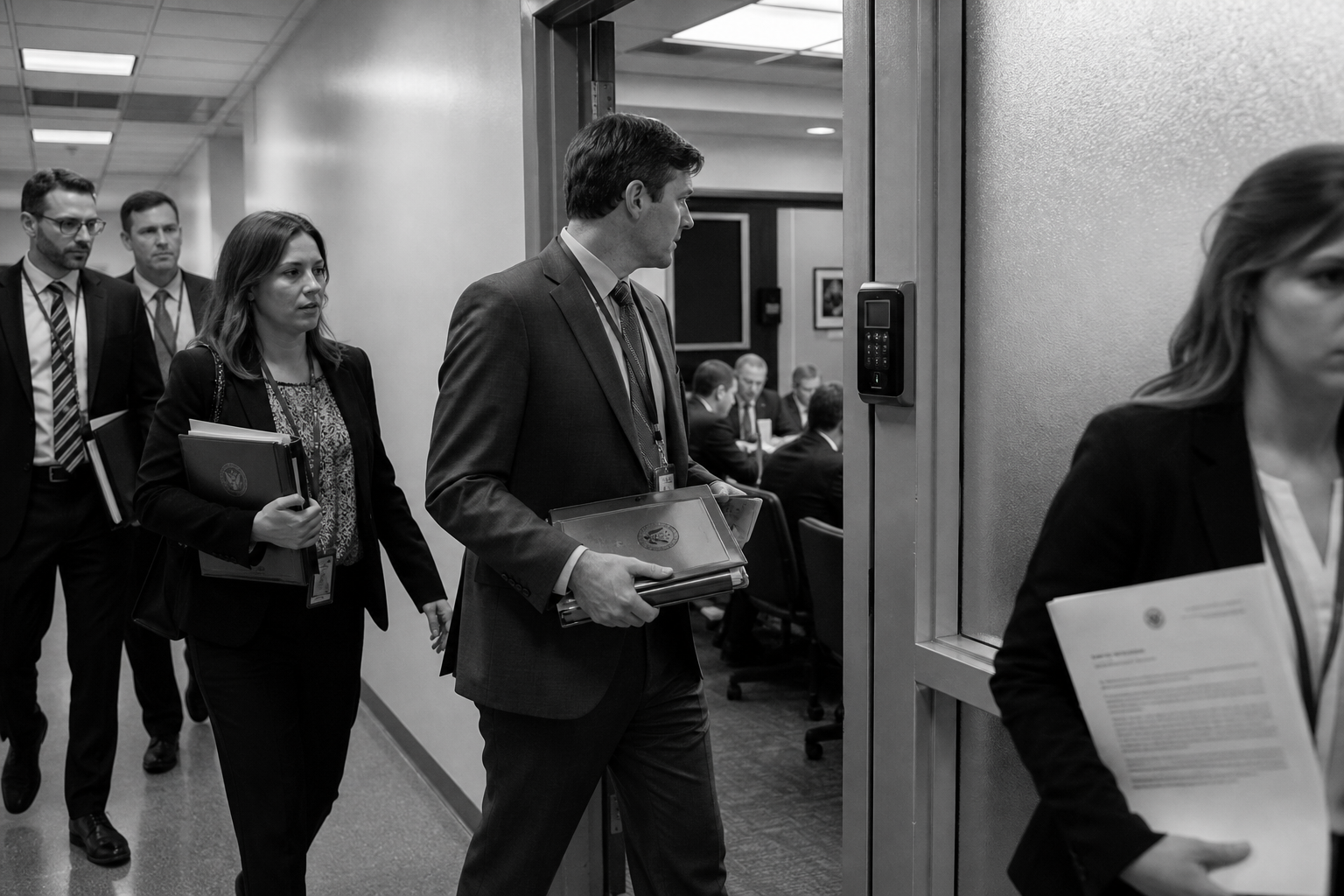
Members can also refer apparent misconduct or mishandling of information to an inspector general, preserve testimony in correspondence or a hearing record, and turn identified gaps into proposed bills or amendments. Each tool has a different result: an inspector-general referral asks an independent oversight office to examine a matter; a legislative proposal seeks to change an obligation or provide funding; and a hearing can place sworn testimony and agency responses in a public congressional record. Together, those actions are the practical leverage behind an Anna Paulina Luna declassification task force.
Formal congressional oversight requires the institution that holds the relevant authority to act. A committee chair and committee procedures determine whether a hearing is scheduled, which witnesses are called, and whether a request escalates. Committee subpoena power is not automatically held by an individual representative or an informal working group; it depends on a properly authorized committee process under House rules.
The limits are equally important. The task force itself cannot unilaterally declassify executive-branch records, order an agency to release classified material, compel a criminal prosecution, or treat an allegation as established fact. Nor can it convert testimony about alleged non-human intelligence into an official confirmation. Those outcomes would require action by the officials and institutions with responsibility for classification, investigation, adjudication, or official findings.
The strongest early sign of progress is therefore not a dramatic claim. It is a visible escalation from informal advocacy to a defined institutional act: a formal request, a committee-backed hearing, a documented response, or legislative text that identifies a specific disclosure obligation.
Where the Effort Can Gain Traction, and Where It Can Stall
Momentum often begins by concentrating scattered interest into a sequence of asks. Coordinated members can press the same agency questions, seek closed-door briefings that permit discussion of classified material, and use public attention to make a missed response more costly. A letter requesting a dated reply does not compel production by itself, but it creates a benchmark: a substantive written answer, a refusal grounded in a stated rationale, or silence that a committee may choose to pursue.
Appropriations and legislative bargaining can raise the stakes. Members may seek reporting requirements, deadlines, review provisions, or limits on how funds are used; those provisions matter most when they survive negotiation and become enacted text. A proposed amendment or transparency hearing about alien disclosure, by contrast, shows a political position rather than a new legal obligation. Cross-member coordination also helps identify whether a records issue belongs with defense, intelligence, archives, or another jurisdiction.
Several bottlenecks can stop that progression. Classification rules and tightly held compartments restrict what can be discussed publicly even after a private briefing. Committees can compete over jurisdiction, agencies can resist broad requests, and a small congressional operation must divide limited staff time among many priorities. House attention can also shift quickly, leaving a request without a hearing, follow-up letter, or legislative vehicle.
The evidentiary standard should remain separate from the oversight process. Testimony alleging crash-retrieval programs, non-human intelligence, or a government UFO cover-up may justify focused questions, protected reporting channels, and efforts to locate records; it does not establish those allegations without corroboration. Durable policy change likewise requires agreement beyond a House initiative: the Senate and president must participate for a bill to become law. The meaningful measure is sustained institutional follow-through, not the intensity of the claims.
Records, Review Boards, and Legislation: Where UAP Disclosure Can Change
Public access changes through several distinct channels, and each has a different endpoint. An agency declassification review decides whether particular classified material can be released, withheld, or released with redactions. A classification challenge can force reconsideration of that decision, but it does not itself make a record public. An inspector general inquiry can examine alleged misconduct, retaliation, or improper handling of information; its value is an investigative record and potential corrective action, not an automatic public release.

The National Archives process operates differently. A UAP records collection can centralize identified federal material, make its existence easier to track, and establish a publication pathway. Transfer into a collection is therefore a meaningful accountability step, but it is not proof that every underlying document has been declassified or posted in full. Researchers should distinguish a collection index, a released document, and a redacted or postponed record.
The Schumer-Rounds UAP Disclosure Act proposal shows why legislative labels require care. Its more ambitious design contemplated a review board and a structured process for locating, reviewing, and disclosing relevant records. Those proposed review-board provisions did not become the final enacted framework. The surviving UAP-records provisions may still require agencies to identify and transfer qualifying material for the National Archives collection, creating a durable paper trail even where release remains subject to lawful withholding and review.
That gap between proposal and enactment matters. Authorization language establishes what a program may or must do; appropriations supply operational resources; implementation deadlines turn text into scheduled agency work. A statutory records mandate is stronger than a congressional request, yet its practical result still depends on agency searches, classification decisions, transfers, archive processing, and publication. The consequential signal is not an announcement that disclosure language was introduced, but completed transfers, published finding aids, release decisions, and explanations for material that remains withheld.
What to Watch Next: Signals That the Task Force Is Producing Results
Rank developments by the paper trail they create, not by the intensity of the announcement.
- Published structure: a charter, named membership, or committee relationship clarifies who participates and through which institutional channel the effort can act.
- A hearing with a record: a notice, witness list, written testimony, archived video, and follow-up questions create something testable. A hearing announcement alone does not.
- Escalated oversight: committee-authorized subpoenas or transcribed interviews show movement beyond informal conversations because they preserve witness accounts and define unanswered issues.
- Agency commitments and deadlines: a public letter that names an office, requests specific records, and sets a response date creates a measurable checkpoint. The stronger result is a written agency answer, briefing commitment, or released unclassified summary.
- Text that can change obligations: introduced appropriations or authorization language matters only when its reporting requirement survives committee action, passes both chambers, and becomes law with an identified responsible office and deadline.
- External outputs: National Archives collection postings and Inspector General findings can show whether records were located, transferred, reviewed, or whether an inquiry produced corrective conclusions. Neither, by itself, proves every underlying allegation.
Weak signals include vague social-media teasers, unnamed-source claims, recycled UAP sightings, and headline-driven UFO news without records, witnesses, deadlines, or follow-through. Individual incidents may warrant investigation, but they are not evidence that congressional disclosure mechanisms are advancing. The useful measure is whether each public claim produces a dated document, an accountable office, and a next action that can be observed.
Bottom Line: Judge the Effort by Documents, Authority, and Follow-Through
Use a simple scorecard for every new claim: What record was obtained? Who gave testimony on the record? What obligation, appropriation, or deadline changed? What public release followed? A press appearance may raise attention; a dated letter with a named recipient creates a narrower but testable measure of follow-through.
That distinction matters when coverage of UFO sightings 2025 or UFO sightings 2026 attaches a new incident to congressional activity. A case-level allegation can justify questions, but verified institutional action requires a traceable House, agency, National Archives, Inspector General, or enacted-law outcome.
The durable standard for UAP disclosure is therefore documentary and procedural, not theatrical. Oversight can create pressure, preserve testimony, and widen transparency; it cannot, by itself, establish that any unexplained event has an extraterrestrial explanation.
The Real Test Is What Changes on the Record
The next announcement should be treated as a claim to be tested, not a result to be assumed. Political visibility can bring reluctant institutions into view, but it becomes consequential only when an identifiable office must answer, act, release, preserve, fund, or explain its refusal.
- A hearing or transcribed interview creates attributable testimony and questions that can be compared with later agency answers; a promotional event does not.
- A formal letter with a response deadline identifies the records sought and the accountable recipient. Its value rises if an agency provides documents, gives a specific withholding rationale, or misses the deadline in a way that prompts further action.
- A subpoena or committee-directed demand would mark an escalation beyond voluntary cooperation, but it would still not establish the truth of a witness’s underlying allegations.
- A released record set permits public scrutiny of what was produced, redacted, or withheld. A promise of future release does not supply that evidence.
- Enacted policy, rather than introduced text, can create a continuing duty, deadline, funding condition, or reporting requirement that survives a news cycle.
That is the practical measure for UAP disclosure: not the task-force label or the scale of a prediction, but whether its activity leaves an enforceable and inspectable public record.
Sources
Frequently Asked Questions
-
What is Anna Paulina Luna’s UAP task force?
Anna Paulina Luna’s UAP task force is a House-led declassification and oversight initiative, not an executive-branch investigative office. Its members can coordinate requests, seek briefings, advocate for hearings, and propose legislation related to UAP records.
-
Does Anna Paulina Luna have the power to declassify UFO files?
No. Luna’s initiative cannot unilaterally declassify executive-branch records, order agencies to release classified material, or confirm allegations as official fact. Declassification decisions remain with the responsible executive-branch officials and established review processes.
-
Is Luna’s UAP task force part of the House Oversight Committee?
Luna’s initiative is a member-organizing House effort, while the House Oversight Committee is a standing committee with established jurisdiction and procedures. The initiative’s ability to obtain formal oversight action depends on members’ committee assignments and support from committee or House leadership.
-
What is the difference between Luna’s UAP task force and AARO?
Luna’s initiative is a congressional effort focused on oversight, declassification advocacy, hearings, and legislation. AARO is a Defense Department executive-branch office that receives, assesses, and reports on unidentified anomalous phenomena through authorized government channels.
-
What should UAP disclosure watchers look for next in Congress?
Look for a published charter and membership list, committee-backed hearings, formal letters with response deadlines, transcribed interviews, authorized subpoenas, and written agency responses. The strongest evidence of progress is enacted legislation, released records, National Archives postings, or Inspector General findings rather than social-media announcements or unverified claims.