AARO’s Unresolved Cases: What We Know
Explore AARO unresolved cases, what unresolved status means, why evidence falls short, and how to assess official UAP reports responsibly.
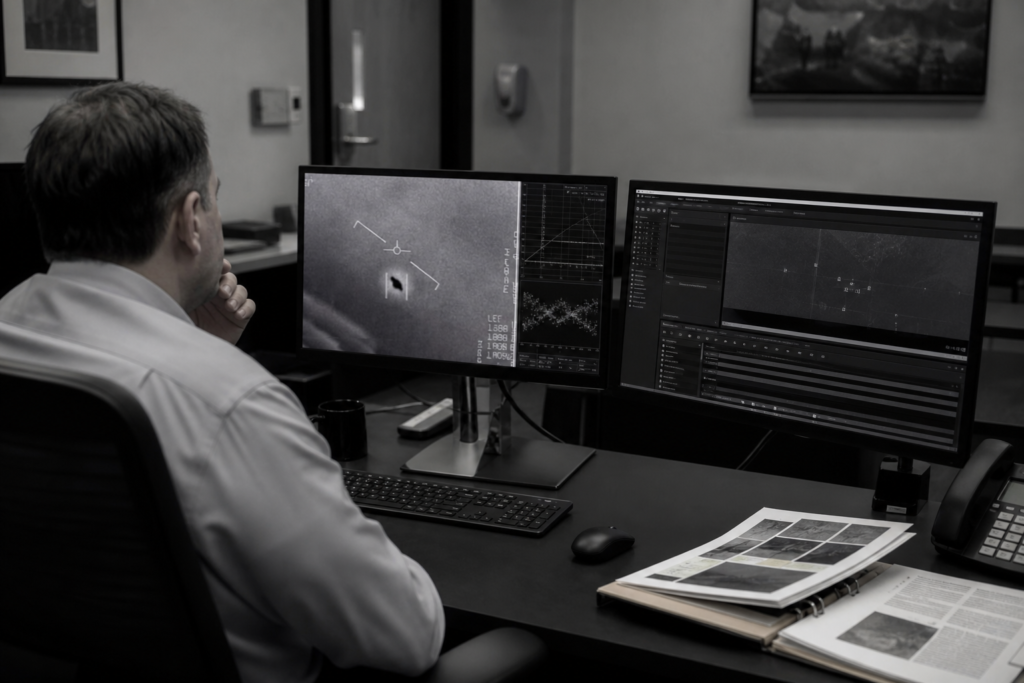
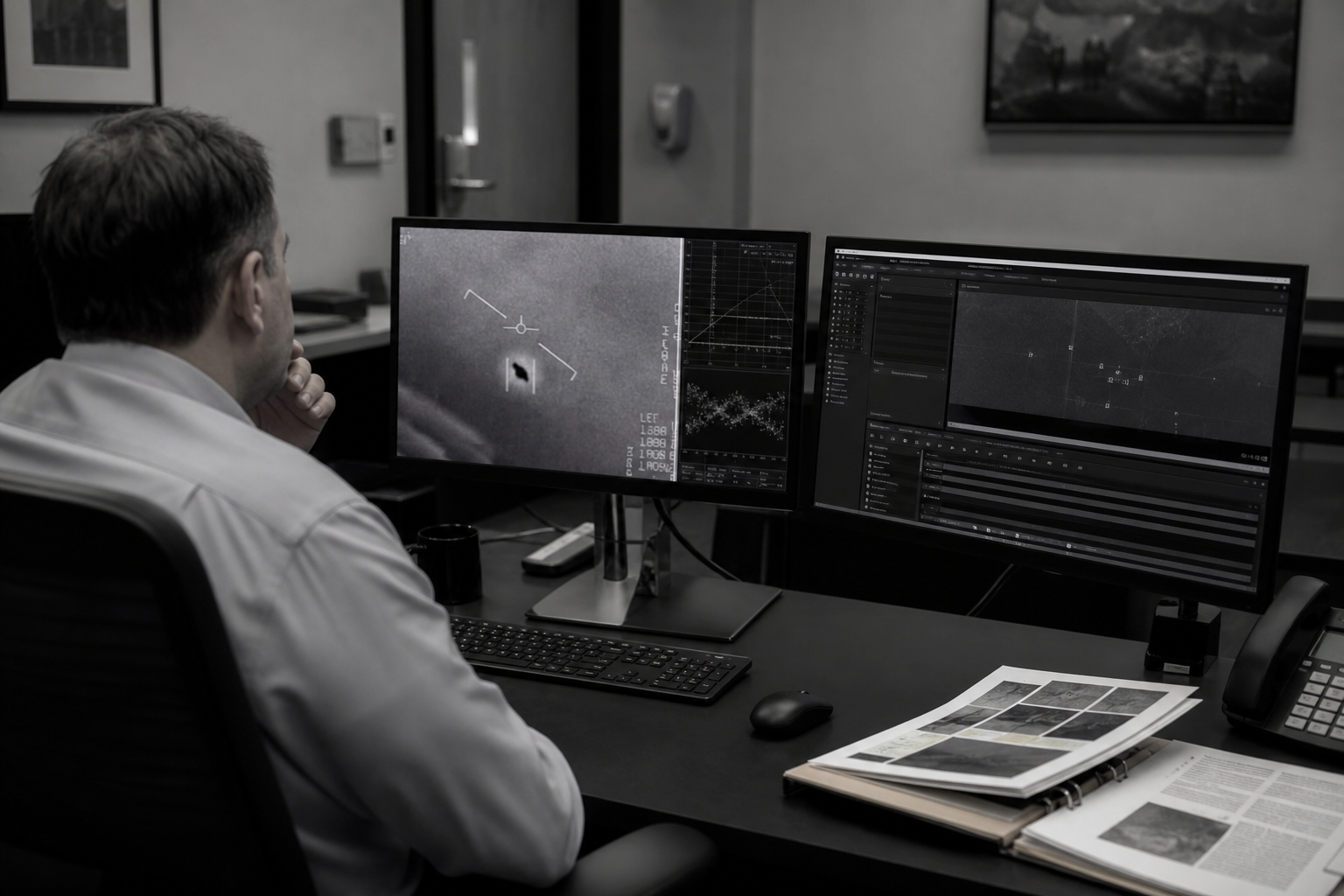
Public interest often treats an unresolved UAP report as a clue to a single extraordinary answer. It is not. AARO unresolved cases are, first and foremost, cases that available information has not yet allowed analysts to attribute confidently to a particular object, phenomenon, or source.
That distinction matters. “Unresolved” describes the state of the evidence and the attribution process; it does not confirm a non-human origin, a foreign system, a threat, or even that every reported observation reflects a distinct physical object. A brief video without supporting sensor data is a weaker basis for attribution than a report with time, location, platform details, calibrated imagery, and independent corroboration. Neither category should be inflated beyond what its evidence can bear.
This article separates the public record into its essential parts: dated reported totals, AARO’s case-status terminology, the practical limits of imagery and sensor data, and the conclusions that do not follow from a case remaining open. The aim is neither to dismiss UAP cases nor to fill gaps in the record with speculation, but to show precisely what is known, and where uncertainty remains.
What AARO Means by an “Unresolved” UAP Case
The Department of Defense office established to centralize the handling and analysis of UAP reports, or AARO, handles reports of unidentified anomalous phenomena. Its case-resolution work is an attribution exercise: analysts seek enough reliable information to connect an observation to a particular object, source, or phenomenon.
That makes the labels important. A resolved report has been attributed with sufficient confidence. A characterized report may have useful descriptive features, such as a recorded shape, motion, or sensor signature, without a final attribution. Insufficient data identifies a specific evidentiary problem: the available material cannot support a sound assessment. “Pending review” describes workflow rather than a conclusion; it should not be read as either resolved or unexplained.
In that framework, an unresolved case is not a finding that an object displayed extraordinary capabilities or came from a non-human source. It is the remaining category when the available record does not justify a more specific attribution. A clear image accompanied by reliable time, location, sensor, and contextual information can be assessed differently from a short clip detached from those details.
This article uses “unresolved” narrowly and does not assume that every public label reflects the full underlying file. Public AARO materials can show how the office describes and counts cases, but they are not a window into every classified collection, operational detail, or analytic method. The absence of a public explanation therefore establishes only a limit on the public record, not the existence of a hidden extraordinary explanation.
How Many Cases Are Publicly Unresolved, and Why the Number Needs a Date
A public total is meaningful only when it is attached to a particular AARO publication date and reporting cutoff. The materials available for this section do not include a dated AARO annual report or official update that supports a current numerical count, so it would be misleading to present a figure for AARO unresolved cases as though it were current through August 2026.
The useful way to read any future AARO table is to separate its columns rather than treating every reported sighting as an unresolved case. Reports received measures intake: submissions can be new, duplicated, incomplete, or awaiting review. Resolved measures the subset that analysts have attributed. A remaining category, whether described as pending, uncharacterized, or lacking enough information for attribution, shows the work not represented by the resolved total. Those categories answer different questions, so subtracting one headline number from another can produce a false “unexplained” count.
A date also matters because the underlying set is not fixed. New reports can enter the system after a reporting cutoff; duplicate or misfiled submissions can be consolidated; and an older file can move into a resolved category when additional sensor data, context, or analysis becomes available. Conversely, a revised reporting method can change how an aggregate is displayed without describing a new event.
The practical checkpoint is simple: cite the report’s publication date, the period it covers, and the exact table label used for the number. A weak claim gives a bare total. A strong claim identifies whether the figure describes all received reports, resolved cases, or cases still awaiting attribution. Even then, an aggregate does not disclose why every individual file remains in that last group.
Why Some UAP Reports Cannot Be Resolved From the Available Evidence
The decisive problem is often not whether an observation looks unusual, but whether the available record permits measurement. A brief sighting may capture an object at one moment without establishing its distance, altitude, size, direction of travel, or persistence. Those missing variables can make an apparently dramatic motion impossible to interpret reliably.

Sensor data is not a single kind of proof. An electro-optical image records visible light; infrared imagery records heat contrast; radar estimates position or movement through returned signals. Each can be valuable, but each answers a different question and can be affected by viewing angle, range, weather, background clutter, calibration, or the limits of the system’s field of view. A radar return alone may indicate that a system registered something; it does not, by itself, identify the thing that produced the return.
- Short observation windows: A few seconds of footage may not show an object before or after the recorded segment. Without that wider track, analysts may be unable to distinguish an object’s movement from the motion of the platform or camera.
- Incomplete context: Missing time, location, sensor settings, aircraft position, or chain-of-custody information weakens the ability to compare a report with known activity or environmental conditions. This is the practical meaning of insufficient data: not necessarily bad evidence, but evidence too incomplete for a defensible attribution.
- Lack of corroboration: A visual report becomes easier to assess when it can be compared with independent instruments, other observers, or a continuous track. A single image or isolated witness account can be important, yet it may leave too many possible explanations open.
- Uncertain range and speed: Apparent velocity depends on knowing distance and perspective. An object of unknown range can seem to move far faster, or more slowly, than it actually does.
Public release introduces a separate limitation. Operational details, collection methods, and associated data may not appear in a releasable image or summary. That absence does not establish that withheld material supports any particular explanation. It means the public record may be narrower than the underlying file, a constraint especially relevant when assessing Pentagon UFO office unresolved cases from clips rather than the full analytic context.
What Resolution Looks Like: Attribution, Misidentification, and Remaining Uncertainty
A defensible resolution links an observation to a specific, evidence-supported cause rather than merely attaching a plausible label. The link might come from a continuous track, matching flight information, a known launch or satellite pass, imagery clear enough to identify physical features, or sensor data whose geometry has been reconstructed.
That process can produce several different outcomes. Balloons and airborne clutter can drift in ways that appear unusual when distance and wind conditions are initially uncertain. A drone may be identifiable through its shape, flight profile, location, or connection to authorized activity. Birds can generate brief visual or radar observations that lack the stable features of an aircraft. Satellites and conventional aircraft can be matched to their expected position and path. A sensor effect, by contrast, attributes the apparent anomaly to the way an instrument, display, or viewing geometry rendered a signal, not necessarily to an object with the observed apparent motion.
Misidentification therefore does not mean that a witness invented an event. It means the initial interpretation of what was seen changed after additional context made a more ordinary attribution supportable. The important distinction is between a conclusion that accounts for the available observations and a guess that merely sounds familiar.
A case remains open when that evidentiary bridge cannot be built. A distant object that resembles a balloon in one frame is not responsibly classified as a balloon without information that distinguishes it from other possibilities. Conversely, a well-supported attribution in one report does not supply an explanation for every other report. For AARO unresolved cases, the proper question is always whether the evidence supports this particular conclusion for this particular event.
What Publicly Released UAP Videos Do, and Do Not Establish
A video can preserve a real sensor recording without preserving the measurements needed to identify what appears in it. Department of Defense release establishes that the released clip came from a military system and was cleared for public distribution; it does not, by itself, establish an object’s size, range, speed, intent, or origin.
The Nimitz UAP footage illustrates the distinction. A short infrared clip can show an airborne contact as rendered by an aircraft’s sensor, but its on-screen appearance is not a direct physical measurement. Interpreting apparent motion requires the aircraft’s movement, camera angle, tracking mode, range information, and the full sequence of observations. A public excerpt may therefore be authentic while remaining insufficient for viewers to calculate performance or identify the contact.
The same caution applies to the Go Fast video UAP. A fast-moving image on screen may reflect the observer’s own speed, viewing geometry, sensor tracking, or an object’s distance as well as the object’s actual motion. “Fast” is a description of the clip’s appearance, not a demonstrated conclusion about extraordinary velocity.
Electro-optical and infrared imagery are useful because they record light or heat-related signal data, often with instrument overlays. They differ from an ordinary visual account, but they are not self-interpreting: overlays require context, and a single sensor perspective can leave key variables unknown.
Publicly available material does not establish whether either named incident is presently among AARO unresolved cases. A released clip, later commentary about it, and an AARO case-status determination are separate records. Treating public fame as proof of an open case would collapse those distinctions.
What an Unresolved Case Cannot Responsibly Prove
Extraordinary conclusions require affirmative evidence that distinguishes them from ordinary uncertainty. An unresolved observation does not do that work. It cannot, by itself, establish an alien craft or non-human intelligence, because the status identifies a gap between the available record and a defensible attribution; it does not identify a maker, a technology, or an intent.
The same distinction applies to claims of a crash-retrieval program. A report of an object that has not been identified is an observation-level matter. A recovery claim concerns a separate chain of evidence: a physical object, documented custody, technical examination, and findings that rule out terrestrial origin. Without that chain, joining an unresolved sighting to a recovery narrative is speculation rather than a demonstrated connection. Testimony and allegations may warrant public interest or further inquiry, but they are not equivalent to verified findings.
Nor does an incomplete public account, standing alone, demonstrate a government UFO cover-up. Classification can narrow what outside observers can scrutinize, particularly when records reveal collection capabilities, military operations, or sensitive sources and methods. That limitation makes transparency questions legitimate: the public may reasonably ask what was withheld, on what basis, and whether an unclassified summary can convey the analytic conclusion. But nonpublication has more than one possible explanation. It is not affirmative evidence that concealed material proves alien disclosure or an extraordinary origin.
A useful evidentiary checkpoint is whether a claim supplies information that would change the competing explanations. A weak signal is simply that a case remains unresolved or that details are unavailable. A stronger signal would be independently assessable material, such as authenticated physical evidence with a documented chain of custody, reproducible analysis, and clear provenance, that specifically supports one hypothesis over others. Until evidence reaches that standard, unresolved status should remain a record of uncertainty, not a substitute for proof.
How to Follow AARO’s Record Without Overreading It
A disciplined reading begins with the record closest to the underlying claim. For case counts and status labels, start with a dated AARO report; for released footage, use the relevant Department of Defense release; for disclosure requirements or hearings, use the statute or congressional record itself. The UAP Records Collection at the National Archives is useful for locating publicly available government records, but an archive entry is not automatically a final analytic finding.

- Identify who made the claim and link it to the original publication rather than a repost, clip, or headline.
- Record both the publication date and the reporting period. A number presented in UFO sightings 2025 coverage may describe an earlier collection window, while UFO sightings 2026 coverage may update, or merely repeat, it.
- Separate the original sensor context from edited public media: note what system recorded the event, what metadata or accompanying material is available, and what remains absent.
- Distinguish a reported observation, an unresolved case status, and a confirmed attribution. They describe different stages of the record and should not be treated as interchangeable.
That sequence keeps AARO unresolved cases in proportion. An unresolved label can justify continued attention and better evidence gathering; it does not establish an extraordinary explanation. The responsible conclusion is narrower: the public evidence available for that case has not supported a reliable identification.
The Bottom Line on AARO’s Unresolved Cases
The most useful conclusion is deliberately limited: AARO unresolved cases mark the boundary of what the available evidence can presently support. They preserve an observation for further analysis; they do not convert uncertainty into evidence for a preferred explanation, and they do not erase the possibility that a real event was observed.
That boundary is why precise language matters. “Reported” records an allegation or observation. “Attributed” means the available material supports a particular explanation. “Unresolved” leaves the attribution question open because the record may lack the measurements, context, corroboration, or accessible detail needed to decide it. Those are different evidentiary positions, not competing narratives.
Readers following future AARO reports should treat every total as a dated snapshot, not a permanent scorecard. A later review can add information, revise a classification, or place newly received reports into the public accounting. The stronger signal is not a dramatic headline number, but a clearly dated official publication that identifies its reporting period, categories, and limits.
In short, AARO unresolved cases warrant attention proportionate to the quality of the underlying record. Start with AARO and Department of Defense materials, retain the agency’s exact status language, and ask what information would actually distinguish among explanations. Until that information is available, uncertainty is the conclusion, not a substitute for one.
Sources
Frequently Asked Questions
-
What does AARO mean when it says a UAP case is unresolved?
An unresolved case is one that AARO cannot confidently attribute to a specific object, source, or phenomenon using the available evidence. It does not establish extraordinary capabilities, non-human origin, foreign involvement, or even a distinct physical object.
-
How many UAP cases does AARO still list as unresolved?
No current unresolved-case total is supported without a dated AARO report and its reporting cutoff. AARO totals must distinguish reports received, resolved cases, and categories such as pending review, uncharacterized, or insufficient data.
-
Why can AARO not resolve some UAP reports?
Some reports lack the measurements needed to determine distance, altitude, size, speed, direction, or persistence. Short video clips, missing time and location data, uncertain sensor settings, and no independent corroboration can prevent a defensible attribution.
-
Does an unresolved AARO case mean it is alien or non-human?
No. Unresolved status records an evidentiary gap, not a finding about an object’s maker, technology, intent, or origin. Evidence for a non-human claim would require independently assessable material such as authenticated physical evidence, documented custody, and reproducible analysis.
-
What should you look for when evaluating AARO case counts or released UAP videos?
Use dated AARO or Department of Defense records and check the publication date, reporting period, and exact case-status label. For video, look for time, location, platform details, sensor settings, range information, continuous tracking, and corroboration rather than relying on a short public clip.