Washington, D.C. ‘UFO Flap’ (1952): Radar, Jets, Headlines, and the Policy Fallout
Explore the Washington D.C. UFO flap 1952: radar reports, jet scrambles, headlines, Air Force response, and its policy fallout.
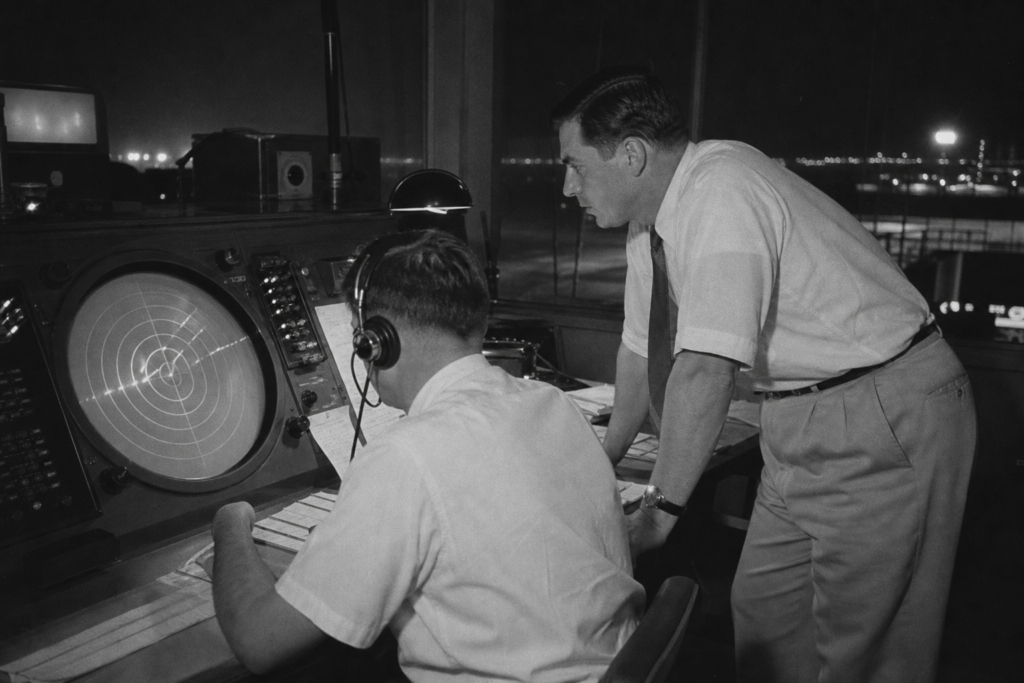
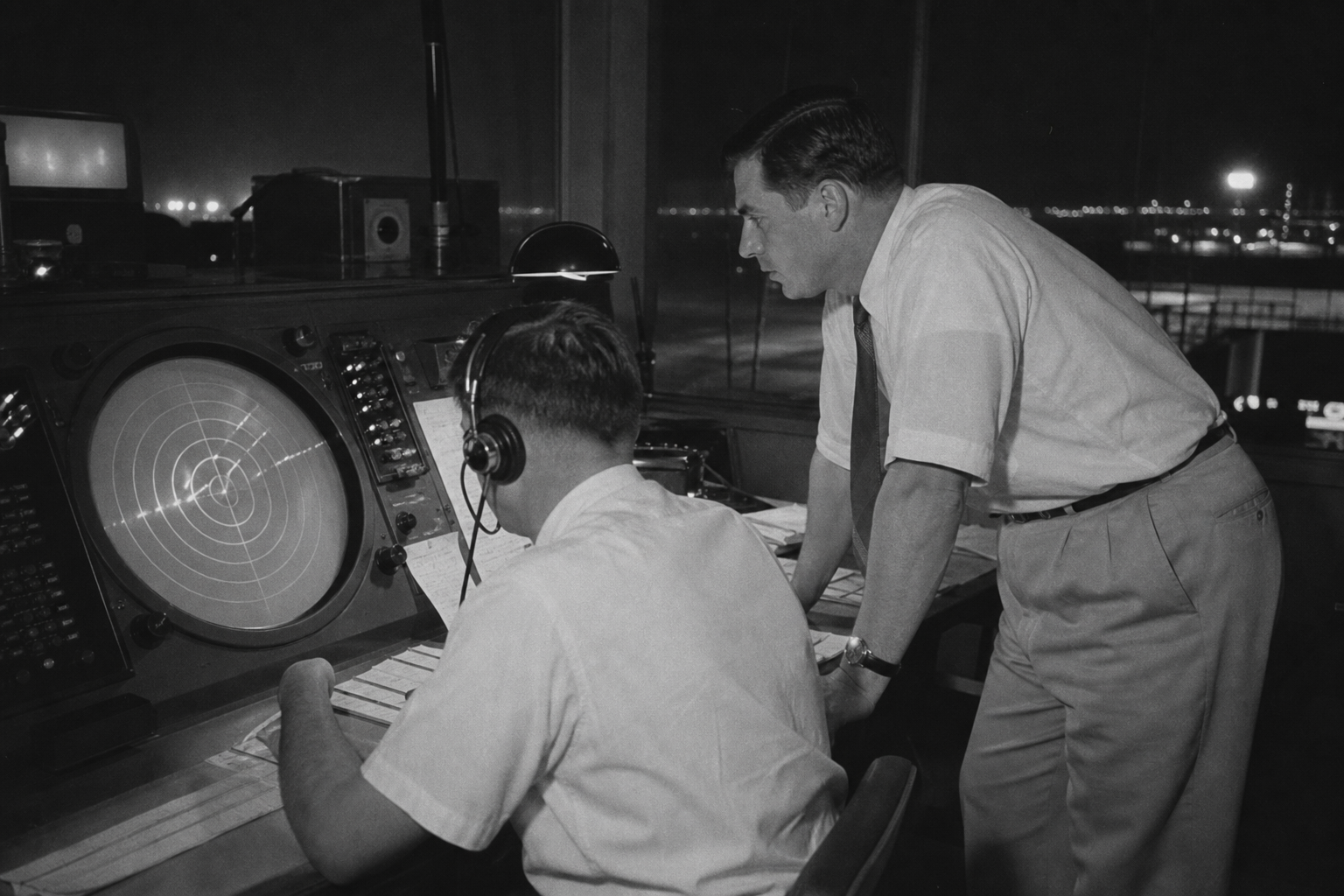
On two July weekends in 1952, unidentified targets appeared on radar screens and as lights in the skies over and around the American capital. The Washington D.C. UFO flap 1952 unfolded above a city whose nearby airports, military installations, and federal institutions made any unexplained air activity especially charged in the early Cold War.
This was not one uniform observation. Controllers reported radar returns; aircrews and people on the ground described lights; interceptor jets were sent aloft; and the Air Force faced the harder task of explaining ambiguous evidence while the story spread through national headlines. A radar target records an electronic return, not an identified object; a visual report records what a witness perceived, not necessarily its distance, speed, or origin. Their overlap made the incidents compelling, but did not by itself settle the cause.
The account that follows reconstructs the two weekends in sequence, separates contemporaneous reports from later interpretation, and examines the Air Force’s temperature-inversion explanation without treating it as a shortcut around the remaining questions. It then follows the episode beyond the runways and radar rooms: through Project Blue Book, the CIA-sponsored Robertson Panel, and a public-information strategy shaped by concern that widespread UFO reports could burden air-defense systems and public confidence.
Why the Washington UFO Flap Became a National Story
What made the July 19–20 and July 26–27 episodes nationally consequential was the collision of aviation uncertainty with the symbolic vulnerability of the capital. Reports involved radar positions at Washington National Airport and Andrews Air Force Base, activity in airspace near major federal institutions, and, on the second weekend, Air Force F-94 interceptor sorties. In the early Cold War, an unidentified track near Washington could not be treated merely as a curiosity: it raised the immediate possibility of an unauthorized aircraft, a sensor error, or an air-defense gap. Each possibility demanded a different response, yet the available reports did not neatly choose among them.
The Washington UFO flap therefore became a public-information crisis as well as an operational one. Reports from controllers, pilots, and ground observers were carried beyond control rooms and airfields into national newspaper coverage, while the Air Force had to address public alarm without claiming more certainty than the evidence allowed. A radar return records an echo on a scope; a visual account preserves a witness’s perception of a light or motion; an interceptor scramble establishes that officials considered the reports important enough to investigate. Those are different evidentiary facts, not interchangeable proof of an object’s identity. Their convergence over two successive weekends explains the scale of the UFO news, and why the episode still resists a single, settled conclusion.
The First Weekend: Radar Returns Around Washington, July 19–20
Shortly before midnight on July 19, controllers at Washington National Airport began reporting a cluster of unexplained primary-radar returns southwest of the field. Primary radar displays echoes by range and direction; unlike a dedicated height-finding system, they did not by themselves establish altitude. The returns appeared to move through restricted-looking airspace, then changed position in ways the controllers could not immediately match to known traffic. Washington National Airport radar personnel also sought corroboration rather than treating one scope as decisive.
The Air Route Traffic Control Center, which handled en-route aircraft rather than local tower traffic, reported corresponding unidentified targets on its radar. Andrews Air Force Base personnel subsequently reported radar activity as well. That multi-site element is central to the first weekend’s significance: several facilities described displays they could not promptly identify, but agreement that echoes appeared is not the same as a complete, instrument-derived reconstruction of individual objects.
Contemporaneous summaries describe targets that seemed to hover, move slowly, or accelerate rapidly, while some tower personnel and aircrews reported lights in the area. Yet the surviving record is largely narrative, controller recollections, logs, and later investigative summaries, not a full archive of synchronized radar plots. It therefore supports a careful conclusion: unidentified radar returns were reported around Washington on July 19–20, including at National, Andrews, and the traffic-control center; it does not securely fix every target’s track, speed, altitude, or physical identity. Those limits would become especially important when the reports returned the following weekend.
The Second Weekend: Visual Reports and Scrambled F-94 Interceptors
Reports resumed on the evening of July 26, bringing another round of radar activity near Washington and visual observations from people on the ground. The Air Force ordered F-94 Starfire interceptors into the area. An F-94 was a two-seat, radar-equipped night fighter: its purpose was to let a pilot and radar observer investigate an unknown track after dark, not simply to add a dramatic aircraft to the story.
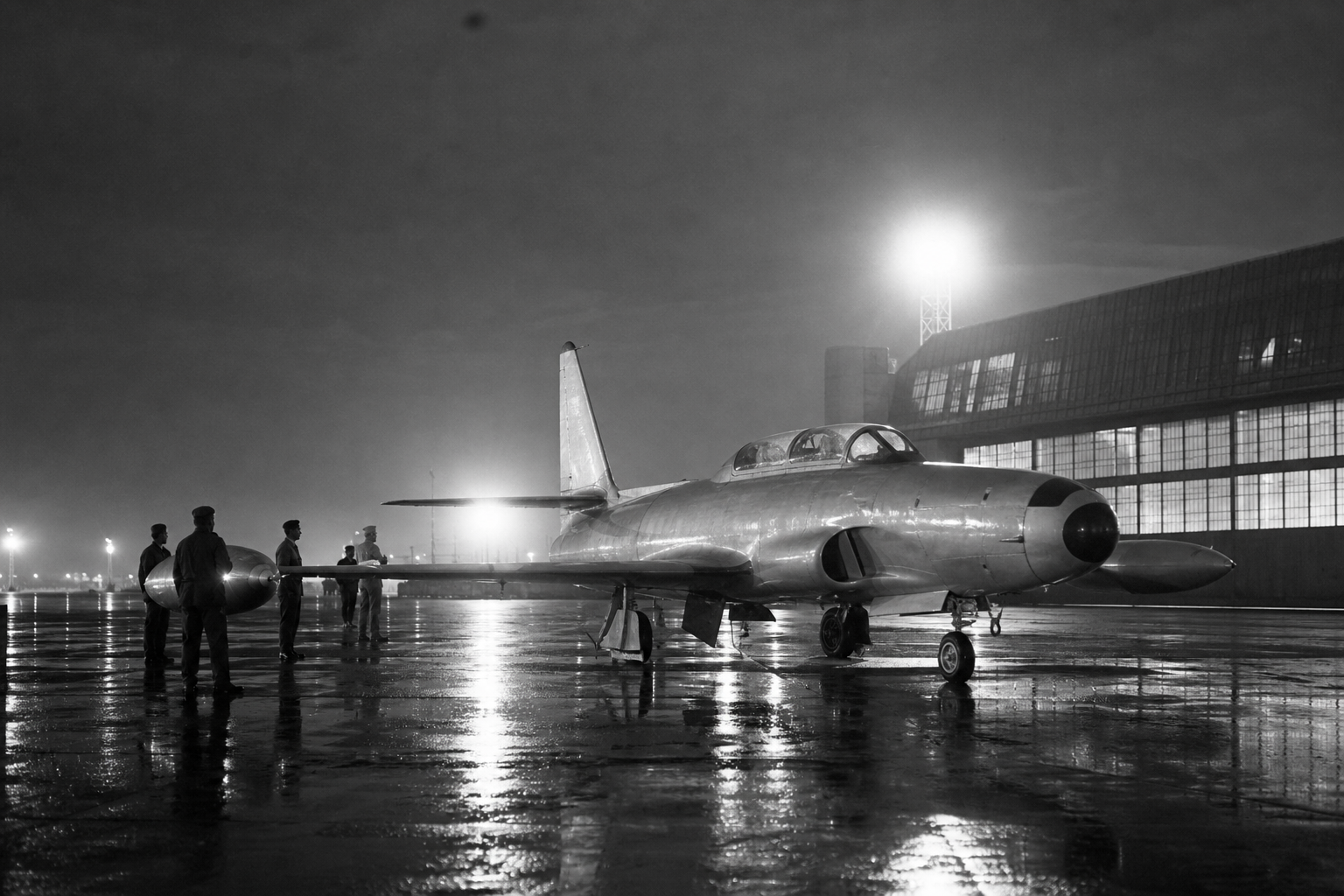
The dispatches are documented; a clean interception is not. Controllers directed the crews toward reported positions, but the radar returns did not remain in a stable enough relation to the jets for an identification. In the surviving accounts, one crew reported lights in the vicinity, while other airmen did not obtain a visual target or a radar contact that could be held and identified. Ground personnel likewise described lights or objects at particular moments, yet their observations did not produce a single, shared position, altitude, or course that the interceptors could test.
That distinction matters in recounting the 1952 Washington UFO incident. A scramble shows that air-defense authorities considered the reports serious enough to investigate; it does not show that the fighters caught, chased, or measured an extraordinary craft. Later retellings often turn the episode into prolonged jet pursuits and spectacular speeds. The contemporary record supports a narrower conclusion: scrambled F-94 interceptors searched an unsettled pattern of radar and visual reports on July 26–27, but neither their crews nor the ground stations secured the definitive identification that a successful interception would have provided.
Radar, Witnesses, and the Limits of the Record
The crucial question is not whether every observation can be placed on one map, but whether particular observations genuinely corroborate one another. A radar-only report records an electronic echo without a matching visual observation. A visual-only report records a light, shape, or motion seen by a person without an instrumented track. Either can be significant to an investigator, but neither alone establishes an object’s identity, altitude, size, or intent.
A radar-visual correlation is stronger in principle: a controller, crew, or observer sees a light in the same direction and at the same time as a radar return. Yet it becomes persuasive only when the correlation is precise enough to connect the two, consistent time, bearing, range, and, where possible, altitude and course. The Washington accounts contain overlapping radar and visual reports, but not a continuous, shared track that tied every light to every return or to an interceptor observation. An identified aircraft, by contrast, would require enough information to match the report to a known flight or physical target.
That gap explains both the case’s force and its limits. Mid-century radar could display echoes affected by atmospheric and operational conditions, while nighttime witnesses could accurately report lights without being able to determine distance or source. “Unexplained” therefore describes the state of identification in the surviving record; it is not affirmative evidence of non-human intelligence. But it also does not justify declaring every report conclusively resolved. The most defensible reading preserves the separate evidence streams and the uncertainty left when they fail to converge.
The Air Force Response: Temperature Inversions and a High-Stakes Press Conference
The Air Force’s working explanation focused on the atmosphere rather than on a single airborne intruder. A temperature inversion occurs when a layer of warmer air sits above cooler air, reversing the usual temperature pattern. In those conditions, radar energy can bend or travel farther than operators expect; echoes from distant terrain, aircraft, or other reflective sources may appear in misleading positions on a display. This anomalous propagation could make returns seem to move, appear, or vanish in ways that did not represent a conventional target’s actual course.
That assessment addressed the radar problem without automatically identifying every reported light. Officials also treated nighttime visual observations as a separate category: stars, ordinary aircraft, and other familiar lights can look unusual when distance, altitude, and motion are difficult to judge. The practical distinction was important. An atmospheric explanation for a radar return did not prove that a particular witness had seen the same phenomenon, just as a reported light did not establish a physical object at the radar-indicated location.
Edward J. Ruppelt, the Air Force officer directing Project Blue Book, the Air Force UFO investigation program, was part of the effort to gather and assess the Washington reports. Its role was to collect cases, seek ordinary identifications, and flag reports that appeared to have defense implications. Its files preserved an official investigative judgment, not an instrument record capable of reconstructing every moment of either weekend.
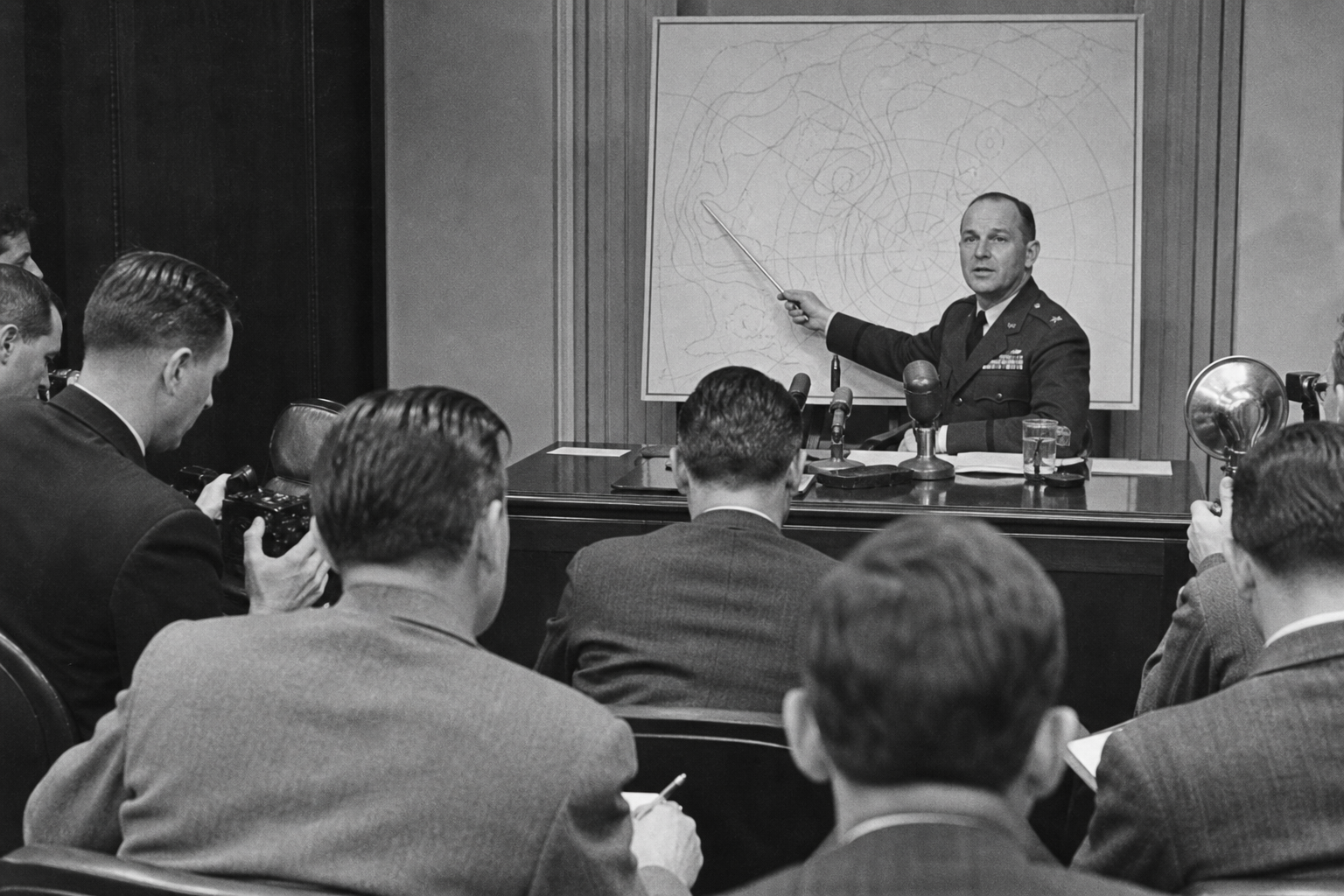
At a major Air Force press conference, officials publicly emphasized the inversion explanation and argued that the available reports did not demonstrate extraordinary craft over Washington. The briefing was a consequential attempt to impose an intelligible account on a fast-moving national story. It should be read as the Air Force’s contemporaneous assessment of a mixed body of radar and visual reports, not as retroactive certainty that every detail had one demonstrated cause.
Headlines, Public Alarm, and the Road to the Robertson Panel
Wire-service dispatches and prominent newspaper coverage gave the story a second life beyond the July nights themselves. The repeat appearance of radar reports, followed by the July 26–27 F-94 scrambles, gave editors a developing sequence rather than a single isolated sighting. The 1952 UFO headlines made the Air Force’s public explanation part of the event: officials had to reassure readers without suggesting that reports near the capital had been ignored.
The resulting concern was institutional as well as public. A continuing flood of UFO reports could consume military reporting channels and make it harder to distinguish a genuine air-defense warning from rumor, misidentification, or an anomalous radar return. CIA Scientific Intelligence treated that vulnerability seriously because an adversary could exploit public fascination and communications congestion even without possessing an extraordinary aircraft.
In January 1953, the CIA-sponsored Robertson Panel brought together scientists to assess UFO reports in national-security terms. Its question was not whether the Washington incidents established extraterrestrial craft; it was whether the volume and publicity surrounding such reports could create mass alarm or impair warning systems. The panel recommended better collection and evaluation of reports while using public education, including material distributed through mass media, to reduce unwarranted public interest.
That recommendation changed the emphasis around Project Blue Book. The Air Force program would still receive cases and seek identifications, but its work also fitted a wider strategy of separating potentially useful observations from noise and preventing every unexplained report from becoming a perceived emergency. Later readers sometimes apply the phrase “government UFO cover-up” to this posture. The Robertson Panel record documents information-management and public-education recommendations; it does not itself demonstrate concealed extraterrestrial evidence.
What the 1952 Case Means for Today’s UAP Disclosure Debate
Modern interest in UFO disclosure and UAP disclosure makes the Washington case newly resonant, but it does not change the evidentiary status of the July 1952 record. The documented core remains a set of radar reports from multiple facilities, visual reports of lights, interceptor deployments, and an Air Force assessment that atmospheric inversion conditions could account for misleading radar echoes. Those categories overlap, but they are not interchangeable proof of one identified object.
That distinction is a useful discipline for any later claim. A strong account separates an instrument reading from an observer’s interpretation, records whether independent observations match in time and direction, and states what data are missing. A weak account begins with an unexplained element and treats it as confirmation of a preferred cause. Military readiness and public attention made uncertainty consequential in 1952; they did not resolve it.
Whistleblower allegations, present-day hearings and formal UAP reporting, and searches for UFO sightings 2025 belong to a later debate with different records and standards. They cannot retrospectively identify the Washington returns or lights. The durable lesson is not that officials should dismiss ambiguity, or that ambiguity establishes an extraordinary answer. The Washington D.C. UFO flap 1952 remains important, genuinely disputed in parts, and not conclusive proof of any single extraordinary explanation.
The Lasting Lesson of Washington’s 1952 UFO Crisis
At the July 29, 1952 Air Force press conference, the central test was not whether every report shared one cause, but whether the available evidence justified an extraordinary one. Radar returns at Washington National Airport and the Air Route Traffic Control Center, lights reported around the capital, and F-94 interceptor scrambles each warranted attention in the moment; none supplied a complete reconstruction. The temperature-inversion account offered a mechanism for misleading radar echoes, but it did not identify every reported light or restore detail missing from the surviving record.
Headlines turned the two July weekends into a national crisis. Repeated reports over Washington and the second weekend’s interceptor response increased pressure for a decisive Air Force statement. In January 1953, the CIA-sponsored Robertson Panel treated the volume and public impact of UFO reporting as a communications and readiness problem as well as an investigative one.
Washington’s 1952 crisis is most useful as a case study in managing uncertain aerial incidents: preserve raw radar data, test whether a sighting and track coincide in time and direction, and state plainly what an explanation does and does not cover. Transparent public communication should avoid both ridicule and overclaiming. “Unexplained” describes an evidentiary remainder; “extraordinary” is a conclusion requiring substantially stronger evidence.
Frequently Asked Questions
-
What happened during the Washington, D.C. UFO flap of 1952?
On July 19-20 and July 26-27, 1952, controllers at Washington National Airport, Andrews Air Force Base, and the Air Route Traffic Control Center reported unidentified radar returns near the capital. Ground observers and aircrews also reported lights, creating a high-profile air-defense and public-information crisis.
-
Did radar confirm UFOs over Washington, D.C. in 1952?
Radar confirmed that unidentified echoes appeared on multiple radar displays, but it did not identify them as physical UFO craft. The surviving records do not provide complete synchronized tracks, verified altitudes, speeds, or identities for every target.
-
Were fighter jets sent after the 1952 Washington UFO sightings?
Yes. During the second weekend, July 26-27, the Air Force scrambled F-94 Starfire interceptors, two-seat radar-equipped night fighters, to investigate the reported radar activity and lights. The crews did not secure a stable radar contact or visual identification of a target.
-
What was the Air Force explanation for the Washington UFO flap?
The Air Force emphasized temperature inversions, in which warmer air sits above cooler air and can bend radar energy or extend its range. This anomalous propagation could create misleading echoes from distant terrain, aircraft, or other reflective sources, but it did not identify every reported light.
-
What should investigators look for when evaluating radar and visual UFO reports?
Investigators should look for precise matches in time, bearing, range, altitude, and course between a radar return and a visual observation. A strong case preserves raw radar data and distinguishes an electronic echo, a witness report, and a confirmed identified aircraft rather than treating them as the same evidence.