UAP Sensors and Data: Radar, Infrared, Electro-Optical Video, Geometry, and Common Failure Modes
Learn how UAP sensors measure radar, infrared, video and signals, and why calibration, geometry and context shape UFO data analysis.
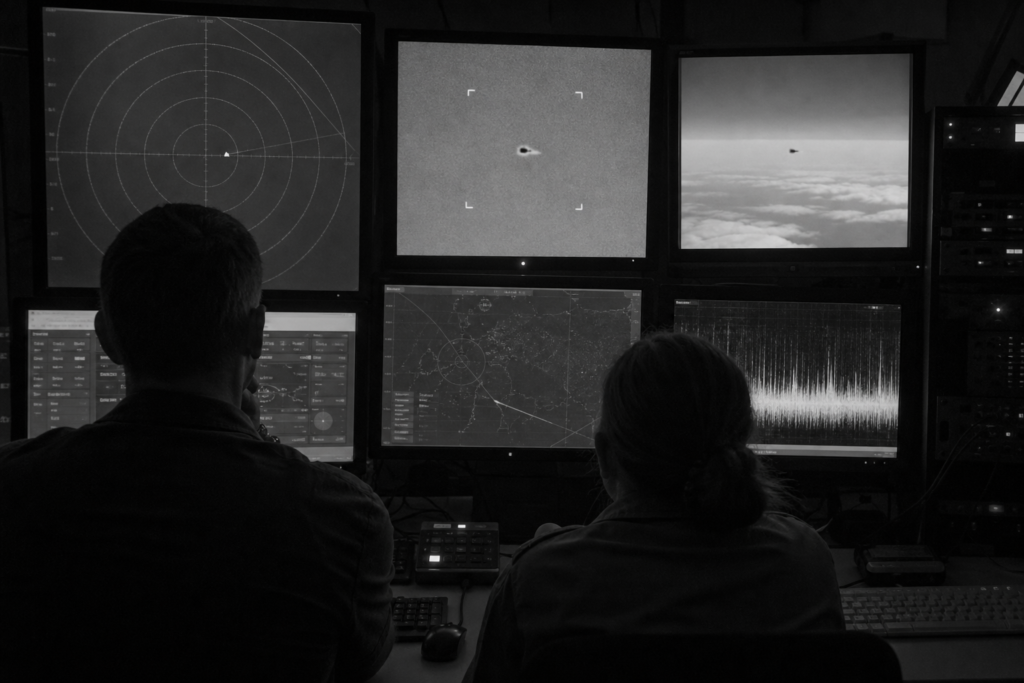
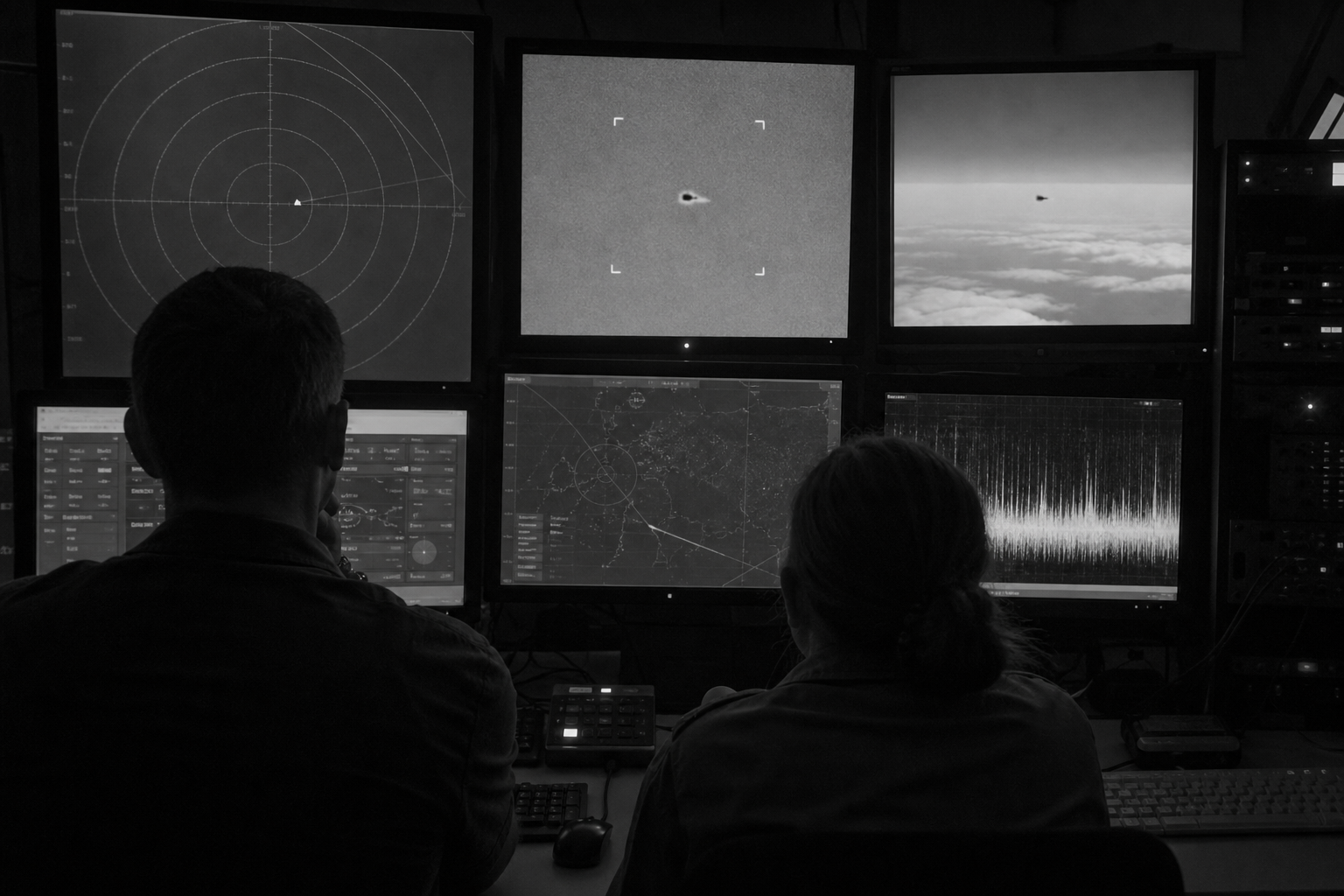
A striking clip or a pilot’s report can be compelling, but it is not the same thing as a complete account of what was observed. UAP sensors do not record “anomalies” as such; they collect limited measurements that analysts must place in context. Radar measures reflected radio energy and can estimate position or motion. Infrared records differences in emitted thermal radiation, not a ready-made temperature or object identity. Electro-optical video records a two-dimensional visible-light image, where zoom, perspective, focus, and stabilization can alter apparent motion. Signals intelligence captures radio-frequency emissions, which may characterize a transmitter without revealing the platform that produced it.
That distinction matters because an unidentified observation is a state of knowledge, not a conclusion about a physical object’s origin or capability. A distant target can seem to race across a frame when the camera or observer is moving; an infrared display can make a cool background and a warm object look more dramatic than their temperatures imply; a radar track can depend on geometry, processing, and the quality of the return. A short, cropped piece of UAP footage with no timing, location, sensor settings, or platform motion is therefore weak evidence for performance claims. A stronger case links calibrated measurements from independent systems, aligns them in time, and tests whether they describe the same geometry. The sections ahead separate what each instrument directly measured from what people infer from it, and from the ways ordinary conditions can look extraordinary.
A UAP Is an Unidentified Observation, Not a Sensor Conclusion
A useful analysis begins by labeling the evidentiary step rather than jumping to an explanation. A detection is a sensor registering something: a radar return, a bright infrared contrast, pixels in a video frame, or a radio-frequency signal. A track is a series of detections that processing associates as one continuing target. That association can be wrong when returns merge, a camera slews, or software follows background clutter.
Correlation asks whether records from different systems refer to the same event at the same time and place. Identification goes further: it matches the observation to a known object, source, or phenomenon using discriminating evidence. Attribution is stronger still, assigning an identified system to an operator or origin. Each step narrows uncertainty; none is supplied automatically by a compelling display.
Claims of extraordinary speed, acceleration, maneuverability, or origin sit beyond detection and usually beyond a simple track. They require derived quantities such as range, velocity, and orientation, which depend on calibrated instruments, reliable timestamps, platform position and motion, viewing geometry, and an account of display processing. A video’s apparent angular movement, for example, is not a measured physical speed without distance and geometry.
For UAP data analysis, the practical checkpoint is whether independent measurements converge on one reconstruction. Preserving uncertainty, what was measured, what was inferred, and what remains unknown, is more informative than treating “unidentified” as a sensor verdict.
Radar: What It Measures, What It Can Infer, and Where It Can Fail
Radar begins with a pulse or beam of radio energy and the energy that returns to the antenna. Primary radar measures that reflection: its delay provides range, antenna pointing provides azimuth (horizontal bearing), and, on a suitably designed system, elevation provides vertical angle. Secondary surveillance radar instead interrogates a cooperating aircraft transponder, which can reply with an identity code and, when available, pressure altitude. A primary return therefore need not carry an aircraft identity or altitude at all.
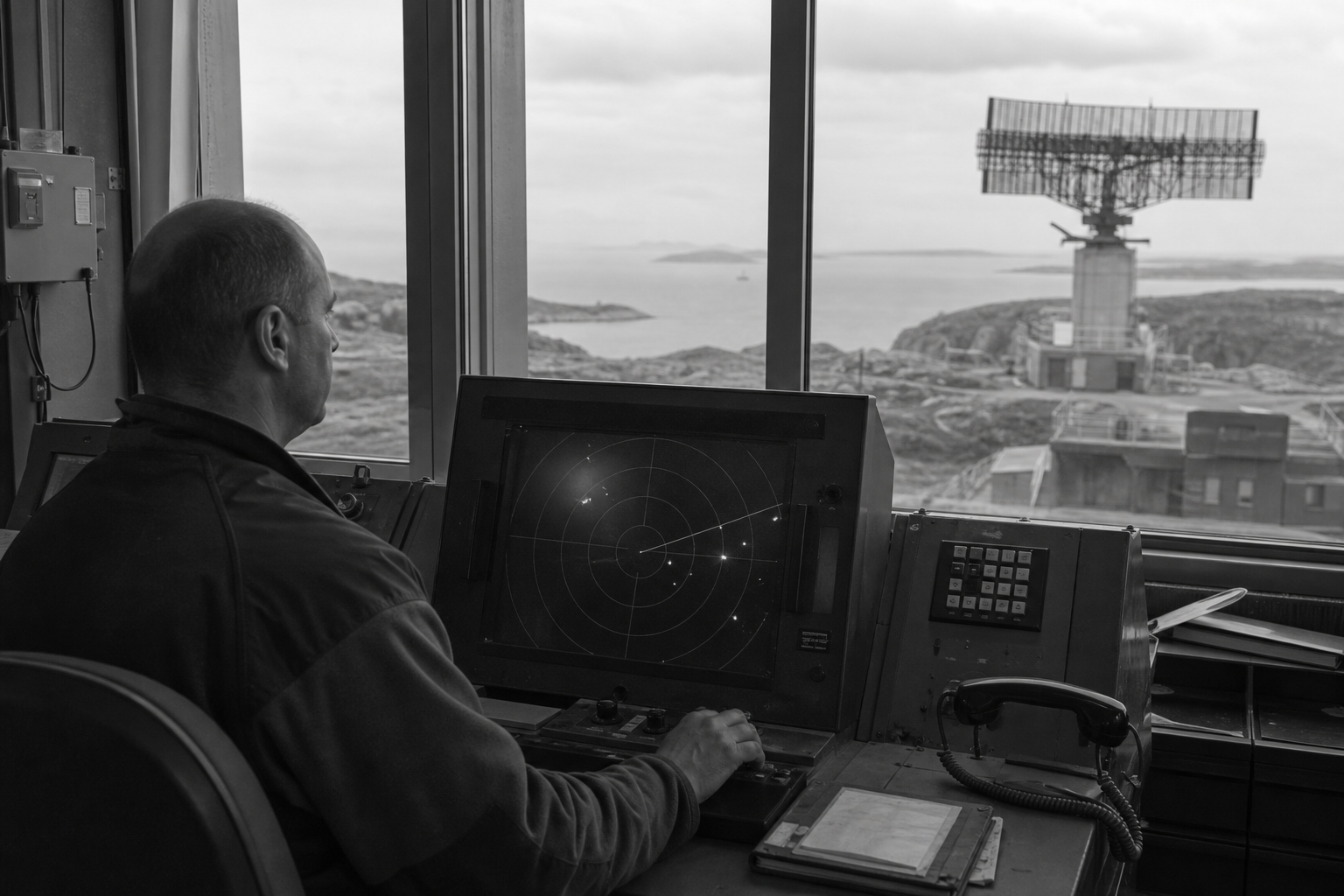
Return strength is not a simple size meter. It varies with radar cross section: the effective reflectivity of a target at a particular frequency and aspect. Shape, orientation, material, range, and weather can change it. Ground, sea, precipitation, birds, and insects can also create clutter; multipath can make a signal reach the radar by both direct and reflected paths, shifting apparent position or creating intermittent returns. Unusual atmospheric propagation can likewise extend or bend radio paths.
A radar display commonly shows a track file, software’s best association of returns over successive scans, rather than an untouched physical trajectory. When two close returns combine, a track can merge; when one fluctuating return is treated as separate targets, it can split. Doppler processing adds radial velocity, motion toward or away from the radar, not total three-dimensional speed. It may also be ambiguous when sampling limits make different velocities resemble one another.
For a claim of extreme speed or acceleration, useful UAP radar data must include time-stamped positions across multiple updates, the radar’s location and scan geometry, altitude or elevation information, platform motion where relevant, sensor accuracy, processing details, and uncertainty bounds. A sequence with only range and bearing can establish changing line of sight, but missing altitude, gaps, or track-association errors can radically change the reconstructed motion.
Infrared and FLIR: Heat Contrast Is Not a Temperature Reading
A forward-looking infrared (FLIR) system turns infrared radiation entering its optics into a contrast image. It does not place a thermometer on the target. A bright or dark patch in infrared UAP footage can show that the target differed from its background in the sensor’s selected band, but cannot by itself establish its temperature, size, range, material, or purpose.
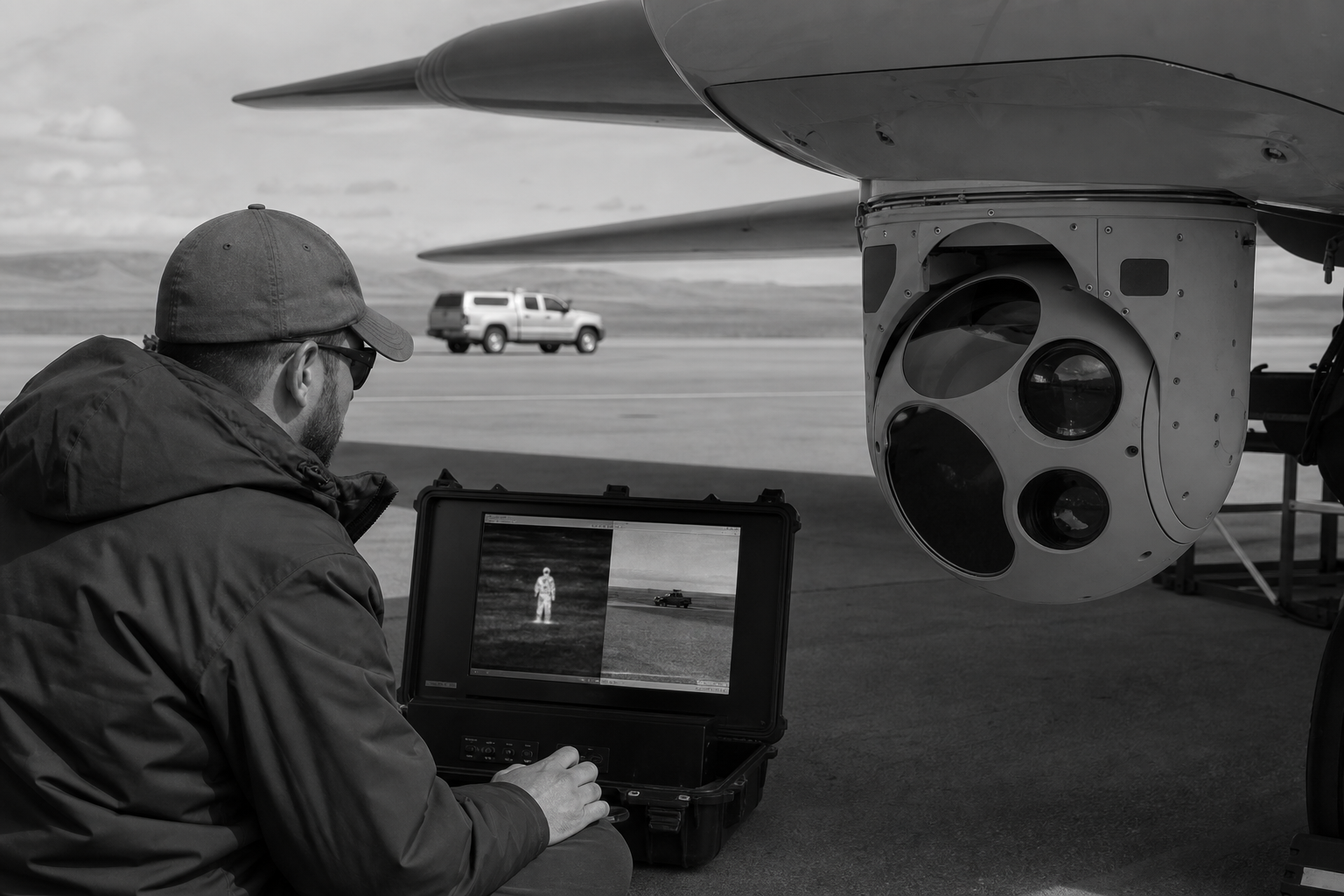
Display choices matter. In white-hot polarity, stronger displayed signal appears light; in black-hot, the same signal appears dark. Neither mode changes the underlying scene, but either can encourage misleading visual impressions. Gain expands or compresses displayed contrast, while level shifts which part of the signal range receives emphasis. A small adjustment can make a faint target seem sharply defined, erase surrounding detail, or change the apparent outline of an exhaust plume.
Infrared contrast also depends on the path between sensor and target. Clouds, humidity, haze, and intervening atmosphere can absorb or scatter infrared energy; a cloud may obscure a target, present its own contrast, or alter the apparent continuity of a track. Hot engines and exhaust are especially conspicuous, yet their brightness is not a direct measure of vehicle size or performance. Glare from the Sun or a warm surface, and blooming when a strong signal spreads into neighboring image areas, can make a compact source look enlarged or oddly shaped.
Automatic tracking adds another layer of interpretation. A tracker can keep a contrast feature near the center of frame, but it may follow a bright exhaust, a cloud edge, glare, or changing background rather than a stable physical point on an object. The useful checkpoint is whether the recording preserves polarity, gain and level changes, field of view, platform motion, range information, and the unprocessed sensor context. Infrared imagery can be valuable evidence; without those details, its most defensible conclusion is usually thermal contrast, not an extraordinary capability.
Electro-Optical Video: Why Perspective, Zoom, and Stabilization Matter
An electro-optical camera records visible-light pixels arranged in a two-dimensional frame sequence. Movement across that frame is angular movement, not a direct measurement of an object’s ground speed, distance, size, or turn rate. Turning those pixels into a trajectory requires the camera’s position and orientation, its field of view and lens state, accurate timing, and a reference geometry such as a horizon, known landmarks, or an independently measured range.
Zoom changes the relationship between scene angle and pixels. Optical zoom narrows the field of view by changing the lens’s effective focal length; digital zoom instead enlarges a selected pixel area, making a target look bigger without adding scene detail. Either can make small camera motions, atmospheric shimmer, or target drift appear dramatic. Parallax adds another trap: when an aircraft-mounted camera moves, a nearby object can sweep across a distant background far faster than a remote object would.
Processing can further reshape the apparent event. Stabilization shifts or warps frames to suppress camera shake, which can make the background slide or bend around a retained target. A rolling-shutter sensor reads an image line by line rather than all at once, so rapid camera motion can skew a shape. Focus hunting can alternately soften and sharpen an object, while compression replaces fine detail with blocky artifacts or smeared edges. None of these effects means the imagery is false; they limit what its appearance alone can establish.
The publicly released Go Fast clip is a bounded lesson: rapid travel across the image does not, by itself, demonstrate extraordinary physical speed. A clip shared without its full-resolution file, timestamps, field-of-view setting, camera orientation, platform telemetry, range data, and tracking overlays is a weak basis for calculating performance. Stronger electro-optical UAP video preserves those details and permits its angular observations to be compared with a reconstructed camera-and-target geometry.
SIGINT: Detecting an Emission Is Not the Same as Identifying a Craft
Radio-frequency activity can add a different kind of clue: signals intelligence (SIGINT) concerns intercepted electromagnetic emissions rather than reflected energy or imagery. Communications intelligence (COMINT) examines communications such as voice, data, or control links. Electronic intelligence (ELINT) examines non-communications emissions, including radar-like waveforms. An intercept can characterize frequency, timing, modulation, pulse pattern, direction, and whether the signal repeats, changes, or goes silent. That can describe an emitter’s behavior without establishing what physical platform carried it or why it transmitted.
Direction finding estimates the bearing from a receiver to a signal source. One receiver generally produces a line of bearing, not a precise point; intersecting bearings from separated, accurately timed receivers can narrow the location. Reflections from terrain or buildings, overlapping transmitters, weak reception, and brief or intermittent bursts widen the uncertainty. A signal may also be relayed, imitated, or deliberately spoofed, so a familiar-looking waveform is a lead for comparison, not an automatic platform identification.
The essential SIGINT and UAP distinction is between detecting activity in the spectrum and tying that activity to a particular observed object. A receiver may hear ambient aviation, maritime, satellite, ground-based, or other traffic while a camera or radar observes something else in the same broad area. Conversely, a visually tracked object may emit nothing detectable because it is silent, outside the receiver’s coverage, or masked by stronger signals. Database matches can narrow candidates when a capture is complete and well located; partial captures and shared signal characteristics leave attribution open. Strong UAP sensor data preserves the intercept’s timing, receiver position, bearing uncertainty, and the geometry linking it, if it links at all, to the other track.
Why Multi-Sensor Data Can Be Stronger, But Is Not Automatically Conclusive
Fusion begins by asking whether separate records can describe one object in one physical scene. In a strong reconstruction, radar supplies range and bearing, an infrared or visible-light camera supplies line of sight, and a radio intercept supplies a bearing or emission timeline; each measurement is plotted from its known sensor location at a calibrated time. If their uncertainty regions overlap and evolve consistently, the combined account is stronger than any one record. UAP sensor fusion does not simply add detections, it tests whether measurements with different error modes fit the same geometry.
Meaningful corroboration requires more than several people or screens reporting a target. Clock offsets can make unrelated events appear simultaneous, while an unknown aircraft position or camera orientation can misplace a line of sight. Raw or minimally processed files preserve timing, sensor mode, and measurement detail; a chain of custody records where those files came from and whether they were altered. Analysts also need the track history, platform motion, weather, and stated error bounds. A radar cue can direct an operator toward a particular patch of sky, for example, making a later video acquisition useful but not fully independent if the radar track itself was mistaken.
- Complementary evidence: independently operating systems produce measurements that converge on a single time-and-place reconstruction, while retaining enough underlying data to test the fit.
- Correlated evidence: several displays repeat one radar-derived track file, or multiple observers rely on the same callout, so apparent agreement may trace back to one uncertain input.
- Weakly attributable evidence: a clip, screenshot, or exported track lacks reliable timestamps, sensor settings, location, or provenance; it may still be interesting, but it cannot tightly constrain geometry.
Absence can matter as well. If a proposed nearby, large, hot, transmitting, or radar-reflective object should have been detectable by a suitably positioned and functioning system, its non-detection narrows that explanation. It does not prove that nothing was present: coverage gaps, masking, range, viewing angle, sensitivity settings, and timing can all explain a miss. The useful question for multi-sensor UAP data is therefore not “how many reports exist?” but whether expected detections and non-detections are jointly consistent with the same scenario.
A Practical Standard for Reading UAP News and Footage Claims
A newly released clip earns attention in proportion to the information that travels with it, not the drama of its imagery. When reading UAP news or UFO news, separate the recorded event from the headline’s interpretation.
- What was directly measured? Pixels, reflected energy, thermal contrast, or an emission are not interchangeable observations.
- What was inferred? Speed, size, distance, intent, and origin require assumptions that should be stated.
- What is missing? Seek provenance, timestamps, location, calibration, sensor mode, platform motion, and the unedited record, not merely a cropped display.
- Do ordinary alternatives fit? Perspective, atmospheric effects, processing artifacts, clutter, and miscorrelation deserve quantitative testing.
- Is there independent agreement? Separate systems must align in time and geometry, rather than repeat one cue.
- What would change the conclusion? A useful claim names the additional measurement that could support or weaken it.
An unresolved observation is an analytical result, not evidence of non-human intelligence. It can justify better collection and careful analysis; it does not fill the gaps in a UFO disclosure narrative.
The Best UAP Question Is What the Sensors Actually Measured
The most durable conclusion is often modest: an instrument registered something, yet the available record cannot determine exactly what produced it. That is not a failure of analysis. It is the boundary between measurement and story.
Keep the evidentiary chain visible. A radar return supports a reflected-energy measurement; infrared supports contrast in a selected band; electro-optical footage supports changing image coordinates; SIGINT supports an intercepted emission. Range, temperature, physical size, velocity, maneuver, platform type, and origin emerge only after analysts add geometry, calibration, environmental conditions, and processing assumptions.
A strong account makes those additions testable. It preserves the sensor mode and platform state, asks whether clutter, display settings, perspective, tracking behavior, or misassociation could produce the observation, and compares records collected independently at matched times. A weak claim may have several screens showing the same cue; a stronger one has measurements with different failure modes that converge on one location and motion history.
Data quality, identification confidence, and claims about capability are separate judgments. An event can be genuinely detected, remain unidentified, and still provide no basis for extraordinary conclusions. Properly synchronized sensor fusion can reduce uncertainty; unresolved data means only that the record has not yet earned a more specific answer.
Sources
Frequently Asked Questions
-
What does SIGINT mean in a UAP investigation?
SIGINT is signals intelligence: the interception and analysis of radio-frequency emissions rather than radar reflections or images. It can measure characteristics such as frequency, timing, modulation, pulse pattern, and direction, but an intercepted signal does not by itself identify the platform that transmitted it.
-
What is the difference between FLIR video and ordinary electro-optical video?
FLIR records contrast in infrared radiation within a selected band, while electro-optical video records visible-light pixels in a two-dimensional frame. Neither system directly provides an object’s temperature, size, distance, or physical speed without calibration, range, geometry, and platform data.
-
Can radar prove that a UAP is moving at extreme speed?
Radar can measure reflected-energy delay for range, antenna pointing for bearing, and sometimes elevation and radial velocity. Proving extreme speed requires time-stamped positions across multiple updates, radar location and scan geometry, altitude or elevation data, processing details, and uncertainty bounds.
-
Why does the Go Fast video not by itself prove extraordinary speed?
Motion across a video frame measures angular movement, not ground speed or distance. Calculating physical speed requires the camera’s field of view, orientation, timestamps, platform telemetry, target range, and reconstructed camera-target geometry.
-
What should I look for when evaluating multi-sensor UAP evidence?
Look for independently collected radar, infrared or visible imagery, and radio intercepts that align in calibrated time and geometry. Strong evidence includes raw or minimally processed files, sensor settings, platform motion, track history, weather, stated error bounds, and a documented chain of custody.