Al Taqaddum Infrared Object: What AARO’s Case Resolution Found
AARO concluded that the 2017 Al Taqaddum infrared object drifted with the wind and matched a cluster of partly inflated balloons, while the released report leaves some underlying data and metadata questions outside public review.
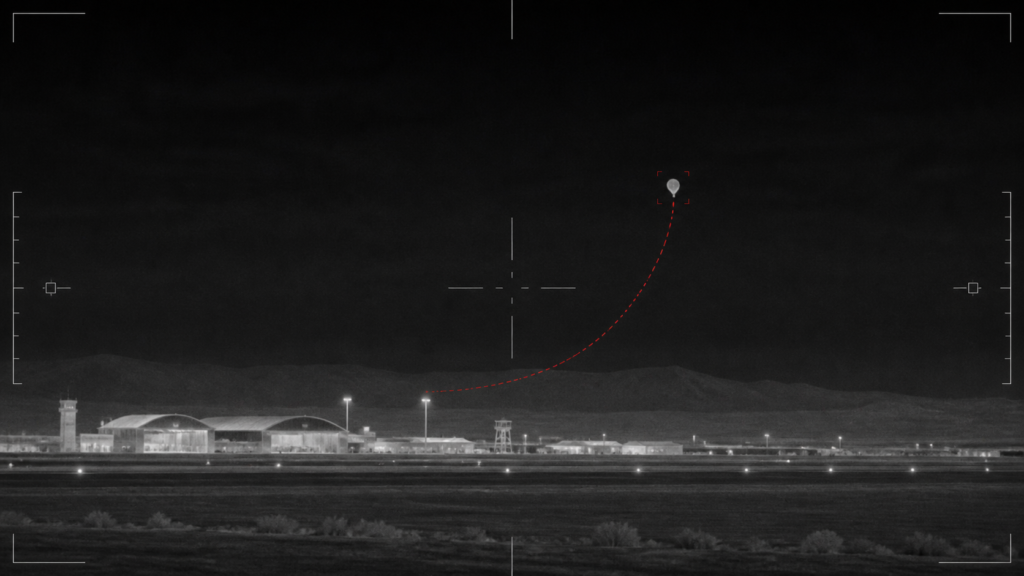
An infrared object recorded over Al Taqaddum Air Base in Iraq looks irregular enough to invite an exotic explanation. Its outline changes, cooler and warmer-looking regions shift, and thin shapes appear to hang below it. Yet none of those visual features requires advanced propulsion. In a September 2025 case resolution, the All-domain Anomaly Resolution Office assessed with high confidence that the object did not show anomalous behavior and was consistent with a cluster of fully and partially inflated balloons.
The conclusion rests on more than resemblance. AARO says it analyzed 17 minutes and 30 seconds of full-motion video, video metadata, the sensor’s line of sight, scenario reconstructions, geolocational information, pixel behavior, and historical and real-time weather data. That combination allowed it to estimate a range of altitude and speed and compare the object’s direction with the wind. The result is a useful example of how a military sensor observation can be genuinely unidentified at first report and later resolved without implying that the original reporter was careless.
What was recorded
AARO’s report dates the encounter to October 23, 2017. An infrared sensor aboard an aerostat force-protection dirigible operating about 2,700 feet above Al Taqaddum Air Base recorded an object that appeared to float above the ground. The public case synopsis says the reporter is unknown, lists infrared as the data type, and describes the reported shape as abnormal. The official DVIDS release provides the 17-minute, 27-second public video and says the footage was captured in October 2017 near the base.
There is a public metadata discrepancy worth flagging. The case resolution specifies October 23, while the DVIDS page’s “Date Taken” field displays October 1, 2017. The DVIDS description itself says only October 2017. The resolution is the detailed analytic product and is used here for the event date, but the mismatch cannot be reconciled from the released pages alone. It does not change the behavior analysis, though it illustrates why source metadata should be compared rather than silently harmonized. Our primary-source guide treats such discrepancies as part of the record.
Altitude, speed, and direction
AARO assessed with moderate confidence that the object was between 850 and 2,200 feet in altitude and moving between 4 and 14 miles per hour. The ranges are broad because historical and real-time wind data varied. Using locational data from the aerostat, the office assessed with high confidence that the object traveled east to west at a speed within the wind range.
That wind match is central. A powered aircraft can fly with the wind, but a target that simply drifts at wind speed and direction needs no propulsion hypothesis. The released video does not show an abrupt acceleration, a controlled turn against the wind, or another maneuver exceeding known aircraft performance. AARO therefore concluded with high confidence that the observation did not display anomalous speed or capability.
The distinction between confidence levels is informative. AARO’s narrower estimates of exact altitude and speed depend on variable weather inputs and receive moderate confidence. The broader relationship—movement consistent with the wind—receives high confidence. Evidence-calibrated reporting should preserve those labels instead of reducing the report to an unqualified claim that every parameter is known precisely. The same discipline appears in our UAP claim-evaluation framework.
What the changing shape shows
In selected frames, AARO says bulbous, rounded forms consistent with fully and partially inflated balloons are visible. Thin, dangling forms beneath them resemble strings and deflated balloons. As the cluster rotates or changes its orientation relative to the sensor, the number and shape of those hanging features appear to change. A shifting outline is therefore expected from a loose three-dimensional cluster viewed in projection; it is not evidence that a solid craft is physically transforming.
Infrared display behavior adds another layer. Thermal video maps detected infrared intensity into grayscale or false color. The sensor continuously adjusts how values are assigned across a scene to preserve useful contrast. As the background changes, the same object can look lighter, darker, or internally variable even if its temperature and structure have not changed dramatically. AARO attributes the fluctuating infrared return in part to this automatic visual dynamic-range adjustment. Toward the end of the clip, increasing distance also makes the object grainier and reduces fine detail.
The report notes no distinct thermal signatures corresponding to motors or another propulsion source. Lack of a visible heat source cannot prove that an object is unpowered in every infrared scenario—range, aspect, atmospheric absorption, and sensor settings all matter—but here it is one element combined with wind-speed drift and balloon-like morphology. The evidentiary weight comes from those factors agreeing, not from any single pixel.
The quadrotor alternative
One of AARO’s partners proposed that the object might be a quadrotor uncrewed aerial system draped in camouflage netting. That hypothesis could explain an irregular silhouette, and considering it is important at a military installation where small drones are a legitimate force-protection concern. AARO rejected it for two stated reasons.
First, the object drifted with the wind rather than maintaining controlled flight. A quadrotor can be carried downwind, but an operating system would normally make active corrections rather than behaving like passive debris across the full observation. Second, electric motors and associated components should create localized heat visible to the infrared sensor under the conditions assumed by the analysts. The video did not show those sources. AARO and its partners therefore judged the quadrotor theory unlikely and the balloon-cluster explanation more consistent with the total data.
This does not mean every irregular object near a base should be dismissed as a balloon. It means this particular recording contained enough positional, weather, duration, and image information for AARO to prefer one ordinary explanation with high confidence. Reporting the initial object as unidentified was still appropriate. Identification is a process, and retaining ambiguous cases until adequate analysis is available is safer than prematurely assigning either a threat or an extraordinary origin.
Why this case was resolvable
Many UAP cases remain unresolved because the observation is short, the sensor platform is unknown, or essential metadata are missing. Al Taqaddum offered a relatively long recording from a known, persistent platform. A fixed or slow-moving aerostat with geolocational data provides more stable geometry than a rapidly maneuvering aircraft. Weather information gave analysts an independent prediction: a passive airborne cluster should move with the wind. The object’s measured range of motion fit that prediction.
AARO states that the visual and sensor data were sufficiently detailed to resolve the case with high confidence. The official video also enables readers to inspect the morphology AARO describes. Compared with a single still image, the long sequence reveals changing orientation, dangling elements, drift, and declining resolution over distance. Temporal behavior is often more diagnostic than a dramatic frame selected from a clip.
The case also supplies a counterexample to the idea that military provenance makes imagery inherently anomalous. Military sensors are optimized for specific missions, not for producing intuitive public video. Their displays can exaggerate contrast changes, obscure range cues, and show distant ordinary objects as shapeless thermal contacts. Provenance establishes that the video is an official record; it does not determine the target’s identity. For related context, see our coverage of AARO’s 2024 annual report and case inventory and the evidence topic cluster.
Limits of the public resolution
The resolution is concise. It does not release every telemetry field, weather dataset, line-of-sight calculation, reconstruction file, or partner analysis cited in the assessment. The public can review the report and video, but cannot reproduce the entire quantitative workflow from the posted material alone. AARO also includes a disclaimer that its information report is not finished intelligence and may reference partner-provided information to substantiate its analytic perspective.
Those limits should prevent overstatement in both directions. The public evidence strongly supports AARO’s explanation as presented, but the report is not a full peer-reviewed data package. Conversely, missing underlying files do not transform a slow, wind-borne target with visible balloon-like components into evidence of extraordinary technology. The responsible conclusion follows the released record: high confidence that the object was a cluster of balloons and that it showed no anomalous performance, with some details of the analytic chain unavailable for independent audit.
Al Taqaddum belongs on the historical timeline not as a mystery that defied analysis, but as a documented resolution. Resolved cases are valuable because they show which observations, metadata, and methods can distinguish an initially unusual contact from a genuinely anomalous performance claim. They also improve the standard applied to cases that remain open.