The ‘Flatwoods Monster’ (1952): How a One-Night Sighting Became an Alien Icon
Explore the Flatwoods Monster 1952 sighting, witness accounts, UFO-era headlines, competing explanations, and the legend's lasting cultural impact.
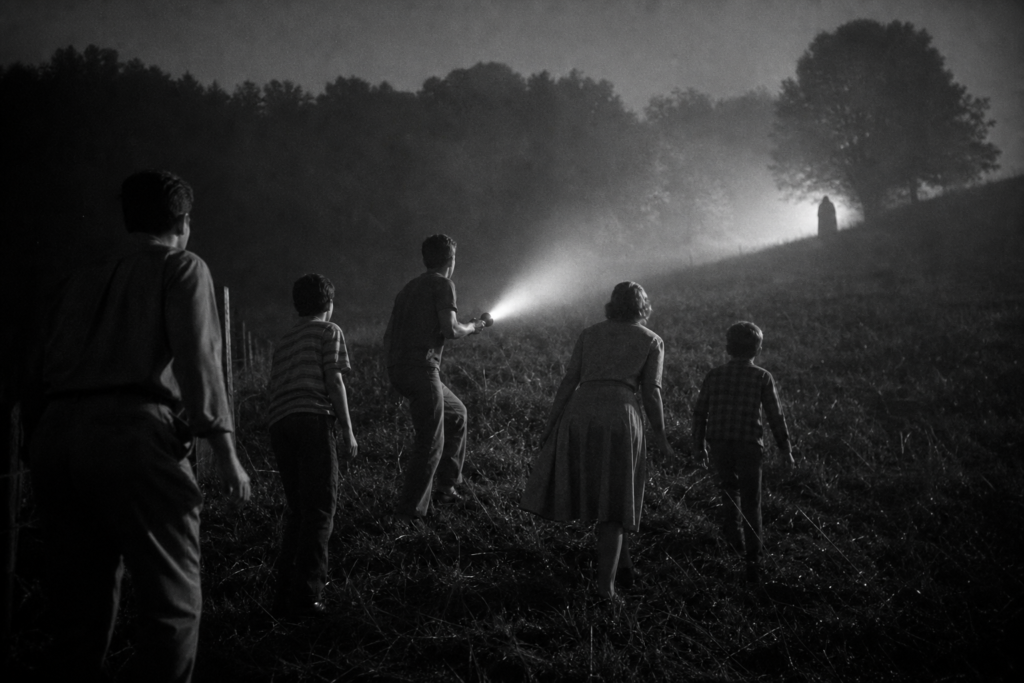
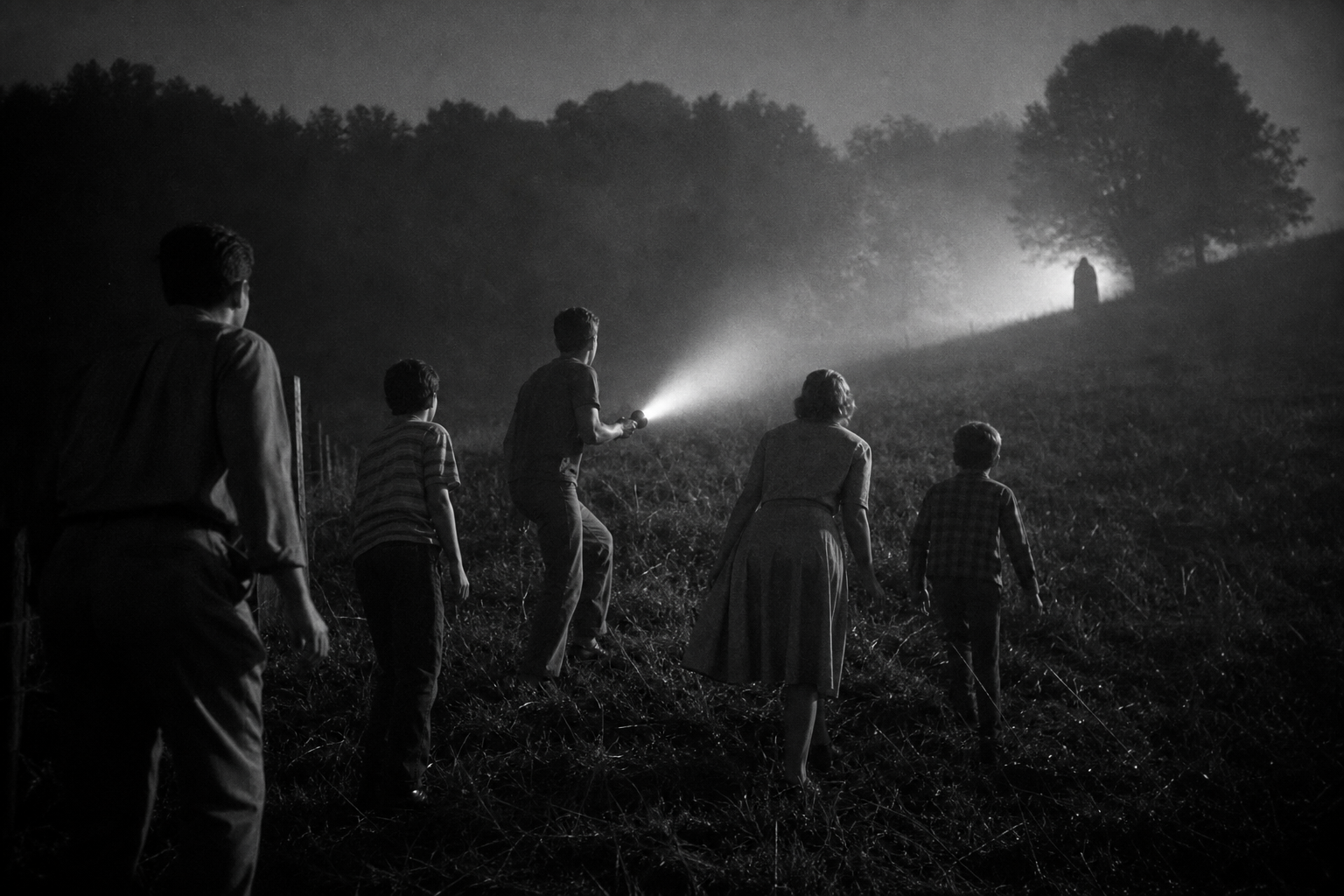
On September 12, 1952, a frightening report from rural Braxton County, West Virginia, began as a short-lived local alarm and became the Flatwoods Monster: one of the most recognizable figures in American UFO folklore. The encounter lasted only one night, its details were filtered through darkness, fear, memory, and fast-moving newspaper coverage, and no single record can turn every reported feature into an established fact.
That uncertainty is central to the story rather than a flaw to be edited away. This article separates what the participants said they experienced from the details added, sharpened, or altered in later retellings. It follows the report’s movement from a hillside search and a startling visual impression to press circulation during the flying-saucer era, then considers competing interpretations, including an owl seen under difficult nighttime conditions, without pretending that an explanation can erase the witnesses’ alarm.
Finally, it examines the transformation that made the case endure: artists gave a fleeting description a repeatable silhouette, while books, films, games, and West Virginia cultural life kept that silhouette in public view. The result is less a confirmed answer to what appeared that night than a revealing record of how a local scare can become an alien icon.
The Night Flatwoods Looked Skyward
Near dusk in Braxton County, several local boys reported seeing a bright red object cross the sky and seem to descend beyond the town of Flatwoods, West Virginia. The sight did not produce a verified crash site or a confirmed craft; it produced urgency. Word spread quickly among nearby families, and a small party set out toward the Fisher Farm hillside, carrying a flashlight into ground that was dark, uneven, and unfamiliar.
What followed was brief. The group later described a disturbing encounter near the hilltop, an intense light, an acrid odor, and a tall, startling figure glimpsed in the darkness. Their accounts agree on the emotional force of the moment: they were frightened and retreated. They do not, however, provide the kind of physical record that could establish what the object or figure was. “Flatwoods Monster” is therefore the name attached to a reported experience, not the identification of a proven extraterrestrial visitor.
The setting matters as much as the image. A rural hillside at night narrowed what the witnesses could see while magnifying sudden light, movement, sound, and smell. By the following day, a local alarm had already become a story with a memorable central question: what had the search party encountered on the Fisher Farm?
What the Witnesses Said They Saw, and What They Did Not
The party’s recollections were not a single, fully agreed portrait. Accounts identify Kathleen May; her sons Eddie and Fred May; their friends Tommy Hyer, Neil Nunley, and Ronnie Shaver; and Gene Lemon, a 17-year-old National Guardsman. After reaching the Fisher Farm hill, Lemon was the participant most often associated with the flashlight and the first close view of the figure. Their impressions were formed in seconds, on a dark slope, after the group had already gone looking for the red object reported overhead.
Early newspaper versions gave the figure an apparent height of roughly 10 feet and emphasized a dark body, a red or reddish face, and two bright, eye-like lights. Kathleen May later described the lights as greenish; other retellings vary their color and the creature’s body color. That disagreement matters: “glowing eyes” records how two lights appeared to frightened observers, while the 10-foot estimate was not a measured dimension. The widely familiar image of a sharply pointed head above a pleated, skirt-like body is a later standardized reconstruction, not a detail recorded with identical wording by every member of the party.
Several participants also reported an acrid, burning odor and a low mist or vapor near the hillside. Lemon’s account included the figure moving or gliding toward the group, prompting their retreat. Those are reports of sensory experience and perceived motion, not physical traces that establish the figure’s anatomy, propulsion, or source. Early coverage connected illness complaints, nausea and throat irritation, to the encounter, but it did not establish that a creature caused them.
That is the essential distinction in reading the Flatwoods Monster eyewitnesses: the group consistently described fear, lights, an imposing shape, odor, and haze, but not a shared technical description of a machine or a stable biological specimen. Later illustrations made the silhouette cleaner, more symmetrical, and easier to recognize than the hurried testimony allowed. The differences do not erase what Kathleen May, Lemon, and the children said they experienced; they show where a frightening nighttime glimpse ended and a durable visual icon began.
How a Local Scare Became a National UFO Story
Print gave the episode a form that private memory could not: a compact, repeatable story. Newspaper coverage could compress separate reports, the light in the sky, the walk to the hillside, and the frightening figure, into one dramatic sequence with a place name attached. That compression makes a strong headline, but it is not independent corroboration that every reported element had a single cause.

Names mattered as much as narrative. Labels such as “Braxton County Monster” or “Phantom of Flatwoods” turned an unsettled account into a subject readers could recognize, repeat, and search for in later collections. A local scare became a Flatwoods, West Virginia UFO story not simply because witnesses described something alarming, but because news circulation supplied a memorable geographic identity and a ready-made mystery.
The wider climate made that framing especially portable. In an era when flying-saucer stories already furnished newspapers with familiar language for strange lights and unexplained encounters, editors could place an unusual local report within a national conversation about UFO sightings. The same year’s contactee and UFO culture made such framing especially visible. Dramatic treatment encouraged attention; it did not establish a connection between the reported aerial object and the reported figure.
That distinction is the essential historical checkpoint. A shared evening and a shared vicinity can explain why the two reports became linked in public memory, while leaving their relationship unproven. Once the account moved beyond the immediate witnesses, repetition favored the cleanest version: a descending object, a monster, and a small West Virginia town. The ambiguities that made the original experience difficult to interpret were far less convenient for a headline.
Alien, Owl, Hoax, or Something Misidentified? The Competing Explanations
The strongest skeptical reading does not require every reported impression to have had one mundane source. It asks which features can be produced by darkness, a narrow flashlight beam, uneven ground, and a frightened group trying to make sense of an unfamiliar shape at short notice.
The owl hypothesis is a retrospective interpretation, not an identification made on the hillside that night. A large bird perched above eye level can present a tall dark form; reflected light from its eyes and a sudden opening of wings can intensify the impression of a face, glowing features, or rapid movement. Combined with vegetation, shadow, and haze, that possibility accounts for why an ordinary animal might seem outsized and bizarre. It cannot recreate the encounter precisely, establish the distance at which witnesses saw the figure, or disprove the fear they experienced.
Misidentification is broader than the owl explanation. It allows that separate stimuli, a light in the sky, an animal or object on the slope, odors, and drifting mist, may have been mentally joined into one threatening presence. Expectation matters here: after people believed something had come down nearby, ambiguous sights and sounds could acquire a shared, alarming meaning. That is a model of perception under pressure, not an accusation that anyone invented the report.
Extraterrestrial claims make the opposite leap, treating the reported figure and aerial light as parts of a single non-human event. The available account does not verify non-human intelligence, a craft, or a physical connection between those impressions; later systems of UFO classification and investigation do not supply that missing evidence. A cryptid label similarly preserves mystery but supplies no method for identifying what was present.
A hoax claim has its own evidentiary burden: it would need persuasive signs of planning, coordination, props, or an admission, rather than the mere fact that the story became famous. Without such support, “hoax” explains neither the witnesses’ alarm nor the particular conditions that shaped their account. The most defensible Flatwoods Monster explanation remains conditional: later reconstructions can clarify plausible mechanisms, but they cannot convert a brief, frightened nighttime experience into a fully settled record.
Project Blue Book, Disclosure Talk, and What This Case Was Not
Official-sounding labels can make a local report appear more evidentially secure than it is. Project Blue Book was the U.S. Air Force’s long-running UFO inquiry, but identifying the Flatwoods episode with that program requires more than later repetition: it would require a traceable case file, dated assessment, or official conclusion tied to the September 1952 reports. No such material establishes the encounter as a major Blue Book investigation or as evidence of an alien visitation.
That absence also separates Flatwoods from crash-retrieval narratives. A retrieval claim depends on documented recovery, custody, and examination of physical material; the Braxton County story rests on reports of a light and a frightening hillside encounter, not a verified recovered craft or body. Newspaper attention and subsequent UFO literature can preserve a case, but neither demonstrates government possession of extraordinary evidence.
Claims of suppression need a similarly specific trail: records showing what was withheld, by whom, and how it conflicts with the public account. Suspicion created by incomplete records is not that trail. Modern UAP disclosure concerns present-day government reporting, classification, and oversight; it does not retroactively turn a 1952 witness report into confirmed non-human technology. The useful distinction is between an unresolved experience and a proven official secret.
Why the Flatwoods Monster Endures as an Alien Icon
What endured was not a reliably observed anatomy but a design. Illustrations transformed scattered impressions, height, a dark body, a luminous face or eyes, and a hooded or spade-like outline, into a single upright silhouette. That visual choice matters: a clean contour can be recognized instantly in a way that a frightened group’s nighttime recollections cannot. Later cultural representations tend to smooth away uncertainty, giving the figure symmetry, fixed proportions, and an unmistakable profile.
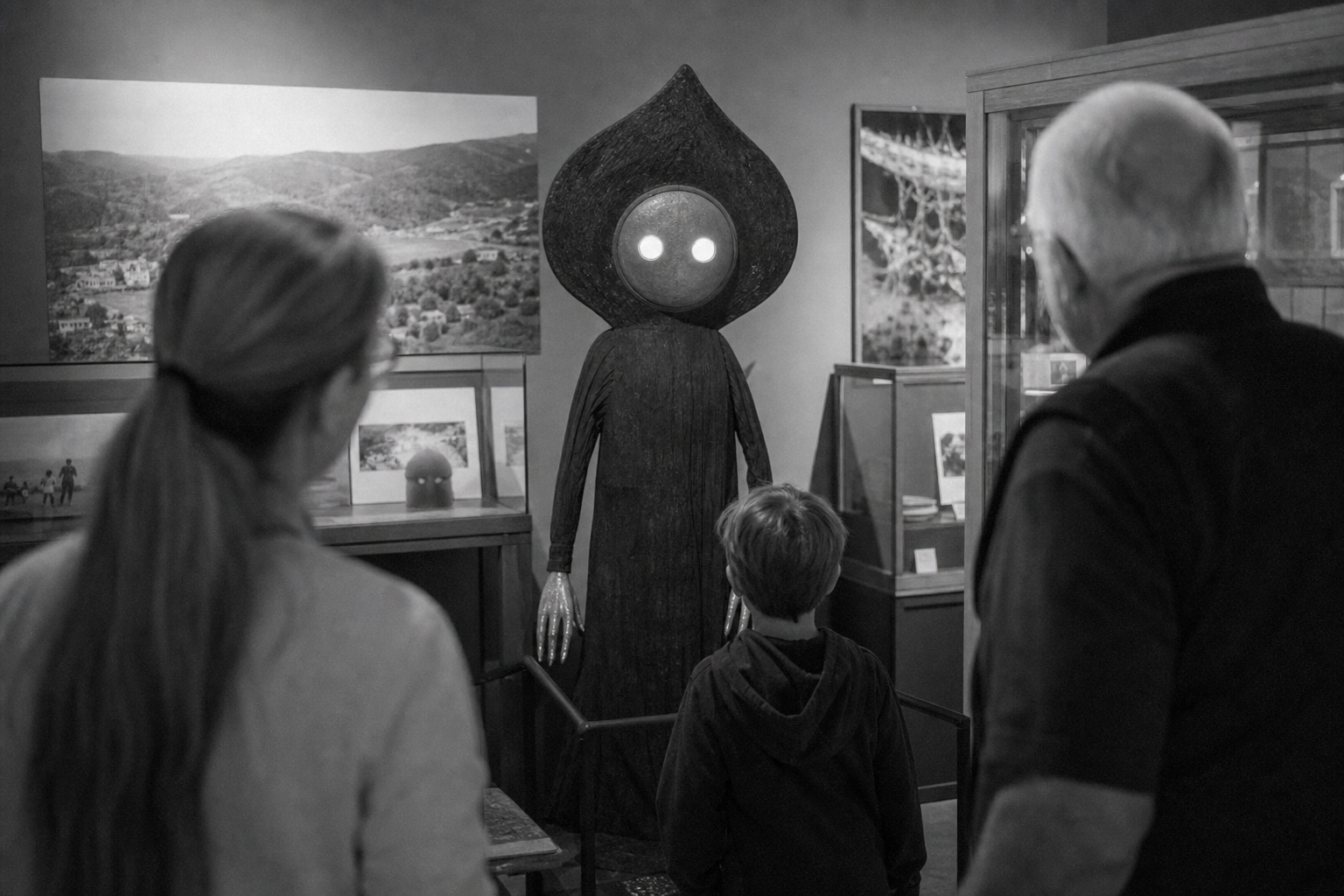
Books, documentaries, games, online imagery, souvenirs, museum displays, festivals, and West Virginia tourism can then circulate that standardized figure without needing to recreate the conditions of the hillside. Each format does something different. A documentary can retell competing accounts; a game can turn the creature into a character; a statue or piece of merchandise makes it a local emblem; an internet image allows the silhouette to travel detached from the original testimony. The tradeoff is clarity for ambiguity: the more recognizable the alien icon becomes, the easier it is to mistake its later visual form for a literal record of 1952.
The name Phantom of Flatwoods captures that shift from alarming encounter to portable folklore. Its unusual shape remains memorable precisely because it resists the familiar big-eyed extraterrestrial template found in other rural close-encounter stories involving glowing beings: it is tall, theatrical, and difficult to classify at a glance. But the durable image should not collapse the case’s three layers into one. There was a reported event in Flatwoods; there remain interpretations of what the witnesses may have perceived; and there is the Flatwoods Monster 1952 as a cultural creation, repeatedly redrawn and reused. The last is undeniable, even though it does not settle the first two.
An Unresolved Night, an Enduring Image
Ambiguity is not a weakness in this history; it is the condition that makes disciplined interpretation necessary. The people who went onto the hillside described fear, light, an alarming figure, and physical discomfort after a short nighttime encounter. Those reports deserve to be treated as testimony to a real experience of alarm. They do not, however, supply the kind of independently preserved physical evidence that could identify an extraterrestrial craft or establish a government cover-up.
Ordinary explanations remain viable because they address the setting as well as the reported figure: an owl or other animal, caught in a flashlight beam amid darkness, brush, haze, and heightened expectation, could help account for several impressions without reproducing every witness’s perception. That is an interpretation of the episode, not a way to erase the experience or prove that every detail had the same cause.
The lasting importance of the Flatwoods Monster lies elsewhere. Testimony gave the night emotional force; headlines carried it beyond Braxton County; illustration turned incomplete impressions into a fixed shape; and the anxieties of the UFO era made that shape immediately legible. Together, those processes converted one unresolved local alarm into enduring American UFO folklore.
Frequently Asked Questions
-
When did the Flatwoods Monster sighting happen?
The Flatwoods Monster incident occurred on September 12, 1952, near Flatwoods in Braxton County, West Virginia. Several local boys reported a bright red object crossing the sky near dusk, prompting a group to search the Fisher Farm hillside.
-
What did witnesses say they saw in the Flatwoods Monster incident?
Witnesses described a tall dark figure, reported in early newspapers as roughly 10 feet high, with a red or reddish face and two bright eye-like lights. They also reported an intense light, an acrid burning odor, low mist or vapor, and a frightening movement toward the group.
-
Why is the Flatwoods Monster associated with UFO sightings?
The event occurred during the 1952 flying-saucer era, and newspapers linked the reported red object in the sky with the frightening figure seen on the hillside. That connection became part of public memory, although no evidence verified that the aerial light and the figure had the same source.
-
Did Project Blue Book investigate the Flatwoods Monster case?
No traceable Project Blue Book case file, dated assessment, or official conclusion establishes the Flatwoods encounter as a major Blue Book investigation. The case is based on witness reports of a light and a hillside figure, not on a verified recovered craft or physical evidence.
-
Was the Flatwoods Monster an alien, an owl, or a hoax?
No explanation has been proven. A large owl seen in a flashlight beam could account for features such as reflective eyes, an imposing shape, and sudden movement, while darkness, haze, and fear may have combined separate sights and sensations into one alarming experience; there is also no persuasive evidence of a planned hoax or extraterrestrial craft.