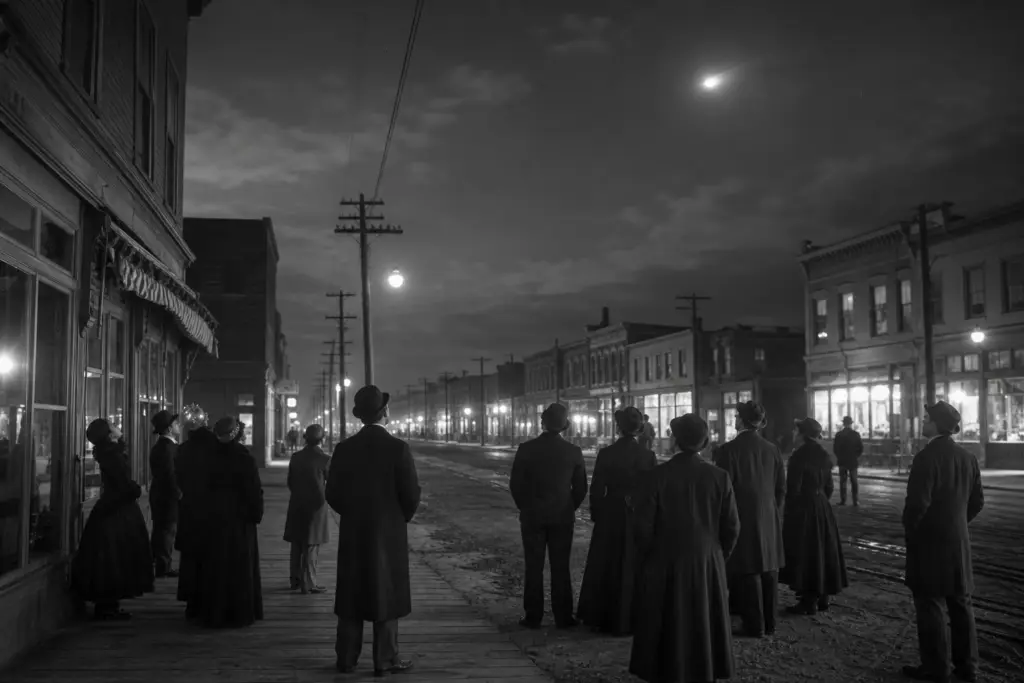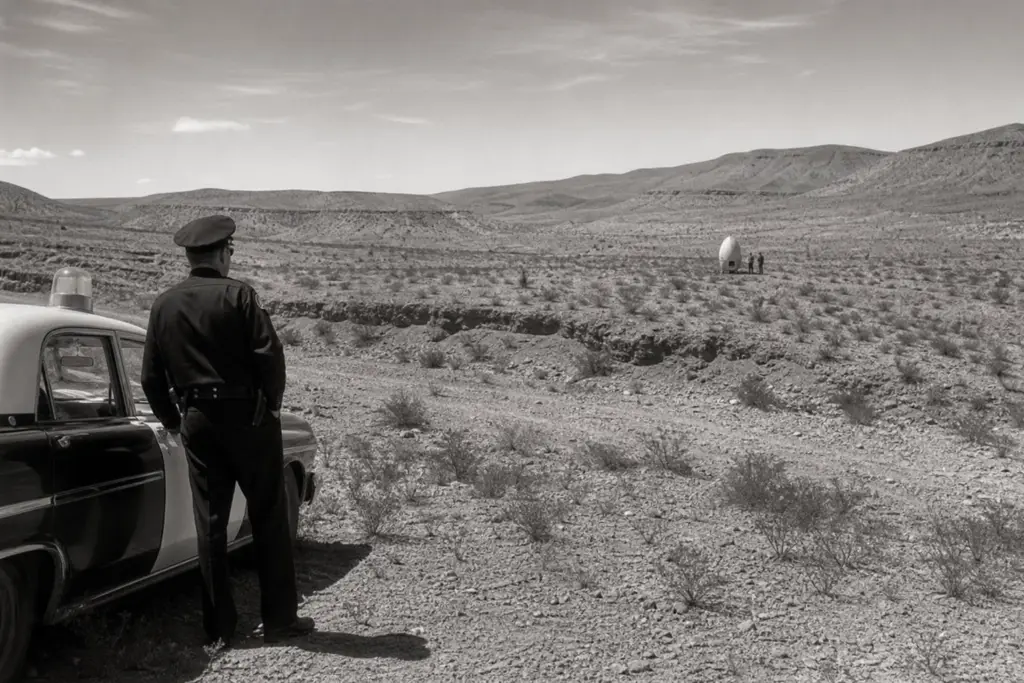
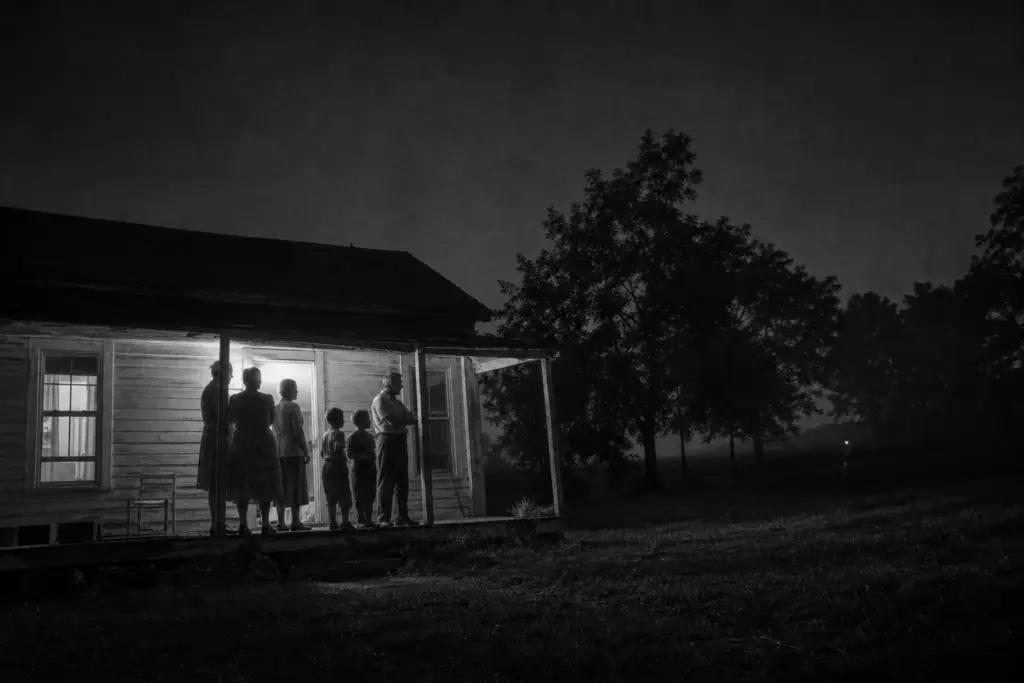
On an August night in 1955, at a farmhouse near Kelly and Hopkinsville, Kentucky, members of the Sutton family and their guests reported an episode so unusual that it became one of America’s most persistent UFO stories. They described small figures with bright or luminous features around the house, reacted with fear, and drove into Hopkinsville to seek help from police. Later retellings gave the figures the memorable label “Hopkinsville goblins,” but that folkloric name can obscure the narrower historical question: what did the people present say they saw, and what can the surviving record establish?
This account of the Kelly–Hopkinsville encounter keeps those questions separate. It follows the reported sequence at the Sutton farmhouse, the response by local authorities and military personnel, and the differences between contemporaneous reporting, official records, and memories recorded years later. It also weighs conventional explanations, including misidentified animals, a light in the sky, darkness, stress, and storytelling drift, against the particular details witnesses described. The case documents an extraordinary report, not verified extraterrestrial contact; its enduring value lies in how much was reported, how quickly officials became involved, and how much uncertainty remains.
The Kelly–Hopkinsville Encounter: A Famous 1955 Report, Not a Settled Mystery
The label covers reports from the Sutton family and visitors at their rural Kentucky farmhouse in August 1955, rather than a single independently verified event. In the earliest broad outline, witnesses said a light had appeared outside and that small, silvery or luminous-looking figures approached the house. Fearful occupants later went to Hopkinsville seeking police assistance, after which the reported disturbances continued at the property. The exact descriptions, timing, and number of figures vary across accounts.
That variation matters. Contemporary newspaper coverage and official-response records are strongest for establishing that a frightened group sought help and that authorities treated the call seriously; interviews and retellings recorded later are more useful, but less secure, for detailed appearance and movement. “Hopkinsville goblins” is therefore a later cultural shorthand, not a finding by investigators. An evidence-first reading distinguishes a possible animal misidentification, darkness and stress, or later narrative expansion from the separate possibility that some observation remains unidentified. None of those possibilities turns the 1955 Kentucky UFO sighting into proof of extraterrestrial or other non-human intelligence.
What the Sutton Family and Their Guests Said Happened That Night
The sequence is clearest when treated as a reported order of events rather than a clock-accurate reconstruction. Billy Ray Taylor was said to have noticed a bright light in the sky while outside at the Sutton farmhouse. Later accounts often supply a precise time and describe the light’s path or landing, but those particulars are less secure than the basic claim that an unusual light preceded the alarm.
Witnesses then placed the first small figure near the house. The people inside included members of the Sutton family and visiting adults and children, although lists of everyone present and their exact positions differ across retellings. Their shared account was that the sight prompted the adults to gather, look outside, and react as though the property was under threat, not as though they were calmly observing a distant aerial phenomenon.
The reported activity became episodic. Figures were said to appear near doors, windows, and the roofline, then disappear into the darkness before reappearing elsewhere. Family members and guests reported firing at them. That is an important distinction in reading the Sutton family UFO encounter: gunfire demonstrates the witnesses’ fear and belief that something was close to the house; it does not independently establish what they fired at, whether anything was hit, or whether every later description came from the same observation.
Contemporary accounts agree more firmly on the group’s decision to drive to Hopkinsville for help than on the duration of the confrontation before that trip. Their arrival brought police attention to the report, after which officers and others went out to the farmhouse. The witnesses nevertheless said the appearances resumed after the authorities’ initial visit and that they remained fearful through the night. Precise claims about how many figures appeared, how long each episode lasted, and the final moment of activity largely come from later recollections.
That chronology preserves the core testimonial claim without turning it into a seamless narrative: a light was reported, unfamiliar figures were reported around the home, frightened occupants sought police assistance, and the reported disturbance continued after they returned. It records an extraordinary experience as the witnesses described it, not a verified identification of its cause.
The Reported Beings: Small Figures, Bright Features, and Unusual Movement
The appearance reports are more stable at the level of impression than at the level of anatomy. Witnesses described small humanoid figures, often placed at roughly child height, with disproportionately large or bright-looking eyes. Several versions add pointed ears, thin arms ending in clawlike hands, and a silvery, reflective, or faintly luminous surface. Those are reported characteristics, not recovered physical evidence or a confirmed biological description.
Some of the most memorable details are also the least uniform. Accounts differ over whether the eyes themselves shone, whether the figures were metallic or merely pale in available light, and whether their hands were clearly seen. Descriptions of movement likewise range from an odd gliding or floating quality to rapid appearances and disappearances at different parts of the house. The popular term Hopkinsville goblins compresses these changing details into a standardized image: squat, silver-skinned, big-eared creatures. It is useful cultural shorthand, but not a neutral reconstruction of what each person reported seeing.
Conditions at the farmhouse complicate any precise visual reading. The observations were brief and intermittent, often made across a yard or through windows into darkness, while frightened people anticipated another appearance. Under those circumstances, reflected light can make eyes or surfaces seem bright, partial views can emphasize a head or outstretched limbs, and abrupt movement can be remembered as floating. That does not establish a conventional explanation; it sets a limit on how confidently later illustrations of the Hopkinsville goblins incident can be treated as eyewitness-level detail.
The Official Response: Hopkinsville Police, Fort Campbell, and Project Blue Book
The trip into Hopkinsville turned a private alarm into a recorded public incident. Contemporary reporting describes a large, frightened group arriving at the police station and recounting gunfire and figures around the farmhouse. Hopkinsville police treated the report as a call for assistance rather than as a resolved explanation: officers went back with the witnesses, searched around the house, and found no intruder or creature to identify.
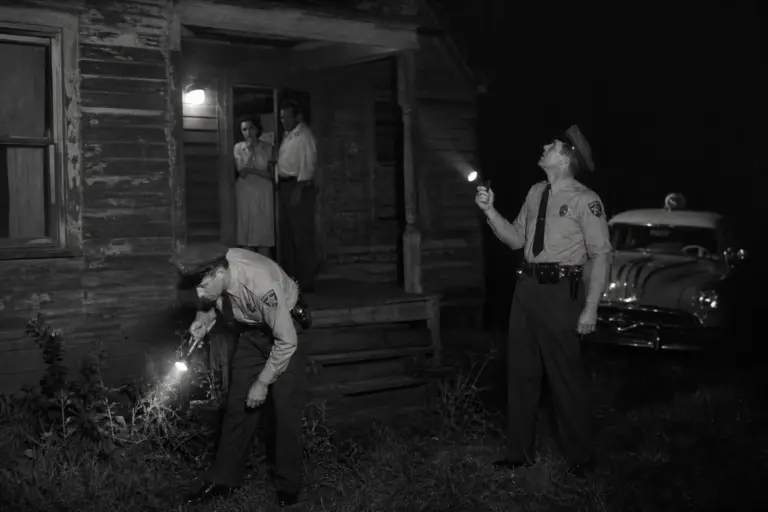
That distinction is central to the law-enforcement investigation. Officers could establish that people had come for help and that shots had apparently been fired; they could inspect the property for the ordinary traces such an episode might leave. Later summaries commonly mention spent shell casings and damage consistent with shooting, including marks or holes around the house. Such evidence supports the limited proposition that firearms were discharged during a frightening night. It does not establish what occupants believed they had fired at.
Accounts of the search also describe an absence of decisive physical proof: no captured figure, no body, and no reliably documented tracks or material trace that could distinguish an animal, person, or unknown object. A negative result is not proof that nothing occurred outside the house; it means the official visit did not convert the witnesses’ descriptions into independently identifiable physical evidence.
Nearby Fort Campbell is often folded into the story as though it conducted a major military operation. The more restrained reading is that military personnel were reported to have taken an interest or assisted during the response, while surviving accounts do not establish a sustained Army investigation with a definitive finding. The scope of that participation matters: reported attendance or inquiry is not the same as a formal military conclusion.
Project Blue Book presents a similar limit. The Air Force’s UFO-investigation program is associated with the case in later UFO literature, but the available historical record does not show a full Blue Book field investigation producing a dispositive case file. That gap may reflect the case’s local, rapidly unfolding character and incomplete record preservation; it is not evidence of a government cover-up. The official response documents an extraordinary report and a serious search, not verified extraterrestrial contact.
How the Main Explanations Fit the Evidence
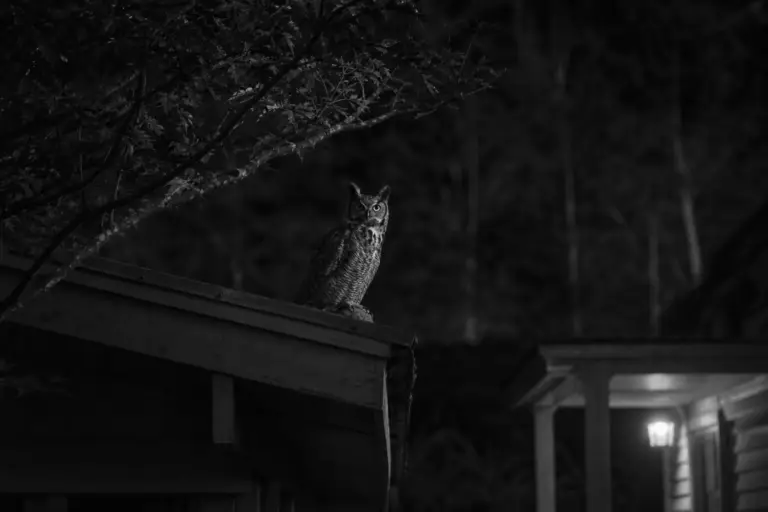
The Great Horned Owl hypothesis addresses several visual elements at once. An owl seen at night can present a compact, upright silhouette; its forward-facing eyes may catch a lamp or flashlight beam; and its ear tufts can read as pointed ears. A bird moving from a tree toward a roofline also fits the witnesses’ reported changes of position better than a figure moving across open ground. Its weakness is explanatory reach: the Sutton-group descriptions included a silvery or luminous-looking body, unusual arm-and-hand impressions, and a repeated apparent return after shots, details that do not neatly reduce to one brief owl encounter.
A meteor sighting is a narrower proposal. If Billy Ray Taylor’s initial light was a transient bright object crossing the sky, it could account for that first visual stimulus without accounting for the later reports around the house. Treating the sky light and the figures as necessarily one event assumes a connection the surviving testimony cannot independently demonstrate. That distinction is important: a plausible explanation for the opening sight does not automatically settle the rest of the night.
Other skeptical explanations focus on perception under pressure rather than on a single animal or object. Brief nighttime glimpses, shifting illumination, gunfire, and fear can make ordinary shapes seem animate, bright, or resistant to harm. Once several people expected another figure to appear, shouted warnings and shared attention could reinforce a common threat interpretation. This does not mean the witnesses invented their fear; it means honest testimony can preserve a powerful experience while leaving the external cause uncertain.
The extraordinary interpretation, that the figures represented non-human intelligence, must explain the full report while meeting a higher evidentiary burden than an account based on animals, lights, or misperception. It would require independently identifiable physical evidence, or observations robust enough to exclude more ordinary causes. The Kelly-Hopkinsville encounter has neither a recovered being nor a conclusive trace linking the reports to an extraterrestrial origin. It remains an unresolved historical report, not verification of extraterrestrial contact.
Why the Case Endures, and What It Does Not Show About Modern UAP Disclosure
Its lasting power comes partly from the way a frightened family’s account was transformed into a compact American legend. Later folklore and retellings often favor the vivid “Hopkinsville goblins” label, standardized creature imagery, and a smoother, more cinematic sequence than the uneven testimony supports. Those versions are memorable, but they can hide the uncertainties that make the original report historically interesting.
The Kelly-Hopkinsville encounter also occupies an important place in the public history of UFO sightings because it combines multiple witnesses, a police response, gunfire, and a setting that invites visual reconstruction. None of those features converts the account into physical proof. They do, however, leave more to assess than a solitary, retrospective claim: the timing of reports, the differences among descriptions, the conditions of observation, and the absence or quality of independently testable traces.
Modern UAP sightings and disclosure debates are a separate category of question. Contemporary UAP policy concerns how governments collect, classify, investigate, and release information about unidentified observations; it does not retroactively establish what appeared near the Sutton farmhouse in 1955. Nor does an unresolved local report demonstrate alien disclosure or a government UFO cover-up. A lack of a final explanation is not evidence for a particular extraordinary explanation.
A useful reading discipline is straightforward: start with contemporaneous reports of the police visit and the witnesses’ immediate claims; treat later interviews as valuable but potentially reshaped by memory; and flag details that first emerge in popular illustrations, books, or retellings. The durable lesson is not that the beings were confirmed, but that an extraordinary report can remain unresolved while still falling far short of proof of extraterrestrial life.
A Remarkable Report With an Unresolved Explanation
The key final checkpoint is the gap between an alarm reported promptly and a cause that can be independently identified. In contemporaneous accounts, the Sutton witnesses described small, luminous-looking intruders after an earlier light in the sky; they later drove to Hopkinsville for help, returned with officers, and said the appearances resumed before ending. Their basic impression was consistent enough to prompt that response, but exact appearance, movement, timing, and the light’s connection to the later sightings varied.
Police involvement shows that frightened people made a report soon after the episode and that officers searched the property; it does not establish the identity of what the witnesses believed they saw. Reports of military interest and later links to Project Blue Book add context, but the surviving record contains no preserved specimen, clear photograph, or physical trace capable of resolving the event.
Conventional interpretations remain plausible without reconstructing every observation. A Great Horned Owl can account for reflective eyes, ear-like points, a startling silhouette, and abrupt movement in poor light, while a meteor or other aerial light addresses only the reported object in the sky. Stress, darkness, and gunfire may help explain how ambiguous stimuli became a sustained threat narrative. An extraterrestrial explanation accommodates the witnesses’ sense of strangeness, but lacks the independent evidence needed to establish it.
The Kelly-Hopkinsville encounter endures because vivid firsthand testimony and imperfect evidence leave room for debate. Its larger lesson is to preserve what witnesses reported, distinguish it from what authorities could establish, and prevent later folklore from hardening into historical fact.
Frequently Asked Questions
What happened during the Kelly-Hopkinsville encounter in 1955?
In August 1955, the Sutton family and guests at a farmhouse near Kelly, Kentucky, reported a bright light followed by small luminous-looking figures around the house. Frightened occupants fired guns, drove to Hopkinsville for police help, and said the appearances resumed after officers searched the property.
What did the Sutton family say they saw at the farmhouse?
Witnesses described small humanoid figures, often about child height, with large or bright-looking eyes and silvery, reflective, or faintly luminous bodies. Some accounts also mentioned pointed ears, thin arms, clawlike hands, and unusual gliding or rapid movement.
Were the Hopkinsville goblins ever identified?
No creature, body, clear photograph, or reliably documented physical trace was recovered or identified. Police found evidence that firearms had been discharged, including shell casings and shooting damage, but that did not establish what the witnesses fired at.
Did Project Blue Book investigate the Kelly-Hopkinsville incident?
Project Blue Book became associated with the case in later UFO literature, but surviving records do not show a full Air Force field investigation or a dispositive Blue Book case file. Reports also indicate possible Fort Campbell interest or assistance, not a sustained military investigation with a final finding.
What should you look for when evaluating the owl explanation for the Kelly-Hopkinsville encounter?
Compare the reported features with a Great Horned Owl seen in poor light: forward-facing reflective eyes, ear tufts, a compact upright silhouette, and movement between trees and rooflines. The owl explanation fits several visual details, while the reported silvery body, hand-like features, and repeated appearances remain less easily matched.