George Adamski’s 1952 Contact Claim and Its Influence on Early UFO Culture
Explore the George Adamski 1952 contact claim, its Venusian message, disputed evidence, and influence on early UFO culture.
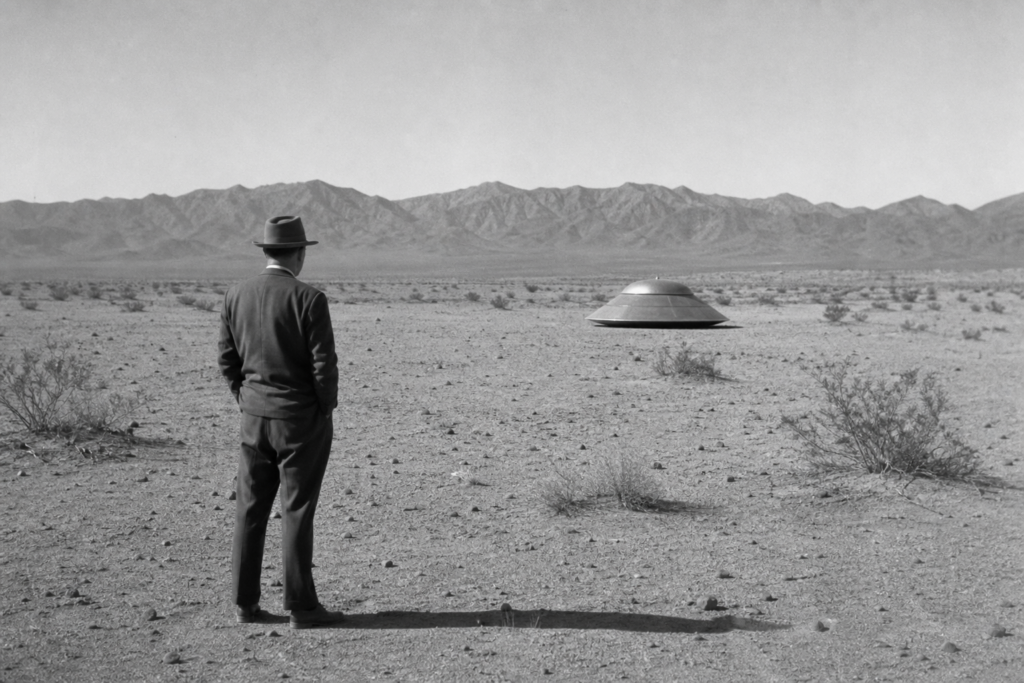
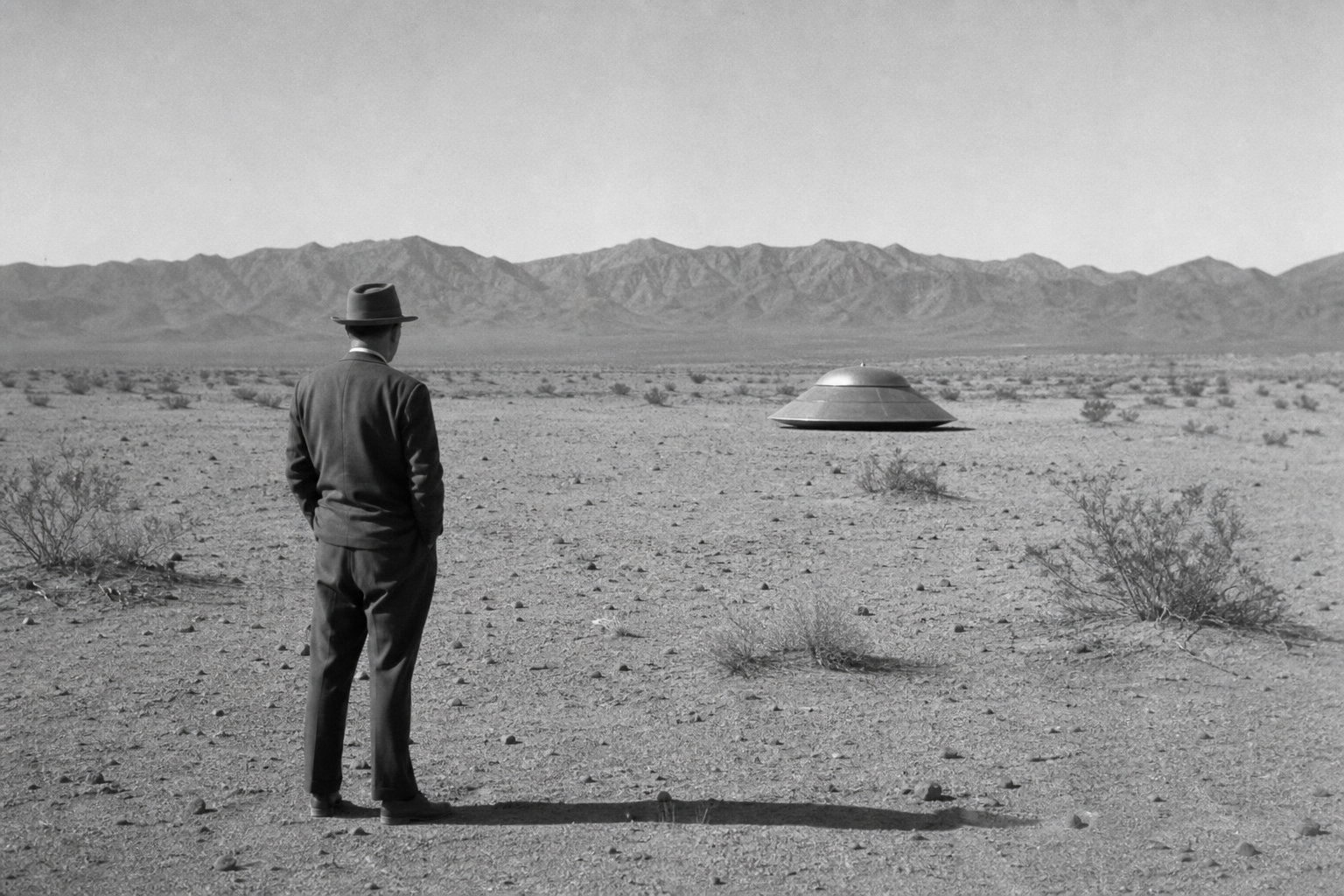
In November 1952, amid the tense optimism and atomic dread of the early flying-saucer era, George Adamski said he met a human-looking visitor from Venus in the California desert. The George Adamski 1952 contact claim was extraordinary not simply because it involved a reported landing, but because it gave extraterrestrials a message: humanity, Adamski alleged, was endangering itself through nuclear weapons and needed to choose peace.
That testimony was never independently verified. Its historical importance lies elsewhere. Adamski rapidly became one of the most visible “contactees”, people who claimed direct communication with beings from other worlds, through photographs, books, lectures, press attention, and a growing audience willing to debate his account. This article follows those documented effects: how a personal desert narrative entered public UFO argument, helped establish contactee culture, and encouraged audiences to expect visitors not merely as unexplained objects in the sky, but as moral teachers with warnings for Earth.
The distinction matters. Official investigations such as Project Blue Book gathered and assessed UFO reports; Adamski offered an individual revelation and built a public persona around it. Examining the latter does not authenticate the encounter. It explains why his story became a durable, divisive template for UFO belief in the 1950s and beyond.
George Adamski and the Moment That Made a Contactee Celebrity
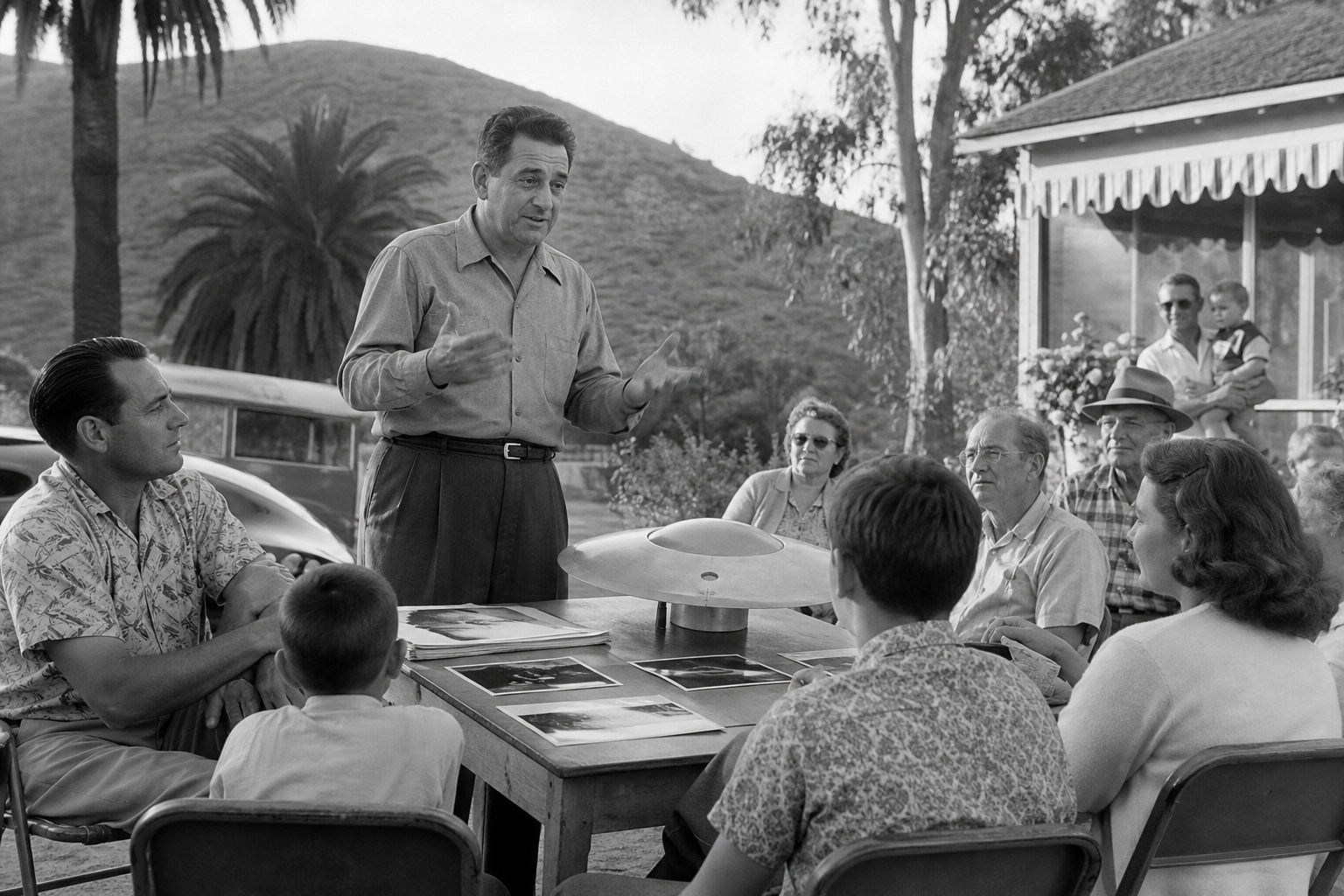
At Palomar Gardens near Valley Center, California, George Adamski had a ready-made public stage before the Desert Center story made him famous: visitors could encounter a saucer enthusiast who discussed cosmic ideas from a named, accessible site. That physical base gave his later allegations a recognizable setting, a host, and an informal audience able to spread them through conversation, photographs, talks, and print.
His November 20, 1952 account arrived five years after the 1947 flying-saucer wave had made unidentified objects a national subject, while atomic weapons and Cold War rivalry sharpened public unease about technology and survival. Adamski presented more than a sighting report: he alleged personal contact with a visitor from Venus and cast himself as the recipient of a message for humanity. For followers, that move made the mystery intimate and morally charged rather than merely aerial.
The account remains unverified, and critics disputed its evidence and its increasingly elaborate implications. Historical influence, however, is a separate question from authentication. Through public appearances, images, and later books, Adamski became a visible interpreter of direct contact, helping shift parts of UFO culture toward personal revelation, spiritual authority, and a mass-media audience eager to debate both the messenger and the message.
What Adamski Said Happened at Desert Center in 1952
On November 20, 1952, Adamski and several companions traveled into the desert near Desert Center, California, where he said they watched an unusual craft maneuver in the sky. In his later published narrative, the group had stopped after seeing what appeared to be a large, hovering object. Adamski said a smaller, silvery, saucer-shaped craft then descended nearby. The chronology is important: the others were present for the reported aerial observation, but Adamski presented the close encounter itself as principally his own experience.
Adamski said he left the group and walked toward the landed craft, where he met a man who looked human rather than monstrous or mechanical. He later identified this visitor as Orthon and described him as a Venusian. In the George Adamski Desert Center encounter, the visitor’s ordinary appearance was central to the story’s appeal: the alleged being was portrayed as calm, physically graceful, and able to move among humans without immediately appearing alien.
Speech, Adamski maintained, played only a limited role. He said he and the visitor exchanged meaning through hand movements, facial expression, and telepathic understanding. That distinction allowed the account to present a detailed exchange without a conventional recorded conversation. Adamski also described the visitor using gestures to communicate concern about humanity’s conduct, a theme he would develop more fully afterward.
The companions’ role gave the George Adamski 1952 UFO contact a structure that sounded partly witnessed and partly private. They could support that they had accompanied him and had seen something in the area, while the alleged visitor’s identity, the telepathic exchange, and the meaning Adamski drew from it depended on his testimony. No independent evidence established that a craft landed or that Orthon existed. The episode is therefore best read as Adamski’s unverified account of a shared sighting followed by a personal encounter, an arrangement that helped make his later authority as interpreter of the visitors’ message possible.
The Venusian Message, Photographs, and Limits of the Evidence
In Adamski’s telling, the encounter carried a moral lesson as consequential as the craft itself. He portrayed the Venusian message as a warning that nuclear weapons endangered not only Earth but a wider cosmic order. The visitors, he said, possessed superior technology without having abandoned spiritual responsibility; their peace message asked humanity to move beyond war, suspicion, and materialism. Those ideas made the narrative intelligible in an atomic-age culture: the alleged visitors were not merely pilots from another planet, but anxious guardians offering a rebuke to modern civilization.
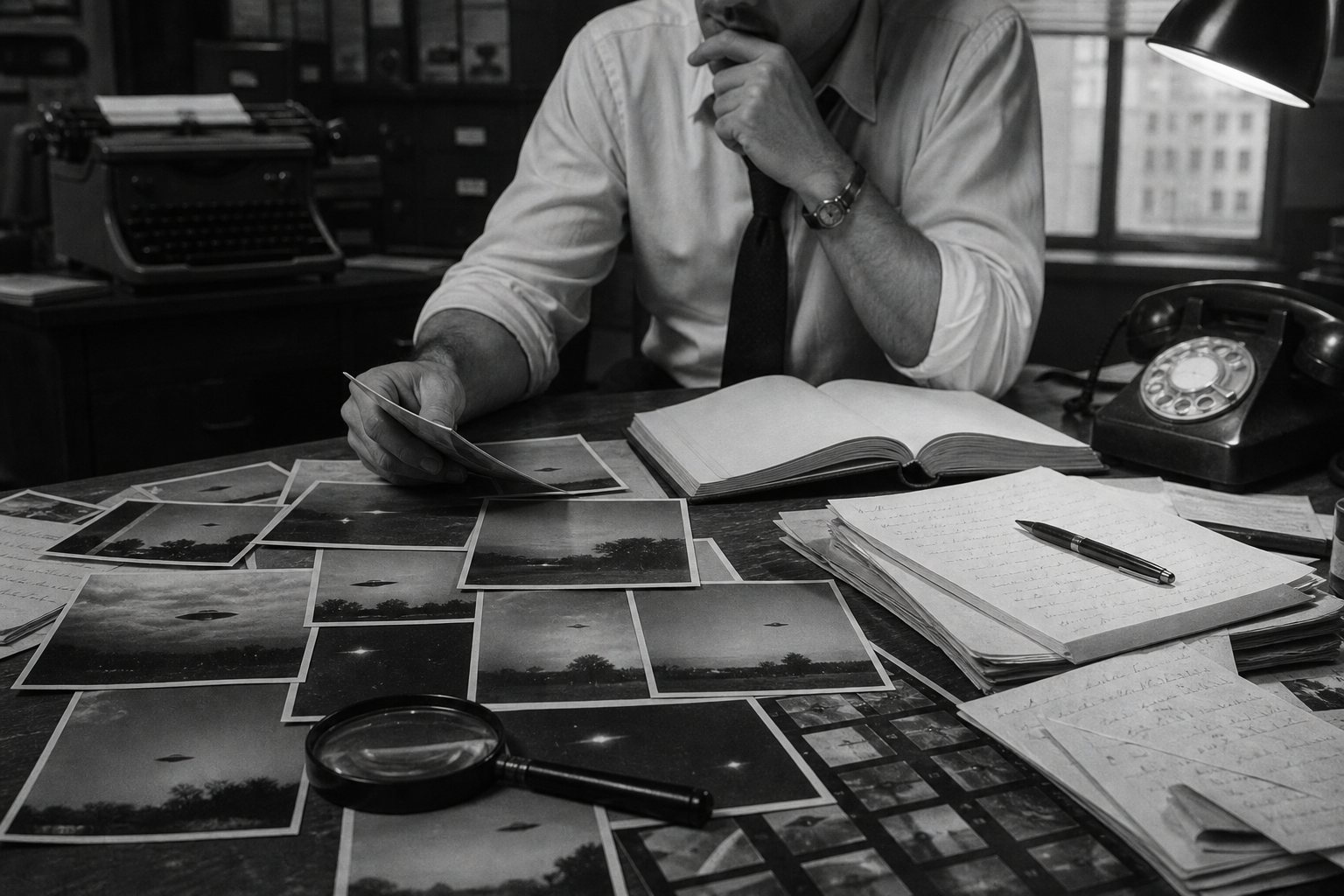
Adamski gave the claim a visual counterpart through UFO photographs that he presented as images of the same type of saucer-shaped craft. Reproduced in lectures, newspapers, and later publications, the pictures offered audiences a concrete object to inspect rather than only a private report of telepathic communication. That changed the story’s public character. A photograph can circulate independently of its maker, but it remains evidence of a photographed object, not, by itself, evidence of its scale, origin, distance, or extraterrestrial manufacture.
The evidentiary record therefore has several distinct layers. Adamski’s description of Orthon, the warning about nuclear arms, and the interpretation of gestures and thoughts rest on his own testimony. Accounts of landing marks, footprints, and other physical traces were presented as supporting signs, yet they did not establish that a Venusian craft had been present. Later retellings also tended to enlarge the contact story into a more elaborate account of extraterrestrial society and continuing communication; those expansions should not be treated as independently observed events.
Critics focused especially on provenance: who handled the images, what could be established about the circumstances of exposure, and whether ordinary models or photographic effects could account for their appearance. Such objections do not erase the documented fact that Adamski made and publicized the photographs, nor do they explain away the sincerity of every follower. They do mark the central limit of the George Adamski 1952 contact claim: its message and imagery became culturally powerful without acquiring independent proof that Venusian visitors, or the reported encounter, were real.
How the Public, Press, and UFO Community Responded
Photographs, a human-looking visitor, and a warning about war gave the November 20, 1952, Desert Center report elements that could travel easily beyond the people present. Public attention did not depend on everyone accepting Adamski’s account: newspapers and popular outlets could treat it as a curiosity, a local sensation, or part of the era’s flying-saucer fascination without endorsing the alleged encounter. Each retelling separated the claim from its original setting, allowing listeners to encounter the image or message before they encountered Adamski himself.
Within the growing UFO subculture, the response was similarly divided. Supportive audiences found in the George Adamski contactee claim a more hopeful alternative to reports of alarming aerial intrusions. His lectures, informal discussion circles, correspondence, and local gatherings gave people places to debate sightings alongside the possibility of direct communication with visitors. For sympathetic listeners, the personal character of the testimony was a strength: it suggested that ordinary people, rather than official institutions such as Project Blue Book, might receive consequential knowledge.
That same feature gave skeptics a clear objection. Adamski’s companions could potentially speak to the November 1952 trip and the reported object in the sky, but the alleged meeting with Orthon, its message, and Adamski’s interpretation of the photographs rested chiefly on his own account. A stronger evidentiary signal would have been independently documented circumstances excluding ordinary explanations; the weaker signal was an extraordinary conclusion resting mainly on a claimant’s narrative and images of uncertain provenance. Supporters defended Adamski’s sincerity and significance, while detractors challenged his evidence and credibility, an argument that itself kept the story visible.
How Adamski Built a Template for Contactee Culture
Flying Saucers Have Landed gave the story a form that conversation alone could not sustain. Published in 1953 with Desmond Leslie as co-author, it paired Leslie’s wide-ranging speculation about flying saucers with Adamski’s first-person account of the Desert Center encounter. That structure mattered: readers moved from a broad suggestion that unidentified craft had a long history to a seemingly intimate testimony by a named man who said he had met their occupant. The book did not establish the truth of Adamski’s allegations, but it made them portable, discussable, and available for rereading beyond the immediate cycle of press attention.
Its imagery was equally reusable. A small, symmetrical saucer with distinctive projections was easier to picture, reproduce, and compare than an ambiguous light in the sky. Adamski presented photographs as visual evidence, while critics disputed their origin and interpretation; culturally, however, the pictures supplied a recognizable design language. Later contact narratives could combine the same basic components: a landed or low-flying craft, visitors who looked substantially human, and a witness granted exceptional access. The visual motif gave audiences something concrete to circulate even when they did not accept its evidentiary claim.
Adamski’s public role completed the pattern. He appeared not merely as a witness reporting an odd event, but as a confident interpreter who could explain what the visitors supposedly wanted from humanity. Lectures, informal groups, letters, and followers turned that interpretive authority into a social practice: believers could gather to hear messages, compare experiences, and treat personal testimony as an alternative route to consequential knowledge. The resulting contactee movement differed from a conventional sighting culture. A sighting could remain a question about an object; a contactee account offered a relationship, a moral teaching, and a claimed mission for the person who received it.
That model was especially adaptable because its visitors were benevolent rather than simply mysterious. Adamski’s alleged space people combined technological superiority with warnings against war, spiritual decline, and nuclear catastrophe. Later claimants did not need to reproduce every detail of his account to adopt its central bargain: privileged contact brought both reassurance and responsibility. Adamski did not create every strand of early UFO belief, but his books, images, and teacher-like persona helped establish one of its most durable narrative forms, an unverified encounter recast as cosmic counsel.
Adamski’s Legacy, and Why It Is Not the Same as Modern UAP Disclosure
Adamski’s enduring importance lies less in the plausibility of his testimony than in the role his story made available: the contactee as witness, interpreter, and bearer of a higher moral authority. His reported encounter invited audiences to weigh institutional expertise against a charismatic individual who claimed access to knowledge unavailable to governments, scientists, or ordinary observers. That tension helped make contact narratives a lasting feature of UFO culture, where belief could be organized around testimony, community, and spiritual meaning as much as around an unexplained object.
That history should not be folded into modern UAP disclosure debates. Adamski offered a personal account of a named extraterrestrial visitor, a telepathic message, and a cosmic warning; neither his companions’ presence in the desert nor his photographs independently established those central allegations. No credible documentary record shows that the U.S. government authenticated his claimed encounters. Project Blue Book, by contrast, was an official program that collected and evaluated sighting reports, not an endorsement of Adamski’s interpretation.
Contemporary discussion of UAP disclosure concerns a different evidentiary category: military sensor readings, pilot testimony, official records, and disputes over what institutions have collected or released. Such material may raise legitimate questions about unidentified observations, but it does not convert a 1952 contact story into verified evidence of non-human intelligence or substantiate a government UFO cover-up. Adamski remains central because he showed how a UFO account could become a durable public worldview, not because later efforts to classify and study UFO reports more systematically resolved the claims he made.
Why Adamski’s Story Still Matters
The lasting pattern is visible in the way a private encounter became a public narrative system. Adamski joined a memorable setting, a reassuring but admonitory visitor, photographs that invited scrutiny, and a speaker’s ability to keep supplying interpretation. Books and press coverage carried the account beyond the people who had heard it directly; lectures and followers gave audiences places to discuss, defend, revise, and imitate it. Controversy was part of that circulation rather than merely an obstacle, since disputes over the images and testimony kept the story in view.
That combination supplied contactee culture with a durable script: advanced visitors appear benevolent, warn humanity about war or spiritual failure, and choose an individual messenger whose testimony asks to be trusted despite limited independent proof. The script could absorb both belief and doubt. Admirers could treat the message as morally urgent, while critics could test the photographs, recollections, and expanding claims without denying that the story had real cultural consequences.
The George Adamski 1952 contact claim therefore matters chiefly as an episode in the making of a UFO public culture, one shaped by portable images, charismatic testimony, media attention, and disagreement. Its legacy is not evidence for extraterrestrial contact. Modern UAP inquiries must stand or fall on their own records, sensors, witnesses, and methods, including officially authenticated military UAP videos; Adamski’s historical importance lies in the culture he helped create.
Frequently Asked Questions
-
What did George Adamski claim happened in 1952?
George Adamski claimed that on November 20, 1952, he saw a saucer-shaped craft near Desert Center, California, and met a human-looking visitor from Venus. He said the visitor communicated concern about humanity’s nuclear weapons and need for peace.
-
Who was Orthon in George Adamski’s UFO story?
Orthon was the name Adamski later gave to the alleged human-looking Venusian he said he encountered in the California desert. Adamski described him as calm and physically human in appearance, communicating mainly through gestures and telepathic understanding.
-
Did George Adamski provide evidence for his UFO contact claim?
Adamski publicized photographs of saucer-shaped objects and cited reported landing marks and footprints, but none independently verified a landed extraterrestrial craft or his meeting with Orthon. The visitor’s identity, telepathic message, and key details of the encounter rested chiefly on Adamski’s own testimony.
-
Why was George Adamski important to the contactee movement?
Adamski helped popularize the contactee model through lectures, photographs, correspondence, and the 1953 book Flying Saucers Have Landed, co-written with Desmond Leslie. His story presented visitors as benevolent moral teachers and the witness as an interpreter with a mission, a pattern later contact claims frequently adopted.
-
How should you distinguish Adamski’s contact claim from modern UAP evidence?
Adamski’s claim centered on a personal account of a Venusian visitor, telepathic communication, and photographs with disputed provenance. Modern UAP inquiries should be assessed separately through records, military sensor data, pilot testimony, authenticated videos, and methods that can test ordinary explanations.