The Eglin Military-Pilot UAP Case: AARO’s Resolution and Its Limits
A military pilot reported four objects near Eglin Air Force Base and photographed one after a radar observation. AARO assessed that the photographed object was very likely a balloon, while leaving the other three radar returns unanalyzed.
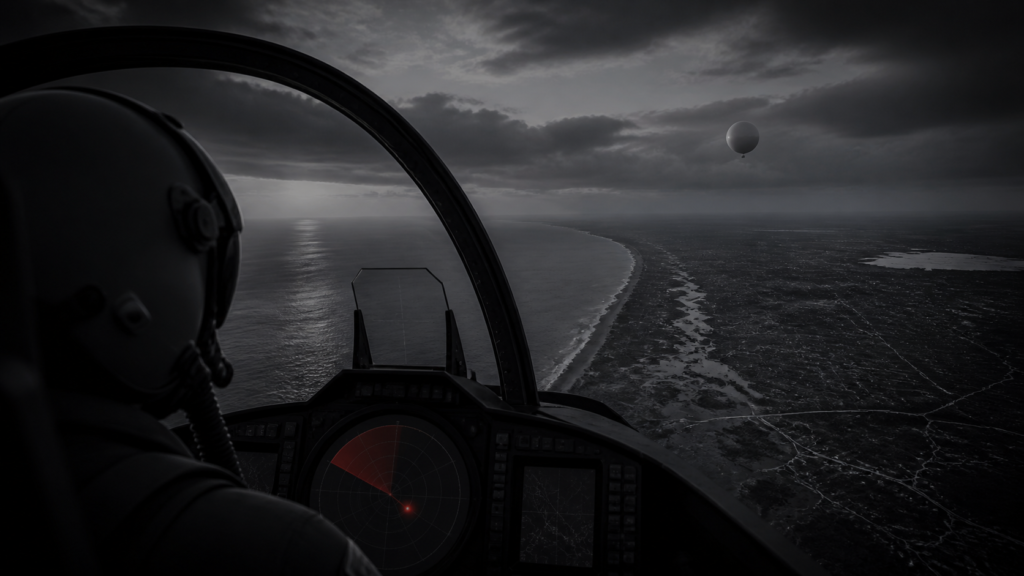
On January 26, 2023, a U.S. military pilot operating in a training range off Florida reported four potential unidentified anomalous phenomena near Eglin Air Force Base. The pilot first saw four objects on the aircraft’s radar between 16,000 and 18,000 feet, apparently in formation. The pilot then visually observed one object at about 16,000 feet and captured two still images with an electro-optical and infrared sensor.
The case attracted attention because it combined a trained observer, radar information, visual observation, imagery, a sensitive range, and an equipment malfunction during the encounter. AARO’s later case resolution concluded with moderate confidence that the photographed object was very likely a lighter-than-air object—possibly a large commercial lighting balloon or another type of balloon—and that it displayed no confirmed anomalous behavior.
That finding is substantial, but it does not resolve every part of the original report. AARO had no imagery for the other three radar returns and said it could not analyze them. The public document also does not identify a recovered balloon, a launch operator, or a definitive product model. The accurate summary is therefore not “all four objects were proven to be balloons.” It is that the single visually observed and photographed object was assessed as very likely a balloon, while three radar-reported objects remained outside the available analysis.
The observation and the available data
AARO says the pilot reported the encounter because the object might pose a flight-safety hazard and because it represented an incursion into a sensitive training range. In the initial account, the four radar objects appeared to be flying together. Only one was seen directly. Video could not be recorded because the aircraft’s recording equipment was already inoperable before and during the flight, leaving two still images rather than a continuous sequence.
The pilot initially described the visible object as gray, with a paneled surface and orange-red coloring at its center. In a later interview with AARO, the pilot estimated it was about 12 feet in diameter and either nearly stationary or moving very slowly. The lower half appeared rounded, while the upper half resembled a rounded three-dimensional cone—compared in the report to the Apollo spacecraft. The pilot perceived “blurry air” below it as a possible heat signature.
During the later discussion, the pilot also recalled what looked like a vertically oriented engine on the object’s side. AARO noted two important limitations: that feature does not appear in the two sensor images and was not included in the initial report. The office said it had no additional data to corroborate an engine. That does not prove the recollection was false; it means the public evidence does not independently confirm it.
The case illustrates why the site’s coverage of military-pilot reporting distinguishes the act of reporting from the later evidentiary finding. A pilot can appropriately report an unusual flight-safety event even when subsequent analysis identifies an ordinary object.
The radar failure
The pilot reported that the aircraft’s radar malfunctioned after closing to within about 4,000 feet of the object and remained disabled for the rest of the exercise. Temporal proximity made the failure an obvious question for investigators: did the object interfere with the aircraft?
A post-mission review found that a circuit breaker had tripped. Technicians reported that the same breaker on that aircraft had tripped three times during preceding months, though they could not conclusively diagnose the specific fault in this incident. AARO assessed that the malfunction was coincidental and likely resulted from a pre-existing technical problem rather than the object.
This is an inference based on maintenance history, not a laboratory proof of the breaker’s exact failure mechanism. The report’s wording is appropriately probabilistic. A known recurring fault makes a causal connection to the nearby object less likely; the inability to diagnose the incident’s precise cause leaves a narrower technical uncertainty. AARO did not treat that residual uncertainty as affirmative evidence of electromagnetic interference.
After the radar failure, the pilot recalled seeing the object descend into the cloud deck. Without continuous video, public analysts cannot reconstruct that descent frame by frame. AARO’s reported geometry, wind, and object behavior nevertheless led it away from an interpretation involving exceptional speed or maneuvering.
Why AARO favored a balloon
AARO based its moderate-confidence assessment on the pilot’s accounts, the two still images, a reconstruction of flight geometry, wind and sun angles, laboratory testing of a commercial lighting balloon, and reviews by an intelligence component and a science-and-technology partner. The office did not rely on appearance alone.
The reported slow or stationary motion and direction were consistent with an object carried by the wind at the observed altitude. The panel-like surface could correspond to seams in a fabric balloon. Large lighting balloons are used at construction sites, outdoor events, and film sets; some models have dark and light hemispheres and reflective material that directs illumination downward. In infrared imagery, differences in temperature, emissivity, or reflectivity can create strong contrast between the halves.
AARO purchased or obtained a commercial lighting balloon for testing and found that it could reproduce aspects of the account. The office also considered meteorological, Mylar, and other large-form balloons. Sunlight and the observer’s angle could have illuminated one hemisphere while leaving the other shaded. The orange-red center might have been sun glint or a colored tether point. “Blurry air” could reflect environmental conditions, motion blur, or a hanging tether rather than exhaust.
The independent partners strengthened the conclusion. An intelligence-community component reconstructed the event using altitude, coordinates, aircraft heading, viewing angle, and sun geometry and assessed with high confidence that the object displayed no anomalous characteristics. An AARO science-and-technology partner deconflicted military and commercial radar traffic and independently assessed with high confidence that the object was non-anomalous and very likely some kind of balloon.
Moderate confidence is not positive identification
AARO labeled the case resolved, but assigned only moderate confidence to the balloon identification because the data were limited. That is not contradictory. “Resolved” reflects the office’s case disposition; “moderate confidence” communicates uncertainty about the precise identification. The analysis found an ordinary class of objects that fit the imagery, motion, environment, and geometry without requiring anomalous capability.
The report does not say investigators recovered the object, traced it to a seller, found a launch record, or matched a serial number. It presents a best-supported analytic identification. The phrase “such as a large commercial lighting balloon” is illustrative, not a declaration that a particular lighting company launched it. Other lighter-than-air objects remained plausible within the office’s assessment.
This calibrated language is important when reading AARO products. As our account of the AARO public website explains, case-resolution reports summarize government analysis but often do not release all underlying operational data. The later AARO annual report likewise separates closed cases from reports that lack enough information for resolution.
What happened to the other three objects?
The original radar picture included four returns, but the pilot’s direct observation and photographs covered one. AARO explicitly states that there was no electro-optical or infrared data for the other three and that it could not analyze them. The report does not publish radar plots or enough track data for an independent evaluation.
That leaves several possibilities open. The returns may have represented additional balloons, aircraft, clutter, or other objects; the public case report does not decide among them. Nor does it establish that the four returns all shared the appearance of the photographed object. Calling the group a confirmed formation of identical craft would exceed the evidence.
Conversely, the lack of imagery for three returns does not overturn the analysis of the photographed one. Evidence can resolve one component of an encounter while leaving another unassessed. Researchers should preserve that structure instead of forcing the whole case into a single “explained” or “unexplained” label.
Flight safety and the value of reporting
A balloon in a military training range is not trivial. Even an ordinary object may threaten an aircraft, interrupt a mission, or reveal gaps in range awareness. The pilot’s report created a record that could be correlated with sensor data, maintenance history, geometry, weather, and comparison testing. That process is a better outcome than discouraging reports because an object might eventually receive a prosaic explanation.
The event occurred during a period of intense attention to airborne objects, shortly before the series covered in the North American object shootdowns. Those cases underline the same basic principle: ordinary lighter-than-air objects can create genuine defense and aviation questions, and initial uncertainty should not be confused with proof of extraordinary origin.
For the public, the Eglin report offers more analytical detail than many short UAP releases. It includes the pilot’s description, later recollections, maintenance evidence, alternative explanations, independent partner assessments, and the office’s stated confidence. It also clearly lists what was missing. Readers can find the report through the primary-source library and place the January 2023 event on the site’s chronological timeline.
The resolution and its limits
The public evidence supports four bottom-line statements. A military pilot reported four radar objects near Eglin on January 26, 2023. One was visually observed and photographed. AARO assessed with moderate confidence that this object was very likely a balloon and confirmed no anomalous behavior. The other three radar-reported objects could not be analyzed from the available electro-optical or infrared data.
The report does not support a claim that a craft disabled the radar, that an engine was confirmed, that all four objects were identified, or that a specific commercial balloon was positively traced. It also does not support dismissing the report as meaningless. It documents a legitimate range-incursion and flight-safety concern, followed by a multi-part technical review and an explicit statement of uncertainty. That combination—resolution where evidence permits and restraint where it does not—is the most useful way to preserve the case.