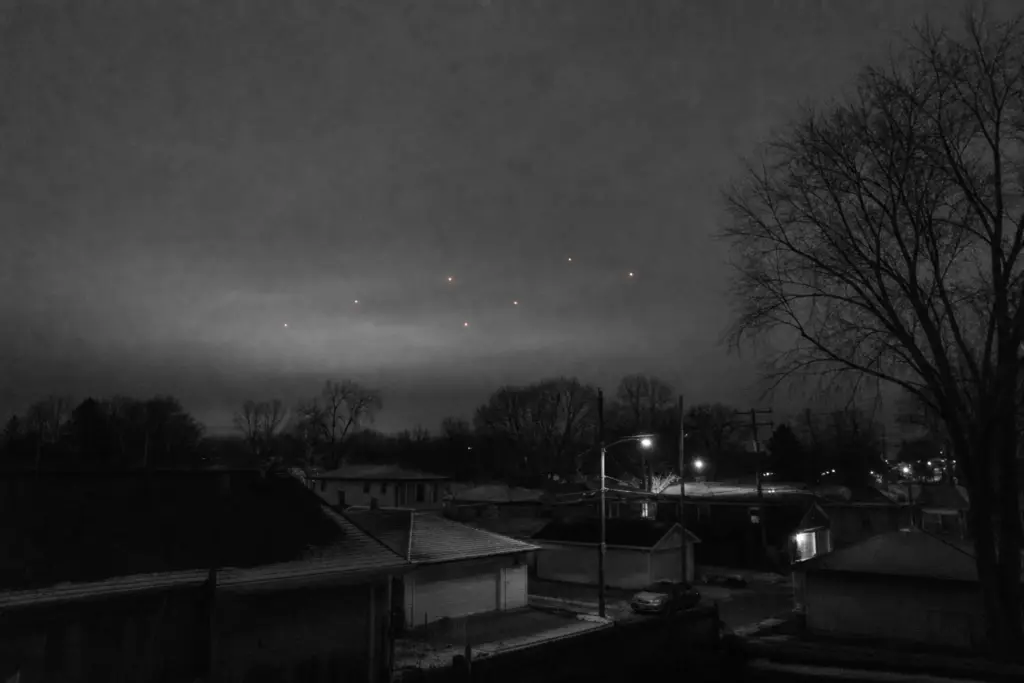
Start with the fixed details: the event is placed over Rockford, Illinois, on February 16, 2000, and the witness description involves eight balls of reddish-orange light. Those details make the report identifiable, but they do not establish distance, altitude, motion, or even whether the observer was seeing eight separate objects rather than lights within one scene.
That distinction matters. A witness report can document that an observer described an event; independently verified evidence would require something additional, such as contemporaneous photographs with usable provenance, multiple accounts that can be compared, aircraft records, weather observations, or local reporting tied to the same time and place. An unusual appearance is not a verified cause.
This account begins by separating the reported details from the evidence that can actually be located and assessed. It then compares ordinary possibilities with observable features, orange-red color, number of lights, apparent arrangement, movement, timing, and viewing conditions. Aircraft lighting, distant activity, lantern-like lights, and atmospheric effects can resemble one another at night, while the surviving record may not preserve the details needed to distinguish them. Where the evidence cannot carry a conclusion, the appropriate finding is unresolved rather than speculative.
What Was Reported Over Rockford on February 16, 2000
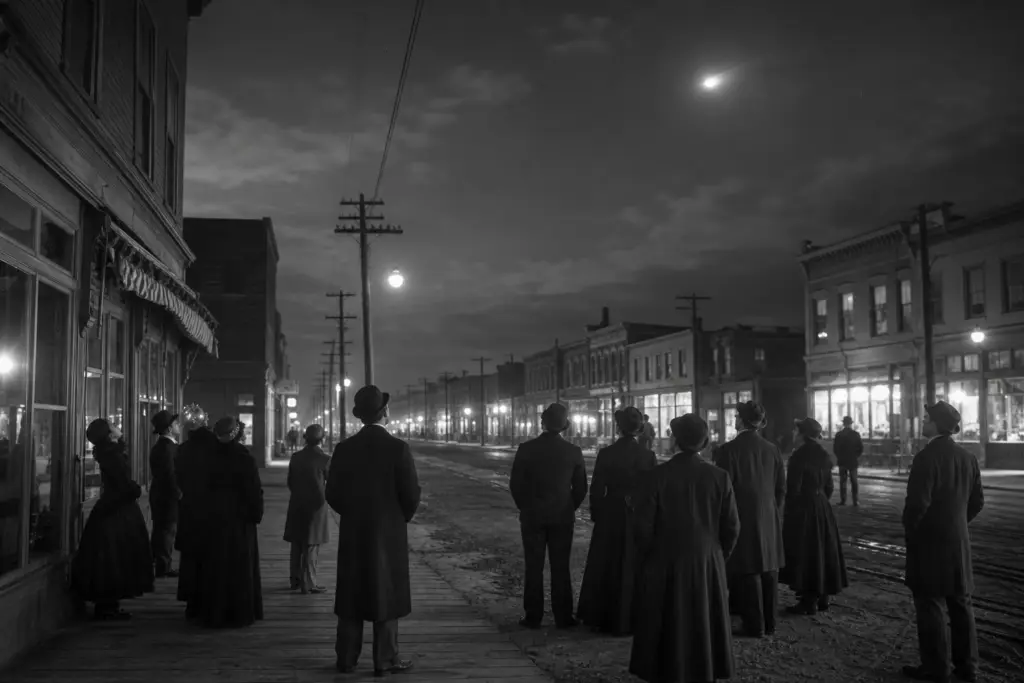
The surviving claim is narrowly framed: on February 16, 2000, an observer reported seeing what appeared to be eight reddish-orange balls of light over Rockford, Illinois. “Eight” describes the observer’s count of visible lights, not a confirmed count of separate physical objects; a formation, reflections, distant lights, or a changing view can affect how many points of light a person perceives.
No section-specific primary report, named witness, submission date, verbatim narrative, photograph, video, radar record, police log, FAA record, or contemporaneous local-news account has been supplied for this assessment. That gap does not disprove the observation. It does mean the available claim cannot yet be treated as a fully reconstructed, independently corroborated event, or identified as a single-witness or multi-witness report.
For that reason, the eight orange lights over Rockford, Illinois are best approached as an unidentified historical report. “Unidentified” records a limit in the surviving information; it does not identify an extraordinary cause. The next step is to locate the earliest available record and determine exactly which details, time, direction, duration, motion, arrangement, and witness count, were actually reported rather than added in later retellings.
Reconstructing the Available Sighting Record
NUFORC preserves multiple submissions made from February 17 through February 21, 2000 describing orange or amber lights over Rockford at about 9:30 p.m. on February 16. The accounts vary in count and formation, including reports of four, five, and eight lights, so they support a shared time-place-color cluster without establishing one exact object count or cause.
- What the available claim contains: the reported location is Rockford, Illinois; the observation date is February 16, 2000; the reported count is eight; and the lights are described as reddish-orange balls of light.
- What it does not contain: an observation time, duration, compass direction, elevation above the horizon, distance estimate, speed, sequence of movement, or formation geometry. Without those details, “over Rockford” cannot distinguish lights nearby from lights seen at a distance in the Rockford sky.
- What it does not identify: no witness name or pseudonym, contact status, number of observers, or first-hand narrative is available here. The record therefore cannot establish whether the account came from one person, several people, or a later compilation.
- What it does not preserve: there is no verbatim description explaining whether “balls” referred to the lights’ apparent shape, a visual impression, or physical objects. There is also no supplied image, video, sketch, follow-up correspondence, or investigator note.
A NUFORC sighting report, if an identifiable entry were located, could separate the date of observation from the date a witness submitted the account and preserve the reporter’s actual wording. Neither field is presently available for this Rockford Illinois UFO sighting 2000 claim. Treating the listed date as both the event date and the report-recording date would add an unsupported assumption.
Later summaries should be handled conservatively. Repeating “eight reddish-orange balls of light Rockford” preserves the core description; adding a precise time, direction, silent hovering, coordinated motion, witness total, or official response would require a traceable earlier record. No such supporting record has been supplied here. The usable reconstruction is consequently limited to the four stated descriptors, with all behavioral and observational context left unknown.
What Can and Cannot Be Verified
The evidentiary threshold changes with the claim being made. A submitted UFO sighting report can establish that someone communicated an account to a database or investigator at a particular time; it cannot, by itself, independently establish that the incident occurred as described, that lights were present over Rockford, that there were exactly eight of them, or that they moved in any particular way.
Independent corroboration would be stronger if separately recorded witnesses matched the date, general location, time window, direction of view, and changing arrangement of the lights without simply repeating one another. A second account that only reproduces the same four descriptors may preserve the story, but it does not necessarily add an independent observation.
Contemporaneous Rockford-area newspaper, television, or radio coverage could show that the event drew attention when it occurred, particularly if it identified multiple observers or recorded time-sensitive details. It would not automatically identify the lights. Likewise, no supplied material includes a photograph or video. Such media would be most useful when the original file, capture time, location, device information, and an unbroken path from recorder to archive are known; an undated repost cannot securely tie an image to this incident.
Aviation and official records have similarly narrow roles. Flight information can sometimes place aircraft in a relevant area, while radar may record some targets and their tracks; neither category alone proves that a particular observer saw a particular object. Police, emergency-dispatch, or other agency logs could document calls received, but a logged call documents reporting activity rather than the cause of the lights.
Several separately submitted NUFORC reports match the date, approximate time, city, and orange or amber appearance. They are corroborating witness submissions, not official measurements: the public record reviewed here still lacks authenticated imagery, radar data, FAA material, or a demonstrated explanation.
Plausible Non-Extraordinary Explanations for Orange Lights
The missing particulars are the very ones that distinguish ordinary light sources. Aircraft lights would become more plausible if the points blinked at regular intervals, held a steady course, changed apparent spacing as they turned, or followed the same approach or departure corridor; a distant line of aircraft can appear nearly stationary or clustered. Helicopters, including civilian or military traffic, would be a better fit for slower movement, prolonged hovering, and audible rotor noise, although sound may not carry reliably over distance or wind.
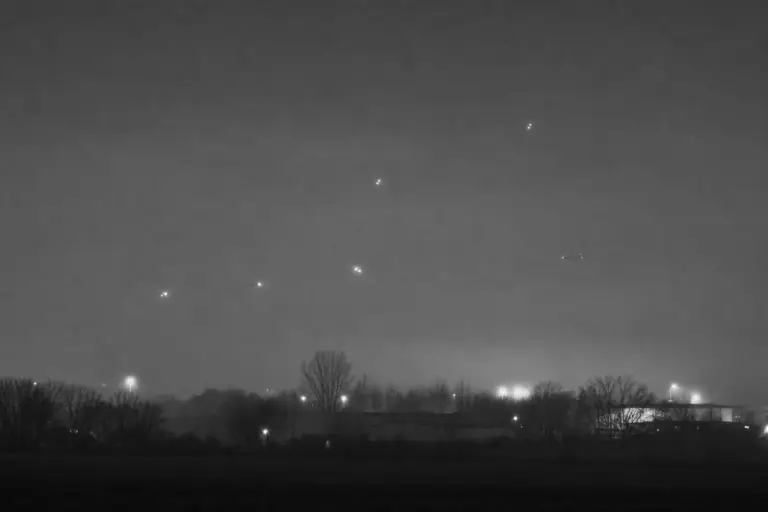
Chinese lanterns and illuminated balloons are possibilities when lights rise after release, drift together with the wind, glow steadily rather than blink, and gradually dim or descend as their fuel or lift is lost. Their loose spacing can change without coordinated turns. By contrast, a tight, persistent geometric formation travelling at a common speed would weigh against independently drifting lanterns or balloons. Neither launch activity nor wind direction, duration, altitude, or rise-and-fall behavior is preserved in the available description of this orange orb UFO sighting.
Astronomical objects would ordinarily remain fixed relative to one another and to the horizon over a short observation, rather than travel together across the sky. A meteor is generally a brief streak or rapidly moving point; re-entering debris can instead produce several fragments moving along one broad path, sometimes with changing brightness. Haze, thin cloud, low viewing angles, reflections, and ordinary limits of night vision can shift a light toward orange-red, enlarge it into a ball-like glow, or make a single moving source seem less distinct. Without a reported time, direction, weather conditions, motion pattern, sound, blinking behavior, or duration, none of these categories can be responsibly selected as the explanation.
Why “Reddish-Orange” and “Eight” Do Not Identify the Cause
Color is a description of the light as it reached the observer, not a fingerprint of its source. At night, a distant light viewed low in the sky can pass through more haze, thin cloud, moisture, and airborne particles than one overhead, muting shorter wavelengths and making the visible glow seem warmer. Brightness also affects apparent size: an intense point can bloom into a soft ball, while visual adaptation after looking at darkness or nearby streetlighting can change its perceived hue.
A photograph would not automatically settle that issue. Exposure length, focus, white balance, digital noise reduction, and lens flare can enlarge, tint, duplicate, or smooth small lights. A useful image would preserve original-file metadata and show stable landmarks, a sequence of frames, and enough context to compare the lights’ positions; an isolated, highly zoomed image is a weaker indicator of color, shape, and number.
“Eight” likewise records a count at a particular moment rather than a demonstrated total of physical objects. Blinking can make lights appear and disappear between glances; a turn can uncover or hide lights; and changing perspective can compress separated sources into a group or make one source seem divided by glare, cloud gaps, or reflections. A stable count, recorded over time with a clear account of spacing and motion, would be more discriminating than a single remembered number. The surviving Rockford description does not preserve those details. The observer may therefore have accurately reported eight reddish-orange lights as experienced, while the underlying source remains unidentified from the available record.
How to Check Historical Illinois Sighting Claims Responsibly
Begin with provenance: seek the earliest record that identifies the observer or submission system, separates the February 16, 2000 observation date from the report-posting date, and preserves the wording about eight reddish-orange lights over Rockford. An anonymous database entry can document an anonymous claim, but copied text on later websites is not independent corroboration. A dated archival capture is stronger than an undated repost because it shows when that wording was publicly available.
For Illinois UAP sightings, search Rockford Public Library and local-library newspaper databases for the days immediately before and after the event, then pursue station news libraries for any broadcast footage or assignment logs. Compare any reported time and direction with historical National Weather Service observations, and seek aviation material through FAA public-record channels while noting that a missing retained record is not evidence that no flight occurred. Claims of an investigation or suppression need a named agency, date, case number, record, or contemporaneous report; repetition alone does not establish either. Modern disclosure debates add nothing to this 2000 report unless a traceable record explicitly links them. Consult archival UAP records to help locate, assess, and contextualize such material.
Bottom Line: A Documented Report, Not a Confirmed Explanation
The decisive checkpoint is provenance: no traceable original submission, named observer, observation time, or independent contemporary record is available in the material assessed here. What survives is a later claim that reddish-orange balls of light were reported near Rockford on February 16, 2000.
Direction, duration, movement, distance, weather conditions, and any relationship to aircraft, lanterns, or another ordinary source therefore remain unresolved. The account is a historical lead, not a basis for assigning a cause.
The most responsible wording is that multiple people submitted reports of orange or amber lights over Rockford in the same time window. Those reports do not establish extraterrestrial craft, non-human intelligence, an official investigation, or a government cover-up; they document a witness-report cluster whose cause remains unresolved in the cited material.
What the Rockford Sighting Can, and Cannot, Show
A useful dividing line is between a record that preserves a claim and evidence that can test the claim. The available material reaches only the first threshold: it retains a later assertion that an unusual-light observation occurred over Rockford on February 16, 2000. It cannot establish the lights’ physical identity, distance, altitude, or point of origin.
Neither surviving descriptive feature closes that gap. Reddish-orange describes appearance rather than a unique signature, while eight is a momentary reported count rather than proof of eight separate objects. Those details can be compared with aircraft, lanterns, balloons, or other ordinary possibilities, but a discriminating comparison requires absent observations: time, direction, duration, motion, spacing, blinking, sound, and sky conditions.
The most valuable future discovery would be an original submission or a contemporaneous item that independently fixes those particulars. A strong record would preserve a submission date, the observer’s own wording, and a specific viewing account; a weak one would only repeat the later summary. Until stronger material appears, the Rockford UFO sighting February 16 2000 remains an unresolved historical report, not evidence for any particular explanation.
Sources
- NUFORC report 12044: eight orange lights
- NUFORC report 12056: five orange fireballs
- NUFORC report 12057: orange lights
- NUFORC report 12076: four amber orbs
- NUFORC February 2000 report index
Frequently Asked Questions
What was reported over Rockford, Illinois, on February 16, 2000?
A later claim reports that an observer saw eight reddish-orange balls of light over Rockford, Illinois, on February 16, 2000. No observation time, direction, duration, motion description, or witness identity survives in the available record.
Were the eight reddish-orange lights over Rockford ever identified?
No confirmed explanation is available for the reported lights. The account remains an unresolved historical report because no original submission, independent witness account, image, video, radar record, or contemporaneous local-media record has been provided.
Is there official evidence for the Rockford UFO sighting in 2000?
No FAA material, radar record, police log, agency record, or documented official investigation has been supplied for this sighting. A logged report or database submission would document that someone made a claim, not prove what caused the lights.
What can cause reddish-orange balls of light in the night sky?
Possible ordinary sources include aircraft lights, helicopters, Chinese lanterns, illuminated balloons, re-entering debris, and atmospheric effects such as haze or thin cloud. Orange-red color and a ball-like appearance can result from distance, low viewing angles, moisture, airborne particles, glare, and night-vision effects.
What should I look for when checking a historical Illinois UFO sighting report?
Look for the earliest traceable record with the observer’s original wording, submission date, observation time, direction, duration, movement, spacing, and witness count. Compare those details with Rockford-area news archives, National Weather Service observations, aviation records, and independently recorded witness accounts from the same time and place.